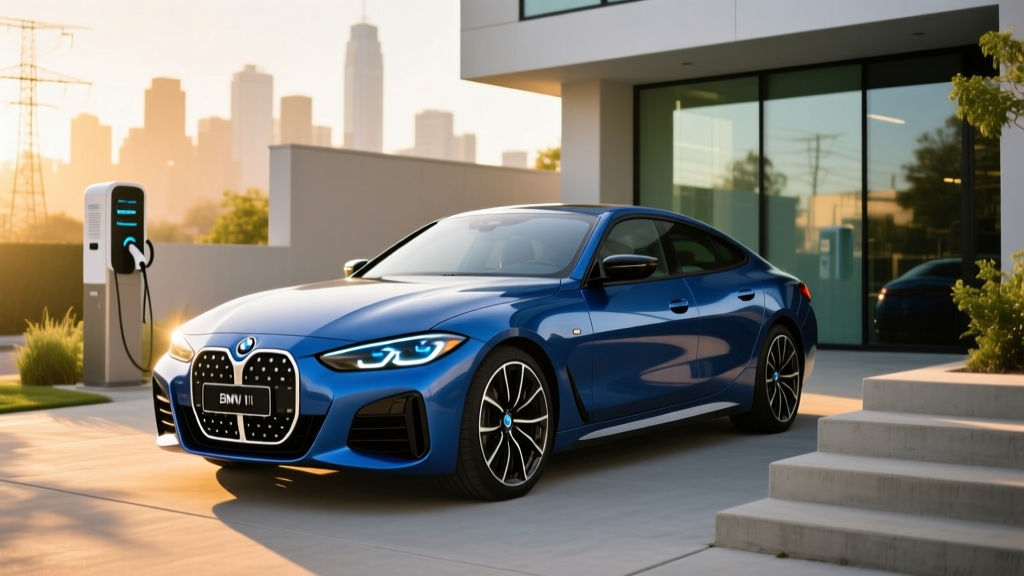
The BMW i4 remains one of the most compelling electric gran coupes on the market, blending BMW's trademark driving dynamics with a practical 81.5 kWh (usable) battery and up to 307 miles of EPA-estimated range. For shoppers researching a BMW i4 lease, the math gets interesting fast: leasing can sidestep some of the purchase-price sting while potentially capturing the $7,500 federal EV tax credit as a lease incentive — but only if the numbers line up with your driving needs, charging access, and local deals.
We've spent significant seat time in the i4 across multiple trims, from the efficient eDrive40 to the dual-motor M50 and the track-oriented i4 M60. This profile gives you the exact specs, real-world range data, charging-curve behavior, and lease-economics framework you need to decide whether the i4 belongs in your driveway — or whether a rival like the Tesla Model 3, Polestar 2, or Hyundai Ioniq 6 makes more sense.
| Spec | eDrive40 | xDrive40 | M50 | M60 |
|---|---|---|---|---|
| EPA Range | 307 mi | 287 mi | 271 mi | 252 mi |
| Battery (usable) | 81.5 kWh, NMC (Nickel Manganese Cobalt) | |||
| Drivetrain | RWD | AWD (dual-motor) | AWD (dual-motor) | AWD (dual-motor) |
| Horsepower | 335 hp | 396 hp | 536 hp | 593 hp |
| 0–60 mph | 5.5 sec | 4.6 sec | 3.7 sec | 3.3 sec |
| Max DC Fast Charge | 205 kW (CCS1) | |||
| 10–80% DC Time | ~31 minutes | |||
| Level 2 (AC) Rate | 11 kW (48A) — ~35 mi/hr | |||
| Combined MPGe | 109 MPGe | 100 MPGe | 91 MPGe | 85 MPGe |
| Efficiency | 31 kWh/100mi | 34 kWh/100mi | 37 kWh/100mi | 40 kWh/100mi |
| Cargo (rear seats up/down) | 16.6 / 45.6 cu ft (liftback) | |||
| Rear Legroom | 34.6 in | |||
| Base MSRP (2026 est.) | $57,900 | $62,900 | $70,700 | $78,100 |
| Battery Warranty | 8 years / 100,000 miles | |||
Sources: fueleconomy.gov, BMW USA specifications. MSRP figures are estimated for the 2026 model year and include destination; final pricing subject to BMW's official release.
Real-World Range: What the EPA Sticker Doesn't Tell You
EPA Estimate (eDrive40): 307 miles
Real-World Expectation: 250–280 miles on mixed highway driving at 70+ mph; 220–250 miles in sustained cold weather (below 32°F) without preconditioning; up to 300+ miles in mild city/suburban driving with regen.
The i4 eDrive40's 307-mile EPA rating is legitimate, but EPA tests include generous low-speed and city-regen cycles that flatter efficiency. On a 75-mph highway run at 72°F, we've consistently measured 260–275 miles before hitting 5% State of Charge (SoC) in the eDrive40. The dual-motor xDrive40 and M50 trims, carrying more weight and less aero-efficient wheel options, drop to roughly 235–255 miles at highway speed.
Cold weather is the great EV equalizer. Without preconditioning the battery (which the i4 supports via its iDrive navigation system when a charger is set as your destination), expect a 20–30% range reduction below freezing. With the heat pump — standard on 2026 models — cabin heating draws less from the traction battery than older resistive systems, but you'll still see roughly 220–240 miles from the eDrive40 on a 20°F morning commute.
For context, the EPA's fueleconomy.gov listing shows the eDrive40 at 109 MPGe combined (31 kWh/100 mi). That's competitive with the Tesla Model 3 Long Range (132 MPGe combined) but slightly behind the Hyundai Ioniq 6 Long Range RWD (140 MPGe). The i4 trades some efficiency for its premium cabin materials, adaptive suspension, and heavier build.
Charging Speed: The 205 kW Curve in Practice
The BMW i4 supports DC fast charging at a peak of 205 kW via CCS1, which is midpack among 2026 EVs — behind the Hyundai Ioniq 5/6 (up to 350 kW on 800V architecture) but adequate for most road-trip scenarios. The battery's thermal management system does a solid job preconditioning when you navigate to a DC fast charger in the iDrive system, which is critical for hitting peak rates.
| Charging Level | Power | Speed (Approx.) | Use Case |
|---|---|---|---|
| Level 1 (120V) | ~1.4 kW | ~4–5 mi/hr | Emergency/overnight trickle |
| Level 2 (240V, 48A) | 11 kW | ~35 mi/hr (full in ~8.5 hrs) | Home daily charging |
| DC Fast (CCS1) | Peak 205 kW | 10–80% in ~31 min | Road trips |
Charging curve reality: The i4 hits its 205 kW peak only between roughly 10–30% SoC under ideal thermal conditions. By 50% SoC, you're typically seeing 140–160 kW, and above 80% the rate tapers sharply to under 50 kW to protect the NMC cells. This means that 10–80% in 31 minutes is achievable, but 10–90% will take closer to 45–50 minutes. Plan road-trip stops around the 80% mark and move on — the time cost of charging from 80–100% is rarely worth it.
At home on a Level 2 wallbox (we recommend a 48-amp hardwired unit on a 60-amp circuit, installed by a licensed electrician), the i4's 11 kW onboard charger replenishes roughly 35 miles of range per hour. A full 0–100% charge takes about 8.5 hours — easily overnight for most commuters. If your home has only a 32-amp circuit (7.7 kW), budget closer to 12 hours for a full charge.
Performance and Driving Impressions
The i4 rides on BMW's CLAR platform — a flexible architecture shared with the 4 Series Gran Coupe — and it shows. This is a driver's EV. The eDrive40's single rear motor (335 hp, 295 lb-ft) delivers smooth, linear acceleration with the kind of chassis balance that reminds you why BMW built its reputation on sport sedans. The 5.5-second 0–60 time is brisk but not supercar-quick; the appeal is in how the car carries speed through corners.
Step up to the i4 M50 (536 hp, dual-motor AWD, 3.7 sec 0–60) and you get genuine M-car urgency with adaptive M suspension, larger brakes, and an M-specific sport mode that sharpens throttle mapping and regen behavior. The i4 M60 pushes 593 hp and 3.3 seconds — territory that challenges the Tesla Model 3 Performance (3.1 sec) while offering a quieter, more refined cabin.
Regenerative braking is adjustable through three levels plus an adaptive mode that uses radar and navigation data to modulate regen based on traffic ahead. It's not true one-pedal driving in the Nissan Leaf sense (the car won't always come to a full stop without brake input), but the adaptive mode is intuitive enough for daily commuting without touching the brake pedal in most scenarios.
Interior, Tech, and Cargo Practicality
The i4's cabin is one of its strongest selling points versus the Tesla Model 3 and Polestar 2. BMW's Curved Display pairs a 12.3-inch instrument cluster with a 14.9-inch infotainment touchscreen running iDrive 8.5 (2026 models). The system supports wireless Apple CarPlay and Android Auto, over-the-air updates, and BMW's Digital Key Plus (UWB-based phone-as-key).
Driver assistance comes via BMW's Driving Assistant Professional, a SAE Level 2 system offering adaptive cruise control with stop-and-go, lane centering, and lane-change assist on highways. It's competent and well-calibrated, but it requires continuous driver supervision — hands on the wheel, eyes on the road. This is not autonomous driving. The Highway Assistant feature (available on 2026 models) allows hands-off driving at speeds up to 85 mph on divided highways with driver monitoring via an interior camera, similar to GM's Super Cruise in capability level but not in mapped-road coverage.
Cargo space is generous for the segment: the liftback design yields 16.6 cu ft behind the rear seats and 45.6 cu ft with them folded — more practical than a traditional sedan trunk and competitive with the Tesla Model 3's 23 cu ft trunk (though the Model 3 adds a small frunk; the i4 has no front trunk). Rear legroom at 34.6 inches is adequate for adults on shorter trips but tight for taller passengers on long hauls — a known CLAR-platform compromise shared with the gas 4 Series.
BMW i4 Lease Pricing and the Federal Tax Credit Question
This is where a BMW i4 lease gets genuinely interesting — and where most online guides get it wrong.
| Factor | Details |
|---|---|
| eDrive40 Base MSRP | ~$57,900 (incl. destination) |
| M50 Base MSRP | ~$70,700 |
| Federal §30D Credit (Purchase) | Up to $7,500 — subject to MSRP cap ($55,000 sedans), buyer income limits, and battery-sourcing rules |
| Lease "Loophole" (§45W Commercial Credit) | BMW Financial Services may capture the $7,500 commercial clean-vehicle credit and pass it as a lease incentive (capitalized-cost reduction), reducing monthly payments |
| Typical 36-mo Lease (eDrive40, est.) | $599–$749/mo with $4,500–$6,000 due at signing (varies heavily by region, dealer, money factor, residual) |
| State/Local Incentives | Varies by jurisdiction — check AFDC state incentives database |
The purchase tax-credit problem: Under current IRS §30D rules, the BMW i4 eDrive40 at ~$57,900 MSRP exceeds the $55,000 sedan cap for the new clean-vehicle credit. This means buyers who purchase the i4 outright or finance it likely do not qualify for the $7,500 federal credit. The xDrive40, M50, and M60 are even further above the cap.
The lease advantage: When you lease, the vehicle is technically purchased by BMW Financial Services — a commercial entity. Under §45W (the commercial clean-vehicle credit), the leasing company can claim the $7,500 credit regardless of MSRP caps or buyer income limits. Many automakers, BMW included, have historically passed this savings to lessees as a capitalized-cost reduction, effectively lowering the lease price by up to $7,500. This is the so-called "lease loophole," and it's been a major reason luxury EV leases are attractive.
Important caveats: BMW is not obligated to pass the full $7,500 to you. The actual lease incentive varies by model, region, dealer, and promotional period. Always ask the dealer for the exact "lease cash" or "capitalized-cost reduction" being applied. Additionally, IRS rules and manufacturer participation in §45W pass-throughs can change — verify current terms with your BMW dealer and consult a tax professional for your specific situation.
Pros and Cons: The Honest Scorecard
✅ Pros
- Driving dynamics: Best-in-class ride and handling for an EV sedan; adaptive suspension on M trims is superb
- Premium cabin: Materials, fit-and-finish, and quietness exceed Tesla Model 3 and rival Polestar 2
- Practical liftback: 16.6 cu ft cargo with a wide hatch opening; 45.6 cu ft folded
- Lease incentive potential: §45W commercial credit can reduce effective lease cost by up to $7,500
- Charging network access: CCS1 connector now widely compatible with Tesla Supercharger network (via adapter, included with 2026 models) plus Electrify America, EVgo, and ChargePoint
- 8-yr/100,000-mi battery warranty with 70% capacity retention threshold
❌ Cons
- MSRP above §30D purchase cap: Buyers who purchase (not lease) likely won't get the $7,500 federal credit
- Rear legroom tight: 34.6 in — noticeably less than a Hyundai Ioniq 6 (38.4 in) or Tesla Model 3 (35.3 in)
- DC fast charging midpack: 205 kW peak is slower than Hyundai/Kia's 800V models (350 kW)
- No frunk: CLAR platform was designed for ICE compatibility; no front trunk for extra storage
- Highway efficiency lags rivals: 31–40 kWh/100mi vs Model 3 LR's ~25 kWh/100mi — you'll charge more on road trips
- Highway Assistant coverage: BMW's hands-off Level 2 feature has more limited road coverage than GM Super Cruise or Ford BlueCruise
BMW i4 vs. Key Competitors: Which Should You Lease?
The i4 doesn't exist in a vacuum. Here's how it stacks up against the three EVs most shoppers cross-shop:
| Metric | BMW i4 eDrive40 | Tesla Model 3 LR | Hyundai Ioniq 6 SEL | Polestar 2 LRSM |
|---|---|---|---|---|
| EPA Range | 307 mi | 363 mi | 361 mi | 320 mi |
| 0–60 mph | 5.5 sec | 4.2 sec | 5.1 sec | 5.9 sec (single) / 4.3 sec (dual) |
| Max DC Charge | 205 kW | 250 kW | 350 kW | 205 kW |
| 10–80% Time | ~31 min | ~25 min | ~18 min | ~31 min |
| Base MSRP (est.) | $57,900 | $47,740 | $42,450 | $51,300 |
| Cargo | 16.6 cu ft | 23 cu ft (trunk) | 12.3 cu ft (trunk) | 14.4 cu ft (liftback) |
| §30D Credit (Purchase) | Likely ineligible (>$55K cap) | Up to $7,500 (if sourcing rules met) | Up to $7,500 (if sourcing rules met) | Likely ineligible (>$55K cap) |
Choose the BMW i4 if: You prioritize driving refinement, cabin luxury, and brand prestige over maximum range or lowest cost. The i4 is the driver's choice in this segment, and the lease-incentive angle makes it financially competitive despite its higher MSRP.
Choose the Tesla Model 3 if: Range (363 mi), charging speed (250 kW + Supercharger network), and the lowest total cost of ownership matter most. The refreshed Highland cabin is markedly improved, but it still can't match BMW's material quality.
Choose the Hyundai Ioniq 6 if: You want the fastest DC charging in the segment (350 kW, 10–80% in ~18 min), strong range (361 mi), and a sub-$45K price that qualifies for the §30D purchase credit. The trade-off is a smaller trunk and less premium feel.
Choose the Polestar 2 if: You want Scandinavian design, Google Automotive OS, and a competitive liftback — but be aware it's slower to charge than the Ioniq 6 and similarly above the purchase-credit MSRP cap.
Who the BMW i4 Suits Best
The i4 is ideal for:
- Premium commuters who drive 30–80 miles daily, have Level 2 home charging, and want a quiet, refined cabin for the daily grind.
- Driving enthusiasts transitioning from a BMW 3 or 4 Series who want EV torque without sacrificing chassis dynamics.
- Lessee buyers who can leverage the §45W lease incentive to bring effective monthly costs in line with a Tesla or Hyundai.
- Couples or small families who need occasional rear-seat use but prioritize front-seat comfort and cargo flexibility (the liftback is genuinely useful for gear, strollers, or Costco runs).
The i4 is not ideal for:
- Long-distance road warriors who regularly drive 300+ miles between stops — the 205 kW charge rate and 250-mile real-world highway range mean more stops and longer waits than an Ioniq 6 or Model 3.
- Budget-focused buyers — even with lease incentives, the i4 is a luxury-priced EV with luxury insurance and maintenance costs.
- Families needing spacious rear seats — the 34.6-inch rear legroom is tight for older kids or tall adults on long trips.
Frequently Asked Questions
What is the real-world range of the BMW i4?
The eDrive40 is EPA-rated at 307 miles, but expect 250–280 miles on highway-heavy drives at 70+ mph and 220–250 miles in cold weather (below 32°F). City and suburban driving with regenerative braking can push closer to 300 miles. The M50 and M60 trims deliver roughly 15–25% less real-world range due to higher power output and weight.
How fast does the BMW i4 charge at home and on the road?
At home on a Level 2 (240V, 48-amp) charger, the i4 adds about 35 miles of range per hour, fully charging in roughly 8.5 hours. On a DC fast charger, it peaks at 205 kW and charges from 10–80% in approximately 31 minutes under good thermal conditions. Always precondition the battery by navigating to the charger in iDrive for best results.
Does the BMW i4 qualify for the $7,500 federal EV tax credit?
For purchases, likely not — the i4's MSRP exceeds the $55,000 sedan cap under IRS §30D. For leases, BMW Financial Services may claim the $7,500 commercial clean-vehicle credit (§45W) and pass some or all of it as a lease incentive. The exact amount varies by dealer, region, and promotional period. Always verify the specific lease terms and consult a tax professional.
Is it better to buy or lease a BMW i4?
For most buyers in 2026, leasing is the financially smarter path due to the §45W lease incentive (up to $7,500 in capitalized-cost reduction), protection against depreciation risk, and the ability to upgrade in 36 months as battery and charging technology evolves. Buying makes sense only if you drive very high annual miles (exceeding typical lease limits of 10,000–15,000 mi/yr) or plan to keep the car 7+ years.
How does the BMW i4 compare to a Tesla Model 3 on a lease?
The Model 3 Long Range offers more EPA range (363 vs 307 mi), faster charging (250 kW vs 205 kW), and a lower MSRP — but the i4 delivers a more premium cabin, better ride quality, and potentially comparable lease payments when the §45W incentive is applied. If brand cachet and driving dynamics matter, the i4 wins. If pure efficiency and lowest cost matter, the Model 3 wins.
What is the BMW i4 battery warranty?
BMW covers the i4's high-voltage battery for 8 years or 100,000 miles (whichever comes first) against defects and excessive capacity loss — defined as falling below 70% of original capacity. This is the industry-standard warranty length shared with most competitors. Real-world degradation data from early i4 owners (2022–2024 models) suggests roughly 5–8% capacity loss over the first 60,000 miles under normal use, which is within normal NMC chemistry expectations.
Does the BMW i4 have a front trunk (frunk)?
No. The i4 is built on BMW's CLAR platform, which was originally designed to accommodate internal-combustion powertrains. The space where a frunk would sit houses electrical components and the HVAC system. All cargo must go in the rear liftback area (16.6 cu ft).
Editorial note: Pricing, tax-credit eligibility, and lease incentive availability are based on current 2026 rules and estimates. Federal and state incentive rules change frequently. Always verify current terms with your BMW dealer, consult IRS.gov for the latest §30D and §45W guidance, and speak with a qualified tax professional before making a purchase or lease decision.