Quick Verdict: The Driver's EV Sedan That Doesn't Shout About It
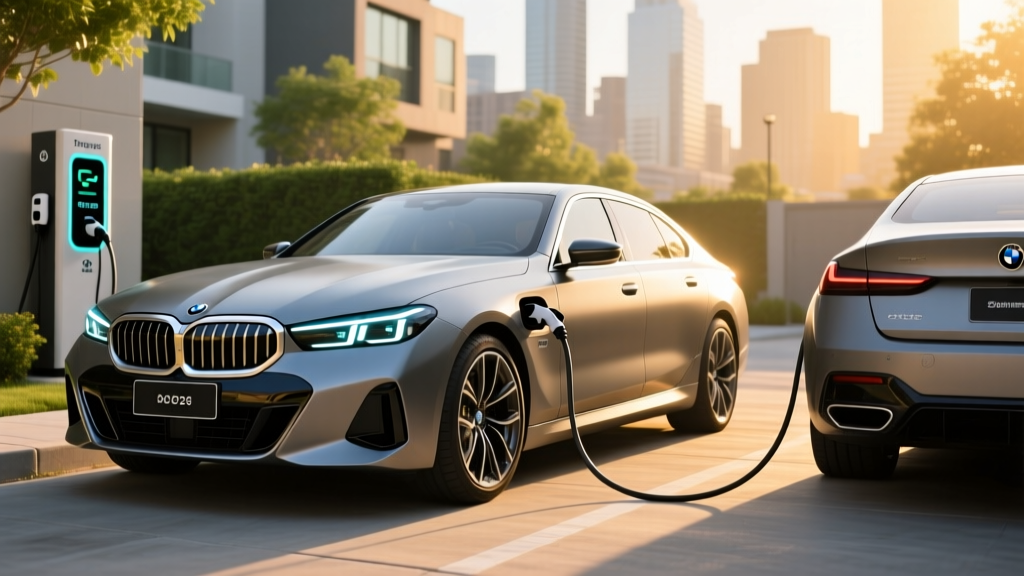
The BMW i4 occupies a rare position in the EV market: it's an electric Gran Coupe that prioritizes driving dynamics and cabin refinement over maximum range or head-turning design. For 2026, the i4 continues with the eDrive40 and M50 trims, offering between 282 and 307 miles of EPA-estimated range depending on configuration, paired with one of the most polished interiors in the premium EV segment. If you've been searching for details on the BMW i4 interior and how it stacks up against the Tesla Model 3, Hyundai Ioniq 6, or Polestar 2, this review covers every spec that matters — from battery chemistry to real-world charging curves.
The i4 is not the longest-range EV at its price point, nor the quickest to charge. What it delivers is a cabin that feels genuinely premium, a ride that balances comfort with engagement, and a powertrain refined enough to disappear beneath you. Whether that trade-off is worth it depends on how you weight interior quality against raw efficiency numbers.
Battery, Range, and Efficiency: What the EPA Says vs. What You'll Actually Get
| Spec | i4 eDrive40 | i4 M50 | i4 xDrive40 |
|---|---|---|---|
| EPA Range | 307 miles | 282 miles | 295 miles |
| Battery (usable) | 83.9 kWh | 83.9 kWh | 83.9 kWh |
| Chemistry | NMC (Nickel Manganese Cobalt) | NMC | NMC |
| MPGe (combined) | 109 MPGe | 97 MPGe | 102 MPGe |
| kWh/100 mi | 31 kWh | 35 kWh | 33 kWh |
| Drivetrain | RWD (single motor) | AWD (dual motor) | AWD (dual motor) |
| Horsepower | 335 hp | 536 hp | 469 hp |
| 0–60 mph | 5.5 sec | 3.7 sec | 4.4 sec |
Real-World Range Reality Check: The EPA rates the i4 eDrive40 at 307 miles, but sustained highway driving at 70–80 mph typically yields 245–270 miles before you need to plug in. In cold weather (below 30°F), expect an additional 15–25% reduction, bringing usable range to roughly 200–230 miles in winter highway conditions. City driving with regenerative braking recovers closer to the EPA sticker. The i4's heat pump (standard on 2026 models) helps mitigate cold-weather cabin energy draw, but battery chemistry limitations still apply to NMC packs in freezing temperatures.
The 83.9 kWh usable NMC battery sits in BMW's CLAR platform — a flexible architecture shared with the 4 Series Gran Coupe. NMC chemistry delivers strong energy density (hence the competitive range in a relatively compact footprint) but requires more careful thermal management than LFP alternatives. BMW's thermal system is robust: preconditioning activates automatically when a DC fast charger is set as your navigation destination, warming the pack to its optimal charging temperature window.
Source: EPA fueleconomy.gov — BMW i4 eDrive40
Charging Speed: DC Fast, Level 2, and the Curve You Need to Know
| Charging Level | Max Rate | Speed | Notes |
|---|---|---|---|
| Level 1 (120V) | 1.4 kW | ~4 mi/hr | Emergency/trickle only |
| Level 2 (240V, 48A) | 11 kW | ~35 mi/hr | Full charge in ~9 hours |
| DC Fast (CCS) | 205 kW peak | 10–80% in ~31 min | Tapers significantly above 80% |
The i4's DC fast-charging peak of 205 kW is respectable but not class-leading. Competitors like the Hyundai Ioniq 6 (peak 240 kW, 10–80% in ~18 minutes) and the Tesla Model 3 (peak 250 kW on V3 Superchargers) add range faster on road trips. The i4 sustains close to its peak rate from roughly 10–50% State of Charge, then begins a progressive taper. From 80–100%, charging slows dramatically — a common NMC characteristic designed to protect long-term battery health. Plan to charge to 80% on road trips and skip the top-off unless you need the full range for the next leg.
For home Level 2 charging, the i4 accepts up to 11 kW (48 amps on a 240V/60A circuit). That translates to roughly 35 miles of range per hour of charging, or a full overnight replenishment in about 9 hours. Most owners will plug in each evening and wake to a full battery — the standard EV ownership pattern that eliminates routine "fueling" stops entirely.
One connector note for 2026: the i4 ships with a CCS1 port in North America. BMW has confirmed NACS (Tesla-style) adapter compatibility for Supercharger network access, but the native port remains CCS. If Tesla Supercharger access is critical to your road-trip planning, confirm adapter availability with your dealer at purchase.
The BMW i4 Interior: Where This EV Earns Its Premium Badge
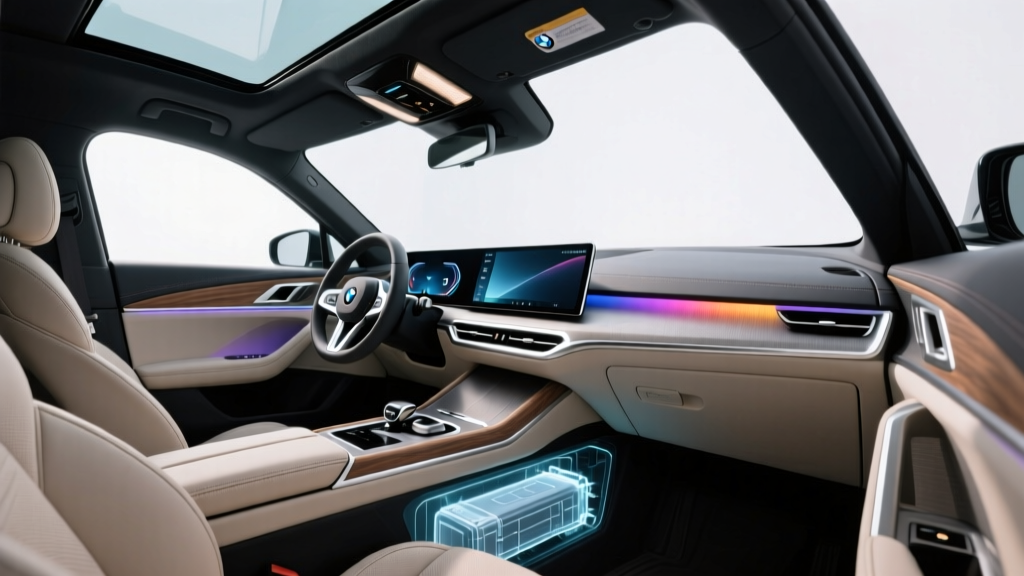
The reason buyers cross-shop the i4 against more efficient alternatives is the cabin. The BMW i4 interior uses BMW's Curved Display layout — a 12.3-inch digital instrument cluster flowing into a 14.9-inch central touchscreen running iDrive 8.5. The glass is slightly angled toward the driver, reducing glare and keeping the interface within easy reach. Material quality is a clear step above the Tesla Model 3's minimalist approach: soft-touch surfaces, available Vernasca leather, real aluminum or open-pore wood trim, and tightly stitched dash panels.
Passenger and cargo dimensions:
- Front legroom: 41.5 inches
- Rear legroom: 34.5 inches (tight for tall adults on longer trips)
- Cargo (rear seats up): 16.6 cu ft (liftback design aids loading)
- Cargo (rear seats folded): 45.6 cu ft
- Frunk: None — the CLAR platform's motor placement eliminates front trunk space
The Gran Coupe roofline creates a trade-off: the sloping rear glass looks sleek but cuts into rear headroom. Adults over 6 feet will notice the compromise on longer drives. The liftback hatch, however, makes the i4 significantly more practical than a traditional sedan trunk — you can load bulkier items through the wide opening.
Standout tech features:
- iDrive 8.5 with wireless Apple CarPlay and Android Auto
- BMW Intelligent Personal Assistant (voice control)
- Harman Kardon surround sound (standard on M50, optional on eDrive40)
- Head-Up Display with EV-specific range and charge info
- BMW Digital Key Plus (UWB-based phone-as-key)
- Available Driving Assistant Professional (Level 2 highway assist with lane centering and adaptive cruise)
Notable drawbacks: The iDrive rotary controller remains, which some prefer for muscle memory but adds console clutter versus pure touchscreen systems. The rear-seat USB-C ports are limited to two, and the sloping roofline is a real headroom constraint. There's also no front trunk — a missed opportunity for charging cable storage that competitors like the Model 3 and Ioniq 6 provide.
Pricing, Trims, and Federal Tax Credit Eligibility
| Trim | Base MSRP (2026) | As-Tested Typical | §30D Credit Eligible? |
|---|---|---|---|
| i4 eDrive40 | $52,200 | $57,000–$62,000 | Partial — subject to sourcing/income rules |
| i4 xDrive40 | $56,700 | $62,000–$67,000 | Partial — subject to sourcing/income rules |
| i4 M50 | $67,300 | $73,000–$80,000 | Partial — subject to sourcing/income rules |
Federal §30D EV Tax Credit — What You Need to Know for 2026:
- Maximum credit: Up to $7,500, split into $3,750 for battery components (North American assembly) + $3,750 for critical minerals sourcing
- MSRP cap: Sedans must be under $55,000 MSRP — this eliminates the i4 M50 and most xDrive40 builds. Only base eDrive40 configurations may qualify
- Buyer income cap: AGI must not exceed $150,000 (single), $225,000 (head of household), or $300,000 (joint filers)
- Battery sourcing: Critical minerals and battery component percentages must meet escalating annual thresholds — BMW's supply chain has been progressively qualifying, but eligibility varies by production batch
- Point-of-sale transfer: Eligible buyers can apply the credit as an immediate dealer discount rather than waiting for tax filing
Source: IRS — Clean Vehicle Credits
Consult a tax professional before assuming full credit eligibility. BMW's North American assembly (Spartanburg, SC for some models; Leipzig, Germany for the i4) and battery supply chain details directly affect qualification.
Important: the i4 is assembled in Munich, Germany, not in North America. Under current §30D rules, final assembly location is a hard requirement for the full credit. This means the i4 may only qualify for the critical-minerals half ($3,750) if its battery sourcing meets thresholds — or potentially no credit at all depending on the specific production date and supply chain. Always verify with your dealer's VIN-specific credit report and the fueleconomy.gov credit lookup tool before committing to a purchase.
Driving Dynamics, Performance, and the M50 Question
The i4 eDrive40's single rear motor produces 335 hp and reaches 60 mph in 5.5 seconds — genuinely quick for daily driving and more than adequate for highway merging. The RWD layout gives the i4 a traditional BMW balance: neutral turn-in, progressive power delivery, and a chassis that communicates through the steering wheel in a way most EVs filter out.
The M50 adds a front motor for 536 hp combined and a 3.7-second 0–60 time. It's ferociously fast, but the 25-mile range penalty and $15,100 price premium make it a passion purchase rather than a rational one. The xDrive40 splits the difference at 469 hp, 4.4 seconds, and 295 miles of range — arguably the sweet spot for buyers who want AWD traction without the M50's range sacrifice.
Regenerative braking in the i4 offers adjustable levels (low, medium, high) plus an adaptive mode that uses radar and navigation data to modulate regen based on traffic and upcoming intersections. One-pedal driving is achievable in the high setting, though BMW doesn't offer the aggressive single-pedal feel of a Nissan Leaf or Chevrolet Bolt. The adaptive mode is the set-and-forget choice for most drivers.
Driver Assistance Level: The available Driving Assistant Professional is a SAE Level 2 system. It provides highway lane centering, adaptive cruise, and automatic lane changes with turn-signal activation — but you must remain fully engaged with hands on or near the wheel at all times. This is not autonomous driving. The system is competent on divided highways but will disengage in construction zones, faded lane markings, and complex interchanges.
Warranty, Battery Longevity, and Ownership Costs
| Coverage | Term |
|---|---|
| Limited vehicle warranty | 4 years / 50,000 miles |
| Battery & powertrain | 8 years / 100,000 miles |
| Battery capacity guarantee | 70% minimum retention over 8 yr / 100,000 mi |
| Complimentary maintenance | 3 years / 36,000 miles |
BMW's battery warranty guarantees that the high-voltage pack will retain at least 70% of its original capacity over 8 years or 100,000 miles. If degradation exceeds that threshold, BMW will repair or replace the battery at no cost. Real-world data from early i4 owners (2022–2025 models) suggests NMC degradation of approximately 5–8% over the first 50,000 miles with normal charging habits — well within the warranty buffer.
For longevity, BMW recommends keeping daily State of Charge between 20–80% for routine use and charging to 100% only before long trips. The i4's iDrive system includes a configurable charge limit and scheduled charging to make this effortless. Avoiding repeated DC fast-charging sessions to 100% will further preserve long-term battery health.
Who the BMW i4 Is For — and Who Should Look Elsewhere
Choose the BMW i4 if:
- You prioritize interior quality and driving refinement over maximum range
- Your daily commute is under 80 miles round-trip (easily covered with nightly home charging)
- You want a premium badge with genuine driving engagement in an EV
- Rear-seat space is a secondary concern (couples, solo commuters, occasional passengers)
- You value BMW's dealer network and service infrastructure
Look elsewhere if:
- Maximum range is your top priority (the Hyundai Ioniq 6 offers 361 miles EPA)
- You need regular rear-seat space for tall adults (the Tesla Model 3 or BMW iX offer more room)
- Federal tax credit qualification is essential to your budget (the i4's German assembly complicates eligibility)
- You take frequent 400+ mile road trips and want the fastest possible DC charging (Ioniq 6 or Model 3 recharge faster)
- You need a front trunk for charging cable storage or additional cargo
Pros
- Premium interior materials and build quality
- Engaging RWD driving dynamics (eDrive40)
- iDrive 8.5 is responsive and feature-rich
- Liftback cargo versatility (45.6 cu ft folded)
- Competitive 307-mile range (eDrive40)
- Strong regenerative braking with adaptive mode
Cons
- Rear headroom compromised by roofline
- No front trunk (frunk)
- 205 kW DC peak trails key competitors
- German assembly limits federal tax credit
- Base price above $52K even before options
- M50 range drops to 282 miles
Frequently Asked Questions
What is the real-world range of the BMW i4?
The EPA rates the i4 eDrive40 at 307 miles, but real-world highway driving at 70–80 mph typically delivers 245–270 miles. In cold weather below 30°F, expect 200–230 miles. City driving with regenerative braking can approach the EPA sticker. The M50's real-world highway range is approximately 220–250 miles.
How fast does the BMW i4 charge at home and on the road?
On a Level 2 home charger (240V, 48A), the i4 charges at up to 11 kW, adding roughly 35 miles per hour and fully replenishing in about 9 hours. On a DC fast charger, it peaks at 205 kW and reaches 10–80% in approximately 31 minutes. Charging above 80% slows significantly — plan road-trip stops around the 10–80% window for efficiency.
Does the BMW i4 qualify for the $7,500 federal EV tax credit?
Partially at best. The i4 is assembled in Munich, Germany, which affects final-assembly requirements under §30D. The critical-minerals portion ($3,750) may apply depending on battery sourcing at the time of production. The $55,000 MSRP cap for sedans eliminates the M50 and most optioned xDrive40 builds. Always verify eligibility by VIN through fueleconomy.gov and consult a tax professional.
Is the BMW i4 worth buying over the Tesla Model 3 or Hyundai Ioniq 6?
It depends on your priorities. The i4 offers a more premium interior and more engaging driving dynamics than either competitor. The Model 3 wins on Supercharger network access, charging speed, and rear-seat space. The Ioniq 6 leads in EPA range (361 miles) and DC charging speed (18-minute 10–80%). If cabin quality and brand cachet matter most, the i4 is the strongest choice. If efficiency and road-trip charging speed dominate, the Ioniq 6 or Model 3 are better fits.
What is the BMW i4's battery chemistry and will it last?
The i4 uses an NMC (nickel manganese cobalt) lithium-ion battery with 83.9 kWh of usable capacity. NMC offers strong energy density but requires careful thermal management. BMW guarantees 70% capacity retention over 8 years/100,000 miles. Early owner data suggests 5–8% degradation over the first 50,000 miles with normal charging habits. Keeping daily charge between 20–80% and minimizing repeated 100% DC fast charges will maximize long-term battery health.
How much does it cost to charge the BMW i4 at home?
At the US average residential electricity rate of approximately $0.16/kWh, fully charging the i4's 83.9 kWh battery costs about $13.40. That delivers roughly 307 miles of EPA-rated range — equivalent to about 4.4 cents per mile. Compare that to a gas sedan getting 30 MPG at $3.50/gallon (11.7 cents per mile), and home charging represents a roughly 60% per-mile fuel savings.
Safety reference: Check the latest IIHS ratings for the BMW i4 and NHTSA crash-test results before purchasing. Ratings are updated annually and vary by model year.