Quick Verdict: The BMW i4 Gran Coupe in 2026
The BMW i4 remains one of the sharpest-driving electric sedans on the market, and the 2026 lineup keeps the formula intact: a CLAR-platform Gran Coupe with rear-wheel-drive and dual-motor all-wheel-drive options, up to 307 miles of EPA-rated range, and a cabin that punches well above its class in materials and technology. If you've been searching for a BMW i4 green configuration — whether that means the striking San Remo Green metallic paint, the eco-focused LFP battery option BMW introduced for European markets, or simply the most efficient variant — this review covers every angle a US buyer needs before signing the paperwork.
For 2026, BMW continues to offer the i4 in eDrive35, eDrive40, and M50 trims, with a new xDrive40 slotting between the eDrive40 and the performance-oriented M50. Pricing starts at $52,200 for the eDrive35 and climbs past $70,000 for a well-equipped M50. Federal tax credit eligibility remains partial for most configurations, and real-world range — as always — depends heavily on your climate, driving style, and wheel choice.
EPA sticker: Up to 307 miles (eDrive40 with 18-inch wheels)
Real-world highway (65-75 mph, 70°F): Expect 260–280 miles
Cold-weather highway (20-30°F): Expect 210–240 miles (20–30% reduction)
eDrive35 (19-inch wheels): EPA 282 mi; real-world highway ~240–255 mi
M50 xDrive: EPA 245–270 mi depending on wheels; real-world highway ~210–240 mi
Source: fueleconomy.gov
Range, Battery, and Efficiency by the Numbers
The 2026 BMW i4 uses an 83.9 kWh usable lithium-ion battery pack (gross capacity approximately 86.4 kWh). BMW sources NMC (nickel manganese cobalt) cells from CATL and Samsung SDI, depending on production batch. Unlike some competitors that have shifted to LFP (lithium iron phosphate) chemistry for lower-cost trims, BMW has kept the i4 on NMC across the US lineup to preserve energy density and cold-weather performance — a meaningful trade-off if you live above the 40th parallel.
| Specification | eDrive35 | eDrive40 | xDrive40 | M50 |
|---|---|---|---|---|
| Drivetrain | RWD (single motor) | RWD (single motor) | AWD (dual motor) | AWD (dual motor) |
| Horsepower | 281 hp | 335 hp | 402 hp | 536 hp |
| 0–60 mph | 5.8 sec | 5.5 sec | 4.6 sec | 3.7 sec |
| Battery (usable) | 83.9 kWh NMC | 83.9 kWh NMC | 83.9 kWh NMC | 83.9 kWh NMC |
| EPA Range | 282 mi | 307 mi | 282 mi | 245–270 mi |
| Combined MPGe | 102 MPGe | 97 MPGe | 93 MPGe | 85–91 MPGe |
| Efficiency (kWh/100 mi) | 33 kWh | 35 kWh | 36 kWh | 37–40 kWh |
| Base MSRP | $52,200 | $57,200 | $62,200 | $68,300 |
Efficiency is a strong point for the RWD models. The eDrive35 returns an impressive 33 kWh per 100 miles, which translates to roughly $0.05–$0.07 per mile on a national-average home electricity rate of $0.16/kWh. The M50's extra weight, wider tires, and dual motors push consumption to 37–40 kWh/100 mi — still competitive against the Tesla Model 3 Performance and Polestar 2 Long Range Dual Motor, but noticeably thirstier than the eDrive40 on long road trips.
Charging Speed: DC Fast Charge and Home Level 2
Charging is where the i4's BMW Gen5 eDrive architecture shows its maturity. All 2026 i4 trims support up to 205 kW peak DC fast charging via CCS1 connector (or NACS with adapter, as BMW began offering a NACS charge-port option on 2025+ models). The charge curve is well-managed: the i4 sustains above 150 kW from roughly 10% to 45% state of charge before tapering progressively.
| Charging Level | Power | Speed / Time | Notes |
|---|---|---|---|
| Level 1 (120V household) | ~1.4 kW | ~4 mi/hr added | Emergency/trickle only; 60+ hr for full charge |
| Level 2 (240V home) | 11 kW (onboard charger max) | ~32 mi/hr; full charge in ~9 hr | Requires 48A–60A circuit; BMW Wallbox or equivalent |
| DC Fast Charge (CCS/NACS) | 205 kW peak | 10–80% in ~31 min | Sustained rate ~155 kW avg; tapers above 80% |
The 10–80% DC fast-charge time of approximately 31 minutes is respectable but trails the Hyundai Ioniq 6 (which hits 10–80% in around 18 minutes on an 800V architecture). On a 350 kW Electrify America or Tesla Supercharger (with adapter) station, you'll add roughly 180–200 miles of range in 20 minutes — enough for a comfortable road-trip stop. Above 80% SoC, the charge rate drops sharply to protect the NMC cells, so plan your stops around 10–80% windows rather than topping to full on the road.
At home, the i4's 11 kW onboard AC charger is among the best in its class. On a properly installed 60-amp circuit with a 48-amp Level 2 wallbox, a full overnight charge takes about 9 hours. If your electrical panel only supports a 40-amp circuit (32-amp continuous), expect closer to 7.4 kW and an 11–12 hour full charge — still fine for overnight replenishment. Budget $800–$2,000 for professional Level 2 installation depending on panel proximity and local permit requirements; a full 200-amp panel upgrade can add $1,500–$3,000 if needed.
Performance, Driving Dynamics, and Tech
The i4's CLAR platform — shared with the 4 Series Gran Coupe — gives it a structural advantage over EVs built on dedicated skateboard architectures. The weight distribution is near 50/50, the center of gravity is low, and the adaptive M suspension (standard on M50, optional on eDrive40) delivers the communicative ride BMW is known for. The eDrive40's 335 hp and 5.5-second 0–60 time feel effortless in daily driving, while the M50's 536 hp and 3.7-second sprint will embarrass most gas-powered M3s at a stoplight.
One-pedal driving is available but not default — BMW lets you choose between high, medium, and adaptive regen settings. The adaptive mode uses radar and navigation data to modulate regen based on traffic and upcoming curves, which is genuinely useful once you trust it.
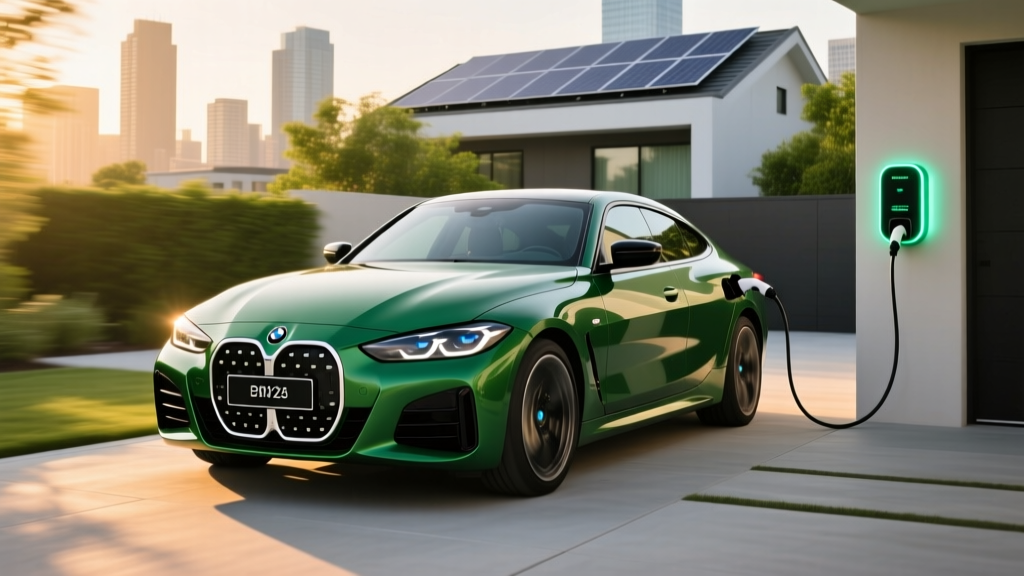
Inside, the i4 runs BMW iDrive 8.5 on a curved display panel (12.3-inch instrument cluster + 14.9-inch infotainment). Wireless Apple CarPlay and Android Auto are standard, along with a head-up display, Harman Kardon surround sound (optional), and BMW's Digital Key Plus for phone-as-key functionality. The BMW i4 in San Remo Green metallic ($650 color option) pairs with a Cognac Vernasca leather or the vegan Sensatec alternative for a striking cabin that photographs as well as it feels.
Driver-assistance tech includes Active Driving Assistant Professional — a SAE Level 2 system with adaptive cruise control, lane-keeping assist, and automatic lane-change assist. It is competent on highways but requires hands-on-wheel engagement at all times. This is not a self-driving system; BMW does not offer a Level 3 or Level 4 feature on the US-market i4.
Pricing, Trims, and Federal Tax Credit Eligibility
BMW positions the i4 competitively against the Tesla Model 3, Polestar 2, and Genesis Electrified G80. Here's what the 2026 lineup costs before incentives:
- eDrive35: $52,200 MSRP (+ $995 destination)
- eDrive40: $57,200 MSRP (+ $995 destination)
- xDrive40: $62,200 MSRP (+ $995 destination)
- M50: $68,300 MSRP (+ $995 destination)
A well-equipped eDrive40 with the Premium Package, 19-inch wheels, and San Remo Green paint typically lands around $63,000–$65,000 before incentives. The M50 with the Executive and Dynamic Handling packages can push past $78,000.
- MSRP cap: Sedans must be ≤ $55,000 — the i4 eDrive35 at $52,200 qualifies on price; eDrive40, xDrive40, and M50 exceed the cap
- Buyer income cap: Modified AGI ≤ $150,000 (single) / $300,000 (joint) / $225,000 (head of household)
- Battery sourcing: Critical minerals and battery components must meet escalating domestic-content thresholds per IRS guidelines — BMW's NMC supply chain is partially compliant, meaning the credit may be $3,750 rather than the full $7,500 depending on production batch
- Point-of-sale transfer: Eligible buyers can transfer the credit to the dealer for an upfront price reduction at purchase
- Assembly: The i4 is assembled in Munich, Germany — this disqualifies it from the new-vehicle §30D credit under the North American final-assembly requirement
Bottom line: The BMW i4 does NOT qualify for the federal new-vehicle EV tax credit because it is assembled outside North America. Consult a tax professional for your specific situation. Some state and utility incentives may still apply — check your local state incentive database.
This is the single biggest financial drawback of the i4 versus a Tesla Model 3, Rivian-built vehicle, or GM-assembled Cadillac Lyriq. If the $7,500 credit is critical to your budget, the i4's German assembly is a dealbreaker for new purchases. However, a used i4 (model year 2022 or later, purchased from a dealer for ≤ $25,000) may qualify for the up-to-$4,000 used clean-vehicle credit under §25E, subject to income caps and dealer reporting requirements.
Cargo, Passenger Space, and Daily Practicality
The i4's Gran Coupe hatchback design gives it a practical edge over traditional sedans. The rear liftgate opens wide to reveal 16.6 cubic feet of cargo space (seats up) and up to 45.6 cubic feet with the 40/20/40 rear seats folded. That's more usable volume than the Tesla Model 3's trunk (23 cu ft total including the frunk) for bulky items, though the Model 3's front trunk adds flexibility for charging cables and small bags.
Front legroom is generous at 42.1 inches. Rear legroom measures 34.6 inches — adequate for adults on shorter trips but tighter than the Hyundai Ioniq 6 (37.4 inches rear) or a midsize sedan. The i4 has no frunk (front trunk), as the CLAR platform's front architecture houses HVAC and power electronics where a dedicated EV platform would leave room for storage. This is a real-world inconvenience if you prefer keeping a dirty charge cable or gym bag up front.
The i4 is best suited for: daily commuters and driving enthusiasts who value handling precision, premium cabin materials, and a hatchback form factor. It's a strong choice for couples or small families who take occasional road trips (the 300-mile range and 200+ kW charging handle interstate travel well). It is not ideal for families needing three-across rear seating, frequent towing (the i4 is not rated for towing), or buyers who depend on the federal tax credit.
Warranty and Long-Term Battery Outlook
BMW backs the i4 with a 4-year/50,000-mile limited warranty and an 8-year/100,000-mile high-voltage battery warranty covering defects and capacity loss below 70% of original capacity. This is industry-standard, matching Tesla, Hyundai, and Ford's battery coverage terms.
NMC cells in the i4 have shown strong durability in early fleet data. BMW's thermal management system uses a liquid-cooled plate with predictive preconditioning — when you set a DC fast-charger as your navigation destination, the car warms or cools the pack to the optimal temperature window before you arrive, reducing charge time and long-term degradation. Real-world data from 2022–2024 model-year i4s suggests approximately 3–5% capacity loss over the first 60,000 miles, which is in line with class leaders. A full battery replacement out of warranty would cost an estimated $15,000–$20,000 based on current BMW parts pricing, though this figure is expected to decline as cell costs continue to fall.
Pros and Cons at a Glance
- Best-in-class driving dynamics and steering feel
- Up to 307 miles EPA range (eDrive40)
- 205 kW DC fast charging; 10–80% in ~31 min
- Hatchback practicality with 45.6 cu ft max cargo
- iDrive 8.5 is responsive with wireless CarPlay/Android Auto
- 11 kW onboard AC charger for fast home replenishment
- Striking color options including San Remo Green metallic
- No federal §30D tax credit (assembled in Germany)
- No frunk — charge cables live in the rear cargo area
- Rear legroom is tight for taller adults (34.6 in)
- DC fast-charge speed trails 800V competitors (Ioniq 6, Taycan)
- M50 range drops to 245 mi with 20-inch wheels
- Driver-assist is Level 2 only; no hands-free highway mode
Frequently Asked Questions
What is the real-world range of the BMW i4?
The EPA rates the eDrive40 at 307 miles, but expect 260–280 miles in real-world highway driving at moderate temperatures. In cold weather (below 30°F), plan for 210–240 miles. The eDrive35 delivers around 240–255 miles on the highway, and the M50 with larger wheels drops to roughly 210–240 miles in mixed driving.
How fast does the BMW i4 charge?
On a DC fast charger, the i4 peaks at 205 kW and completes a 10–80% charge in approximately 31 minutes. At home on a 240V Level 2 charger (11 kW), a full charge takes about 9 hours. Level 1 (120V) adds roughly 4 miles per hour and is only practical for overnight trickle-charging.
Does the BMW i4 qualify for the federal EV tax credit?
No. The i4 is assembled in Munich, Germany, which disqualifies it from the IRS §30D new clean-vehicle credit under the North American final-assembly requirement. A used i4 (2022 or newer, purchased for ≤ $25,000 from a dealer) may qualify for the up-to-$4,000 used-vehicle credit. Always verify current rules at irs.gov and consult a tax professional.
Is the BMW i4 worth buying vs. the Tesla Model 3 or Hyundai Ioniq 6?
The i4 wins on driving dynamics, cabin quality, and hatchback practicality. The Model 3 wins on charging network access (Superchargers natively), federal tax credit eligibility, and software features. The Ioniq 6 wins on charging speed (800V architecture, 10–80% in ~18 min) and rear-seat space. Choose the i4 if premium driving feel and build quality are your top priorities and the lost tax credit doesn't break your budget.
What does "BMW i4 green" refer to?
Most commonly, this refers to the San Remo Green metallic exterior color option ($650), which is one of BMW's most popular i4 paint choices. It may also refer to the i4's environmental profile — as a zero-tailpipe-emission vehicle running on increasingly clean grid electricity, the i4's lifecycle emissions are significantly lower than a comparable gas-powered 4 Series. In European markets, BMW has explored LFP battery variants for lower-cost trims, but the US-market i4 continues to use NMC chemistry.
How much does it cost to charge a BMW i4 at home?
With the 83.9 kWh usable battery and a national average electricity rate of $0.16/kWh, a full home charge costs approximately $13.42. That's roughly equivalent to 2.5 gallons of gas at $5.40/gallon — but delivers 260+ real-world miles. Annual home-charging costs for 12,000 miles of driving average $580–$720, compared to $1,600–$2,000 in gasoline for a 30 MPG sedan.