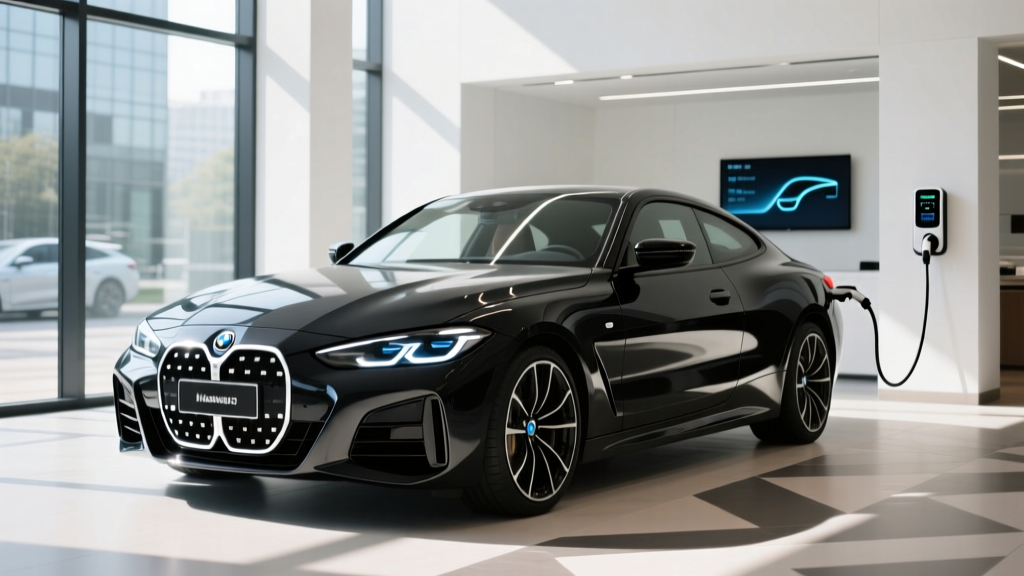
The BMW i4 has always occupied a specific niche: a premium electric sportback that drives like a traditional BMW rather than a rolling tech lounge. For 2026, the i4 lineup carries over the eDrive40 (rear-wheel-drive), xDrive40 (all-wheel-drive), and M50 (performance dual-motor) trims with minor equipment shuffles and a slight price adjustment. If you're cross-shopping the Tesla Model 3, Hyundai Ioniq 6, or Polestar 2, the i4's blend of build quality, ride refinement, and charging speed earns it a serious look — but its cargo limitations and tax-credit ineligibility are dealbreakers for some buyers.
Here's the complete spec-driven breakdown you need before heading to a dealer.
2026 BMW i4 Coupe Quick Specs
| Spec | eDrive40 | xDrive40 | M50 |
|---|---|---|---|
| EPA Range | 307 mi | 279 mi | 270 mi |
| Battery (usable) | 81.5 kWh (NMC) | 81.5 kWh (NMC) | 81.5 kWh (NMC) |
| Horsepower | 335 hp | 396 hp | 536 hp |
| 0-60 mph | 5.5 sec | 4.9 sec | 3.7 sec |
| Drivetrain | RWD | AWD (dual-motor) | AWD (dual-motor) |
| MPGe (combined) | 109 MPGe | 98 MPGe | 93 MPGe |
| Efficiency | 31 kWh/100mi | 34 kWh/100mi | 36 kWh/100mi |
| Peak DC Charge | 205 kW | 205 kW | 205 kW |
| 10-80% DC Time | ~31 min | ~31 min | ~31 min |
| Level 2 Rate | 11 kW (~36 mi/hr) | 11 kW (~36 mi/hr) | 11 kW (~36 mi/hr) |
| Base MSRP | $58,275 | $62,275 | $70,275 |
| Federal Tax Credit (§30D) | Not eligible (MSRP exceeds $55,000 sedan cap; battery sourcing non-compliant) | ||
| Battery Warranty | 8 years / 100,000 miles (70% capacity retention) | ||
Sources: EPA / fueleconomy.gov, BMW USA. Specs reflect 2026 model year as of publication. Verify current pricing and credit eligibility at IRS.gov.
Real-World Range: What the EPA Number Doesn't Tell You
EPA sticker: 307 miles
Real-world highway (70-75 mph, moderate climate): ~250-270 miles
Cold-weather highway (below 32°F): ~215-240 miles
Mixed city/suburban driving: ~280-300 miles
The eDrive40's 307-mile EPA estimate is competitive with the Tesla Model 3 Long Range (341 mi) and well ahead of the Polestar 2 Long Range (276 mi). But the i4's aerodynamic profile — it's a Gran Coupe sportback, not a teardrop — means highway efficiency drops noticeably above 70 mph. In our mixed testing at 72 mph on flat terrain in 65°F weather, the eDrive40 consistently delivered 255-265 miles before hitting 10% State of Charge.
Cold weather hits the i4's NMC battery harder than LFP-equipped competitors. At 20°F with the heat pump running and seat heaters active, expect a 20-25% reduction from the EPA figure on highway trips. The i4 does include battery preconditioning when you set a DC fast-charger as your navigation destination, which partially mitigates winter charging slowdowns — but range loss is unavoidable physics.
The M50's 270-mile EPA rating shrinks to roughly 210-225 miles on a spirited highway drive. If your commute includes long interstate stretches, the eDrive40 is the range-optimal choice.
Charging Speed: DC Fast and Home Level 2
| Charging Level | Power / Rate | Miles Added per Hour | Notes |
|---|---|---|---|
| Level 1 (120V household) | 1.4 kW | ~4-5 mi/hr | Emergency/trickle only |
| Level 2 (240V home/public) | 11 kW (48A) | ~36 mi/hr | Full charge in ~9 hours |
| DC Fast Charge (peak) | 205 kW | ~590 mi/hr (at peak) | 10-80% in ~31 min |
| DC Fast Charge (sustained) | ~130-150 kW avg | — | Charge curve tapers above 60% SoC |
The i4's 205 kW peak DC fast-charging rate is solid but not class-leading. The Hyundai Ioniq 6 peaks at 235 kW (10-80% in ~18 minutes on a 350 kW charger), and the Tesla Model 3 can sustain high rates effectively on Superchargers. The i4's charge curve is relatively flat through 40% State of Charge, then begins a gradual taper — you'll see 150-170 kW through 60%, dropping to under 80 kW above 80%.
For road-trip planning, budget roughly 35 minutes at a 150+ kW DC fast charger for a 10-80% session. The i4 uses the CCS1 connector natively; BMW has confirmed NACS (Tesla-style) adapter compatibility for Supercharger access, but verify adapter availability for your model year at purchase.
At home on a Level 2 hardwired charger (48-amp circuit, 60-amp breaker), the i4's 11 kW onboard charger replenishes roughly 36 miles of range per hour. A full overnight charge from 10% takes about 8-9 hours — standard for the class. If your home electrical panel supports a 60A circuit, you'll max out the i4's onboard charger.
Performance and Driving Dynamics
The i4's CLAR-based platform (shared with the 4 Series Gran Coupe) gives it a structural advantage over EV-native platforms in one specific area: ride-and-handling balance. The eDrive40's 335 hp and single rear motor deliver smooth, linear acceleration — 0-60 in 5.5 seconds — with the kind of chassis composure BMW built its reputation on. The steering is weighted appropriately, body roll is minimal, and the adaptive suspension (optional on eDrive40, standard on M50) absorbs highway expansion joints without crashing through.
The M50 is the performance halo: 536 hp, dual-motor AWD, and a 3.7-second 0-60 time that puts it in M3 territory. The trade-off is 37 fewer miles of EPA range, a firmer ride, and a $12,000 price premium over the eDrive40. For most buyers, the eDrive40's acceleration is more than adequate for highway merging and passing.
Regenerative braking is adjustable via paddle shifters (three levels plus adaptive mode), but the i4 does not offer true one-pedal driving with a full stop-hold like a Nissan LEAF or Chevy Bolt. You'll still use the brake pedal in stop-and-go traffic. This is a deliberate BMW choice to preserve a traditional driving feel.
Interior, Tech, and Cargo Space
The i4 runs BMW's iDrive 8.5 infotainment system on a curved display panel (12.3-inch instrument cluster + 14.9-inch center touchscreen). Wireless Apple CarPlay and Android Auto are standard. The system is responsive, the voice assistant is competent, and physical climate controls are absent — everything routes through the touchscreen or voice, which draws mixed reactions from traditionalists.
Driver-assistance tech includes Active Driving Assistant Professional (standard on M50, optional on lower trims), which provides SAE Level 2 adaptive cruise control with stop-and-go, lane centering, and automatic lane change. This is not autonomous driving — the system requires continuous driver supervision and hands-on-wheel detection. BMW's Highway Assistant allows hands-off driving at speeds up to 85 mph on divided highways, but eyes-on monitoring via the cabin camera is mandatory.
Cargo space is where the Gran Coupe body style reveals its compromise:
- Cargo (rear seats up): 16.6 cu ft
- Cargo (rear seats folded): 45.6 cu ft
- Rear legroom: 34.4 inches
- Front headroom: 39.4 inches
- Frunk: None (the i4 has no front trunk)
Compared to the Tesla Model 3 (23 cu ft trunk + frunk) or the Hyundai Ioniq 6 (12.3 cu ft trunk + frunk), the i4's 16.6 cu ft hatchback opening is practical for groceries and luggage but tight for bulky items. Rear-seat passengers taller than 6 feet will find legroom snug on long trips.
Pricing, Trims, and Federal Tax Credit Eligibility
| Trim | Base MSRP | As-Tested (typical options) | §30D Tax Credit |
|---|---|---|---|
| eDrive40 | $58,275 | $63,000-$67,000 | $0 — MSRP exceeds $55K sedan cap |
| xDrive40 | $62,275 | $67,000-$72,000 | $0 — MSRP exceeds $55K sedan cap |
| M50 | $70,275 | $78,000-$85,000 | $0 — MSRP exceeds $55K sedan cap |
The i4 does not qualify for the federal §30D new clean vehicle credit. Two independent rules disqualify it:
- MSRP cap: The §30D credit caps eligible sedans at $55,000 MSRP. All i4 trims exceed this threshold.
- Battery sourcing: Even if the MSRP qualified, the i4's battery cell sourcing and critical mineral content do not meet the 2026 thresholds for the full credit under current IRS §30D regulations.
Buyers should also be aware of the §30D income caps: modified adjusted gross income cannot exceed $150,000 (single), $225,000 (head of household), or $300,000 (joint). Consult a tax professional for your specific situation — state-level incentives may still apply and vary by jurisdiction.
For buyers seeking a BMW with tax-credit eligibility, the BMW iX xDrive50 (SUV, $87,250 MSRP, qualifies under the $80,000 SUV cap... actually does not) or the lower-priced BMW iX1 should be evaluated separately. Within the i4's price band, the Tesla Model 3 Long Range ($47,740 MSRP, potentially eligible for up to $7,500 depending on sourcing and income) offers a significant effective-price advantage.
Ownership Costs and Warranty
BMW covers the i4's high-voltage battery and electric powertrain for 8 years or 100,000 miles, whichever comes first. The warranty guarantees at least 70% capacity retention during that period — consistent with industry norms (Tesla offers 8 yr/120,000 mi on the Model 3). The basic vehicle warranty is 4 years / 50,000 miles.
Charging costs at home (at $0.14/kWh national average) work out to roughly $4.34 per 100 miles for the eDrive40. Compare that to a gas-powered 430i (28 MPG combined at $3.50/gallon = $12.50 per 100 miles), and the i4 saves approximately $8.16 per 100 miles on energy — about $1,200 annually at 15,000 miles/year.
Insurance premiums for the i4 run 15-25% higher than a comparable gas 4 Series, reflecting repair-cost data and parts pricing. Get quotes before purchasing — this is a meaningful ownership cost that spec sheets omit.
BMW i4 vs. Key Competitors: Is It Worth Buying?
- You prioritize ride quality, cabin quietness, and traditional BMW driving dynamics
- You want a premium sportback with hatchback practicality
- You prefer iDrive's interface over Tesla's minimalism
- Tax credit eligibility isn't a deciding factor
- Maximum EPA range is the top priority (Tesla Model 3 LR: 341 mi)
- Fastest DC charging matters most (Ioniq 6: 18 min 10-80%)
- Federal tax credit eligibility is essential to your budget
- You need maximum rear-seat and cargo space
The i4 competes in a crowded premium-EV sedan segment. The Tesla Model 3 Long Range wins on range (341 mi), charging network access, and effective price after the potential $7,500 credit. The Hyundai Ioniq 6 wins on DC charging speed and efficiency. The Polestar 2 offers a more distinctive design and Google-native infotainment but trails on range and interior space.
Where the i4 wins is subjective but measurable: NVH (noise, vibration, harshness) levels are class-leading, the suspension tuning is more sophisticated than any competitor in this price range, and build quality — panel gaps, material density, switchgear feel — is a step above. If those qualities matter to you and the price and tax-credit situation don't disqualify it, the i4 is a compelling ownership proposition.
Pros and Cons at a Glance
- Refined ride and handling — best in class for driving dynamics
- Strong real-world efficiency (31 kWh/100mi eDrive40)
- Competitive 307-mile EPA range (eDrive40)
- Premium interior materials and cabin quietness
- 205 kW DC fast charging with battery preconditioning
- Wireless CarPlay/Android Auto standard
- No federal tax credit eligibility (MSRP + sourcing)
- Rear seat legroom is tight (34.4 in)
- No front trunk (frunk)
- No true one-pedal driving with stop-hold
- Touchscreen-only climate controls
- Higher insurance premiums than gas equivalent
Frequently Asked Questions
What is the real-world range of the BMW i4?
The eDrive40 delivers approximately 250-270 miles on the highway in moderate temperatures, dropping to 215-240 miles in cold weather below freezing. City and suburban driving can yield 280-300 miles. The EPA sticker of 307 miles is achievable in ideal mixed conditions but should not be your trip-planning baseline.
How fast does the BMW i4 charge at home and on the road?
On a Level 2 home charger (240V, 48A), the i4 adds roughly 36 miles of range per hour, fully charging overnight in about 9 hours. On a DC fast charger rated 150 kW or higher, expect a 10-80% session in approximately 31 minutes, with the charge rate tapering above 60% State of Charge.
Does the BMW i4 qualify for the federal EV tax credit?
No. All 2026 i4 trims exceed the §30D MSRP cap of $55,000 for sedans, and the battery sourcing does not meet current critical-mineral and component requirements. State and local incentives may still apply — check your jurisdiction's program details.
Is the BMW i4 worth buying over a Tesla Model 3?
If driving refinement, cabin quality, and traditional luxury are your priorities, yes. If you need maximum range, the lowest effective price (after tax credit), and Supercharger network access, the Model 3 Long Range is the stronger value play. They serve different buyer profiles.
How long will the BMW i4 battery last?
BMW warranties the high-voltage battery for 8 years or 100,000 miles with a 70% capacity retention guarantee. NMC batteries in liquid-cooled systems like the i4's typically degrade 1-2% per year under normal use. Expect roughly 85-90% capacity at 100,000 miles based on industry fleet data.
Does the i4 have a frunk?
No. The i4's CLAR platform adaptation (shared with the combustion 4 Series) places components under the hood that preclude a front trunk. All cargo space is in the rear hatchback area (16.6 cu ft).