Quick Answer: Electric Car Brakes Last 2-3x Longer Than Gas Car Brakes
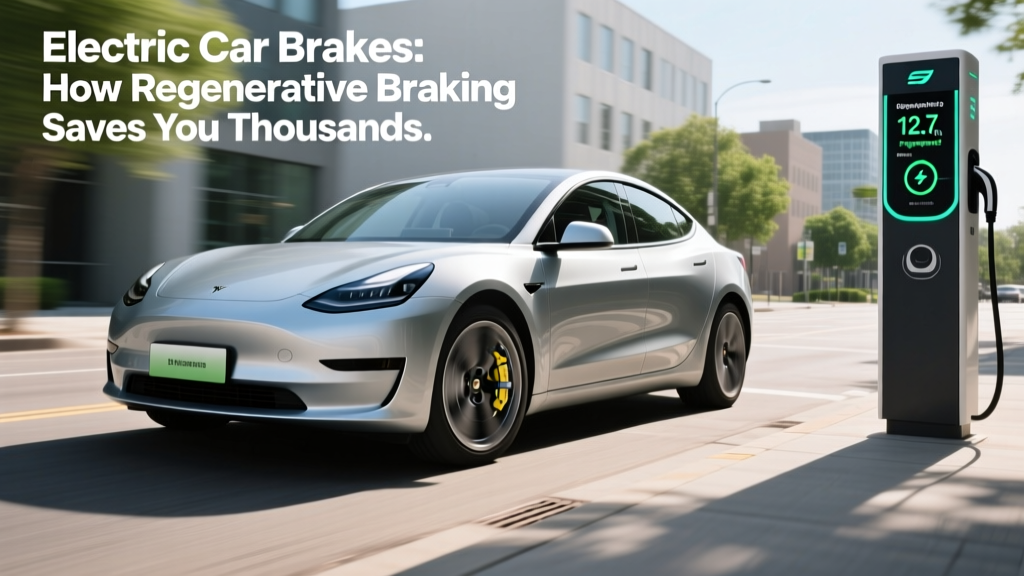
Electric car brakes last significantly longer than conventional brakes because regenerative braking handles most deceleration. While gas car brake pads typically need replacement every 30,000–50,000 miles, EV brake pads routinely exceed 100,000 miles before needing service. The friction brakes still exist for emergency stops and low-speed maneuvering, but regen does the heavy lifting, converting kinetic energy back into battery charge instead of wasting it as heat.
How Electric Car Brakes Actually Work
Every EV uses a blended braking system with two distinct mechanisms working together:
Regenerative braking (primary): When you lift off the accelerator or press the brake pedal lightly, the electric motor reverses direction and becomes a generator. This creates resistance that slows the vehicle while sending electricity back to the battery pack. Most daily deceleration — slowing for traffic, approaching stoplights, descending hills — happens entirely through regen without the friction brakes engaging at all.
Friction brakes (secondary): Traditional disc brakes with pads and rotors remain on all four wheels. They activate during hard emergency stops (typically above 0.3g deceleration), when the battery is fully charged and can't accept regen energy, or at very low speeds below 5 mph where regen becomes ineffective. The vehicle's brake controller blends these systems seamlessly — you press one pedal and the car decides how much braking comes from each source.
This blended system is why you'll see EV owners reporting original brake pads at 80,000, 120,000, or even 150,000 miles. The friction brakes simply aren't working hard enough to wear out quickly.
The Real Cost Savings: EV Brakes vs Gas Car Brakes
Let's put concrete numbers on what this means for your wallet over a typical ownership period.
| Maintenance Item | Gas Car (Typical Midsize Sedan) | Electric Vehicle (Typical Midsize) |
|---|---|---|
| Front brake pad replacement | $250–$400 (at ~40,000 mi) | $0 (pads at 50%+ life) |
| Rear brake pad replacement | $200–$350 (at ~50,000 mi) | $0 (pads at 50%+ life) |
| Front rotor resurfacing/replacement | $300–$600 (often with 2nd pad change) | $0 (minimal wear) |
| Brake fluid flush | $100–$150 (every 2-3 years) | $100–$150 (every 2-3 years) |
| Total 5-year brake cost | $850–$1,500 | $100–$150 |
Over 5 years and 75,000 miles, you're looking at $700–$1,350 in brake maintenance savings with an EV. Extend that to 10 years or 150,000 miles and the gap widens further — a gas car might need 3-4 brake jobs while an EV might need only one pad replacement (if any).
According to fueleconomy.gov, reduced maintenance is consistently cited as one of the top three ownership benefits EV drivers report, alongside fuel savings and performance.
EV vs Gas: Complete Ownership Cost Context
Brake savings are just one piece of the EV maintenance advantage. Here's how the full picture compares.
| Category | Gas Vehicle | Electric Vehicle | Annual EV Savings |
|---|---|---|---|
| Engine oil changes | $150–$300 | $0 | $150–$300 |
| Brake service | $170–$300 | $20–$30 | $140–$270 |
| Transmission fluid | $50–$150 | $0 (no multi-speed trans) | $50–$150 |
| Air/engine filters | $50–$100 | $20–$40 (cabin filter only) | $30–$60 |
| Spark plugs, belts, exhaust | $100–$400 | $0 | $100–$400 |
| Coolant service | $100–$200 | $100–$200 (battery thermal) | $0 |
| Total annual maintenance | $620–$1,450 | $140–$270 | $470–$1,180 |
The data is clear: EVs cost roughly 50–70% less to maintain annually. A Consumer Reports analysis estimated lifetime maintenance savings of $4,600–$9,200 for EVs compared to gas vehicles, with brake savings contributing a meaningful portion of that figure.
One-Pedal Driving: Maximizing Your Regen Advantage
Most EVs offer adjustable regenerative braking levels, with the strongest setting enabling "one-pedal driving" — where lifting off the accelerator provides enough deceleration for most stops without touching the brake pedal at all.
How it works in practice: In maximum regen mode (often called "e-Pedal" in Nissan, "One Pedal Driving" in Chevy/BMW, or simply the highest regen setting in Tesla), lifting off the accelerator decelerates the car at roughly 0.15–0.25g. That's enough to slow from 65 mph to a complete stop over about 8–12 seconds — perfect for highway traffic flow and approaching red lights with plenty of distance.
Energy recaptured: Aggressive regen driving can recover 15–25% of the energy you'd otherwise waste during deceleration. On a vehicle with an 80 kWh battery and 270-mile EPA range, that translates to roughly 5–10 additional miles of range per full charge cycle in stop-and-go city driving. Highway driving sees less benefit since there's less deceleration events.
The trade-off: Maximum regen can feel jerky to passengers if you're not smooth with pedal modulation. Many drivers prefer a medium regen setting that balances energy recovery with coasting comfort. Experiment to find what works for your commute.
Common EV Brake Misconceptions: Myth vs Fact
| Myth | Fact |
|---|---|
| "EVs don't have friction brakes at all" | Every EV has conventional disc brakes on all four wheels for emergency stops, low-speed maneuvering, and when the battery is full. They're required by NHTSA safety regulations. |
| "Regen braking makes EVs unsafe in emergencies" | Friction brakes engage instantly during hard pedal application. EVs match or exceed gas car stopping distances — a Tesla Model Y stops from 60 mph in roughly 115–120 feet, comparable to a Honda Accord. |
| "You never need to service EV brakes" | Brake fluid still needs flushing every 2–3 years (it absorbs moisture over time). Calipers can seize from underuse. Pads and rotors need periodic inspection even if wear is minimal. |
| "Regen doesn't work in cold weather" | Regen is reduced when the battery is cold (below ~50°F) because a cold battery can't accept charge as quickly. Most EVs limit regen power until the battery warms up via preconditioning or driving. Friction brakes compensate automatically. |
| "EV brakes are more expensive to replace when they finally wear out" | EV brake components are standard automotive parts — pads, rotors, and calipers cost the same as gas car equivalents. You're just replacing them far less often. |
Real-World Ownership Considerations
Cold-climate driving: If you live where winters regularly drop below freezing, expect reduced regen effectiveness for the first 10–20 minutes of driving until the battery warms up. During this window, you'll use friction brakes more than usual. Preconditioning your EV while plugged in (warming the battery before departure) mitigates this significantly and is one of the biggest cold-weather EV ownership tips.
Mountain driving: Descending long grades is where regen shines brightest. A gas car descending a 5-mile mountain pass rides the brakes and risks overheating them (brake fade). An EV converts that potential energy into battery charge, often adding 5–15 miles of range on a single descent while keeping friction brakes cool and ready for emergencies.
City vs highway driving patterns: Stop-and-go city driving maximizes regen usage and brake savings. Highway cruising sees minimal braking events regardless of vehicle type. If your commute is 90% highway, your brake savings advantage over gas cars is smaller (though still present).
Rust and corrosion: Because EV friction brakes see so little use, rotors can develop surface rust from sitting — especially in humid or salted-road climates. This isn't a safety issue (the rust scrubs off during the next brake application), but it can cause initial noise or vibration. Some owners perform a deliberate hard brake application monthly to keep rotors clean.
Decision Framework: Is Brake Savings Enough to Justify an EV?
Choose an EV if:
- You drive 15,000+ miles annually in stop-and-go traffic (maximizes brake and fuel savings)
- You have access to home charging (Level 2, ~$500–$2,000 installed) — this unlocks the lowest per-mile "fuel" cost of $0.03–$0.05/mile vs $0.12–$0.18/mile for gas
- You plan to keep the vehicle 7+ years (longer ownership = more cumulative maintenance savings)
- You value reduced maintenance hassle alongside cost savings
Stick with gas or hybrid if:
- You lack reliable charging access (apartment without charging, frequent street parking)
- You drive under 8,000 miles annually (lower mileage = less total savings to offset EV's higher purchase price)
- You regularly tow heavy loads or drive in extreme cold below -20°F (EVs lose 20–40% range in these conditions)
- Your budget is under $30,000 and you need a new vehicle (few affordable new EV options at this price point as of 2026)
Frequently Asked Questions
Do I ever need to replace brake pads on an EV?
Eventually, yes — but likely not for 100,000+ miles. Many EV owners report original brake pads at 80,000–120,000 miles with 50% or more life remaining. The exact lifespan depends on your driving style, regen settings, and how much hard braking you do.
What happens if my EV battery dies — do I lose braking?
No. The 12V auxiliary battery (separate from the main traction battery) powers the brake booster and ABS system. Even if the main battery is completely depleted, you retain full friction braking capability. This is a federal safety requirement.
Can I adjust how much regenerative braking my EV uses?
Most EVs offer 2–5 regen intensity levels, from minimal (coasting feel similar to a gas car) to maximum (one-pedal driving). Some models like Tesla allow on-the-fly adjustment via the touchscreen, while others like the Hyundai Ioniq 5 use steering wheel paddles. Check your owner's manual for your specific vehicle's controls.
Does regenerative braking extend my EV's range significantly?
In city driving with frequent stops, regen can recover 15–25% of energy that would otherwise be lost. That might add 5–15 miles to your effective range on a 250-mile EPA-rated vehicle. Highway driving sees minimal benefit since you rarely decelerate. The EPA range figure already accounts for typical regen recovery, so real-world city range often matches or slightly exceeds the sticker number.
Are EV brake repairs more expensive than gas car brakes?
No. When EV brake pads or rotors do need replacement (rarely before 100k miles), the parts and labor cost the same as equivalent gas car brakes — typically $250–$400 per axle. You're just doing this service once per 2–3 times a gas car owner would.