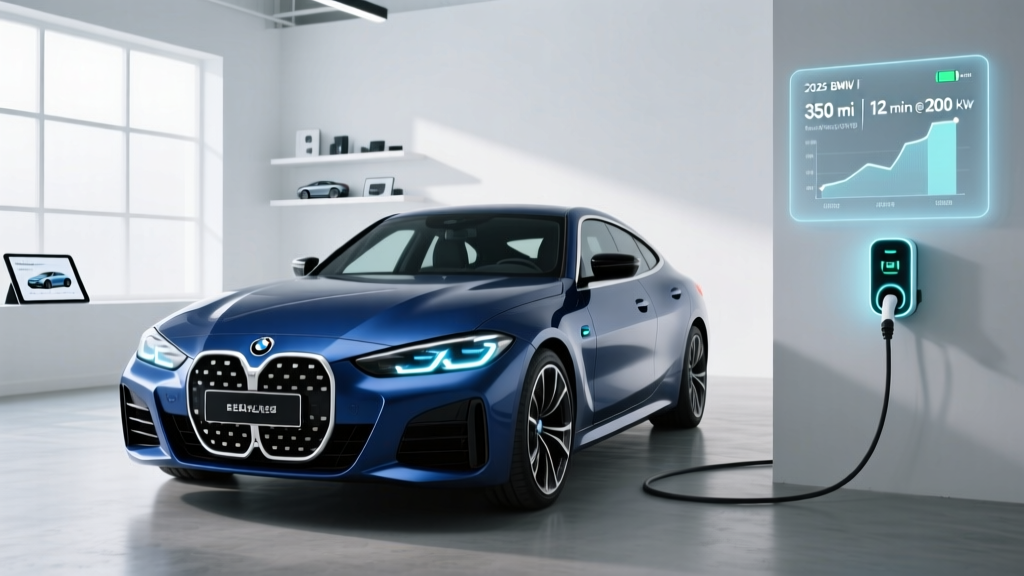
The BMW i4 slots into a crowded luxury electric sedan segment as the brand's answer to the Tesla Model 3, Polestar 2, and Hyundai Ioniq 6. Built on BMW's CLAR platform (shared with the 4 Series Gran Coupe), the i4 delivers the driving dynamics BMW is known for, wrapped in an electric powertrain. But for buyers researching the BMW i4 cost, the sticker price is only the beginning — tax credit eligibility, charging infrastructure, and real-world range all shape what you'll actually pay over five years of ownership.
This guide breaks down every 2026 BMW i4 trim, the real numbers behind EPA estimates, charging performance, and whether the math works after federal incentives.
2026 BMW i4 Trim Pricing at a Glance
The 2026 i4 lineup spans four trims, from the rear-wheel-drive eDrive35 to the high-performance M50. Pricing below reflects base MSRP before destination charges ($995) and before any federal or state incentives.
| Trim | Drivetrain | Base MSRP | Est. As-Tested* | EPA Range |
|---|---|---|---|---|
| eDrive35 | RWD | $53,075 | $56,500–$59,000 | 301 mi |
| eDrive40 | RWD | $58,275 | $63,000–$67,000 | 318 mi |
| xDrive40 | AWD | $62,775 | $68,000–$73,000 | 289 mi |
| M50 | AWD | $69,675 | $75,000–$82,000 | 269 mi |
*As-tested estimates include popular packages (Premium, Driving Assistance Professional, larger wheels). Higher trims with full option loads can exceed $85,000.
BMW positions the eDrive35 as the entry point, but most buyers gravitate toward the eDrive40 for its additional range and feature content. The M50 commands a premium for its 536 hp dual-motor setup and M-tuned suspension — a performance play, not a value play.
Federal Tax Credit Eligibility: Does the i4 Qualify?
This is where the BMW i4 cost equation gets complicated. Under current IRS §30D rules, the BMW i4 does not qualify for the full $7,500 federal EV tax credit. The reason: BMW's battery cells are sourced from suppliers that do not meet the critical-minerals and battery-component requirements established under the Inflation Reduction Act. As of the 2026 model year, the i4 typically qualifies for $0 in federal tax credit at point of sale.
- ✅ MSRP under $55,000 (sedan cap): eDrive35 qualifies on MSRP; eDrive40, xDrive40, and M50 exceed the cap
- ✅ Buyer income limits: $150K single / $300K joint filers
- ❌ Battery sourcing (critical minerals): Does not meet 2026 thresholds
- ❌ Battery component manufacturing: Does not meet North America assembly requirement
- Result: $0 federal credit for all trims in 2026
Always verify current eligibility at fueleconomy.gov or consult a tax professional. Rules change, and state-level incentives may still apply.
This is a significant disadvantage against competitors. The Tesla Model 3 Long Range (~$48,000 MSRP) and certain trims of the Hyundai Ioniq 6 still qualify for up to $7,500, effectively widening the price gap by that amount. Buyers set on the i4 should investigate state rebates (California's CVRP, Colorado's innovative motor vehicle credits, and others) and manufacturer loyalty incentives to close the gap.
EPA Range vs. Real-World Expectations
BMW equips the eDrive40 and xDrive40 with an 83.9 kWh usable battery pack (NMC chemistry — nickel-manganese-cobalt), while the eDrive35 uses a smaller 70.2 kWh usable pack, also NMC. The M50 shares the 83.9 kWh pack with the higher-volume trims.
EPA Estimate: 318 miles
Expect in practice: 270–290 miles on mixed highway driving at 70 mph; 230–250 miles in sustained cold weather (below 30°F) without preconditioning; up to 310 miles in city-heavy commuting with regen braking.
The i4's real-world efficiency is strong for its class, but highway speeds and winter temperatures cut into any EV's range. Preconditioning the battery while plugged in (via the BMW app) recovers an estimated 15–20 miles of winter range.
Per fueleconomy.gov, the eDrive40 achieves 105 MPGe combined (109 city / 100 highway), translating to roughly 32 kWh per 100 miles. That's competitive with the Tesla Model 3 Long Range (131 MPGe combined) though not class-leading — the Model 3's lighter curb weight and more aggressive aero give it an efficiency edge.
Cargo space is modest at 16.6 cubic feet (hatchback liftback design), which beats the traditional sedan trunks of some rivals but falls short of the Model 3's 23 cu ft. Rear legroom measures 35.2 inches — adequate for adults on shorter trips, tight for anyone over six feet on long drives.
Charging Performance: DC Fast and Home Level 2
The i4 supports up to 205 kW peak DC fast charging on 83.9 kWh trims (eDrive40, xDrive40, M50) and up to 180 kW on the eDrive35. BMW quotes a 10–80% charge time of approximately 31 minutes under ideal conditions at a compatible 350 kW station.
| Charging Level | Power (kW) | Speed / Time | Connector |
|---|---|---|---|
| Level 1 (120V household) | ~1.4 kW | ~3–4 mi/hr | J1772 adapter |
| Level 2 (240V home) | 11 kW (max onboard) | ~33 mi/hr; full charge ~9 hr | J1772 / NACS (with adapter) |
| DC Fast Charge | 205 kW peak (83.9 kWh) / 180 kW (70.2 kWh) | 10–80% in ~31 min | CCS1 (native) / NACS (adapter) |
A critical note on the charging curve: the i4 peaks at 205 kW only between roughly 10–30% state of charge. Between 30–60%, it sustains approximately 140–160 kW, then tapers to under 80 kW above 60%. This means the 10–80% time is realistic, but charging from 80–100% at a DC station is painfully slow — plan to unplug at 80% on road trips.
For home charging, BMW includes the Flexible Charger (up to 40 amps / 9.6 kW on a NEMA 14-50 outlet). For the full 11 kW onboard rate, you'll need a hardwired BMW Wallbox or third-party Level 2 unit (ChargePoint Home Flex, Emporia Level 2) on a 60-amp circuit. Expect home installation costs of $800–$2,500 depending on panel capacity and run length — budget for a potential panel upgrade if your home has a 100-amp service.
BMW ships the i4 with a CCS1 port natively. Following the industry shift to NACS, BMW provides a NACS adapter for Tesla Supercharger access (over 17,000 stalls in the U.S. as of 2026). This is a meaningful advantage for road-trippers in areas where Electrify America and EVgo coverage is sparse.
Performance and Driving Dynamics
| Trim | Horsepower | Torque (lb-ft) | 0–60 mph | Drivetrain |
|---|---|---|---|---|
| eDrive35 | 281 hp | 295 | 5.8 sec | RWD |
| eDrive40 | 335 hp | 317 | 5.4 sec | RWD |
| xDrive40 | 396 hp | 440 | 4.6 sec | AWD (dual-motor) |
| M50 | 536 hp | 586 | 3.7 sec | AWD (dual-motor) |
Even the base eDrive35 delivers smooth, linear acceleration that outpaces most gas-powered 4 Series models. The eDrive40's 335 hp hits the sweet spot — genuinely quick without the insurance premium of the M50. The xDrive40 adds all-weather confidence and a meaningful 0–60 improvement, making it the trim of choice for buyers in snow-belt states.
The M50 is a legitimate performance machine: 3.7 seconds to 60 mph, M Sport brakes, adaptive M suspension, and an electronically limited top speed of 130 mph. The tradeoff is range (269 miles EPA) and a price that pushes well past $75,000 as-tested. For most buyers, the eDrive40 or xDrive40 delivers 90% of the thrill at a fraction of the cost.
Technology, Interior, and Driver Assistance
The i4 runs BMW's iDrive 8.5 on a curved display setup: a 12.3-inch digital instrument cluster flows into a 14.9-inch central touchscreen. Wireless Apple CarPlay and Android Auto are standard, as is BMW's Intelligent Personal Assistant (voice control).
Standard driver-assistance features include:
- Active Driving Assistant (forward collision warning, automatic emergency braking, lane departure warning)
- Park Distance Control (front and rear sensors)
- Dynamic Cruise Control
The optional Driving Assistance Professional Package (~$1,700) adds Extended Traffic Jam Assistant (hands-free driving up to 40 mph on divided highways), Steering and Lane Control Assistant, and Active Cruise Control with Stop & Go. This is an SAE Level 2 system — you must keep your eyes on the road and hands near the wheel at all times. It is not autonomous driving.
Notable drawbacks: the i4's rear seat is tighter than competitors (the Model 3 and Hyundai Ioniq 6 both offer more legroom), and the hatchback cargo opening, while practical, creates more road noise than a sealed trunk. Some owners report the iDrive 8.5 climate controls buried in touchscreen menus — a physical button complaint that applies broadly to modern BMWs.
Warranty and Long-Term Ownership
| Coverage Type | Term |
|---|---|
| Limited Vehicle Warranty | 4 years / 50,000 miles |
| High-Voltage Battery | 8 years / 100,000 miles (70% capacity retention) |
| Powertrain (electric motor, transmission) | 8 years / 100,000 miles |
| Corrosion Perforation | 12 years / unlimited miles |
| Roadside Assistance | 4 years / unlimited miles |
BMW's battery warranty guarantees the pack will retain at least 70% of its original capacity over 8 years or 100,000 miles — industry standard, matching Tesla, Hyundai, and Ford. Real-world degradation data from 2022–2024 model-year i4 owners suggests roughly 3–5% capacity loss over the first 50,000 miles, which is typical for NMC chemistry with active thermal management.
Long-term ownership costs are where the i4 faces headwinds. Without the federal tax credit, the effective cost gap against a Tesla Model 3 Long Range widens by $7,500. Insurance premiums for the i4 run 15–25% higher than the Model 3 in most states (based on industry averages), and BMW maintenance costs — while lower than gas 4 Series ownership — exceed Tesla's minimal service requirements. Plan for cabin air filter replacements, brake fluid checks, and tire rotations; the i4's regenerative braking extends pad life significantly.
Is the BMW i4 Worth It vs. Key Competitors?
Pros
- Best-in-class driving dynamics and ride refinement
- Premium interior materials over Tesla/Polestar
- Strong real-world range (270–290 mi highway, eDrive40)
- NACS adapter enables Tesla Supercharger access
- Hatchback practicality with 16.6 cu ft cargo
- Quiet cabin, excellent NVH isolation
Cons
- No federal tax credit ($7,500 disadvantage vs. Model 3)
- Tight rear legroom (35.2 in) for the class
- DC charging tapers heavily above 60% SoC
- iDrive climate controls buried in menus
- Higher insurance premiums than key rivals
- Base eDrive35 range (301 mi) trails eDrive40 by 17 mi
Decision Framework: Who Should Buy the BMW i4?
Choose the i4 if: You prioritize driving feel and interior luxury over maximum range-per-dollar, you have reliable home Level 2 charging, and you value BMW's dealer/service network. The eDrive40 is the best value trim — strong range, 335 hp, and a premium cabin that Tesla still can't match.
Look elsewhere if: Federal tax credit eligibility is a dealbreaker (the Model 3 and Ioniq 6 qualify), you regularly carry rear-seat passengers, or you want the longest possible range for road trips (the Hyundai Ioniq 6 SE achieves 361 miles EPA at a lower price).
Frequently Asked Questions
What is the real-world range of the BMW i4 eDrive40?
The EPA rates the eDrive40 at 318 miles. In mixed highway driving at 70 mph, expect 270–290 miles. In cold weather (below 30°F) without preconditioning, range drops to approximately 230–250 miles. City driving with regenerative braking can push close to 310 miles.
How fast does the BMW i4 charge at home and on DC fast chargers?
On a 240V Level 2 home charger (11 kW), the i4 gains approximately 33 miles of range per hour, with a full charge taking about 9 hours. On a DC fast charger, the eDrive40/xDrive40/M50 peak at 205 kW, charging from 10–80% in roughly 31 minutes. The eDrive35 peaks at 180 kW.
Does the 2026 BMW i4 qualify for the $7,500 federal EV tax credit?
No. Under current IRS §30D rules, the BMW i4 does not meet the battery sourcing and critical-mineral requirements for the 2026 tax year. The eDrive35 falls under the $55,000 MSRP cap, but battery sourcing disqualifies all trims. Check IRS.gov for rule updates and consult a tax professional.
What is the total BMW i4 cost after incentives?
Without the federal credit, the eDrive35 starts around $54,070 (with destination), and the eDrive40 around $59,270. State incentives can reduce this: California's CVRP offers up to $2,000 for income-qualified buyers, and Colorado offers up to $5,000 in state tax credits. Manufacturer lease incentives may also reduce effective cost — check BMW Financial Services for current offers.
Is the BMW i4 worth buying over the Tesla Model 3?
The i4 wins on interior quality, ride comfort, and driving engagement. The Model 3 wins on price (especially after the $7,500 federal credit), range, charging speed, and efficiency. If driving dynamics and luxury matter most, the i4 is the better car. If cost-per-mile and tech-forward minimalism matter most, the Model 3 is harder to beat.
What is the BMW i4 battery warranty?
BMW covers the high-voltage battery for 8 years or 100,000 miles, whichever comes first, guaranteeing at least 70% of original capacity. The electric motor and powertrain electronics carry the same 8-year/100,000-mile coverage.
Sources: EPA Fuel Economy — BMW i4, IRS Clean Vehicle Credits, BMW USA product specifications. Pricing and tax credit rules reflect the 2026 model year and are subject to change.