The 2025 Subaru Solterra occupies a curious space in the electric SUV market: it's a co-developed twin of the Toyota bZ4X, built on the shared e-TNGA platform, yet it wears Subaru's adventure-ready badge and comes standard with all-wheel drive. For buyers searching specifically for 2025 Subaru Solterra interior features, the cabin delivers a practical, tech-forward layout with a 12.3-inch infotainment screen, a unique center console design, and materials that lean durable over luxurious. But the real question for EV shoppers isn't just what's inside — it's whether the range, charging speed, and pricing make this SUV competitive in a segment now crowded with compelling alternatives.
We've compiled every spec that matters: EPA range with real-world adjustments, battery chemistry and capacity, DC fast-charging curves, home charging rates, federal tax credit eligibility under current IRS §30D rules, and a thorough breakdown of the interior and cargo dimensions. Here's what you need to know before you buy.
2025 Subaru Solterra: Core EV Specifications at a Glance
| Specification | 2025 Subaru Solterra |
|---|---|
| EPA Range | 222 miles (Touring); 227 mi (Premium/Limited) |
| Battery Capacity | 72.8 kWh (gross), ~66 kWh usable, lithium-ion (NMC) |
| Drivetrain | Dual-motor AWD (standard on all trims) |
| Horsepower | 215 hp combined |
| Torque | 248 lb-ft |
| 0-60 mph | ~6.5 seconds |
| Max DC Fast Charge Rate | 150 kW (peak) |
| 10-80% DC Fast Charge | ~35 minutes |
| Level 2 Home Charging | 7.7 kW (onboard charger), ~25 miles/hr |
| Efficiency | 104 MPGe combined; 33 kWh/100 mi (Touring) |
| Base MSRP | $39,995 (Premium) + $1,395 destination |
| Battery/Powertrain Warranty | 8 years / 100,000 miles |
Range and Efficiency: EPA Numbers vs. Real-World Driving
EPA Estimated Range: 227 miles (Premium/Limited trims with 18-inch wheels); 222 miles (Touring with 20-inch wheels)
Real-World Expectation: Expect 190–210 miles on highway-heavy trips at 70+ mph. In cold weather (below 30°F), range can drop 20–30%, yielding as little as 155–175 miles. City driving with regenerative braking can approach or slightly exceed the EPA sticker.
The Solterra's efficiency of 104 MPGe combined (per fueleconomy.gov) is middling for the class. The Hyundai Ioniq 5 achieves 114 MPGe combined with RWD, and the Tesla Model Y hits 120 MPGe. Subaru's standard dual-motor AWD adds weight and mechanical drag that inherently reduce efficiency — a trade-off for the all-weather traction that Subaru buyers expect.
The Solterra uses a heat pump for cabin heating, which is a significant advantage in cold climates. Resistive heaters can consume 3–5 kW of battery power; a heat pump cuts that to roughly 1–2 kW in moderate cold, preserving more range. However, in extreme sub-zero temperatures, the heat pump's efficiency drops and supplemental resistive heating engages, which is where the steeper range losses occur.
Charging Speed: DC Fast Charging and Home Level 2
Charging is where the 2025 Solterra shows its most notable limitation relative to competitors. The peak DC fast-charge rate of 150 kW is respectable, but the charge curve — how the vehicle sustains that peak — matters more than the headline number.
| Charging Method | Power / Rate | Time / Miles Added |
|---|---|---|
| Level 1 (120V household) | 1.2 kW | ~4 miles per hour |
| Level 2 (240V home, 32A) | 7.7 kW (max onboard) | ~25 miles per hour; full charge ~9.5 hrs |
| DC Fast Charge (150 kW peak) | Up to 150 kW | 10-80% in ~35 min |
| DC Fast Charge (50 kW station) | ~50 kW | 10-80% in ~70 min |
Charge curve reality check: The Solterra peaks near 150 kW only at a low state of charge (roughly 10–25% SoC) and then tapers progressively. From 50% to 80%, you'll see sustained rates closer to 50–70 kW. This is why the 10-80% time stretches to approximately 35 minutes — competitive with the Toyota bZ4X but slower than the Hyundai Ioniq 5 (18 minutes on a 350 kW charger) or the Tesla Model Y (roughly 20–25 minutes on a V3 Supercharger).
For home charging, the 7.7 kW onboard charger means a full overnight replenishment is easily achievable. If you install a 48-amp Level 2 circuit (hardwired), you'll max out the Solterra's onboard charger. A standard 32-amp NEMA 14-50 outlet delivers about 7.2 kW, which is nearly identical in practical terms — roughly 25 miles of range per hour of charging.
2025 Subaru Solterra Interior Features: Cabin, Tech, and Cargo
The cabin of the 2025 Solterra reflects Subaru's utilitarian heritage with a few modern EV touches. Here's a detailed look at what you'll find inside, organized by what matters most to daily drivers.
Infotainment and Displays
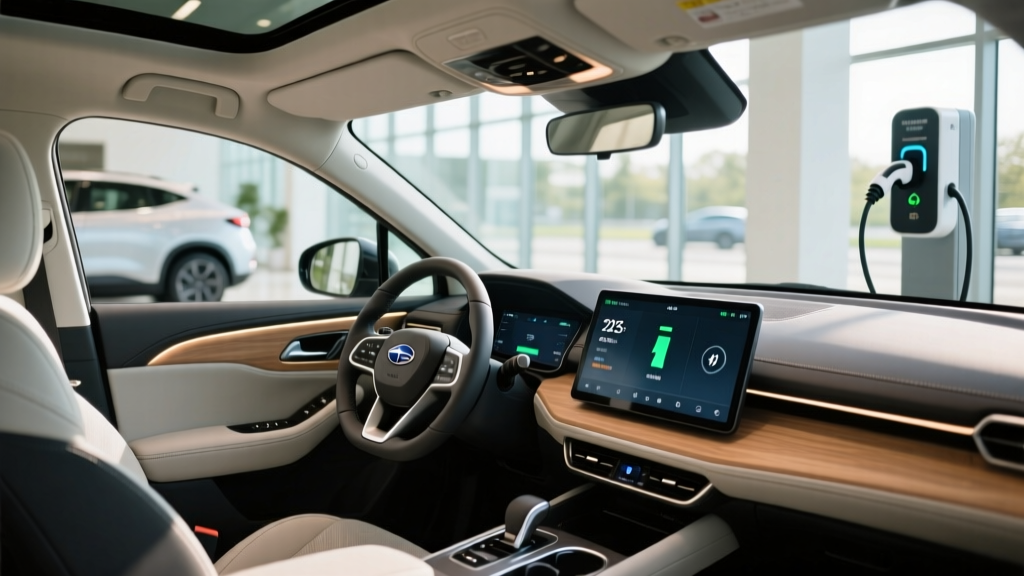
Every 2025 Solterra features a 12.3-inch touchscreen running Subaru's latest Starlink multimedia system with wireless Apple CarPlay and Android Auto. The screen is oriented in landscape mode and sits atop a raised center stack — a design choice that improves outward visibility compared to the Tesla-style tablet approach. Below the screen, physical knobs and buttons for climate controls are a welcome inclusion; no hunting through submenus to adjust the fan speed.
A 7-inch digital instrument cluster sits behind the steering wheel. Higher trims (Limited, Touring) add a heads-up display projected onto the lower windshield — not a full augmented-reality HUD, but adequate for speed and navigation prompts.
Seating, Materials, and Comfort
The Solterra seats five. Front seats are well-bolstered and heated on all trims; ventilated front seats and heated rear seats are available on Limited and Touring. The upholstery is a synthetic leather (SofTex on mid-trims, a upgraded leatherette on Touring) that's durable and easy to clean — appropriate for the adventure-oriented buyer. Base Premium trims come with cloth seating surfaces.
The center console features a unique "bridge" design with a lower storage shelf and an upper armrest, creating useful open storage space for a bag or pair of shoes. Two USB-C ports (one data, one charge-only) are located in the front, with two more for rear passengers on upper trims. A wireless charging pad sits in the lower console shelf.
Cargo and Passenger Dimensions
| Dimension | Measurement |
|---|---|
| Front legroom | 42.1 inches |
| Rear legroom | 35.7 inches |
| Front headroom | 39.9 inches |
| Rear headroom | 38.4 inches |
| Cargo volume (rear seats up) | 23.8 cu ft |
| Cargo volume (rear seats folded) | 56.9 cu ft |
| Frunk (front trunk) | None |
The absence of a frunk is a missed opportunity — the e-TNGA platform's motor placement leaves space that Subaru simply sealed off. Competitors like the Ioniq 5 (0.85 cu ft frunk) and Ford Mustang Mach-E (4.7 cu ft frunk) offer at least some front cargo space for charging cables or groceries.
The 23.8 cu ft behind the rear seats is competitive with the bZ4X (27.7 cu ft is the bZ4X figure, though interior packaging differs slightly) but falls short of the Model Y (30.2 cu ft) and Ioniq 5 (27.2 cu ft). Fold the 60/40 split rear seats and 56.9 cu ft is adequate for weekend camping gear or a pair of mountain bikes with wheels removed.
Driver Assistance and Safety Tech
Subaru's EyeSight driver-assistance suite is standard across all trims and includes:
- Adaptive cruise control with stop-and-go
- Lane-keeping assist and lane-centering
- Pre-collision braking with pedestrian detection
- Blind-spot monitoring with rear cross-traffic alert (Limited/Touring)
- Reverse automatic braking
SAE Automation Level: Level 2. EyeSight with lane-centering and adaptive cruise is a driver-assist system, not autonomous driving. The driver must remain fully engaged, hands on or near the wheel, and eyes on the road at all times. Subaru does not offer a hands-free driving mode comparable to GM's Super Cruise or Ford's BlueCruise.
Pricing, Trims, and Federal Tax Credit Eligibility
The 2025 Solterra is offered in three trims. Here's the pricing breakdown and how the federal EV tax credit applies under current IRS §30D rules:
| Trim | MSRP (incl. destination) | Est. After §30D Credit | Key Features |
|---|---|---|---|
| Premium | $41,390 | ~$33,890* | 18" wheels, cloth seats, 12.3" screen, AWD, EyeSight |
| Limited | $45,190 | ~$37,690* | SofTex seats, heated/ventilated front, power liftgate, blind-spot monitor |
| Touring | $49,790 | ~$42,290* | 20" wheels, premium audio, HUD, panoramic fixed glass roof, leatherette |
*Federal tax credit estimates assume full eligibility. Actual credit amount varies based on battery sourcing, buyer income, and tax liability. See details below.
Does the 2025 Solterra Qualify for the Federal EV Tax Credit?
The Solterra's eligibility for the IRS §30D New Clean Vehicle Credit (up to $7,500) depends on several factors that change periodically due to battery-sourcing and critical-mineral requirements. As of the current tax year, buyers should verify the following before purchase:
- MSRP Cap: The Solterra is an SUV, so the MSRP cap is $80,000. All trims qualify.
- Buyer Income Cap: Modified adjusted gross income must not exceed $300,000 (joint), $225,000 (head of household), or $150,000 (single).
- Battery Sourcing: The credit is split into two halves ($3,750 each) — one for battery components manufactured in North America, one for critical minerals sourced from the U.S. or FTA partners. The Solterra's battery is manufactured by Panasonic; sourcing compliance varies by production batch and model year. Confirm current eligibility with your dealer and a tax professional before purchase.
- Point-of-Sale Transfer: Eligible buyers can transfer the credit to the dealer at purchase, reducing the purchase price directly rather than waiting for a tax refund. This requires the dealer to be registered with the IRS Energy Credits Online system.
- Final Assembly: Must occur in North America. The Solterra is assembled at Toyota's Motomachi plant in Japan, which may disqualify it from the §30D credit depending on current enforcement. Always verify VIN eligibility at fueleconomy.gov before purchasing.
Critical Note: Because the Solterra is assembled in Japan, it has historically faced challenges meeting the North American final-assembly requirement for the full $7,500 credit. Some buyers may qualify for partial credit or none at all depending on current IRS guidance. Always verify your specific vehicle's eligibility before relying on the credit in your budget.
Performance and Driving Impressions
The Solterra's 215 hp and 248 lb-ft of torque from its dual electric motors (one front, one rear) deliver a 0-60 mph time of approximately 6.5 seconds. That's adequate for highway merging and passing but noticeably slower than the Hyundai Ioniq 5 AWD (5.1 seconds, 320 hp) and the Tesla Model Y Long Range AWD (5.0 seconds, 384 hp).
Where the Solterra differentiates itself is off-pavement capability. Subaru's X-MODE with hill-descent control is standard, and the 8.3 inches of ground clearance exceeds most competitors. The AWD system can independently torque-vector between front and rear axles, providing genuine traction in snow, mud, and gravel — not just a marketing sticker. If your EV needs include regular unpaved roads, ski-resort access, or snowy commutes, the Solterra's capability envelope is genuinely wider than the Ioniq 5 or Model Y.
Ride quality is firm but compliant, and the low center of gravity from the floor-mounted battery keeps body roll reasonable through corners. Steering is light and accurate, though it lacks the precision feel of the BMW iX or even the Volkswagen ID.4. Regenerative braking offers multiple levels via paddle shifters behind the wheel, but the Solterra does not offer true one-pedal driving — it will not come to a complete stop using regen alone, which is a missed opportunity for city commuters.
How the Solterra Compares to Key Competitors
| Spec | 2025 Subaru Solterra (Touring) | 2025 Hyundai Ioniq 5 (SEL AWD) | 2025 Tesla Model Y (LR AWD) | 2025 Toyota bZ4X (XLE AWD) |
|---|---|---|---|---|
| EPA Range | 222 mi | 290 mi | 311 mi | 228 mi |
| Battery | 72.8 kWh (NMC) | 77.4 kWh (NMC) | ~81 kWh (NMC) | 72.8 kWh (NMC) |
| Peak DC Charge | 150 kW | 240 kW | 250 kW | 150 kW |
| 10-80% Time | ~35 min | ~18 min | ~25 min | ~35 min |
| 0-60 mph | 6.5 sec | 5.1 sec | 5.0 sec | 6.5 sec |
| Base MSRP (AWD) | $41,390 | $50,100 | $48,630 | $44,445 |
| MPGe Combined | 104 | 110 | 120 | 104 |
The comparison reveals the Solterra's core challenge: it offers less range, slower charging, and less power than both the Ioniq 5 and Model Y, while sitting at a similar or slightly lower price point. Its closest sibling, the bZ4X, shares nearly identical specs — the choice between them comes down to brand preference, dealer experience, and subtle styling differences.
The Solterra wins on standard AWD (included at every trim level, whereas competitors charge $3,000–$4,000 for AWD upgrades), ground clearance, and Subaru's reputation for long-term reliability and resale value in the outdoor-enthusiast market.
Pros, Cons, and the Verdict
Pros
- Standard dual-motor AWD on all trims — no upcharge
- Genuine off-pavement capability with X-MODE and 8.3" ground clearance
- Physical climate control buttons (no touchscreen-only frustration)
- Heat pump included standard for cold-weather efficiency
- Strong safety suite (EyeSight) standard on every trim
- 8-year/100,000-mile battery warranty
- Comfortable ride quality and good outward visibility
Cons
- 222-mile EPA range trails most competitors by 50–90 miles
- 150 kW peak DC charging with a slow taper curve; 35 min 10-80%
- No frunk for cable/grocery storage
- No true one-pedal driving mode
- Japan assembly may disqualify from federal §30D tax credit
- Modest 215 hp feels slow compared to segment leaders
- Rear legroom (35.7") is tight for taller passengers
Who Should Buy the 2025 Subaru Solterra?
Choose the Solterra if: You need standard AWD for snow and unpaved roads, you value Subaru's brand and safety reputation, your daily commute is under 150 miles round-trip, you have reliable home Level 2 charging, and you prioritize off-pavement capability over maximum range or fastest charging.
Look elsewhere if: You regularly take road trips exceeding 200 miles between stops, you want the fastest DC charging for public-station convenience, you need maximum cargo space or a frunk, you rely on the $7,500 federal tax credit to make the math work, or you want the quickest acceleration in the segment.
Frequently Asked Questions
What is the real-world range of the 2025 Subaru Solterra?
The EPA rates the Solterra at 222–227 miles depending on trim and wheel size. In real-world highway driving at 70 mph, expect 190–210 miles. In cold weather below 30°F, range can drop to 155–175 miles. The heat pump helps mitigate cold-weather losses compared to EVs without one, but physics still applies — battery chemistry is less efficient in the cold.
How fast does the 2025 Solterra charge?
On a DC fast charger, it peaks at 150 kW but tapers significantly above 50% SoC, resulting in a 10-80% charge time of approximately 35 minutes. At home on a Level 2 (240V) charger, the 7.7 kW onboard charger adds about 25 miles of range per hour, so a full overnight charge takes roughly 9.5 hours from empty.
Does the 2025 Subaru Solterra qualify for the $7,500 federal EV tax credit?
Eligibility is uncertain and depends on current IRS rules regarding North American final assembly (the Solterra is built in Japan), battery component sourcing, and your personal income. Always verify eligibility via your VIN at fueleconomy.gov and consult a tax professional before purchase. The credit cannot be assumed.
Is the Subaru Solterra worth buying over the Toyota bZ4X?
They share the same platform, battery, and powertrain. The Solterra's advantage is standard AWD (the bZ4X offers FWD as a base option), Subaru's X-MODE for off-pavement use, and slightly different interior trim. If you don't need the Subaru-specific capability features, the bZ4X may be available at a lower price at Toyota dealerships. Test-drive both.
Does the Solterra have a frunk?
No. The 2025 Solterra does not have a front trunk. All cargo must go in the rear cargo area (23.8 cu ft behind rear seats, 56.9 cu ft with seats folded).
What is the battery warranty on the 2025 Solterra?
Subaru covers the high-voltage battery and electric powertrain components for 8 years or 100,000 miles, whichever comes first. The warranty covers defects and excessive capacity loss — typically defined as falling below 70% of original capacity. Subaru also includes 3 years/36,000 miles of basic bumper-to-bumper coverage and 5 years/60,000 miles of powertrain coverage for non-EV components.
Can the Solterra tow?
Yes, but modestly. The 2025 Solterra has a maximum towing capacity of 2,000 pounds when properly equipped — sufficient for a small utility trailer or a pair of dirt bikes, but not a boat or camper. Towing will significantly reduce range, potentially by 30–40%.