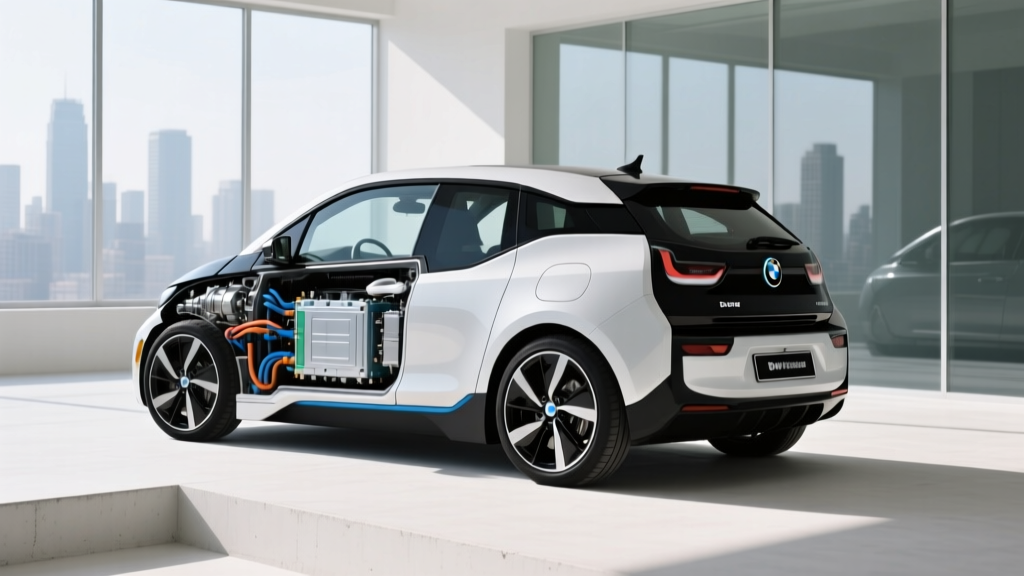
The BMW i3 spent nearly a decade as one of the most recognizable electric vehicles on the road. Its carbon-fiber-reinforced plastic (CFRP) body, coach-hinge rear doors, and skinny low-rolling-resistance tires made it look like nothing else in a dealership lot. But one question still surfaces regularly from shoppers browsing the used-EV market or comparing early electric powertrains: what exactly replaced the BMW i3 engine?
The short answer is that the i3 never had a conventional engine in the way most drivers mean the term. From its 2014 U.S. debut through its final 2021 model year, the i3 used a rear-mounted synchronous electric motor. A small two-cylinder gasoline range extender was available as an option on early models, but the primary drivetrain was always electric. BMW officially discontinued the i3 in July 2022, so this review examines the final and most mature version — the 120 Ah model — as it exists on the used-EV market today.
The BMW i3 Electric Motor: Specs and Powertrain Layout
The i3's powertrain centers on a single permanent-magnet synchronous electric motor mounted on the rear axle. There is no multi-speed transmission; a single-speed reduction gear delivers power to the rear wheels. This is a fundamentally simpler drivetrain than any internal-combustion setup, with far fewer moving parts and no oil changes, spark plugs, or exhaust systems to maintain.
| Spec | Value |
|---|---|
| Motor type | Permanent-magnet synchronous (rear axle) |
| Horsepower | 170 hp (125 kW) |
| Torque | 184 lb-ft |
| Drivetrain | Rear-wheel drive (RWD) |
| Transmission | Single-speed reduction gear |
| 0–60 mph | 6.9 seconds |
| Top speed | 93 mph (electronically limited) |
The 170 hp and 184 lb-ft of torque move the i3's roughly 2,970-pound curb weight with adequate pep. Because electric torque is available from zero RPM, the i3 feels brisker around town than the 6.9-second 0–60 figure suggests. Merging onto highways is confident enough, though the car runs out of breath above 70 mph — a deliberate engineering trade-off for efficiency over top-end speed.
The Range Extender Option: The 'Engine' Some i3 Models Actually Had
The confusion around the "BMW i3 engine" largely stems from the optional Range Extender (REx) package offered from 2014 through 2018 on 60 Ah and 94 Ah battery variants. The REx added a 647 cc, two-cylinder gasoline engine borrowed from BMW's Motorrad scooter division. This engine did not drive the wheels — it functioned as a generator, producing electricity to maintain the battery's state of charge once it dropped to a predefined threshold (roughly 5–6% SoC).
Key facts about the REx engine:
- Output: 34 hp (25 kW) — enough to sustain highway speeds on flat terrain but not enough to fully recharge the battery while driving
- Fuel tank: 2.4 gallons (early models), later expanded to 2.9 gallons
- Added range: Approximately 60–80 additional miles on gasoline after battery depletion
- Weight penalty: ~265 lbs, which reduced pure-electric range by about 5–7 miles
- Discontinued: BMW dropped the REx option for the U.S. market after the 2018 model year as the 120 Ah battery's 153-mile EPA range made the range extender less necessary
If you're shopping for a used i3 today and encounter a "BMW i3 engine," it's almost certainly this small range-extender generator, not a primary propulsion engine. The REx models also required oil changes, fuel-system maintenance, and smog checks — negating some of the simplicity advantage of going electric.
Battery, Range, and Real-World Efficiency
The final-generation i3 (120 Ah) uses a 42.2 kWh gross battery pack (approximately 37.9 kWh usable) built from Samsung SDI lithium-ion cells with NMC (nickel-manganese-cobalt) cathode chemistry. BMW's battery management system maintains a top and bottom buffer to protect long-term health, which is why usable capacity is lower than the gross figure.
EPA estimated range: 153 miles (combined city/highway)
Real-world highway (70+ mph): Expect 120–135 miles — the i3's tall, upright profile creates significant aerodynamic drag at speed
Real-world city driving: 145–160 miles — regenerative braking recovers energy effectively in stop-and-go traffic
Cold weather (below 32°F): 100–120 miles — the i3 lacks a heat pump, relying on resistive cabin heating that draws heavily from the battery
Combined realistic expectation: 125–145 miles for most drivers in mixed conditions
| Metric | Value |
|---|---|
| EPA combined MPGe | 113 MPGe |
| Energy consumption | 30 kWh / 100 miles |
| Battery gross capacity | 42.2 kWh |
| Battery usable capacity | ~37.9 kWh |
| Chemistry | NMC (nickel-manganese-cobalt) |
| Thermal management | Liquid cooling + resistive heating (no heat pump) |
According to fueleconomy.gov, the 120 Ah i3 achieves 113 MPGe combined. That's competitive with other small EVs of its era, though newer vehicles like the Chevrolet Bolt EUV and Hyundai Kona Electric deliver more range per kWh thanks to improved aerodynamics and heat-pump systems.
Charging Speed: DC Fast Charging and Home Level 2
Charging speed was never the i3's strong suit, and this is the area where its age shows most clearly against modern EVs. The i3 uses a CCS1 connector for DC fast charging and a J1772 inlet for Level 1 and Level 2 AC charging.
| Charging Level | Max Power | Speed / Time | Connector |
|---|---|---|---|
| Level 1 (120V household) | ~1.4 kW | ~5 miles per hour | J1772 |
| Level 2 (240V home/public) | 7.4 kW (single-phase) | ~25 miles per hour; 0–100% in ~5.5 hours | J1772 |
| DC Fast Charge | 50 kW peak | 10–80% in ~38 minutes | CCS1 |
The 50 kW DC fast-charging peak is the i3's most significant limitation for road-trip use. While competitors from the same era like the Chevrolet Bolt EV also topped out around 50 kW, modern EVs routinely accept 150–250 kW. On a DC fast charger, the i3 will sustain close to 50 kW up to roughly 50% state of charge, then taper significantly. Expect a 10–80% session to take approximately 35–40 minutes on a properly functioning 50+ kW CCS station.
For daily use, Level 2 home charging at 7.4 kW fully replenishes the 42.2 kWh pack in about 5.5 hours. Most i3 owners charge overnight on a 240V circuit and start every morning with a full battery — making the limited DC speed less of a concern for commuting.
Interior, Cargo, and Practicality
The i3's interior was genuinely innovative for its time. BMW used renewable and recycled materials throughout — eucalyptus wood dashboard trim, recycled PET bottle fabric on the seats, and natural fiber door panels. The result is an airy, minimalist cabin that still looks distinctive a decade later.
| Dimension | Measurement |
|---|---|
| Front headroom | 39.6 inches |
| Front legroom | 40.5 inches |
| Rear headroom | 37.2 inches |
| Rear legroom | 31.9 inches |
| Cargo (rear seats up) | 15.1 cu ft |
| Cargo (rear seats folded) | 39.2 cu ft |
| Frunk | None (hood houses power electronics) |
| Curb weight | ~2,970 lbs |
The rear seats are best suited for children or short-trip adult passengers — the 31.9 inches of rear legroom is tight by modern standards. Access requires opening the rear coach doors (which have no B-pillar), a design that looks dramatic but creates a structural gap when both doors are open and requires the front door to open first.
Cargo space is reasonable for a subcompact: 15.1 cu ft behind the rear seats handles a week's groceries, and folding the 50/50 split rear seat opens up 39.2 cu ft — enough for a bicycle with the front wheel removed. There is no front trunk (frunk); the hood covers the power electronics and is not a user-accessible storage area.
Technology, Safety, and Driver Assistance
The final i3 models came equipped with BMW's iDrive 6 infotainment system displayed on a 10.25-inch screen. Features include:
- Wireless Apple CarPlay (added for 2019 model year)
- Navigation with real-time range estimation and charging-station routing
- Heated front seats and steering wheel (standard on most trims)
- LED headlights with automatic high beams
- Parking sensors and rearview camera
On the driver-assistance front, the i3 offers basic features — forward collision warning, automatic emergency braking, lane-departure warning, and adaptive cruise control on higher trims. These are SAE Level 0–1 systems. There is no hands-free driving capability, and the i3 does not offer Tesla Autopilot-level or GM Super Cruise-level features. For city driving, this is adequate; the i3's compact dimensions and excellent outward visibility make it easy to pilot without heavy reliance on driver aids.
Safety ratings were mixed. The NHTSA did not fully crash-test the i3, but the IIHS gave it acceptable and good ratings in several categories. The carbon-fiber passenger cell is exceptionally rigid, though the lack of comprehensive modern crash-test data is a consideration for safety-conscious buyers.
Pricing, Tax Credits, and Used-Market Value
Since the BMW i3 was discontinued after the 2021 model year, it is no longer available new. However, understanding its original pricing and current used-market position is essential for buyers.
| Model/Trim | Original MSRP | Current Used Range (2026 est.) |
|---|---|---|
| i3 120 Ah (base) | $44,450 | $16,000–$21,000 |
| i3 120 Ah w/ Range Extender | $48,300 | $15,000–$19,500 |
| i3s 120 Ah (sport) | $51,500 | $18,000–$24,000 |
The i3s variant bumped output to 184 hp, widened the track, added sport suspension, and lowered the ride height for sharper handling — though at the cost of a few miles of range.
Federal tax credit status: When sold new, the i3 qualified for the full $7,500 federal EV tax credit under the pre-2023 rules (before the Inflation Reduction Act restructured IRS §30D requirements). Today, used i3 buyers may qualify for the Used Clean Vehicle Credit under IRC §25E, which provides up to $4,000 or 30% of the sale price (whichever is less) for qualifying used EVs. Requirements include:
- Sale price must be $25,000 or less (most used i3s qualify)
- Buyer income caps: $75,000 single / $112,500 head of household / $150,000 joint
- Vehicle must be at least two model years old (all i3s qualify)
- Must be purchased from a licensed dealer
- Buyer cannot have claimed the used-EV credit in the prior three years
This means a $18,000 used i3 could net a $4,000 credit, bringing the effective cost to $14,000 — genuinely compelling for a carbon-fiber-bodied EV with BMW build quality.
Battery Warranty and Long-Term Degradation
BMW backed the i3's high-voltage battery with an 8-year / 100,000-mile warranty covering defects and capacity loss below 70% of original capacity. For a 2021 model year i3, this warranty remains active through 2029 or 100,000 miles, whichever comes first.
Real-world degradation data from i3 owners and fleet operators suggests the NMC pack holds up well under normal use:
- After 5 years / 60,000 miles: Typical capacity retention of 85–92%
- After 8 years / 100,000 miles: Typical capacity retention of 78–88%
- Key degradation factors: Frequent DC fast charging, sustained high SoC storage, extreme heat exposure
The i3's liquid-cooled battery management helps mitigate thermal degradation, but the absence of active battery preconditioning for DC charging (the pack is passively managed to a degree) means cold-weather fast charging is slower and potentially harder on the cells. Owners who primarily charge at home on Level 2 and avoid routinely charging to 100% tend to see the best long-term health.
If a battery replacement is needed out of warranty, expect a cost in the range of $12,000–$16,000 for a new or refurbished pack from BMW — a significant expense relative to the car's current market value. Third-party refurbishment options may be available at lower cost as the i3 ages.
Who Should Buy a Used BMW i3?
- Urban commuters with home Level 2 charging and round-trip commutes under 80 miles
- Second-car households needing an efficient, easy-to-park city runabout
- EV-curious buyers wanting to try electric ownership at a low entry price ($14K–$20K after credits)
- Drivers who value unique design and sustainable materials in their vehicle interior
- Frequent road-trippers — 50 kW DC charging and 153-mile range make long journeys slow
- Families needing rear-seat space for teenagers or bulky child seats
- Cold-climate drivers without garage parking — resistive heating slashes winter range to ~100 miles
- Anyone needing towing capability (the i3 is not rated for towing)
Pros and Cons at a Glance
- Ultra-light carbon-fiber body delivers excellent efficiency (113 MPGe)
- Tight turning radius (32.3 ft) and compact size make parking effortless
- Instant electric torque feels quicker than 6.9-second 0–60 suggests
- Premium interior materials with genuine sustainability credentials
- Strong used-EV tax credit eligibility (up to $4,000 under §25E)
- BMW build quality and dealer service network
- Remaining battery warranty on 2019–2021 models (through 2027–2029)
- 153-mile EPA range is limiting for anything beyond commuting
- 50 kW DC fast charging is painfully slow by 2026 standards
- No heat pump — cold-weather range drops 30–35%
- Rear seat space is tight; coach-door design is impractical in tight parking spots
- No frunk; limited total cargo capacity
- Discontinued model — future parts availability may become a concern
- Tall narrow tires (155/70R19) are expensive and have limited replacement options
How the i3 Compares to Modern Alternatives
Shoppers considering a used i3 should weigh it against both other used EVs and new budget-priced electric vehicles:
| Vehicle | EPA Range | DC Fast Charge | Used Price (est.) | Best Advantage |
|---|---|---|---|---|
| BMW i3 120 Ah | 153 mi | 50 kW | $16K–$21K | Build quality, efficiency, design |
| Chevrolet Bolt EV (2020–2023) | 259 mi | 55 kW | $14K–$20K | Range per dollar, practicality |
| Nissan Leaf SV Plus (2020–2023) | 212 mi | 100 kW | $13K–$18K | Comfort, dealer availability |
| Hyundai Kona Electric (2020–2022) | 258 mi | 75 kW | $16K–$22K | Range, warranty, features |
| Volkswagen ID.4 (2021–2022) | 260 mi | 125 kW | $19K–$25K | Space, charging speed, crossover utility |
The i3 trades range and charging speed for efficiency, build quality, and a genuinely unique ownership experience. If your daily driving is predictable and short, the i3's 153 miles is plenty — and you're getting a carbon-fiber BMW for the price of a used Honda Civic.
Frequently Asked Questions
Does the BMW i3 have a gasoline engine?
Only as an optional range extender on 2014–2018 models. The 647 cc two-cylinder engine acted as a generator to maintain battery charge — it never drove the wheels directly. The primary powertrain on every i3 is a 170 hp rear-mounted electric motor. The range extender was discontinued for the U.S. market after 2018.
What is the real-world range of the BMW i3?
The EPA rates the 120 Ah i3 at 153 miles combined. In real-world driving, expect 125–145 miles in mixed conditions, 120–135 miles at sustained highway speeds, and as little as 100–120 miles in cold weather below freezing due to the resistive cabin heater drawing significant battery power.
How fast does the BMW i3 charge?
On a DC fast charger, the i3 peaks at 50 kW and charges from 10–80% in approximately 38 minutes. At home on a 240V Level 2 charger (7.4 kW), a full charge takes about 5.5 hours. On a standard 120V outlet (Level 1), expect roughly 5 miles of range per hour of charging.
Is the BMW i3 still eligible for any tax credit?
Not the new-vehicle §30D credit (the car is discontinued). However, used i3 buyers may qualify for the Used Clean Vehicle Credit (IRC §25E) — up to $4,000 or 30% of the sale price, whichever is less. The car must sell for $25,000 or less from a licensed dealer, and buyer income must fall below IRS thresholds ($75K single / $150K joint).
Is the BMW i3 worth buying in 2026?
For the right buyer — yes. If you need an affordable city commuter with home charging, a sub-80-mile daily drive, and appreciate BMW build quality, a used i3 at $14,000–$18,000 (after the used-EV credit) is a strong value. If you need road-trip capability, family rear-seat space, or live in a cold climate without garage parking, a used Bolt EV or Kona Electric is a better fit.
How long will the BMW i3 battery last?
BMW's battery warranty covers 8 years / 100,000 miles against capacity loss below 70%. Real-world data shows most i3 packs retain 85–92% capacity after five years with typical use. Battery replacement out of warranty costs $12,000–$16,000 — a major expense relative to the car's value, so prioritize examples with documented charging habits and remaining warranty coverage.