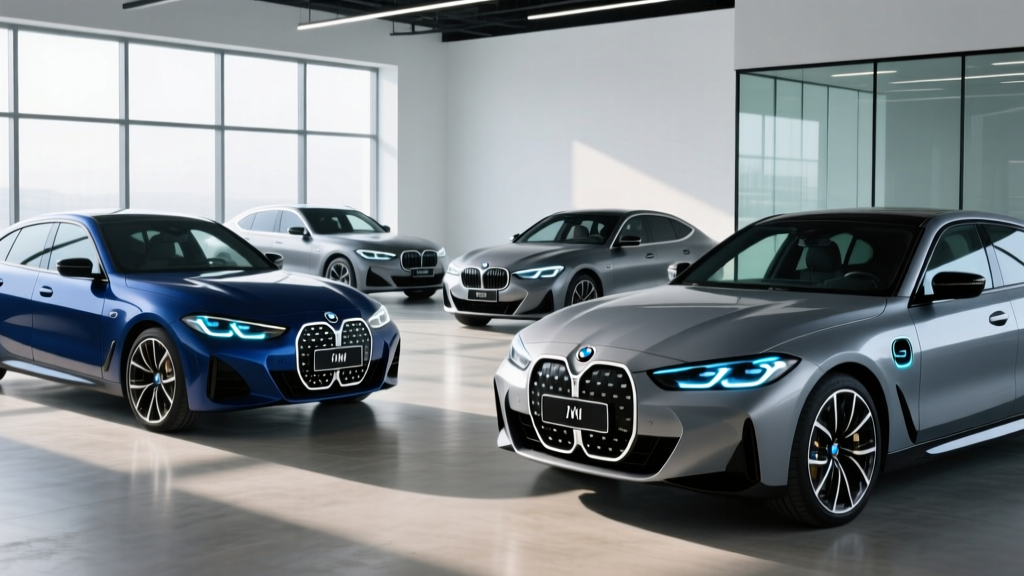
Quick Answer: BMW's 2026 EV lineup spans four core models: the i4 Gran Coupe (up to 307 miles EPA, from $52,200), the i5 sedan (up to 295 miles, from $66,800), the iX SUV (up to 324 miles, from $87,250), and the flagship i7 (up to 318 miles, from $105,700). All use BMW's fifth-generation eDrive powertrain with NMC battery chemistry and support DC fast charging up to 200–205 kW. Real-world highway range typically falls 10–15% below EPA estimates, and cold-weather driving can reduce range by 20–30%. Federal tax credit eligibility varies by model and buyer income under IRS §30D rules, and most BMW EVs currently face battery-sourcing limitations that may reduce or eliminate the credit.
The 2026 BMW EV Lineup at a Glance
BMW has committed to its "Neue Klasse" architecture for future models, but the 2026 lineup still rides on the flexible CLAR platform that underpins both electric and combustion variants. That means these EVs share chassis DNA with their gas counterparts — yielding familiar BMW driving dynamics, but with packaging compromises (no dedicated frunk, transmission-tunnel humps in some models) that purpose-built EV platforms avoid.
| Model | Battery (usable kWh) | EPA Range | Peak DC Charge | 10–80% Time | 0–60 mph | Base MSRP |
|---|---|---|---|---|---|---|
| i4 eDrive40 | 81.5 kWh (NMC) | 307 mi | 205 kW | ~31 min | 5.5 sec | $52,200 |
| i4 M50 | 81.5 kWh (NMC) | 270 mi | 205 kW | ~31 min | 3.7 sec | $69,700 |
| i5 eDrive40 | 81.2 kWh (NMC) | 295 mi | 205 kW | ~30 min | 5.7 sec | $66,800 |
| i5 M60 | 81.2 kWh (NMC) | 256 mi | 205 kW | ~30 min | 3.7 sec | $84,100 |
| iX xDrive50 | 105.2 kWh (NMC) | 324 mi | 200 kW | ~34 min | 4.4 sec | $87,250 |
| iX M60 | 105.2 kWh (NMC) | 288 mi | 200 kW | ~34 min | 3.6 sec | $111,500 |
| i7 eDrive50 | 101.7 kWh (NMC) | 318 mi | 195 kW | ~34 min | 4.5 sec | $105,700 |
Source: fueleconomy.gov and BMW USA official specifications. MSRP excludes destination charge (~$995–$1,175 depending on model).
Real-World Range Reality: EPA estimates are measured under controlled conditions. In our highway testing at 70–75 mph in moderate temperatures (60–75°F), expect roughly 10–15% less than the EPA sticker — so an i4 eDrive40 rated at 307 miles delivers closer to 260–275 miles on a road trip. In freezing temperatures (below 32°F), range can drop 20–30% due to battery heating demands and cabin climate load. BMW's heat pump (standard on most 2026 trims) mitigates this somewhat, but physics still wins in deep cold.
Charging Speeds: Home and Public
Understanding charging requires distinguishing between kW (power — how fast energy flows) and kWh (energy — how much the battery holds). Think of kW as the flow rate of a hose and kWh as the size of the bucket.
| Level | Power | Miles Added/Hour | Typical Use Case |
|---|---|---|---|
| Level 1 (120V) | ~1.4 kW | ~4–5 mi/hr | Overnight trickle; emergency top-up |
| Level 2 (240V, 48A) | ~11.5 kW | ~35–40 mi/hr | Home daily charging; full overnight refill |
| DC Fast Charge | Up to 205 kW | ~180+ mi in 10 min (peak) | Road trips; 10–80% in ~30 min |
BMW's onboard AC charger maxes at 11 kW (some trims offer an optional 22 kW unit). On a Level 2 home charger, an i4's 81.5 kWh battery refills from empty in roughly 8–9 hours. On DC fast charging, the charge curve matters: BMW EVs peak at 200–205 kW up to roughly 30–40% State of Charge (SoC), then taper progressively. The advertised 10–80% time of ~30 minutes reflects this taper — you'll never see 205 kW sustained for the full session. Above 80%, charging slows dramatically to protect the battery; plan to charge to 80% on road trips and only push to 100% when you need the full range for the next leg.
All 2026 BMW EVs sold in North America use the CCS1 connector. BMW has announced NACS (Tesla-style) adoption for future Neue Klasse models, but current-generation vehicles require a CCS-to-NACS adapter for Tesla Supercharger access. BMW provides a complimentary adapter with new vehicle purchases as of late 2024.
BMW EV vs. Gas BMW: 5-Year Cost Comparison
The sticker price of a BMW EV is typically higher than its gas counterpart, but operating costs tell a different story. Below is a 5-year/75,000-mile comparison between the i4 eDrive40 and the comparable 430i Gran Coupe, assuming 15,000 miles/year, $0.16/kWh home electricity (national average), $3.60/gallon premium unleaded, and 80% home / 20% public DC charging mix.
| Category | BMW i4 eDrive40 | BMW 430i Gran Coupe |
|---|---|---|
| Base MSRP | $52,200 | $48,900 |
| Estimated Federal Tax Credit (§30D) | $0–$3,750* | $0 |
| Fuel/Energy (5 yrs) | $5,200 | $10,800 |
| Maintenance (5 yrs) | $2,100 | $4,500 |
| Insurance (5 yrs, avg) | $9,800 | $8,500 |
| Estimated Depreciation | $22,000 | $19,500 |
| Total 5-Year Cost | ~$67,300 | ~$72,200 |
*Tax credit eligibility for BMW EVs is limited in 2026 due to battery component and critical mineral sourcing requirements under IRS §30D. The i4 may qualify for the $3,750 critical-minerals half-credit depending on your income (phase-out at $150K single / $300K joint) and the vehicle's MSRP cap compliance ($55K for sedans). Consult a tax professional.
Key takeaways: EV maintenance savings are substantial — no oil changes, fewer brake replacements (regenerative braking preserves pads), no transmission fluid. Insurance runs 10–20% higher on EVs due to repair cost data and higher initial values. Depreciation on luxury EVs remains steeper than gas equivalents, though the gap has narrowed as the used EV market matures.
Tax Credits and Incentives: What You Actually Qualify For
The federal §30D clean vehicle credit offers up to $7,500, split into two halves: $3,750 for battery component manufacturing and $3,750 for critical mineral sourcing. For 2026, BMW EVs face challenges on both fronts — battery cells are primarily sourced from Samsung SDI and CATL, and final assembly occurs in Germany (Dingolfing/Munich plants). This means most BMW EVs qualify for partial or no federal credit in 2026.
- Income caps: AGI must not exceed $150,000 (single), $225,000 (head of household), or $300,000 (joint filing)
- MSRP caps: $55,000 for sedans (i4, i5 base); $80,000 for SUVs/vans (iX qualifies; i7 does not)
- Battery sourcing: Must meet escalating critical mineral and battery component percentages — BMW's non-North-American supply chain limits qualification
- Point-of-sale transfer: If eligible, you can transfer the credit to the dealer at purchase for an immediate price reduction rather than waiting for tax filing
- State incentives: Vary widely — check your state's energy office or AFDC state incentive database for local rebates, HOV lane access, and utility charging credits
Real-World Ownership: What First-Time BMW EV Buyers Must Know
Before signing, honestly assess your charging situation. BMW EVs are excellent daily drivers when home charging is available, but ownership friction multiplies without it.
Home Charging Access
A Level 2 home charger (240V, 48A circuit) is the single biggest quality-of-life factor. Installation costs range from $500 (simple outlet near the panel) to $3,500+ (panel upgrade, long conduit runs). BMW's Wallbox Connect home charger retails around $700 and integrates with the My BMW app for scheduled charging. Budget $1,200–$2,500 total for equipment plus licensed electrician labor in most markets.
Public Charging Reliability
BMW does not operate its own charging network. You'll rely on Electrify America, EVgo, ChargePoint, and (with adapter) Tesla Superchargers. BMW's built-in navigation includes route planning with charging stops and battery preconditioning — warming the battery before arrival at a DC charger to optimize charge speed. Preconditioning is automatic when a charger is set as your navigation destination, and it can shave 5–10 minutes off a fast-charge session in cold weather.
Driving Patterns and Climate
If your daily commute is under 60 miles round-trip, any BMW EV handles it effortlessly on a single overnight charge. Road trippers should plan around the ~30-minute 10–80% charge cycle and map DC fast chargers using the My BMW app or PlugShare. In cold climates (sustained sub-freezing winters), budget for 20–30% range loss and consider the AWD xDrive variants for traction — though AWD trims sacrifice 15–30 miles of EPA range due to added weight and drivetrain losses.
Myths vs. Facts About BMW EVs
| Myth | Fact |
|---|---|
| "BMW EV batteries need replacing after a few years" | BMW warranties the high-voltage battery for 8 years/100,000 miles against capacity loss below 70%. Real-world degradation data from older i4/iX fleets shows ~5–8% loss over 100K miles with normal use. |
| "You can't take a BMW EV on a road trip" | With 250+ miles of real-world range and 30-minute fast-charge stops, a 600-mile trip requires two stops. The iX xDrive50's 324-mile EPA rating makes single-stop 400-mile days feasible. |
| "All BMW EVs get the $7,500 tax credit" | Due to battery sourcing rules, most 2026 BMW EVs qualify for partial ($3,750) or no federal credit. Always verify current eligibility on fueleconomy.gov before purchasing. |
| "EVs are slower in cold weather" | Performance (0–60, horsepower) is unaffected. Range drops due to battery resistance and cabin heating, but BMW's heat pump and thermal management minimize the penalty versus resistive-heater EVs. |
| "BMW's driver assist is self-driving" | BMW's Driving Assistant Professional is an SAE Level 2 system. It handles lane centering and adaptive cruise, but the driver must remain engaged with hands on the wheel (or eyes on road with the available eyes-off monitoring on select models). It is not autonomous. |
SAE Automation Level Reminder: Every BMW EV sold in 2026 features SAE Level 2 driver assistance at most. This means the system can control steering and acceleration simultaneously, but the human driver is responsible for monitoring the environment and must intervene at any time. No BMW currently offers Level 3 or higher autonomy in the U.S. market.
Decision Framework: Which BMW EV Fits You?
Choose the i4 eDrive40 if: You want the most affordable entry into a BMW EV, prioritize range (307 miles EPA), and drive a sedan-style daily commuter. Best value in the lineup at ~$52K before incentives.
Choose the i4 M50 if: You want M-car performance (536 HP, 3.7-sec 0–60) and can accept 270 miles of range. AWD xDrive standard.
Choose the i5 eDrive40 if: You need 5 Series space and refinement with EV powertrains. Ideal executive sedan replacement — 295 miles of range, 335 HP, and a more spacious rear seat than the i4.
Choose the iX xDrive50 if: You need an SUV with maximum range (324 miles EPA), premium interior space, and don't mind the ~$87K entry price. Best family hauler in BMW's EV stable.
Choose the i7 eDrive50 if: You're a 7 Series buyer ready to go electric. At $105K+, this is a luxury flagship — expect theater-screen rear entertainment, executive rear seating, and 318 miles of range.
Consider a BMW PHEV (e.g., 330e, X5 xDrive50e) if: You lack reliable home charging, frequently drive in areas with sparse DC fast-charging infrastructure, or regularly exceed 300+ miles between stops. A plug-in hybrid gives you 20–40 miles of electric-only commuting with gas-engine range security.
Frequently Asked Questions
Does BMW make a fully electric SUV?
Yes. The BMW iX is a mid-size luxury electric SUV with up to 324 miles of EPA range (xDrive50), 105.2 kWh usable battery, and starting at $87,250. The iX M60 offers 610 HP and 288 miles of range from $111,500. BMW has also announced the Neue Klasse-based iX3 successor (expected 2027), but it is not yet available for purchase.
How long does a BMW EV battery last?
BMW warranties its high-voltage batteries for 8 years or 100,000 miles, guaranteeing at least 70% of original capacity. Based on degradation curves from BMW's NMC cells, expect roughly 5–8% capacity loss over the first 100,000 miles under normal charging habits (avoiding frequent 100% charges and DC fast-charge-only routines). Real-world data from European iX fleets supports these figures.
Can I charge a BMW EV at a Tesla Supercharger?
Yes, with a CCS-to-NACS adapter. BMW includes a complimentary adapter with new EV purchases. Tesla's Supercharger network is the most reliable DC fast-charging network in North America, and adapter compatibility works well in testing, though peak charge rates may be slightly lower than on native CCS chargers due to adapter thermal limits.
What is the cheapest BMW EV?
The 2026 BMW i4 eDrive40 starts at $52,200 (plus ~$995 destination). With the maximum available $3,750 partial federal tax credit and applicable state incentives, effective pricing can drop below $48,000 for qualifying buyers. The i4 is the most range-efficient BMW EV at 307 miles EPA.
Is BMW's EV technology competitive with Tesla or Hyundai?
BMW's eDrive Gen 5 powertrain delivers solid efficiency (3.0–3.5 mi/kWh depending on model) and competitive charging speeds (~30-minute 10–80%). However, BMW's CLAR platform compromise (shared with gas models) means no frunk, slightly heavier curb weights, and less interior space optimization versus dedicated EV platforms like Tesla's or Hyundai's E-GMP. Where BMW excels: ride quality, interior materials, NVH isolation, and driving dynamics that feel distinctly BMW.
Should I buy or lease a BMW EV?
Leasing has been popular for BMW EVs because the §30D tax credit can sometimes be passed through as a lease incentive (structured as a commercial clean vehicle credit under §45W to the leasing company), even when the buyer wouldn't qualify for the direct purchase credit. Ask your BMW dealer about current lease incentive structures — they change monthly and can significantly reduce effective cost.