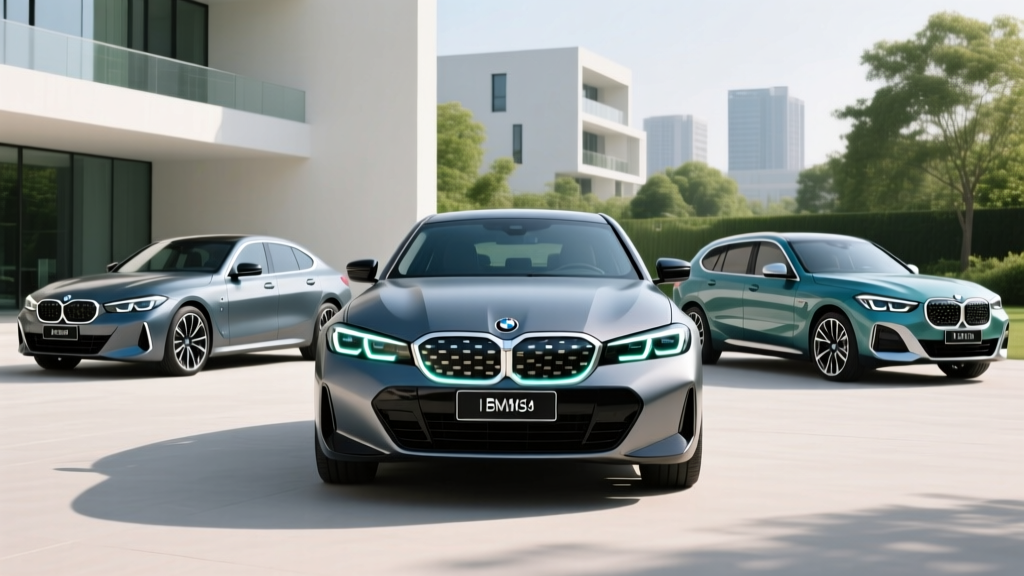
Quick Answer: BMW's 2026 electric vehicle lineup spans five models — the i4 gran coupe, i5 sedan, i7 luxury flagship, iX SUV, and the newly launched iX3 (Neue Klasse). EPA ranges run from 282 miles (iX xDrive50) to 345 miles (i5 eDrive40). Most BMW EVs use an 800V-compatible architecture enabling DC fast charges from 10–80% in roughly 21–31 minutes at peak rates up to 205 kW. However, no current BMW EV qualifies for the full $7,500 federal §30D tax credit due to battery-sourcing and MSRP-cap rules. Expect real-world highway range 10–15% below EPA stickers, and plan for $1,200–$2,500 in home Level 2 charger installation.
The 2026 BMW Electric Vehicle Lineup at a Glance
BMW has committed fully to electrification without abandoning its driver-oriented DNA. Unlike some rivals that built EVs on dedicated skateboard platforms from day one, BMW's current generation (except the upcoming Neue Klasse models) rides on flexible architectures shared with ICE counterparts. That engineering choice draws criticism from purists but delivers a tangible benefit: BMW EVs retain the balanced weight distribution and steering feel the brand is known for.
Here's how the full 2026 lineup breaks down on paper and in practice.
| Model | Battery (usable kWh) | Chemistry | EPA Range | Peak DC kW | 10–80% Time | 0–60 mph | HP | Base MSRP |
|---|---|---|---|---|---|---|---|---|
| i4 eDrive40 | 81.5 | NMC | 307 mi | 205 | ~31 min | 5.5s | 335 | $57,900 |
| i4 M50 | 81.5 | NMC | 270 mi | 205 | ~31 min | 3.7s | 536 | $69,900 |
| i5 eDrive40 | 84.3 | NMC | 345 mi | 205 | ~26 min | 5.7s | 335 | $71,900 |
| i5 M60 | 84.3 | NMC | 295 mi | 205 | ~26 min | 3.7s | 593 | $87,900 |
| i7 eDrive50 | 101.7 | NMC | 318 mi | 195 | ~34 min | 4.5s | 449 | $107,900 |
| iX xDrive50 | 111.5 | NMC | 324 mi | 195 | ~35 min | 4.4s | 516 | $89,900 |
| iX M60 | 111.5 | NMC | 282 mi | 195 | ~35 min | 3.6s | 610 | $111,500 |
Sources: fueleconomy.gov, BMW USA product specifications. All figures for 2026 model year base trims.
Real-World Range vs. EPA Sticker: What You'll Actually Get
The EPA range number on the window sticker is a useful baseline, but it's generated under controlled laboratory conditions. In real-world driving, several variables compress that figure.
Real-World Range Expectations for the BMW i5 eDrive40 (EPA 345 mi):
- Mixed city/suburban driving (65°F): ~320–340 miles — close to EPA
- Sustained highway driving at 75 mph: ~280–300 miles — aerodynamic drag dominates
- Cold weather (below 32°F) mixed driving: ~240–270 miles — battery chemistry and cabin heating reduce efficiency
- Cold weather highway: ~210–240 miles — worst-case scenario
BMW equips all current EVs with a heat pump for cabin climate, which reduces cold-weather energy draw compared to resistive heaters. Still, lithium-ion NMC chemistry inherently loses performance below freezing. If you live in the upper Midwest or Northeast and regularly drive in sub-30°F conditions, budget 20–25% off the EPA number as your realistic winter floor.
Regenerative braking settings also matter. BMW offers adjustable regen levels (and an adaptive mode that uses radar data to modulate braking), but the i4 and i5 don't offer true one-pedal driving to a full stop in all modes — you'll still use the friction brake at very low speeds. This is a deliberate BMW tuning choice, not a deficiency, but it surprises first-time EV buyers accustomed to Tesla or Hyundai's aggressive regen.
Charging a BMW EV: Home Setup and Public Networks
All current BMW EVs in the U.S. ship with a NACS (Tesla-style) charge port as of the 2025 model year, giving native access to Tesla Superchargers without an adapter. This is a significant practical advantage over the CCS-equipped models from some competitors still transitioning.
Home Level 2 Charging
The onboard charger in every 2026 BMW EV accepts up to 11 kW on Level 2 AC power (48 amps). That means a full charge from near-empty takes roughly 8–11 hours depending on battery size — ideal for overnight replenishment.
| Item | Typical Cost Range | Notes |
|---|---|---|
| Level 2 charger (48A hardwired) | $400–$700 | BMW Wallbox or third-party (ChargePoint, Emporia, Wallbox Pulsar) |
| Electrical permit | $50–$200 | Varies by municipality |
| Electrician labor (standard install) | $500–$1,200 | Panel is close to garage, 240V/60A circuit |
| Panel upgrade (if needed) | $1,500–$3,500 | Required if existing panel lacks capacity — common in older homes |
| Total (no panel upgrade) | $950–$2,100 | |
| Total (with panel upgrade) | $2,450–$5,600 |
The single most overlooked cost is the electrical panel. Many homes built before 2000 have 100-amp service, which may not support a 60-amp EV circuit alongside existing loads like an electric dryer and oven. Have a licensed electrician evaluate your panel before committing to a charger purchase.
DC Fast Charging on the Road
BMW's peak DC charge rates (195–205 kW) are competitive but not class-leading. The Hyundai Ioniq 5 and Kia EV6 can peak at 240+ kW on 800V architectures. However, peak rate only tells part of the story — the charge curve matters more.
BMW's charge curve holds near peak rate up to roughly 50% state of charge, then tapers progressively. From 80% to 100%, charging slows dramatically to protect battery longevity. On a road trip, plan your stops around the 10–80% window for the fastest throughput. Charging past 80% at a DC fast charger is rarely worth the time — you'll add more miles faster by getting back on the road and stopping again sooner.
At current Electrify America and Tesla Supercharger pricing (averaging $0.35–$0.48/kWh nationwide), filling a BMW i5's 84.3 kWh battery from 10% to 80% costs roughly $20–$28. That's approximately 235 miles of range for the price of about 4 gallons of premium gasoline.
BMW EV vs. Gas BMW: 5-Year Cost of Ownership
The sticker price of a BMW EV is higher than its gasoline equivalent, but operating costs tell a different story over time. Here's a realistic comparison between the i4 eDrive40 and the closest ICE counterpart, the BMW 430i Gran Coupe.
| Category | i4 eDrive40 (EV) | 430i Gran Coupe (Gas) |
|---|---|---|
| Base MSRP | $57,900 | $49,900 |
| Federal tax credit (§30D) | $0* | $0 |
| Home charger install | $1,500 | $0 |
| 5-year fuel/energy (15k mi/yr) | $4,200** | $9,750*** |
| 5-year maintenance | $1,800 | $4,200 |
| 5-year insurance (avg) | $11,500 | $9,500 |
| 5-year total (excl. depreciation) | $76,900 | $73,350 |
*Most BMW EVs exceed the §30D MSRP cap ($55,000 for sedans, $80,000 for SUVs) or fail battery-sourcing requirements. Check current IRS §30D rules for eligibility.
**Assumes 80% home charging at $0.14/kWh, 20% public DC at $0.42/kWh, i4 efficiency of 3.2 mi/kWh.
***Assumes premium gasoline at $4.10/gal, 430i combined EPA 29 MPG.
The i4 costs roughly $3,550 more over five years when you exclude depreciation — and depreciation is where EVs remain harder to predict. BMW EVs have held value reasonably well, but the rapid pace of battery and charging tech means residual values carry more uncertainty than established ICE models. If you lease (a popular route for BMW buyers), the depreciation risk shifts to BMW Financial Services.
Federal Tax Credit and Incentive Reality Check
This is where many BMW EV shoppers encounter disappointment. Under current IRS §30D rules, the federal clean vehicle credit of up to $7,500 requires the vehicle to meet multiple criteria simultaneously:
- MSRP cap: Sedans must be under $55,000; SUVs, vans, and trucks under $80,000
- Buyer income cap: AGI below $150,000 (single), $225,000 (head of household), $300,000 (joint)
- Battery sourcing: Increasing percentages of critical minerals and battery components must originate from the U.S. or free-trade-agreement countries
- Final assembly: Must occur in North America
Most BMW EVs are assembled in Germany (except the iX, which is built in Dingolfing). The i4 eDrive40 starts at $57,900, exceeding the sedan MSRP cap. The iX xDrive50 at $89,900 exceeds the SUV cap. As of early 2026, no BMW EV sold in the U.S. qualifies for the full federal credit. Some buyers have accessed partial credits on specific configurations — always verify via the IRS VIN-lookup tool before purchase.
State incentives vary widely. California's CVRP, Colorado's innovative motor vehicle credit, and various utility rebates can offset $1,000–$5,000 depending on your location. Check your state energy office and local utility for current programs.
Common Misconceptions About BMW Electric Vehicles
| Myth | Fact |
|---|---|
| "BMW EV batteries will need replacing within a few years." | BMW warranties cover the high-voltage battery for 8 years/100,000 miles against capacity loss below 70%. NMC batteries in BMW EVs show degradation of roughly 5–8% over the first 100,000 miles based on fleet data — well within the warranty threshold. |
| "I can't take a BMW EV on a road trip." | With NACS native access to Tesla Superchargers plus Electrify America and other networks, a 300-mile BMW i5 trip requires one 25-minute charge stop. Route planning via the BMW Maps EV planner or A Better Routeplanner handles this automatically. |
| "EV maintenance is basically zero." | You eliminate oil changes, spark plugs, and transmission fluid. But tire wear is 15–25% faster on EVs due to higher vehicle weight and instant torque. Budget for tire replacement every 25,000–35,000 miles. Cabin air filters, brake fluid, wiper fluid, and cabin filter still require service. |
| "BMW EVs aren't 'real' BMWs because they share platforms with gas cars." | The flexible CLAR architecture adds weight versus a dedicated EV platform, but BMW's engineering tuning preserves 50/50 weight distribution and steering precision. Independent testing consistently rates BMW EVs among the best-driving in their segments. |
| "Charging at home is just plugging into a regular outlet." | Level 1 (120V) charging adds roughly 3–5 miles per hour — enough for a plug-in hybrid, but painfully slow for a full EV with an 80+ kWh battery. A 240V Level 2 installation is practically essential for daily BMW EV ownership. |
Who Should Buy a BMW EV — and Who Shouldn't
Not every buyer is well-served by a BMW electric vehicle. Here's a practical decision framework based on real ownership variables.
Choose a BMW EV if:
- You have access to home Level 2 charging (garage or driveway with a 240V circuit) — this is non-negotiable for convenient daily ownership
- You value driving dynamics and want an EV that doesn't feel like an appliance — BMW's steering, damping, and chassis tuning remain class-leading
- Your daily driving is under 200 miles round-trip, which covers every current BMW EV's real-world range with margin
- You're willing to pay a premium for interior materials, build quality, and brand cachet
- You lease rather than buy outright, avoiding depreciation risk and the federal tax credit eligibility problem
Consider alternatives if:
- You rely exclusively on apartment or street parking with no charging access — public-only charging is expensive ($0.35–$0.48/kWh) and time-consuming
- You regularly tow heavy loads — the iX is rated for 3,500 lbs, but towing cuts range by 30–50%
- You want maximum federal tax credit value — Hyundai Ioniq 5, Ford F-150 Lightning, and select Tesla models still qualify for partial or full credits
- You need the absolute fastest DC charging — Hyundai/Kia's 800V platform charges 10–80% in ~18 minutes vs. BMW's 26–35 minutes
- Budget is the primary concern — a Tesla Model 3 or Hyundai Ioniq 6 delivers 320+ miles of range for $15,000–$20,000 less
BMW EV Ownership FAQ
How long does a BMW EV battery last?
BMW warranties the high-voltage battery for 8 years or 100,000 miles, whichever comes first, against capacity loss below 70% of original. Real-world data from high-mileage BMW EV fleets suggests NMC batteries retain roughly 90–92% capacity at 100,000 miles under normal use. Full battery replacement (rarely needed) costs $15,000–$25,000 depending on the model, though individual module replacement is possible at lower cost.
Can I charge a BMW EV at a Tesla Supercharger?
Yes. All 2025+ BMW EVs sold in the U.S. come equipped with a native NACS charge port, the same connector used by Tesla Superchargers. No adapter is required. Use the BMW app or the Tesla app to initiate sessions at Supercharger stalls.
What does it cost to insure a BMW EV?
Insurance premiums for BMW EVs run 10–20% higher than equivalent gas BMWs, driven by higher repair costs for battery-adjacent damage and elevated parts pricing. Expect $2,000–$2,800 annually for an i4 or i5, depending on your driving record, location, and coverage level. Always get quotes from multiple carriers before purchasing — some insurers now offer EV-specific discounts.
Is the BMW iX a good family SUV?
The iX offers strong interior space (35.5 cu ft cargo behind the second row), standard all-wheel drive, excellent crash-test performance, and a quiet, comfortable ride. Its 324-mile EPA range and 3,500-lb tow rating make it practical for family road trips. The main drawback is price: at $89,900 base, it competes with the Tesla Model X, Rivian R1S, and Mercedes EQS SUV — each with different trade-offs in space, range, and tech.
Should I buy or lease a BMW EV?
Leasing is the financially stronger option for most BMW EV buyers in 2026. A lease bypasses the federal tax credit eligibility problem (the lessor claims the credit and can pass savings through as a capitalized-cost reduction), shields you from depreciation uncertainty, and lets you upgrade as charging and battery tech advances. If you drive more than 15,000 miles annually or prefer long-term ownership, buying can still make sense — but run the numbers with your dealer's finance manager on both paths.
What's the best BMW EV for the money?
The i4 eDrive40 at $57,900 offers the strongest value proposition: 307 miles of EPA range, 335 hp, BMW's best interior in the 4 Series footprint, and NACS Supercharger access. It's the entry point that sacrifices nothing critical. The i5 eDrive40 at $71,900 is the range king at 345 miles and is ideal if you need a full-size sedan. The iX xDrive50 is the best all-around family choice if budget allows.