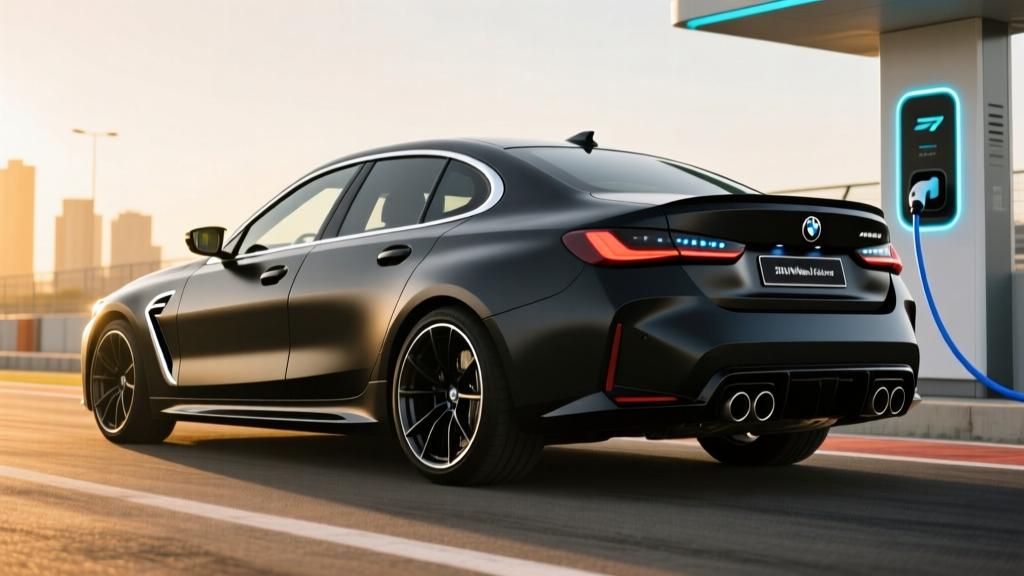
The BMW electric M3 — officially part of BMW's Neue Klasse generation — represents the automaker's first ground-up electric M performance sedan. Expected to debut for the 2027 model year (arriving in late 2026), the electric M3 will ride on BMW's dedicated EV platform with 800-volt architecture, up to four electric motors, and a design language previewed by the Vision Neue Klasse concept and the recently revealed iX3.
Quick Answer: What Is the BMW Electric M3?
The BMW electric M3 is an upcoming all-electric performance sedan based on BMW's Neue Klasse platform. Preliminary specifications suggest a 100+ kWh battery (likely NMC chemistry), 800V fast-charging architecture capable of 10-80% in roughly 20 minutes at peak rates above 300 kW, and a quad-motor M variant producing approximately 600-700 horsepower. Estimated base pricing starts around $85,000-$95,000 before incentives. It is not yet available for purchase — BMW has confirmed the Neue Klasse M performance lineup is in development, with production expected to begin in 2027.
Neue Klasse Design: What Makes the Electric M3 Different
The "bmw electric m3 design" conversation centers on BMW's radical Neue Klasse aesthetic, which strips away the oversized grilles of recent BMWs in favor of a cleaner, more geometric surfacing language. Based on the Vision Neue Klasse sedan concept and the production 2026 iX3 (the first Neue Klasse vehicle to reach showrooms), expect the electric M3 to feature:
- Flush, aerodynamic bodywork with a drag coefficient likely below 0.23 Cd — critical for high-speed efficiency in a performance sedan
- Reinterpreted kidney grille as a slim, illuminated panel rather than the dominant vertical openings on the current G80 M3
- Full-width light bars front and rear, consistent with Neue Klasse design DNA
- Panoramic iDrive display spanning the full windshield base, replacing the traditional curved display with a projection-based interface
- M-specific body modifications: wider fenders, aggressive front splitter, rear diffuser, and likely an active rear spoiler for downforce management
The design isn't purely cosmetic. BMW has stated that Neue Klasse vehicles will deliver 30% more range efficiency than current-generation EVs, partly through aerodynamic optimization and partly through the 800V electrical architecture and next-generation cylindrical battery cells (similar in form factor to Tesla's 4680 cells). BMW calls these "Gen6" batteries, manufactured in partnership with CATL and EVE Energy.
Preliminary Specifications: Range, Battery, and Charging
BMW has not published final EPA range or charging figures for the electric M3. The numbers below are estimated based on BMW's confirmed Neue Klasse platform capabilities, the iX3's published specs, and BMW's public statements about Gen6 battery technology. Treat them as preliminary.
| Specification | Estimated (Electric M3) | Current G80 M3 (Gas) |
|---|---|---|
| Powertrain | Tri- or Quad-motor AWD | 3.0L Twin-Turbo I6, RWD/AWD |
| Horsepower | ~600-700 HP (M variant) | 473 HP (base) / 503 HP (Competition) |
| 0-60 mph | ~3.0-3.4 seconds (est.) | 3.8s (Competition xDrive) |
| Battery Capacity | ~100-110 kWh usable (NMC, Gen6 cylindrical) | N/A |
| EPA Range (est.) | ~280-320 miles | ~350-400 miles (15.5-gal tank) |
| Peak DC Fast Charge | ~300+ kW (800V) | N/A |
| 10-80% DC Charge Time | ~18-22 minutes (est.) | N/A |
| Level 2 Charging | ~11-22 kW onboard | N/A |
| Base MSRP (est.) | $85,000-$95,000 | $76,900 (2025 Competition) |
Real-World Range Reality Check
If the electric M3 achieves an EPA estimate of ~300 miles, expect real-world highway range of approximately 240-270 miles at 75 mph in moderate temperatures. Performance-oriented EVs with aggressive tires, high power output, and driver engagement tend to consume more energy than their EPA cycles suggest. In cold weather (below 32°F), plan for a further 15-25% reduction, bringing usable highway range closer to 200-230 miles. Preconditioning the battery while plugged in will mitigate some cold-weather loss and is essential for achieving peak DC charging speeds.
Cost of Ownership: Electric M3 vs. Gas M3
Performance sedans carry premium operating costs regardless of powertrain. Here's how a projected electric M3 compares to the current G80 M3 Competition over five years and 75,000 miles of mixed driving.
| Cost Category (5 yr / 75k mi) | Electric M3 (Est.) | Gas M3 Competition |
|---|---|---|
| Purchase Price (base) | $90,000 | $76,900 |
| Federal Tax Credit (§30D) | $0-$7,500 (see below) | $0 |
| Fuel / Electricity | $3,200-$4,500 (home + DC mix) | $8,500-$10,000 (premium fuel) |
| Maintenance | $1,500-$2,500 (tires, cabin filter, fluid top-offs) | $4,000-$6,000 (oil, brakes, spark plugs, belts) |
| Insurance (est. annual avg) | $3,500-$4,500/yr | $3,000-$4,000/yr |
| Tire Replacement (performance) | $2,000-$3,000 (heavier vehicle eats tires faster) | $1,800-$2,500 |
| 5-Year Total (approx.) | $100,000-$115,000 | $95,000-$108,000 |
Key takeaways: The electric M3 will likely cost more upfront, but fuel and maintenance savings partially offset that gap over time. Insurance for high-performance EVs tends to run higher due to specialized repair networks and battery replacement cost exposure. Tire wear on a heavy, high-torque EV sedan is a real cost factor — expect 20,000-25,000 miles from a set of performance rubber if you drive it like an M car.
Federal Tax Credit Eligibility (§30D)
Whether the electric M3 qualifies for the federal clean vehicle credit depends on several factors that won't be confirmed until BMW finalizes battery sourcing and production location:
- MSRP cap: Sedans must be priced at or below $55,000 to qualify. At an estimated $85,000+, the electric M3 will almost certainly exceed this cap and be ineligible for the new-vehicle credit.
- Buyer income limits: Even if it qualified, AGI caps apply ($150K single / $300K joint filers).
- Battery sourcing requirements: Critical minerals and battery component sourcing from FTA countries must meet escalating annual thresholds.
- Point-of-sale transfer: If eligible, the credit can be applied at purchase rather than waiting for tax filing.
Realistically, the electric M3 will not qualify for the federal tax credit due to its MSRP. Some state-level incentives may still apply — check your local DMV or energy office for current programs.
Charging at Home and on the Road: What M3 Buyers Need
Performance EV ownership hinges on charging infrastructure. Here's what the electric M3's 800V architecture means in practice:
| Charging Level | Power (kW) | Miles Added per Hour | Typical Use Case |
|---|---|---|---|
| Level 1 (120V outlet) | ~1.4 kW | ~4-5 mi/hr | Emergency/trickle only — not practical for daily use |
| Level 2 (240V, 48A) | ~11.5 kW | ~35-40 mi/hr | Home daily charging — full overnight replenishment |
| Level 2 (240V, 80A) | ~19.2 kW | ~55-65 mi/hr | High-power home — 4-5 hours for full charge |
| DC Fast (800V, peak) | ~300+ kW | ~700+ mi/hr (peak) | Road trips — 10-80% in ~20 min |
Home charging is essential for this vehicle. Relying solely on public DC fast charging will cost significantly more per mile (typically $0.35-$0.55/kWh at networks like Electrify America or EVgo vs. $0.12-$0.18/kWh for residential electricity), and frequent DC fast charging can accelerate battery degradation over time.
For a Level 2 home installation with a 48-amp charger (requiring a 60-amp circuit), budget $800-$2,500 for the charger unit plus $1,000-$3,500 for electrician labor, panel upgrades if needed, and permitting. Homes with older 100-amp electrical panels may need a $2,000-$5,000 panel upgrade to support simultaneous EV charging and household loads.
BMW has committed to NACS (Tesla-style) connectors for all North American Neue Klasse vehicles, meaning the electric M3 will have native access to Tesla's Supercharger network — currently the most reliable and extensive DC fast-charging network in the U.S. with over 25,000 stalls. This is a significant advantage over CCS-only vehicles, which depend on Electrify America and other networks with more variable uptime.
Common Misconceptions About the Electric M3
| Myth | Fact |
|---|---|
| "It won't feel like a real M car." | Electric motors deliver instant torque with no turbo lag. BMW's M division has confirmed the electric M3 will use torque vectoring across individual motors for precision handling. The question isn't acceleration — it's whether BMW can replicate the steering feel and weight balance enthusiasts expect. Independent testing will determine this. |
| "The battery will need replacing in 5 years." | Modern NMC batteries with active thermal management typically retain 85-90% capacity after 100,000 miles. BMW provides an 8-year/100,000-mile battery warranty (minimum 70% capacity retention). Gen6 cylindrical cells are designed for improved longevity and thermal stability. Full replacement, if ever needed, would likely cost $15,000-$25,000 out of warranty. |
| "I can charge it at any public station." | With a NACS connector, the M3 will access Superchargers natively. However, many older public Level 2 stations use J1772 connectors — you'll need an adapter (usually included). CHAdeMO stations (Nissan Leaf standard) will not be compatible without specialized adapters. |
| "It will qualify for the $7,500 tax credit." | Almost certainly not. The §30D credit caps sedan eligibility at $55,000 MSRP. At $85,000+, the electric M3 is excluded. Don't factor the federal credit into your purchase budget. |
| "Electric means no maintenance." | Tires, cabin air filters, brake fluid, windshield washer fluid, and wiper blades still need regular attention. Performance EVs are heavy and torque-dense — tire replacement intervals are shorter than on gas equivalents. Budget $500-$800/year for basic maintenance. |
First-Time EV Buyer Checklist: Are You Ready for an Electric M3?
If this is your first electric vehicle, the M3 is a high-stakes entry point. Work through this framework before committing:
Decision Framework: Should You Buy the Electric M3?
Choose the electric M3 if:
- You have reliable home charging (garage or driveway with 240V access)
- Your daily commute is under 150 miles round-trip
- You take 2-4 road trips per year and can plan DC fast-charging stops
- You're comfortable with a $90,000+ vehicle that won't receive a federal tax credit
- You value instant torque, silent performance, and lower per-mile fuel costs
- You live in a region with moderate winters, or you accept 20%+ cold-weather range loss
Consider the gas M3 or wait if:
- You live in an apartment or lack home charging access
- You regularly drive 300+ miles in a day through areas with sparse charging infrastructure
- You live in extreme cold climates (sustained sub-0°F) where range loss compounds
- You want track-day capability — sustained high-speed laps generate battery heat that triggers power limiting in most EVs
- The Neue Klasse M hasn't been independently tested yet — waiting for first reviews is prudent for a new platform
What We're Still Waiting to Confirm
As of early 2026, BMW has not released final specifications for the electric M3. The following remain unconfirmed and subject to change:
- Exact battery capacity and chemistry — Gen6 cylindrical cells confirmed, but kWh and NMC formulation details pending
- EPA range certification — won't be available until the vehicle undergoes testing, likely mid-2027
- Final pricing by trim — BMW typically announces pricing 2-3 months before production begins
- Motor configuration — tri-motor vs. quad-motor for the M variant; BMW has demonstrated both in prototypes
- Weight — critical for a performance sedan; the current G80 M3 weighs ~3,900 lbs, and the electric version will likely exceed 4,500 lbs due to the battery pack
- Charging curve specifics — peak kW is only part of the story; sustained charge rate between 20-80% SoC determines actual road-trip charging times
We'll update this guide with confirmed data as BMW releases it. For the latest official information, check BMW's M performance page and follow EPA certifications at fueleconomy.gov.
Frequently Asked Questions
When will the BMW electric M3 be available to buy?
BMW has confirmed that Neue Klasse M performance models are in development, with production expected to begin in 2027 for the 2028 model year. U.S. deliveries would likely begin in late 2027 or early 2028. The vehicle is not currently available for purchase or reservation.
Will the electric M3 have a manual transmission?
No. Electric vehicles use single-speed reductions (or, in rare cases, two-speed gearboxes). BMW has explored simulated gearshift feel in prototypes, but there is no physical manual transmission. If a manual gearbox is non-negotiable, the current G80 M3 remains your option.
How does the electric M3 compare to the Tesla Model S Plaid or Porsche Taycan Turbo GT?
Direct competitors include the Tesla Model S Plaid (~1,020 HP, $89,990, EPA 396 mi) and the Porsche Taycan Turbo GT (~1,019 HP, $217,900, EPA 269 mi). The electric M3 is positioned as a more driver-focused, less tech-centric alternative — think analog feel in a digital package. Pricing will likely slot between the Model S Plaid and the Taycan, with BMW emphasizing chassis dynamics over raw straight-line numbers.
Can I charge a NACS-equipped BMW at home with my existing J1772 charger?
Yes, with a NACS-to-J1772 adapter. BMW is expected to include this adapter with the vehicle. For DC fast charging, the NACS connector provides native Supercharger access. If you're installing a new home charger, consider purchasing a NACS-native unit (such as the Tesla Wall Connector or ChargePoint Home Flex with NACS cable) to avoid adapter dependency.
Will the electric M3 support vehicle-to-load (V2L) or vehicle-to-home (V2H)?
BMW has not confirmed V2L or V2H capability for the Neue Klasse M models. The standard Neue Klasse platform is expected to support bidirectional charging, but whether BMW enables it on M variants — and whether it's offered in North America — remains unconfirmed.
What battery warranty does BMW offer?
BMW's standard high-voltage battery warranty covers 8 years or 100,000 miles, whichever comes first, against defects and capacity loss below 70% of original capacity. This is consistent across BMW's EV lineup and meets the industry standard. For a performance vehicle driven hard, monitoring State of Health (SoH) through BMW's iDrive system is recommended.