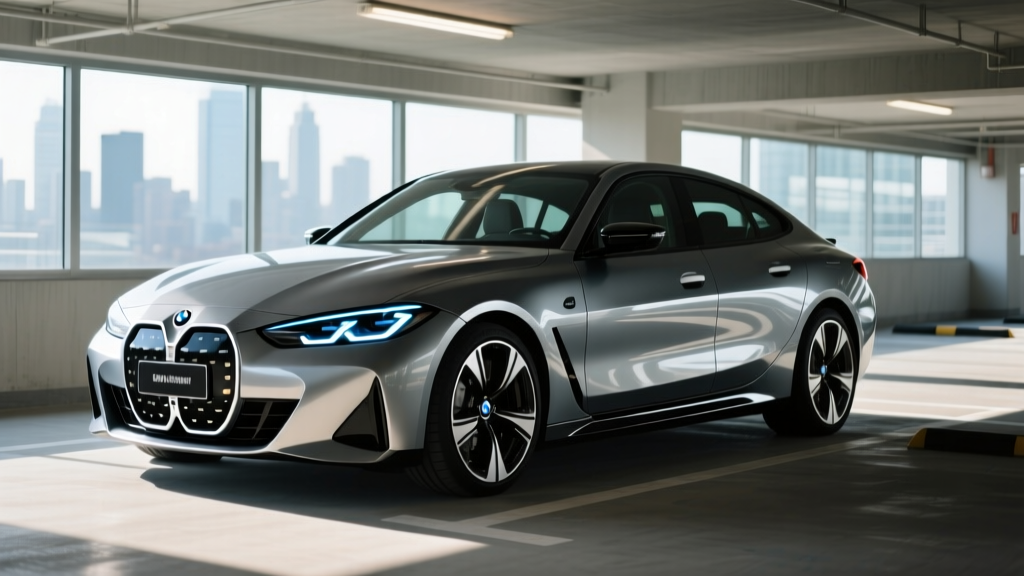
BMW's aggressive electric lease specials on models like the i4, iX, and i7 have become a staple of the brand's marketing strategy. With monthly payments that sometimes undercut their gas-powered counterparts, these deals look compelling on paper. But a low monthly lease payment tells only part of the ownership story. Before signing, you need to understand the full financial picture: federal tax credit eligibility, real-world charging costs, insurance premiums, and what happens at lease-end when residual values come due.
This guide dissects the total cost of owning a BMW EV through a lease in 2026, using the popular BMW i4 eDrive40 as our baseline — a 335-hp electric Gran Coupe with an EPA-estimated 307 miles of range and an 81.5 kWh (usable) NMC battery pack. We'll run the numbers on fuel, maintenance, insurance, depreciation, and incentives so you can decide whether that lease special is genuinely a deal or a marketing mirage.
The 2026 BMW i4 eDrive40: Lease Baseline Specs
Before we calculate ownership costs, here's what you're actually leasing. The 2026 BMW i4 eDrive40 sits in the sweet spot of BMW's electric lineup — rear-wheel drive, strong range, and a price point that keeps it under federal tax credit MSRP caps.
| Spec | Value |
|---|---|
| Base MSRP | $57,900 (before options/destination) |
| EPA Range | 307 miles |
| Battery (usable) | 81.5 kWh, NMC chemistry |
| Efficiency | 97 MPGe combined (35 kWh/100 mi) |
| Peak DC Fast Charge | 205 kW (CCS/NACS adapter) |
| 10–80% DC Charge Time | ~31 minutes |
| Level 2 Charge Rate | 11 kW (onboard charger) |
| 0–60 mph | 5.5 seconds |
| Horsepower | 335 hp |
| Battery Warranty | 8 years / 100,000 miles |
| Drivetrain | Rear-wheel drive, single motor |
Federal Tax Credit: Do You Qualify Under §30D Rules?
The federal EV tax credit under IRS §30D offers up to $7,500 — but qualifying is not automatic. For a leased BMW EV, the credit mechanics work differently than a purchase, and this distinction is critical.
Lease vs. Purchase: When you lease an EV, the tax credit technically goes to the lessor (BMW Financial Services), not to you. However, most manufacturers — BMW included — typically pass this credit through as a "lease cash" incentive, effectively reducing your capitalized cost and lowering monthly payments. This is why BMW electric lease specials often appear more attractive than purchase deals. Always confirm with your dealer that the full $7,500 is being applied to your lease's cap cost reduction.
§30D Eligibility Checklist (2026 Rules)
- MSRP Cap: Sedans and coupes must have an MSRP ≤ $55,000; SUVs, vans, and trucks ≤ $80,000. The i4 (sedan) at $57,900 base exceeds the $55,000 sedan cap — meaning the i4 may NOT qualify for the purchase credit. However, the commercial vehicle lease loophole (§45W) has historically allowed leased vehicles to bypass MSRP and sourcing restrictions. This provision remains under legislative scrutiny in 2026; consult your tax professional.
- Buyer Income Limits: Modified adjusted gross income (MAGI) must not exceed $150,000 (single), $225,000 (head of household), or $300,000 (married filing jointly).
- Battery Sourcing: Up to $3,750 requires critical minerals from the U.S. or FTA partners; up to $3,750 requires battery components manufactured in North America. BMW's battery supply chain (primarily Samsung SDI cells) has shifted toward compliance, but exact sourcing percentages vary by model year and production batch.
- Point-of-Sale Transfer: As of 2024, buyers can transfer the credit to the dealer for an immediate price reduction rather than waiting for a tax refund. For leases, this is handled by the lessor.
- Final Assembly: Vehicle must undergo final assembly in North America. The i4 is built in Munich, Germany — this disqualifies it from the §30D purchase credit. The BMW iX (built in Spartanburg, SC) does qualify for purchase credit purposes.
5-Year Total Cost of Ownership Breakdown
Let's model a realistic 5-year ownership scenario. For the lease comparison, we'll assume a 36-month lease followed by either a second lease or a purchase of a comparable used EV for years 4–5. For the purchase scenario, we'll model buying the i4 outright and holding for 5 years.
| Cost Category | i4 Lease (36 mo) + 2nd Lease | i4 Purchase | 430i Gas (Purchase) |
|---|---|---|---|
| Vehicle Payment (5 yr total) | $28,800 ($480/mo avg) | $52,900 (after credit) | $47,500 |
| Fuel / Charging | $4,375 | $4,375 | $9,750 |
| Insurance | $11,400 | $11,400 | $8,700 |
| Maintenance | $1,800 | $1,800 | $4,200 |
| Depreciation (loss in value) | N/A (lessor's risk) | $22,000 | $18,500 |
| Federal Tax Credit | −$7,500 (applied to cap cost) | −$7,500 (if eligible) | $0 |
| 5-Year Net Cost | $38,875 | $85,475 | $81,650 |
Assumptions: 12,000 miles/year; $0.14/kWh average electricity (mix of home and public); $3.50/gallon gasoline; 28 MPG combined for 430i. Insurance based on national EV average premium. Lease payments assume $7,500 cap cost reduction applied. Depreciation for purchase scenario based on projected 40% 5-year residual for i4.
Charging vs. Gas: The Per-Mile Cost Reality
This is where EVs consistently win — but the magnitude of savings depends heavily on how and where you charge.
| Scenario | Cost/kWh or Gallon | Cost Per Mile | Annual (12k mi) |
|---|---|---|---|
| i4 — Home L2 (utility avg) | $0.14/kWh | $0.049 | $588 |
| i4 — Public DC Fast (avg) | $0.40/kWh | $0.140 | $1,680 |
| i4 — Blended (70% home / 30% DCFC) | — | $0.076 | $916 |
| 430i — Gasoline (28 MPG combined) | $3.50/gal | $0.125 | $1,500 |
At a 70/30 home-to-public charging split — realistic for most owners with home Level 2 access — the i4 costs roughly $0.076 per mile versus the 430i's $0.125 per mile. That's a savings of approximately $584 per year, or $2,920 over 5 years.
If you charge exclusively at home on a time-of-use plan with off-peak rates ($0.08–$0.10/kWh), savings widen considerably. If you rely entirely on public DC fast charging, the per-mile cost can actually exceed gasoline — a scenario common among apartment dwellers without home charging access.
Maintenance Savings: Fewer Parts, Lower Bills
EVs eliminate the maintenance items that plague internal combustion vehicles over time. The i4's single electric motor has one moving part (the rotor), compared to hundreds in a turbocharged inline-4.
| Service Item | BMW i4 | BMW 430i |
|---|---|---|
| Oil Changes | $0 (none required) | $1,200 (6 services @ ~$200) |
| Brake Pads | $0–$300 (regen extends life 2–3×) | $800–$1,200 |
| Transmission Fluid | $0 (single-speed reduction gear) | $300–$500 |
| Coolant / Filters | $200 | $600 |
| Tire Rotation / Replacement | $1,800 (heavier EV, faster wear) | $1,400 |
| Cabin Air Filter / Wipers | $400 | $400 |
| Total Estimated | $2,400–$2,700 | $4,700–$5,300 |
Net maintenance savings over 5 years: approximately $2,100–$2,600. Note that EV tire costs are typically higher — the i4's additional weight (~4,800 lbs) and instant torque accelerate tire wear, particularly on the drive axle. Budget for premium tire replacements every 30,000–40,000 miles.
Insurance Costs: The Uncomfortable Premium
EV insurance remains a sore spot. According to industry data, EVs cost approximately 20–30% more to insure than comparable gas vehicles. The reasons are structural, not arbitrary:
- Higher repair costs: EV battery packs and power electronics are expensive to replace after collision damage. A minor rear-end impact that would cost $2,000 to repair on a gas car can total an EV if the battery enclosure is compromised.
- Specialized labor: High-voltage system repairs require certified technicians, limiting the repair network and increasing labor rates.
- Vehicle value: The i4's higher MSRP translates to higher comprehensive and collision premiums.
- Parts availability: BMW EV-specific body panels and structural components have longer lead times, increasing rental-car costs during repairs.
For the i4 eDrive40, expect annual premiums of approximately $2,200–$2,400 depending on your state, driving record, and coverage levels — compared to roughly $1,700–$1,900 for a 430i. That's an additional $500–$600 per year, or $2,500–$3,000 over 5 years, which partially offsets fuel and maintenance savings.
Mitigation strategies: Shop quotes from insurers with dedicated EV programs (some offer discounts for home charging or low annual mileage). Bundling home and auto policies can reduce premiums by 10–15%.
Depreciation and Resale: What Happens at Lease-End?
Depreciation is the single largest ownership cost for any vehicle, and EVs have experienced volatile residual values. Through 2023–2024, many EVs depreciated faster than gas counterparts due to rapid technology advancement, price cuts by Tesla, and consumer uncertainty about battery longevity.
By 2026, the picture has stabilized somewhat:
- Projected 5-year residual for BMW i4: ~55–60% of MSRP (improved from ~45–50% in 2024), driven by stronger consumer confidence in BMW's battery durability data and stabilized EV pricing.
- Lease residual advantage: When you lease, depreciation risk belongs to BMW Financial Services. If the i4's residual value at lease-end is lower than projected, that's BMW's problem — you simply walk away. This is a meaningful hedge in a market where EV values remain less predictable than gas vehicles.
- Purchase residual risk: If you buy and plan to sell or trade in at year 5, you absorb the full depreciation hit. At a projected 55% residual on a $57,900 MSRP, you'd recoup roughly $31,800, losing ~$26,100 to depreciation (before tax credit offset).
The lease structure effectively converts an unpredictable depreciation risk into a fixed monthly cost — which is precisely why BMW electric lease specials appeal to risk-averse buyers in a rapidly evolving market.
State, Local, and Utility Incentives
Beyond the federal credit, additional incentives can meaningfully reduce your net cost — but availability varies dramatically by location.
- State rebates: States like California (CVRP, up to $2,000 for income-qualified buyers), Colorado (up to $5,000 tax credit), and New York (up to $2,000 rebate) offer substantial additional incentives. Many states offer nothing.
- Utility rebates: Some utilities offer $500–$1,500 rebates for purchasing an EV or installing a home Level 2 charger. Check with your local provider.
- HOV lane access: Several states grant EVs access to carpool lanes regardless of occupancy — a non-monetary benefit with real commute-time value.
- Home charging installation: The federal 30C Alternative Fuel Infrastructure Tax Credit offers up to $1,000 for home charger installation (30% of cost, capped). This applies to the equipment and electrical work for a Level 2 home station.
The Lease-vs-Buy Decision Framework
Choose the BMW Electric Lease Special If:
- You want to lock in a predictable monthly cost without depreciation risk
- You're uncertain about long-term EV technology direction (solid-state batteries, NACS standardization)
- You typically drive under 12,000 miles/year (lease mileage limits usually 10k–12k)
- You want to upgrade to newer EV technology every 3 years
- The lease cash incentive (passed-through federal credit) makes the monthly payment competitive with gas equivalents
Choose to Purchase If:
- You drive over 15,000 miles/year (lease overage penalties of $0.20–$0.30/mile add up fast)
- You plan to keep the vehicle 7+ years (total cost drops significantly after the payment period ends)
- You qualify for the full $7,500 purchase credit and your state offers additional rebates
- You want to build equity and avoid perpetual car payments
- You have reliable home charging and low public-charging dependence
Frequently Asked Questions
How much does it really cost to own a BMW i4 over 5 years?
Based on our analysis, a leased i4 eDrive40 costs approximately $38,875 over 5 years (assuming two consecutive 36-month leases with $7,500 cap cost reduction applied). A purchased i4 costs approximately $85,475 over the same period, though you retain equity in the vehicle. The gas-powered 430i costs approximately $81,650. The lease is the lowest out-of-pocket option, but you own nothing at the end.
Do I qualify for the federal EV tax credit on a BMW i4?
For a purchase, likely not — the i4 is assembled in Germany and its sedan MSRP exceeds the $55,000 cap. However, leasing may qualify under the commercial vehicle (§45W) provision, which has different rules. BMW Financial Services typically passes the credit through as lease cash. Verify current rules on IRS.gov and with your tax advisor.
How much do I save on fuel and maintenance with the i4?
Combined fuel and maintenance savings over 5 years total approximately $5,000–$5,500 compared to the gas 430i — assuming 70% home charging. Fuel savings alone are ~$2,900; maintenance savings are ~$2,300. These savings are real but modest relative to the vehicle's purchase price.
Are BMW EVs more expensive to insure?
Yes. Expect to pay approximately 20–30% more for insurance on the i4 versus the 430i — roughly $500–$600 extra per year. Higher repair costs, specialized labor, and the vehicle's MSRP drive this premium. Shop multiple insurers and ask about EV-specific discounts.
How well do BMW EVs hold their value?
The i4's projected 5-year residual value is approximately 55–60% of MSRP as of 2026 — improved from the steeper depreciation seen in 2023–2024 but still slightly below comparable gas BMWs. Leasing transfers this depreciation risk to the lessor, which is a key advantage in the current EV market.
What if I don't have home charging — is a BMW EV lease still worth it?
It depends on your local public charging infrastructure and rates. If you rely entirely on DC fast charging at $0.35–$0.50/kWh, your per-mile fuel cost rises to $0.12–$0.18, potentially exceeding gasoline. Without home charging, the economic case for an EV weakens significantly. Consider a PHEV like the BMW 330e or X5 xDrive50e as an alternative that offers electric commuting without full charging dependence.