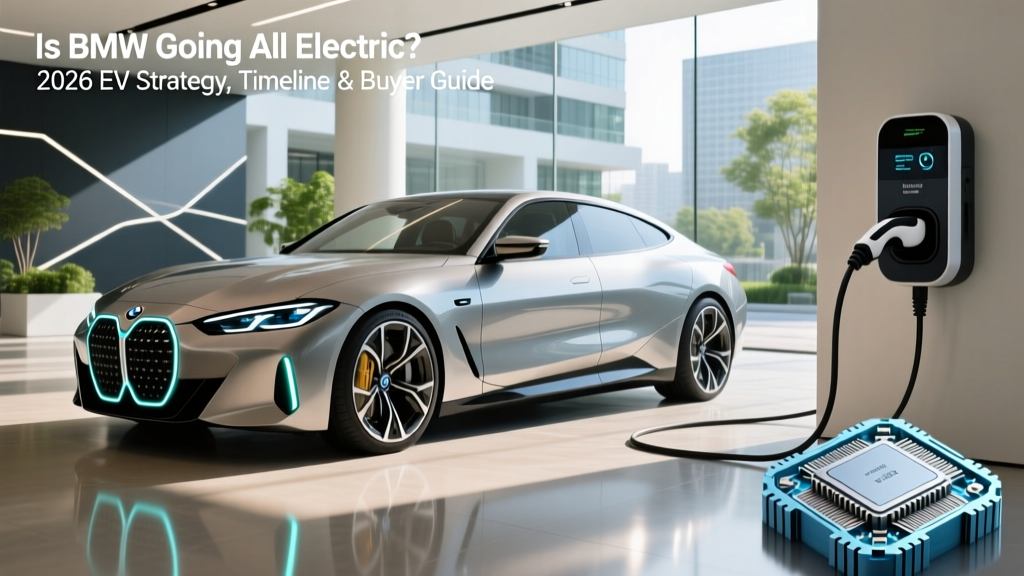
The Short Answer: Is BMW Going All Electric?
No — BMW is not going fully electric by a fixed global deadline. Instead, BMW's official strategy targets at least 50% of global sales being battery-electric vehicles (BEVs) by 2030, with the possibility of going fully electric in specific markets (like the EU) if infrastructure and demand support it. BMW continues to sell plug-in hybrids (PHEVs) and internal combustion engine (ICE) vehicles alongside its growing "i" EV lineup. The company's next-generation Neue Klasse platform, launching with production models in 2025–2026, represents BMW's biggest electric pivot yet — but gas and hybrid options will coexist for years.
BMW's Electrification Roadmap: Where Things Stand in 2026
BMW has taken a more measured approach to electrification than rivals like Volvo (which dialed back its 2030 full-EV pledge) or Mercedes-Benz (which extended its ICE timeline). Rather than committing to a hard ICE phase-out date, BMW has structured its transition around three pillars:
- Current "i" EV lineup — built on shared platforms with ICE models (e.g., the i4 shares architecture with the 4 Series Gran Coupe; the iX is a dedicated EV but uses a flexible platform).
- Neue Klasse platform (2025–2027+) — BMW's first EV-dedicated architecture, debuting with the next-generation iX3 (expected as a 2026 model), followed by an i3 sedan and additional models through 2027. This platform promises 30% more range, 30% faster charging, and new cylindrical battery cells.
- Continued PHEV and ICE offerings — BMW has explicitly stated it will keep combustion engines available as long as market demand and regulation require them, particularly in markets with limited charging infrastructure.
As of early 2026, BMW offers the following fully electric models in the U.S. market:
| Model | EPA Range | Battery (kWh usable) | Peak DC Charge | 10–80% Time | 0–60 mph | Base MSRP |
|---|---|---|---|---|---|---|
| i4 eDrive40 | 307 mi | 81.5 kWh (NMC) | 205 kW | ~31 min | 5.5 sec | $57,900 |
| i4 M50 | 271 mi | 81.5 kWh (NMC) | 205 kW | ~31 min | 3.7 sec | $69,700 |
| i5 eDrive40 | 295 mi | 84.3 kWh (NMC) | 205 kW | ~30 min | 5.7 sec | $66,800 |
| i5 M60 | 256 mi | 84.3 kWh (NMC) | 205 kW | ~30 min | 3.7 sec | $84,100 |
| i7 eDrive50 | 318 mi | 101.7 kWh (NMC) | 195 kW | ~34 min | 4.5 sec | $105,700 |
| iX xDrive50 | 324 mi | 111.5 kWh (NMC) | 195 kW | ~35 min | 4.4 sec | $87,250 |
| iX M60 | 296 mi | 111.5 kWh (NMC) | 195 kW | ~35 min | 3.6 sec | $111,500 |
Sources: EPA fueleconomy.gov, BMW USA official specifications. Real-world highway range typically runs 10–15% below EPA estimates; cold-weather (below 32°F) can reduce range by 20–30% depending on cabin heating use and preconditioning.
Neue Klasse: BMW's Real Electric Turning Point
The Neue Klasse platform is where BMW's electric ambitions become concrete. Announced in 2021 and entering production for the 2026 model year, this architecture introduces several technical shifts:
- Round cylindrical cells — moving from prismatic pouch cells to 46mm-diameter cylindrical cells (similar in form factor to Tesla's 4680 cells), with energy density improvements of 20% or more.
- 800-volt architecture — enabling faster DC charging, with BMW targeting 10–80% in approximately 20 minutes on the next-gen models.
- Dedicated EV skateboard — unlike the current i4/i5, which share underbodies with ICE models, Neue Klasse vehicles are designed from the ground up as electric, improving packaging efficiency and weight distribution.
- Gen6 eDrive motors — BMW claims 30% more efficiency and higher power density from its next-generation electric drive units.
The first U.S.-bound Neue Klasse vehicle is expected to be the next-generation iX3 (a compact luxury SUV slotting below the iX), followed by a new i3 sedan. These models will likely feature EPA ranges in the 340–400 mile range based on BMW's preliminary WLTP estimates, though final EPA certification numbers remain pending.
Real-World Range Reality Check
BMW's current EVs use NMC (nickel manganese cobalt) battery chemistry, which offers strong energy density but is sensitive to temperature. In our experience with the i4 eDrive40:
- EPA sticker: 307 miles
- Mixed driving (city/highway, 65–75°F): ~275–290 miles achievable
- Highway-only at 75 mph: ~255–270 miles
- Cold weather (20–35°F) without preconditioning: ~210–240 miles
BMW's thermal management system is competent, and preconditioning the battery before DC fast charging (via the navigation-routed charging feature) helps sustain charge speeds. But buyers in cold climates should budget 20–25% below the EPA number for winter planning.
BMW EV vs. Gas: The Real Ownership Cost Comparison
Whether a BMW EV makes financial sense depends heavily on your driving mileage, electricity rates, and whether you can charge at home. Let's compare the 2026 BMW i4 eDrive40 against the comparable 2026 BMW 430i Gran Coupe over a 5-year, 60,000-mile ownership period.
| Cost Category | i4 eDrive40 (EV) | 430i Gran Coupe (Gas) |
|---|---|---|
| Base MSRP | $57,900 | $49,900 |
| Federal Tax Credit (§30D)* | $0 (see note) | $0 |
| Fuel/Energy (60k mi) | $4,320 (home L2 @ $0.15/kWh) | $9,000 (30 MPG combined @ $3.50/gal) |
| Maintenance (5 yr) | ~$1,800 | ~$3,600 |
| Insurance (5 yr est.) | ~$12,500 | ~$10,800 |
| Estimated Depreciation | ~$24,000 | ~$22,000 |
| Total 5-Year Cost | ~$100,520 | ~$95,300 |
*As of 2026, BMW's U.S.-sold EVs do not qualify for the full $7,500 §30D federal tax credit due to battery component and critical mineral sourcing requirements under the Inflation Reduction Act. BMW's battery cells are sourced primarily from CATL (China) and Samsung SDI (South Korea), which currently do not meet the domestic-content thresholds. Always verify current eligibility on the IRS Clean Vehicle Credit page or with a tax professional — rules change frequently.
Key takeaway: The i4 costs roughly $5,200 more over 5 years in this scenario, driven by a higher purchase price and lack of federal tax credit eligibility. However, the i4 delivers significantly more torque (295 lb-ft vs. 295 lb-ft on the 430i but delivered instantly), lower NVH, and no oil changes. For buyers driving 15,000+ miles annually with cheap home electricity, the fuel savings narrow the gap substantially — at 20,000 miles/year, the i4 breaks even around year 4.
Common Misconceptions About BMW's EV Plans
| Myth | Fact |
|---|---|
| "BMW is going 100% electric by 2030." | BMW targets 50% BEV sales by 2030 globally, with no hard ICE phase-out date. The EU may push higher percentages due to the 2035 zero-emission mandate, but U.S. buyers will still have ICE and PHEV options. |
| "BMW EVs qualify for the $7,500 tax credit." | As of 2026, no BMW EV sold in the U.S. qualifies for the full §30D credit due to battery sourcing rules. The i4, i5, i7, and iX all fall short on critical mineral and battery component domestic-content thresholds. |
| "BMW EVs are just gas BMWs with batteries stuffed in." | Partially true for the current i4/i5 (shared CLAR platform), but the iX was designed as an EV from inception, and the upcoming Neue Klasse models will be fully EV-dedicated architectures with 800V systems. |
| "BMW's charging speeds can't compete with Tesla or Hyundai." | BMW's current 205 kW peak is competitive with most luxury EVs (Mercedes EQE: 170 kW; Audi e-tron GT: 270 kW). It trails Hyundai/Kia's 800V E-GMP platform (~240 kW, 10–80% in ~18 min) but is adequate for most road-trip scenarios. Neue Klasse's 800V architecture will close this gap. |
| "BMW EV batteries degrade quickly." | BMW warranties its high-voltage batteries for 8 years/100,000 miles against capacity dropping below 70% of original. Real-world data from i3 and iX3 fleets in Europe shows typical degradation of 8–12% over 5 years/60,000 miles for NMC packs with proper charging habits. |
Who Should Buy a BMW EV in 2026 — And Who Should Wait
Decision Framework: Buy Now or Wait for Neue Klasse?
Buy a current BMW EV (i4, i5, iX) now if:
- You need a luxury EV sedan or SUV in the next 6 months and value BMW's driving dynamics, interior quality, and iDrive 8.5 infotainment.
- You have reliable Level 2 home charging access (a 240V/48A circuit adding ~30 miles of range per hour of charging).
- Your daily driving is under 80 miles round-trip, meaning you'll rarely need DC fast charging.
- You lease (which insulates you from EV depreciation risk and may unlock lease-pass-through tax credit benefits under §30D commercial vehicle rules — consult a tax professional).
Wait for Neue Klasse (2027+ model year) if:
- You want 800-volt fast charging (~20 min 10–80%) for frequent road trips.
- Maximum range is a priority — Neue Klasse models are targeting 350–400+ EPA miles.
- You want a purpose-built EV platform with optimized interior space (flat floor, shorter overhangs).
- You're considering the compact SUV segment and want the next-gen iX3 rather than the larger, pricier current iX.
Consider a BMW PHEV instead if:
- You lack reliable home charging and your area has limited public DC fast-charging infrastructure.
- You regularly drive 300+ miles in a single day (towing, rural routes, charging deserts).
- The BMW X5 xDrive50e PHEV (38 miles electric-only, ~50 MPGe combined) offers a practical bridge — you can commute electric and road-trip on gas without range compromise.
Real-World Ownership: What First-Time BMW EV Buyers Need to Know
Home Charging Setup
BMW includes a dual-voltage Mobile Charger (Level 1/Level 2 portable unit) with new EV purchases, but for daily use, most owners install a dedicated Level 2 wallbox. Expect:
- Equipment cost: $500–$800 for a quality 48A wallbox (BMW's Wallbox or a ChargePoint Home Flex).
- Electrician installation: $800–$2,500 depending on panel proximity, conduit run length, and whether your electrical panel needs a 200A upgrade ($1,500–$3,500 additional).
- Permitting: $50–$250 depending on municipality.
- Total typical install: $1,500–$3,500 for a straightforward setup; up to $6,000+ if a panel upgrade is required.
The i4 and i5 accept up to 11 kW on Level 2 AC, meaning a full 0–100% charge takes roughly 8–9 hours — easily achievable overnight. The iX, with its larger 111.5 kWh pack, needs 11–12 hours on Level 2.
Public Charging Compatibility
Current BMW EVs use the CCS1 (Combined Charging System) connector for DC fast charging. BMW has announced that future Neue Klasse models in North America will adopt the NACS (North American Charging Standard) connector, aligning with Tesla's Supercharger network. In the meantime, BMW provides adapters or charging credits for Electrify America and other CCS networks, and CCS-to-NACS adapters are available for Supercharger access.
Insurance and Depreciation
BMW EVs carry insurance premiums 15–25% higher than their ICE equivalents, driven by higher repair costs for battery-adjacent damage and elevated vehicle values. The i4 eDrive40 typically insures for $2,400–$2,800/year depending on driver profile and state. Depreciation on luxury EVs has been steeper than ICE counterparts in 2024–2025 (partly due to Tesla-initiated price cuts cascading through the market), though this is stabilizing as the market matures.
Frequently Asked Questions
Will BMW stop making gas cars entirely?
Not by a fixed date. BMW's CEO Oliver Zipse has repeatedly stated the company will remain "technology open" and continue offering ICE, PHEV, and BEV powertrains based on market demand. The EU's 2035 zero-tailpipe-emission mandate may force an effective ICE phase-out in Europe, but the U.S., Middle East, and other markets will likely see gas BMWs well into the 2030s.
Does any BMW EV qualify for the U.S. federal tax credit?
As of 2026, no BMW EV qualifies for the full $7,500 §30D credit due to battery sourcing requirements. However, leasing a BMW EV may allow the dealer to apply the commercial clean vehicle credit (§45W) as a lease incentive — this is a structurally different mechanism that some automakers pass through as a capitalized cost reduction. Consult your dealer and a tax professional for current specifics.
How long will a BMW EV battery last?
BMW warranties its high-voltage batteries for 8 years or 100,000 miles (whichever comes first) against capacity dropping below 70%. Based on real-world fleet data from European iX3 and i4 owners, NMC packs typically lose 8–12% capacity over 5 years with normal use. Avoiding routine 100% charges (staying at 80–90% daily) and minimizing DC fast charging in extreme heat will extend longevity. Replacement costs, if needed out of warranty, range from $15,000–$25,000 depending on the model.
Is the BMW iX a dedicated EV platform?
The iX uses a modified version of BMW's CLAR architecture that was designed with EV priority in mind — it features a dedicated battery pack layout and electric drive modules, but it is not a pure skateboard platform in the way a Tesla Model Y or Hyundai Ioniq 5 is. The upcoming Neue Klasse vehicles will be BMW's first true dedicated-EV architectures.
Should I buy a BMW i4 or wait for the Neue Klasse i3 sedan?
If you need a car now and value proven reliability and current availability, the i4 eDrive40 is a strong luxury EV sedan with 307 miles of EPA range and excellent driving dynamics. If you can wait until late 2026 or 2027, the Neue Klasse i3 sedan should offer faster 800V charging, potentially 350+ miles of range, and a more EV-optimized interior. The trade-off is paying early-adopter pricing on a new platform with unproven long-term reliability.
For the latest BMW EV specifications, visit BMW USA's official EV page. For federal tax credit eligibility, always check the IRS Clean Vehicle Credit page before purchasing. Range and efficiency data sourced from fueleconomy.gov.