Quick Verdict: Tesla, HOV Lanes, and the 2026 Landscape
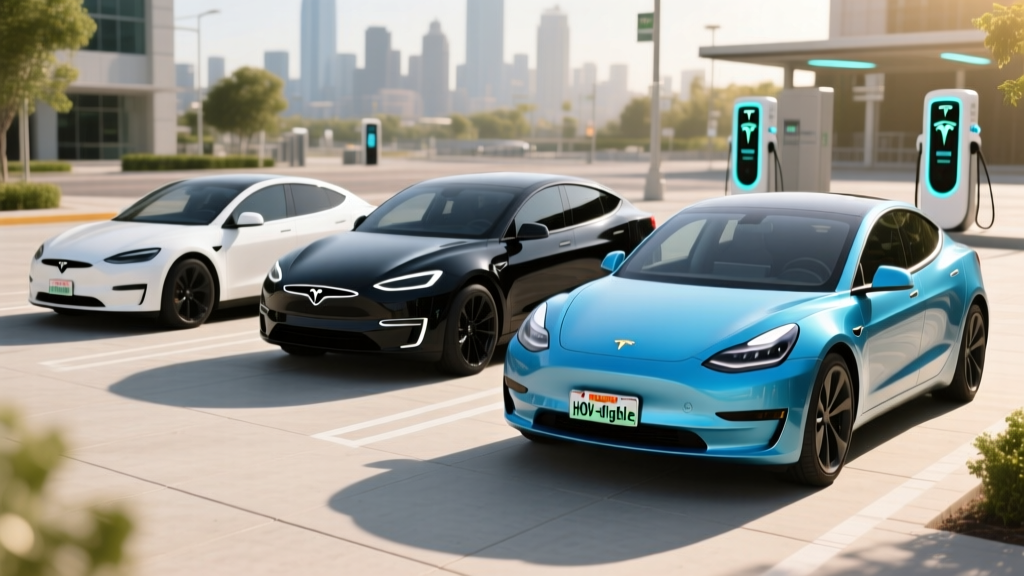
If you're researching Tesla HOV lane eligibility, the answer depends as much on your state's sticker program as it does on the car itself. As of 2026, California's Clean Air Vehicle (CAV) decal program — the most popular HOV-lane benefit in the country — has undergone significant changes. New battery-electric vehicles purchased after January 1, 2025, receive CAV decals that expire on September 30, 2027, under the current California DMV program rules. Other states like Colorado, Florida, and Virginia offer their own HOV or toll exemptions for qualifying EVs, each with distinct expiration dates and income thresholds.
But HOV access is just one factor in the ownership equation. Below, we break down the two Teslas most commonly purchased for commuter-lane benefits — the 2026 Model 3 Long Range AWD and the 2026 Model Y Long Range AWD — with exact specs, real-world range data, charging performance, and total cost after federal incentives.
2026 Tesla Model 3 Long Range AWD: The Commuter's EV
| Spec | Value |
|---|---|
| EPA Range | 341 miles |
| Battery Capacity | 79 kWh usable (NMC chemistry) |
| Max DC Fast Charge | 250 kW peak |
| 10–80% DC Charge Time | ~25 minutes |
| Level 2 Home Charging | 11.5 kW (~44 mi/hr) |
| 0–60 mph | 4.2 seconds |
| Horsepower | 346 hp (dual-motor AWD) |
| MPGe (combined) | 134 MPGe |
| Efficiency | 25 kWh/100 mi |
| Cargo Volume | 23 cu ft (rear trunk) + 3 cu ft (frunk) |
| Rear Legroom | 35.2 inches |
| Base MSRP | $47,740 (incl. destination) |
| Battery Warranty | 8 years / 120,000 miles |
Charging Performance: Home and Road
At home, the Model 3 Long Range accepts up to 11.5 kW on a Level 2 Wall Connector, adding approximately 44 miles of range per hour of charging. A full overnight charge from 20% to 100% takes roughly 7 hours on a 48-amp circuit. For daily commuting, most owners set a charge limit of 80% to preserve long-term battery health — the NMC chemistry in the Long Range benefits from avoiding sustained high states of charge.
On the road, Tesla's Supercharger network remains the gold standard for reliability. The Model 3 Long Range peaks at 250 kW at V3 and V4 Superchargers, though the charge curve tapers significantly above 60% state of charge. Expect to sustain 200+ kW only between roughly 10–45% SoC; from 80–100%, the rate drops below 50 kW. A 10–80% session takes approximately 25 minutes under optimal thermal conditions. According to fueleconomy.gov, the Model 3 LR AWD achieves 134 MPGe combined — among the most efficient vehicles in its class.
Interior, Tech, and Drawbacks
The refreshed Model 3 (internally called "Highland") features a quieter cabin with acoustic glass, ventilated front seats, ambient lighting, and a rear touchscreen for passengers. The 15.4-inch center display handles all vehicle controls — there are no physical stalks for turn signals or gear selection, which remains a polarizing design choice. Autopilot comes standard with Traffic-Aware Cruise Control and Autosteer (SAE Level 2); Full Self-Driving (Supervised) is an optional $8,000 add-on that still requires active driver engagement at all times.
Notable drawbacks include the absence of a traditional instrument cluster, limited rear visibility due to the sloping roofline, and a firm ride quality on broken pavement compared to rivals like the Hyundai Ioniq 6 or BMW i4.
2026 Tesla Model Y Long Range AWD: The Family EV
| Spec | Value |
|---|---|
| EPA Range | 320 miles |
| Battery Capacity | 78 kWh usable (NMC chemistry) |
| Max DC Fast Charge | 250 kW peak |
| 10–80% DC Charge Time | ~27 minutes |
| Level 2 Home Charging | 11.5 kW (~37 mi/hr) |
| 0–60 mph | 4.8 seconds |
| Horsepower | 384 hp (dual-motor AWD) |
| MPGe (combined) | 122 MPGe |
| Efficiency | 28 kWh/100 mi |
| Cargo Volume | 34 cu ft (behind 2nd row) / 76 cu ft (folded) |
| Rear Legroom | 41.6 inches |
| Base MSRP | $48,240 (incl. destination) |
| Battery Warranty | 8 years / 120,000 miles |
Why Families Choose the Model Y
The Model Y's crossover form factor provides genuine utility: 34 cubic feet of cargo space behind the second row, an available third-row seat (for children only — legroom is 26.5 inches), and a flat load floor with the rear seats folded. The 41.6 inches of rear legroom exceeds most midsize SUVs, and the optional tow package adds a 3,500-pound towing capacity.
The Juniper refresh brought a front light bar, ventilated seats, a rear 8-inch touchscreen, and improved suspension tuning. The cabin is noticeably quieter than pre-2025 models, with redesigned acoustic insulation and new bushings.
Federal Tax Credit and HOV Lane Eligibility
| Model / Trim | MSRP | §30D Credit | Effective Price |
|---|---|---|---|
| Model 3 Long Range AWD | $47,740 | Up to $7,500 | ~$40,240 |
| Model Y Long Range AWD | $48,240 | Up to $7,500 | ~$40,740 |
Both the Model 3 and Model Y remain eligible for the full $7,500 federal EV tax credit under IRS §30D in 2026, provided buyers meet income and sourcing requirements. Key eligibility rules, per the IRS Clean Vehicle Credit guidelines:
- MSRP cap: Sedans (Model 3) must be under $55,000; SUVs/pickups (Model Y) must be under $80,000 — both qualify comfortably.
- Buyer income cap: Modified adjusted gross income must not exceed $150,000 (single), $225,000 (head of household), or $300,000 (joint filing).
- Battery sourcing: The vehicle must meet critical-mineral and battery-component requirements that phase in stricter thresholds annually. Tesla's North American supply chain has adapted, but always verify current-year compliance on the manufacturer's window sticker or the IRS qualified vehicles list.
- Point-of-sale transfer: Buyers can elect to transfer the credit to the dealer at purchase, reducing the out-of-pocket price immediately rather than waiting for a tax refund.
HOV Lane Access by State
HOV lane eligibility for Teslas is not a federal program — it's determined at the state level. Here's what to know for the most active programs:
- California: New BEVs receive a white CAV decal allowing solo HOV-lane use. Decals issued in 2025–2026 expire September 30, 2027. Apply through the California DMV within 30 days of purchase. There is no income cap for the CAV decal.
- Colorado: EVs with qualifying plates can use HOV lanes on I-25 and US-36. Benefits are tied to vehicle registration and expire based on program sunset dates.
- Virginia: Qualifying EVs may use HOV lanes on I-64, I-95, and I-395 regardless of occupancy. The program has annual reauthorization requirements.
- Florida: EVs with the Florida SunPass Green sticker can use I-95 Express Lanes toll-free. The program is subject to legislative renewal.
Always confirm current rules with your state DMV or DOT before purchasing specifically for HOV access — program sunsets and legislative changes can alter eligibility mid-ownership.
How Teslas Compare to Key Competitors
| Attribute | Model 3 LR AWD | Hyundai Ioniq 6 SEL | BMW i4 xDrive40 |
|---|---|---|---|
| EPA Range | 341 mi | 342 mi | 282 mi |
| 0–60 mph | 4.2 sec | 5.1 sec | 4.7 sec |
| Max DC Charge | 250 kW | 350 kW | 205 kW |
| Base MSRP | $47,740 | $46,500 | $59,095 |
| HOV Eligible (CA) | Yes (CAV decal) | Yes (CAV decal) | Yes (CAV decal) |
| Supercharger Access | Native | NACS adapter required | NACS adapter required |
The Ioniq 6 matches Model 3 range and charges faster at 350 kW-capable stations, but the Supercharger network remains Tesla's strongest moat for road-trip convenience. The BMW i4 offers superior interior materials and driving dynamics but at a significantly higher price point. All three qualify for California CAV decals, so HOV lane access is not a Tesla-exclusive advantage.
Pros and Cons
Pros
- Industry-leading Supercharger network with 20,000+ stalls in North America
- Class-leading efficiency (25 kWh/100 mi on Model 3 LR)
- Over-the-air updates continuously add features
- Strong resale value relative to EV segment average
- HOV lane eligible in all major state programs
- Point-of-sale tax credit transfer reduces upfront cost
Cons
- Turn-signal buttons on steering wheel (no stalks) frustrate some drivers
- Panel-gap and paint-quality inconsistencies persist
- No Apple CarPlay or Android Auto integration
- FSD (Supervised) requires $8,000 add-on and still demands full driver attention
- Insurance premiums run 15–25% above segment average
- HOV decals have expiration dates — not a permanent benefit
Who Should Buy a Tesla for HOV Lane Access?
Choose the Model 3 Long Range if: You're a solo commuter covering 40+ miles daily on HOV-equipped highways, prioritize efficiency and range over cargo space, and want the lowest cost-per-mile EV in Tesla's lineup.
Choose the Model Y Long Range if: You need family-hauler utility with genuine cargo versatility, tow occasionally (up to 3,500 lbs), and your HOV commute justifies the crossover premium.
Look elsewhere if: You don't commute on HOV-eligible corridors (the decal provides no daily benefit), you prefer physical controls and Apple CarPlay, or your state's HOV program is sunsetting within 1–2 years.
Frequently Asked Questions
Do all Teslas qualify for HOV lane access?
All current-production Tesla BEVs (Model 3, Model Y, Model S, Model X) qualify for HOV lane decals in states that offer them, including California, Colorado, Virginia, and Florida. However, each state has its own application process, expiration dates, and potential income or vehicle-price requirements. Always check your state's current program before purchasing.
How long do HOV lane decals last?
In California, CAV decals issued for vehicles purchased in 2025–2026 expire on September 30, 2027. When they expire, the vehicle loses solo HOV-lane access unless the state legislature extends the program. Other states have varying timelines — some tie benefits to vehicle registration renewal, others to specific legislative sunset dates.
Is the Tesla Model 3 or Model Y better for HOV commuters?
For pure commuting efficiency, the Model 3 Long Range wins: 341 miles EPA, 25 kWh/100 mi, and a $500 lower base price. The Model Y is better if you need cargo space, a higher seating position, or occasional third-row seating for children. Both qualify for HOV decals and the $7,500 federal tax credit.
Does the Tesla HOV decal transfer to a new owner if I sell the car?
In California, CAV decals are tied to the vehicle, not the owner. If you sell your Tesla, the decal transfers with it — which can boost resale value. However, the expiration date does not reset; the new owner inherits the remaining decal validity period.
What is the real cost to charge a Tesla at home vs. Supercharging?
Home charging on a Level 2 Wall Connector at the national average electricity rate of $0.16/kWh costs approximately $12.64 to charge a Model 3 Long Range from 0–100% (79 kWh). Supercharger pricing averages $0.28–$0.36/kWh in 2026, making a full charge roughly $22–$28. For daily commuting, home charging saves $600–$900 annually versus exclusive Supercharger use.
Does the Tesla battery warranty cover HOV-commute driving?
Yes. Tesla's battery warranty covers 8 years or 120,000 miles (whichever comes first) for the Model 3 and Model Y Long Range, with a guaranteed minimum 70% capacity retention. There are no exclusions for highway commuting, HOV lane use, or high-mileage driving within the warranty period.