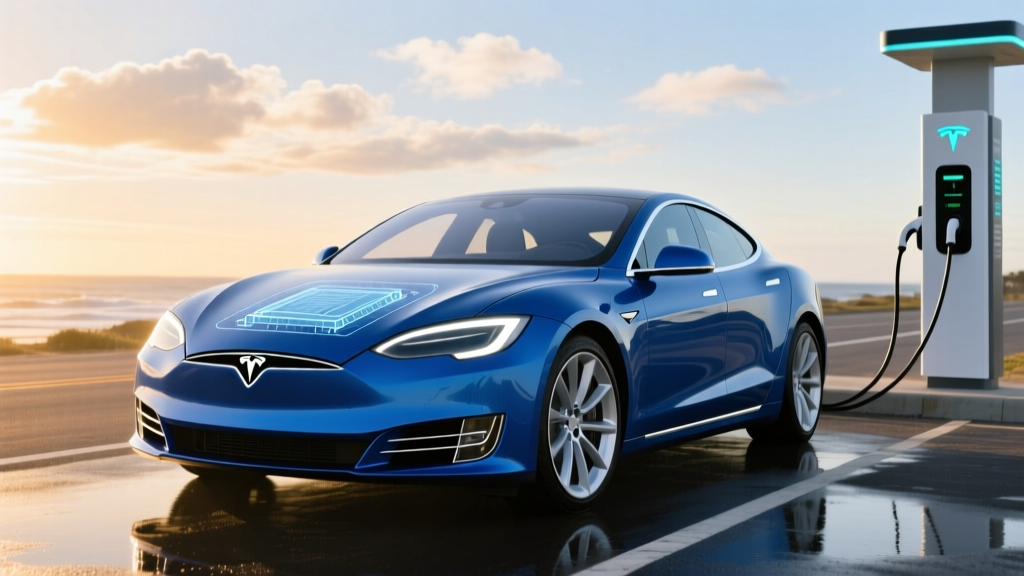
If you've searched for a blue Model S Tesla lately, you've likely noticed something: Tesla retired the signature Deep Blue Metallic years ago, and today's color palette leans toward Ultra Red, Pearl White, Solid Black, Stealth Grey, and Quicksilver. Yet the blue Tesla Model S remains one of the most searched configurations on the market — a testament to how deeply that color defined the brand's early identity. Whether you're hunting a certified pre-owned blue Model S or configuring a new 2026 Model S in a modern hue, the underlying question is the same: does Tesla's flagship sedan still earn its premium price in a market now crowded with the Lucid Air, BMW i5, Mercedes EQS, and Porsche Taycan?
This review covers the 2026 Tesla Model S Long Range and Model S Plaid with the exact numbers that matter — EPA range, real-world highway expectations, DC fast-charge curves, battery chemistry, pricing after federal tax credits, and the ownership realities Tesla's configurator won't show you.
2026 Tesla Model S Quick Specs
| Spec | Model S Long Range | Model S Plaid |
|---|---|---|
| Base MSRP | $74,990 | $89,990 |
| EPA Range | 402 miles | 359 miles |
| Battery (usable) | ~100 kWh, NMC | ~100 kWh, NMC |
| Drivetrain | Dual-Motor AWD | Tri-Motor AWD |
| Horsepower | 670 hp | 1,020 hp |
| 0–60 mph | 3.1 seconds | 1.99 seconds |
| Top Speed | 155 mph | 200 mph |
| Peak DC Charge Rate | 250 kW | 250 kW |
| 10–80% DC Fast Charge | ~30 minutes | ~30 minutes |
| Level 2 Charge Rate | 11.5 kW (~34 mi/hr) | 11.5 kW (~34 mi/hr) |
| MPGe (combined) | 120 MPGe | 116 MPGe |
| Efficiency | 28 kWh/100 mi | 29 kWh/100 mi |
| Battery Warranty | 8 yr / 150,000 mi | 8 yr / 150,000 mi |
| Cargo (rear + frunk) | 28 cu ft + 3.1 cu ft | 28 cu ft + 3.1 cu ft |
Sources: fueleconomy.gov, Tesla Model S configurator.
Real-World Range: What the EPA Sticker Doesn't Tell You
EPA Estimate: 402 miles
Highway (70 mph, 72°F): ~340–360 miles
Cold Weather (30°F, highway): ~280–310 miles
Plaid Highway Real-World: ~290–310 miles (EPA 359 mi)
The Model S Long Range's 402-mile EPA figure remains one of the highest of any production EV sold in the U.S. — only the Lucid Air Grand Touring (516 mi EPA) beats it among sedans. But EPA range is measured on a blended city/highway cycle with generous regenerative braking recovery. On a sustained 70-mph highway run, expect to use roughly 300–320 Wh/mi, which nets you about 340–360 miles before the buffer warning.
Cold weather is the bigger variable. The Model S uses a heat pump for cabin and battery thermal management, which mitigates but does not eliminate winter range loss. At 30°F on a highway drive, lithium-ion cells increase internal resistance and the heat pump draws additional energy, cutting usable range by roughly 25–30%. That 402-mile sticker becomes closer to 280–310 real-world miles. For most commuters this is still ample, but if you're planning a 300-mile winter road trip through the Rockies, you'll want one Supercharger stop.
The Plaid's tri-motor setup and stickier rubber increase rolling resistance and drag, trimming its real-world highway range to approximately 290–310 miles despite the same ~100 kWh pack. If range is your priority, Long Range is the clear pick.
Charging Speed and the 250 kW Reality
| Charging Level | Power / Rate | Time / Miles Added |
|---|---|---|
| Level 1 (120V outlet) | ~1.4 kW | ~4 mi/hr — emergency use only |
| Level 2 (240V, 48A Wall Connector) | 11.5 kW | ~34 mi/hr — full overnight charge |
| DC Fast (Supercharger V3) | Peak 250 kW | 10–80% in ~30 min; ~200 mi in 15 min |
| DC Fast (Supercharger V4) | Up to 250 kW (Model S limited) | Same as V3 for current Model S architecture |
The Model S charges at a peak rate of 250 kW on Tesla's V3 and V4 Superchargers. Here's what that means in practice: the car will ramp to approximately 250 kW between 10–30% state of charge (SoC), then progressively taper. By 60% SoC, you're typically seeing 120–140 kW; above 80%, the rate drops sharply to roughly 40–60 kW to protect the NMC battery chemistry. The 10–80% session takes about 30 minutes — competitive, but no longer class-leading.
For context, the Hyundai Ioniq 5 and Porsche Taycan (with 800V architecture) can sustain higher charge rates deeper into the session, achieving 10–80% in approximately 18–22 minutes. Tesla's 400V architecture in the Model S is the limiting factor. On a road trip, this means your second and third charging stops take slightly longer than competitors with flatter charge curves.
Home charging is straightforward: the Tesla Wall Connector at 48 amps delivers 11.5 kW, adding roughly 34 miles of range per hour. An overnight session (8 hours) restores approximately 270 miles — more than enough for daily driving. Installation typically runs $500–$1,500 depending on panel proximity, though a 200-amp panel upgrade can add $1,500–$3,000 if your home needs one.
Battery Chemistry, Degradation, and Warranty
The 2026 Model S uses an NMC (nickel manganese cobalt) lithium-ion battery pack with approximately 100 kWh of usable capacity. Tesla does not publish exact chemistry breakdowns, but teardown data and supply-chain reporting confirm NMC in the Model S lineup (LFP is reserved for the Standard Range Model 3 and Model Y).
NMC trade-offs vs. LFP: NMC offers higher energy density (more range in the same physical pack) but is more sensitive to sustained high-SoC storage and extreme heat. Best practice for longevity: charge to 80–90% daily, use 100% only for road trips, and avoid leaving the car at 100% for extended periods.
Tesla's battery warranty covers 8 years or 150,000 miles (whichever comes first) with a minimum 70% capacity retention threshold. Real-world data from high-mileage Model S owners and fleet analyses suggest typical degradation of approximately 10–12% over the first 100,000 miles, with the curve flattening significantly afterward. A Model S at 150,000 miles retaining 85–88% of original capacity is common, not exceptional.
Out-of-warranty battery replacement for the Model S currently ranges from $12,000 to $20,000 depending on whether Tesla installs a new or remanufactured pack. This is a real ownership risk beyond year 8, though the failure rate on current-generation packs is low.
Performance: Long Range vs. Plaid
The Long Range's dual-motor AWD setup produces 670 horsepower and hits 0–60 mph in 3.1 seconds. That's supercar territory from just a few years ago, delivered silently and with zero drama. The Plaid's tri-motor arrangement — one front, two rear — generates 1,020 horsepower and a claimed 1.99-second 0–60 time (with rollout subtracted, on a prepped surface). In independent testing, the Plaid consistently delivers 2.1–2.3 seconds, which still makes it one of the quickest production cars on Earth.
But the Plaid isn't just about straight-line speed. The torque-vectoring rear motors provide exceptional corner-exit grip, and the carbon-ceramic brake package (optional, ~$8,000) enables repeated track use without fade. For daily driving, the Long Range is more than fast enough — the performance delta matters only if you're tracking the car or simply want the halo of 1,020 hp.
Both trims feature adaptive air suspension that adjusts ride height automatically based on speed and GPS memory (it'll remember your steep driveway). Ride quality in Comfort mode is genuinely compliant for a 4,700-lb sedan, though it's not S-Class plush over broken pavement.
Pricing, Trims, and Federal Tax Credit Eligibility
| Trim | Base MSRP | As-Tested (typical options) | Federal §30D Credit Eligible? |
|---|---|---|---|
| Long Range | $74,990 | $78,000–$82,000 | See eligibility notes below |
| Plaid | $89,990 | $95,000–$105,000 | No — exceeds MSRP cap |
Federal tax credit reality check: Under IRS §30D rules, the new EV credit is up to $7,500, but eligibility depends on three filters:
- MSRP Cap: Sedans must be priced at or below $55,000. The Model S Long Range starts at $74,990 — well above the cap. Neither the Long Range nor the Plaid qualifies for the new-vehicle §30D credit based on MSRP alone.
- Buyer Income Cap: Modified AGI must not exceed $150,000 (single) / $300,000 (joint). Even if the MSRP cap didn't disqualify it, many Model S buyers exceed these thresholds.
- Battery Sourcing: Critical minerals and battery component requirements from IRS guidance must be met. Tesla's supply chain has shifted significantly, but this is moot given the MSRP disqualification.
Bottom line: The 2026 Model S does not qualify for the $7,500 federal tax credit. If you see older articles claiming it does, they predate the Inflation Reduction Act's MSRP caps. The used Model S may qualify for up to $4,000 under the §25E used clean vehicle credit (income caps apply; vehicle must be under $25,000, which limits options to high-mileage older models).
Interior, Cargo, and Daily Livability
The Model S interior has been refreshed multiple times since 2012, and the current generation features a 17-inch center touchscreen, a rear-seat 8-inch display, a yoke or round steering wheel (your choice, at no extra cost since 2023), and ventilated front seats. Build quality on 2025–2026 models is noticeably improved over the 2021–2023 "Palladium" refresh, with tighter panel gaps and more consistent stitching.
Passenger space: Front legroom is generous at 42.7 inches; rear legroom measures 35.4 inches — adequate for adults but tighter than a BMW i5 or Mercedes EQS. The rear seat is best for two adults; the center position is cramped by the transmission tunnel hump (yes, it still has one, a legacy of the original platform).
Cargo: The hatchback-style liftback opens to reveal 28 cubic feet behind the rear seats (expandable to 79 cu ft with seats folded) plus a 3.1 cu ft front trunk (frunk). This is significantly more practical than a traditional sedan trunk and makes the Model S viable for Costco runs and airport pickups.
Notable drawbacks: The minimalist interior isn't for everyone — physical buttons are almost entirely absent, and HVAC vent direction is adjusted via touchscreen. Road noise at highway speeds is more pronounced than in the Lucid Air or EQS. And while the yoke steering is a conversation piece, it requires genuine adaptation for low-speed maneuvers and roundabouts.
Driver Assistance: Autopilot and FSD Supervised
Tesla Autopilot and Full Self-Driving (Supervised) are SAE Level 2 driver-assistance systems. The driver must remain fully engaged, hands on or near the wheel, and eyes on the road at all times. These systems do not make the vehicle autonomous. Only Level 4 services like Waymo operate without a human driver.
Every Model S ships with Basic Autopilot (adaptive cruise control + lane centering). The $8,000 FSD (Supervised) upgrade adds automatic lane changes, traffic light/stop sign recognition, and Navigate on Autopilot for highway on-ramp-to-off-ramp driving. As of early 2026, FSD Supervised remains a Level 2 system that requires active monitoring — it handles many scenarios competently but will disengage without warning in construction zones, faded lane markings, or unusual intersections.
Tesla's camera-only vision approach (no LiDAR or radar) continues to generate debate. It works well in clear conditions but is more prone to phantom braking and reduced confidence in heavy rain or fog compared to sensor-fused systems like GM Super Cruise or Ford BlueCruise.
Is the Tesla Model S Still Worth It vs. the Competition?
- You want 400+ mile EPA range in a proven sedan
- Supercharger network access matters for road trips
- You value OTA updates and a strong resale market
- You want tri-motor performance (Plaid) without going exotic
- You want true Level 3/4 autonomy (no consumer car offers this yet)
- Interior luxury is paramount — try Lucid Air or EQS
- Federal tax credit eligibility is a dealbreaker
- You prefer physical controls and traditional luxury build
The Model S occupies a unique space: it's no longer the only premium long-range EV sedan, but it remains the one with the deepest Supercharger integration, the most over-the-air evolution over time, and a performance ceiling (Plaid) that few competitors match. The Lucid Air Grand Touring beats it on range and interior quality; the BMW i5 M60 offers better driving dynamics and build; the Porsche Taycan charges faster. But none replicate the full Tesla ecosystem.
Frequently Asked Questions
Can I still get a Tesla Model S in blue?
Tesla discontinued Deep Blue Metallic for the Model S in 2023. The current color palette includes Ultra Red, Pearl White Multi-Coat, Solid Black, Stealth Grey, and Quicksilver. If you specifically want a blue Model S, your best path is the certified pre-owned market through Tesla or a third-party vinyl wrap (~$3,000–$5,000 for a quality color-change wrap).
What is the real-world range of the Tesla Model S?
The Long Range delivers approximately 340–360 miles on the highway in moderate temperatures, dropping to 280–310 miles in cold weather (below 35°F). The Plaid averages 290–310 real-world highway miles. City driving with regenerative braking can actually exceed the EPA estimate.
How fast does the Model S charge at home and on the road?
At home on a 240V/48A Tesla Wall Connector, the Model S charges at 11.5 kW, adding about 34 miles per hour (full overnight charge). On a V3 Supercharger, it peaks at 250 kW and reaches 10–80% in approximately 30 minutes. Expect about 200 miles of range added in a 15-minute stop.
Does the 2026 Model S qualify for the federal EV tax credit?
No. The Model S exceeds the $55,000 MSRP cap for sedans under IRS §30D rules. Neither the Long Range ($74,990) nor the Plaid ($89,990) qualifies. Some buyers may be eligible for state-level incentives — check your state's energy office or IRS.gov for current rules.
How long will the Model S battery last?
Tesla warranties the battery for 8 years or 150,000 miles with a minimum 70% capacity retention. Real-world data suggests most packs retain 85–90% capacity at 100,000 miles. Out-of-warranty replacement costs $12,000–$20,000. Following best charging practices (80–90% daily, avoid prolonged 100% storage) helps maximize longevity.
Is the Model S Plaid worth the premium over Long Range?
The $15,000 premium buys you 350 additional horsepower, a tri-motor setup, and a sub-2.3-second 0–60 time. If you're tracking the car or want the ultimate performance sedan, yes. For daily driving and road trips, the Long Range is faster than most drivers will ever use, gets 43 more EPA miles, and is the better value.