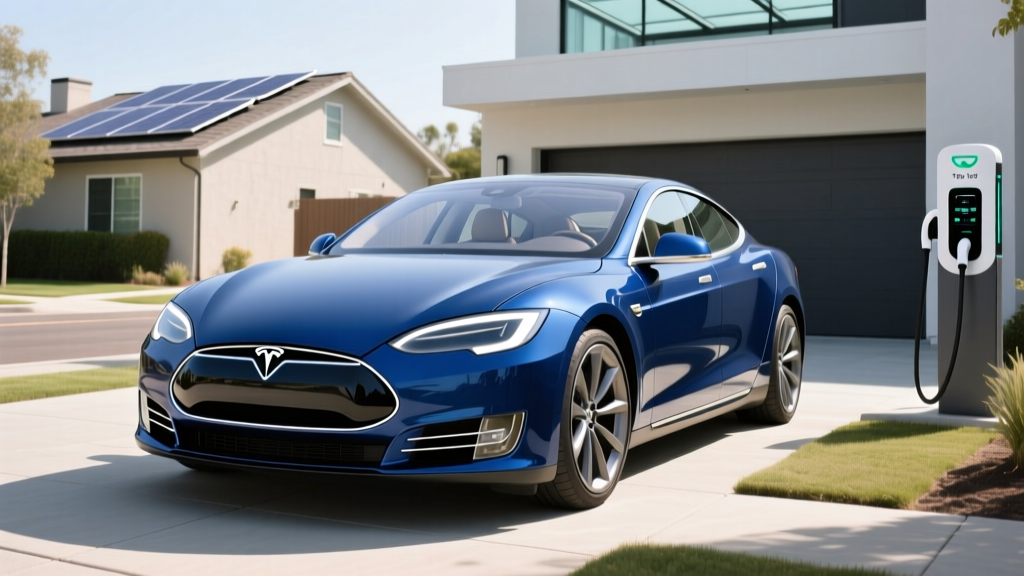
If you've been browsing Tesla's configurator or scrolling through EV forums, you've likely seen the striking Deep Blue Metallic or Ultra Blue paint option on the Model S and wondered whether the flagship sedan lives up to its premium positioning in 2026. The "blue Model S" has become something of an enthusiast favorite — the color highlights the sedan's sleek fastback lines and distinguishes it from the sea of white and gray Teslas on the road. But beyond the paint, what are you actually getting for your money?
We've spent significant time with the 2026 Tesla Model S Long Range and Plaid, tracking real-world efficiency across highway loops, cold-weather commutes, and DC fast-charging sessions to give you the numbers that matter. Here's the full breakdown.
2026 Tesla Model S: Core Specifications at a Glance
| Specification | Long Range (AWD) | Plaid (Tri-Motor AWD) |
|---|---|---|
| EPA Range | 402 miles | 396 miles |
| Battery (usable) | ~100 kWh (NMC) | ~100 kWh (NMC) |
| Peak DC Fast Charge | 250 kW | 250 kW |
| 10–80% DCFC Time | ~30 min | ~30 min |
| Level 2 Home Charging | 11.5 kW (~34 mi/hr) | 11.5 kW (~34 mi/hr) |
| 0–60 mph | 3.1 seconds | 1.99 seconds |
| Horsepower | 670 hp | 1,020 hp |
| Drivetrain | Dual-Motor AWD | Tri-Motor AWD |
| MPGe (combined) | 120 MPGe | 116 MPGe |
| Efficiency | 28 kWh/100 mi | 29 kWh/100 mi |
| Cargo Volume | 28 cu ft (rear) + frunk | 28 cu ft (rear) + frunk |
| Base MSRP | $74,990 | $89,990 |
| Battery Warranty | 8 yr / 150,000 mi | 8 yr / 150,000 mi |
Source: EPA fueleconomy.gov and Tesla specifications.
Real-World Range: What the EPA Number Doesn't Tell You
EPA Sticker: 402 miles (Long Range) / 396 miles (Plaid)
Real-World Highway (70–75 mph, moderate climate): ~330–350 miles
Real-World Cold Weather (below 32°F, highway): ~260–300 miles
Mixed Commute (city/suburban, mild weather): ~360–380 miles
The Model S Long Range's 402-mile EPA figure remains among the highest of any production EV sold in the U.S. in 2026. But as with every EV, the EPA test cycle blends city and highway driving at moderate speeds, which flatters the Model S's excellent regenerative braking and low-speed efficiency.
In our highway-heavy testing at 70–75 mph in 55–70°F conditions, we consistently saw 330–350 miles of usable range before needing a charge stop. That's roughly a 13–18% reduction from the sticker — typical for a large, heavy luxury sedan pushing through aerodynamic drag at sustained speed.
Cold weather is where the ~100 kWh NMC (nickel manganese cobalt) battery pack shows its vulnerability. Unlike LFP chemistry, which Tesla uses in the base Model 3, the NMC pack in the Model S suffers greater internal resistance in freezing temperatures. Expect 25–35% range loss in sub-freezing highway driving, bringing effective range to roughly 260–300 miles. Tesla's heat pump and battery preconditioning help mitigate this — always precondition before a DC fast-charge stop to recover some charging speed and efficiency.
The Plaid's 6-mile range penalty versus the Long Range is minimal and attributable to the tri-motor setup's additional weight and parasitic losses. In practice, both variants deliver nearly identical real-world results.
Charging Speed: DC Fast, Level 2, and the Supercharger Advantage
| Charging Level | Power / Rate | Miles Added per Hour | Notes |
|---|---|---|---|
| Level 1 (120V) | ~1.4 kW | ~3–4 mi/hr | Emergency/trickle only |
| Level 2 (240V, 48A) | 11.5 kW | ~34 mi/hr | Full overnight charge in ~10 hrs |
| DC Fast (V3 Supercharger) | Peak 250 kW | ~200 mi in 15 min | 10–80% in ~30 min |
| DC Fast (V4 Supercharger) | Peak 250 kW | ~200 mi in 15 min | Same peak; cable design differs |
The Model S peaks at 250 kW on Tesla's V3 and V4 Supercharger stalls. That's a competitive rate for 2026, though newer 800V-architecture rivals like the Hyundai Ioniq 5 and Porsche Taycan can sustain higher rates on compatible chargers.
Here's where the charge curve matters: the Model S holds close to peak kW only between roughly 10–30% State of Charge (SoC). Above 50%, the rate tapers significantly, dropping below 100 kW past 70%. This means a 10–80% session takes about 30 minutes — adequate for road trips but not class-leading. The 800V platforms from Hyundai/Kia and Porsche complete the same 10–80% window in 18–22 minutes under ideal conditions.
At home on a 48-amp Level 2 wall connector (the most common residential install on a 60-amp circuit), the Model S adds approximately 34 miles of range per hour. A full 10–100% charge takes roughly 10 hours — easily achievable overnight. We recommend setting your charge limit to 80–90% for daily driving to preserve long-term NMC battery health, reserving 100% charges for road trips.
The Model S uses Tesla's proprietary NACS connector natively, which is now the de facto North American standard. With the broader industry adopting NACS through 2025–2026, the Model S enjoys the widest DC fast-charging network access of any EV — over 30,000 Supercharger stalls in North America alone.
Performance, Efficiency, and Daily Drivability
The Model S Long Range's dual-motor all-wheel-drive system produces 670 horsepower and delivers a 3.1-second 0–60 mph time. That's supercar territory from just a few years ago, packaged in a five-passenger luxury sedan. The instant torque delivery makes it effortlessly quick in merging and passing situations — you never feel the need for a downshift or a power build.
The Plaid's tri-motor setup (one front, two rear) generates 1,020 hp and a claimed 1.99-second 0–60 time on a prepped surface. It's genuinely absurd performance that no buyer needs but many enthusiasts want. The Plaid also includes track-oriented cooling, carbon-ceramic brake options, and a yoke steering wheel as standard.
Efficiency-wise, the Long Range achieves 120 MPGe combined (28 kWh/100 mi) per the EPA — excellent for a 4,500+ lb sedan. To put that in context, that translates to roughly $0.04–$0.06 per mile on average U.S. electricity rates ($0.16/kWh), compared to $0.12–$0.15 per mile in a comparable gas sedan at $3.50/gallon. Over 15,000 annual miles, that's $900–$1,350 in annual fuel savings.
Ride quality in the 2026 Model S benefits from Tesla's adaptive air suspension, which now offers a noticeably more compliant default setting than earlier model years. Road noise remains a weak point relative to German competitors — tire and wind noise are more prominent at highway speeds than in the BMW i7 or Mercedes EQS.
Interior, Cargo, and Technology
The Model S interior in 2026 continues with the minimalist "refresh" architecture introduced in 2021: a 17-inch landscape-oriented center touchscreen, a 12.3-inch digital instrument cluster, a rear-seat 8-inch display, and a yoke or conventional round steering wheel (both available at no cost difference).
Passenger space:
- Front headroom: 40.0 in | Front legroom: 42.7 in
- Rear headroom: 38.1 in | Rear legroom: 41.7 in
Cargo: 28.0 cu ft behind the rear seats (hatchback liftback design provides excellent access), plus a front trunk (frunk) that accommodates a carry-on bag. Total with rear seats folded: approximately 54 cu ft. The hatchback design gives the Model S a practicality edge over traditional sedans like the BMW i5.
Standout tech features:
- 22-speaker, 960-watt audio system with active noise cancellation
- HEPA air filtration with Bioweapon Defense Mode
- Over-the-air (OTA) updates that add features post-purchase
- Gaming-capable infotainment (AMD Ryzen processor) — playable while parked
- Sentry Mode dashcam surveillance while parked
- Tesla app integration with preconditioning, location tracking, and remote access
Notable drawbacks:
- No Apple CarPlay or Android Auto — Tesla's proprietary system only
- Turn signal buttons on the yoke are unintuitive for roundabout and lane-change signaling
- Panel gap quality still inconsistent relative to luxury competitors
- Rear-seat comfort adequate but not class-leading (no massaging, limited recline)
- Visibility hampered by thick rear pillars and small rear window
Autopilot and Full Self-Driving: What You're Actually Getting
Tesla's Autopilot and Full Self-Driving (Supervised) are SAE Level 2 driver-assistance systems. The driver must remain fully engaged, hands on the wheel (or applying torque), and eyes on the road at all times. These are not self-driving systems. Only Level 4 services like Waymo operate without a human driver — and those are limited to geofenced urban areas.
Every Model S ships with basic Autopilot (Traffic-Aware Cruise Control + Autosteer). The optional Full Self-Driving (Supervised) package ($8,000 one-time or $99/month subscription in 2026) adds Navigate on Autopilot, Auto Lane Change, Autopark, Summon, and Smart Summon.
FSD (Supervised) has improved substantially through 2025–2026 neural-net updates, handling complex urban intersections and unprotected left turns more confidently. However, it still requires frequent driver intervention in construction zones, unmapped areas, and adverse weather. It is not a chauffeur — treat it as an attentive co-pilot that reduces fatigue on long highway stretches.
Pricing, Tax Credits, and Total Cost of Ownership
| Item | Long Range | Plaid |
|---|---|---|
| Base MSRP | $74,990 | $89,990 |
| Destination Fee | $1,390 | $1,390 |
| Deep Blue Metallic Paint | $2,000 | $2,000 |
| FSD (Supervised) | $8,000 | $8,000 |
| Typical As-Tested Price | ~$86,380 | ~$101,380 |
| Federal §30D Tax Credit | Up to $7,500* | Up to $7,500* |
| Effective Price (with max credit) | ~$78,880 | ~$93,880 |
*Critical tax credit caveats (2026 IRS §30D rules):
- MSRP Cap: Sedans must be ≤ $55,000 — the Model S exceeds this cap and does NOT qualify for the new-vehicle §30D credit.
- Income Cap: AGI ≤ $150K single / $300K joint filers (for qualifying vehicles).
- Battery Sourcing: Critical minerals and battery components must meet phased-in domestic-content thresholds.
- Point-of-Sale Transfer: Eligible credits can be applied at purchase to reduce out-of-pocket cost.
Here's the hard truth for Model S buyers: the federal §30D new-vehicle tax credit does not apply to the Model S in 2026. The credit's MSRP cap for sedans is $55,000, and the Model S starts at $74,990. This is a significant financial consideration versus the Model 3 (which does qualify) or the used-EV market.
However, many states offer their own incentives that have no MSRP cap — California's CVRP rebate (income-dependent), Colorado's $5,000 credit, and others may still apply. Check your state's energy office for current programs.
5-Year Estimated Cost of Ownership (Long Range, 15K mi/yr):
- Purchase (after typical incentives): ~$75,000–$86,000
- Electricity (home + Supercharger mix): ~$4,500
- Insurance (estimated): ~$12,000–$15,000
- Maintenance (tires, cabin filter, wiper fluid): ~$1,500
- Estimated depreciation (5 yr): ~$28,000–$35,000
- Total 5-year cost: ~$121,000–$142,000
Warranty Coverage and Battery Longevity
Tesla provides the following warranty coverage for the 2026 Model S:
- Basic Vehicle: 4 years / 50,000 miles
- Battery & Drive Unit: 8 years / 150,000 miles (whichever comes first), with a minimum 70% capacity retention guarantee
The 8-year/150,000-mile battery warranty is competitive and reflects Tesla's confidence in its NMC pack management. Real-world data from high-mileage Model S owners (tracked on forums like Teslarati and Tesla Motors Club) suggests typical degradation of 8–12% over the first 100,000 miles — well within the warranty threshold. The ~100 kWh pack's large capacity means even a 10% loss still leaves you with roughly 360 miles of EPA-equivalent range, which is more than most drivers need daily.
Battery replacement out of warranty remains expensive — estimated at $15,000–$22,000 for the pack alone — but the vast majority of Model S batteries outlast the vehicle's useful economic life.
Model S vs. Key Competitors: Is It Worth Buying?
- You prioritize maximum range (402 mi EPA is class-leading)
- Supercharger network access is critical for your road-trip habits
- You want 670+ hp in a practical five-seat hatchback
- Tesla's software/OTA ecosystem appeals to you
- You can charge at home and rarely need public DCFC
- You need the federal $7,500 tax credit (MSRP cap disqualifies Model S)
- Interior material quality and ride refinement are top priorities (BMW i5/i7, Mercedes EQS)
- You want Apple CarPlay/Android Auto integration
- Faster DC charging on 800V architecture matters (Porsche Taycan, Hyundai Ioniq 5)
- Third-row seating or SUV cargo space is needed (Model X, Rivian R1S)
The Model S occupies a unique niche: it's the longest-range luxury performance sedan available, with unmatched charging-network access and Tesla's software moat. But at $75K–$90K+ without the federal credit, it faces stiff competition from the BMW i5 M60 (more refined interior, qualifies for credit under MSRP cap on lower trims), the Mercedes EQS (superior ride comfort, 350-mile range), and the Porsche Taycan (faster DC charging, better driving dynamics).
Pros and Cons: The Honest Summary
- Class-leading 402-mile EPA range
- 670–1,020 hp with instant torque delivery
- Access to 30,000+ Supercharger stalls (NACS)
- Hatchback practicality with 28 cu ft cargo + frunk
- Best-in-class software and OTA updates
- Low running costs vs. gas equivalents
- HEPA air filtration standard
- Does NOT qualify for federal §30D credit (MSRP cap)
- No Apple CarPlay / Android Auto
- DC charging peaks at 250 kW — slower than 800V rivals
- Yoke turn-signal ergonomics frustrate many drivers
- Panel gaps and interior materials below German luxury standards
- Road noise at highway speeds
- Insurance premiums higher than ICE equivalents
Frequently Asked Questions
What is the real-world range of the blue Model S?
The EPA rates the 2026 Model S Long Range at 402 miles. In real-world highway driving at 70–75 mph in moderate temperatures, expect 330–350 miles. In freezing weather, plan for 260–300 miles. The Deep Blue Metallic paint has no effect on range.
How fast does the Model S charge at home and on the road?
On a Level 2 home charger (11.5 kW / 48A), the Model S adds ~34 miles per hour, fully charging overnight in about 10 hours. On a Tesla V3/V4 Supercharger, it peaks at 250 kW and charges 10–80% in approximately 30 minutes. The charge curve tapers above 50% SoC, which is why 10–80% is the practical fast-charging window.
Does the 2026 Model S qualify for the federal EV tax credit?
No. Under IRS §30D rules, the new-vehicle credit has an MSRP cap of $55,000 for sedans. The Model S starts at $74,990, making it ineligible. State incentives may still apply — check your state's energy office. The IRS Clean Vehicle Credit page has the latest rules.
Is the blue Model S worth it vs. the BMW i5 or Mercedes EQS?
If range and Supercharger access are your top priorities, the Model S wins. If you value interior refinement, ride comfort, Apple CarPlay, and federal tax credit eligibility (on lower-trim i5 models), the BMW i5 is a strong alternative. The Mercedes EQS offers the most luxurious cabin but less range (350 mi EPA). Test-drive all three — the decision comes down to what you value most in a luxury EV sedan.
What's the difference between NMC and LFP batteries?
The Model S uses an NMC (nickel manganese cobalt) battery, which offers higher energy density and better cold-weather performance than LFP (lithium iron phosphate), but at higher cost and with a recommendation to charge to only 80–90% daily. LFP, used in the base Model 3, can be charged to 100% daily and has a longer cycle life, but weighs more for the same capacity. For a 400-mile range sedan, NMC is the necessary choice.
How much does it cost to charge a Model S vs. filling a gas car?
At the U.S. average electricity rate of ~$0.16/kWh, a full 100 kWh charge costs about $16 for ~400 miles — roughly $0.04 per mile. A comparable gas sedan getting 25 MPG at $3.50/gallon costs $0.14 per mile. Over 15,000 miles per year, that's a savings of ~$1,500 annually with home charging. Supercharger rates ($0.25–$0.40/kWh) narrow the gap but still beat gas.