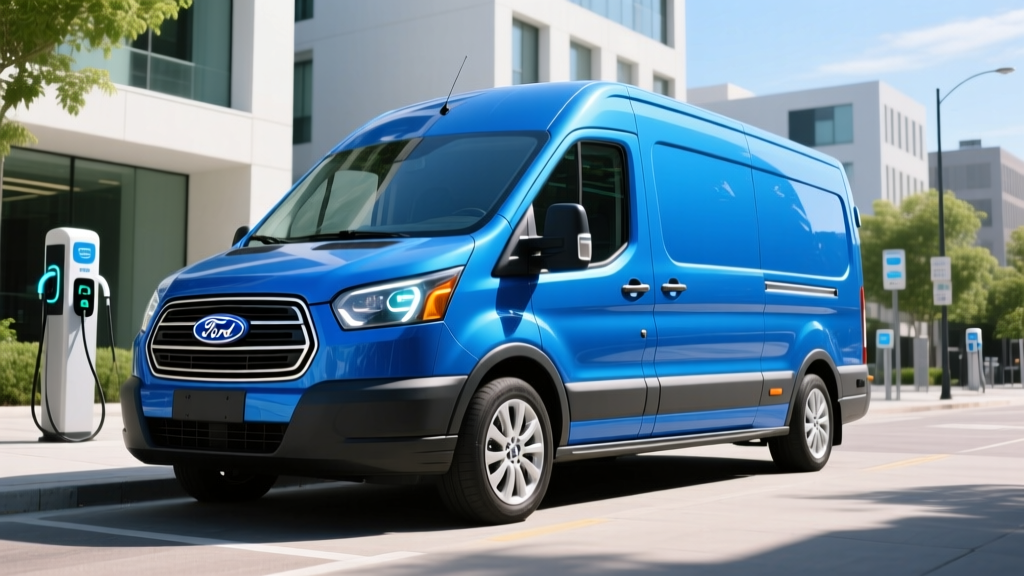
If you're searching for a blue electric van for commercial or personal use, the Ford E-Transit is the dominant answer in the U.S. market for 2026. It's available in Oxford White, but fleet buyers and upfitters commonly wrap or order in custom colors including blue. The E-Transit offers an EPA-estimated 126 miles of range (low-roof cargo van), a 68 kWh usable battery, 266 horsepower, and DC fast charging up to 115 kW (10–80% in roughly 45 minutes). Starting at approximately $52,990 before incentives, it targets last-mile delivery, tradespeople, and shuttle operators who return to a home base nightly.
Quick Answer: Is There a Blue Electric Van You Can Buy Today?
Ford does not offer a factory blue paint option for the E-Transit in 2026 — it ships primarily in Oxford White. However, blue is one of the most popular fleet-wrap colors, and many commercial upfitters apply branded blue vinyl or paint post-delivery. If you need a blue electric van, budget an additional $2,500–$5,000 for a quality commercial wrap over a white E-Transit. Competitors like the Mercedes-Benz eSprinter and BrightDrop Zevo 600 offer different color programs but are either discontinued (BrightDrop) or limited in availability.
2026 Ford E-Transit: Core Specs at a Glance
| Specification | 2026 Ford E-Transit (Low-Roof Cargo Van) |
|---|---|
| EPA Range | 126 miles (low-roof); ~108 miles (high-roof) |
| Battery Capacity | 68 kWh usable (NMC chemistry) |
| Motor Output | 266 hp / 317 lb-ft torque |
| 0–60 mph | ~8.0 seconds (unladen) |
| Max DC Fast Charge | 115 kW peak |
| 10–80% DC Charge Time | ~45 minutes |
| Level 2 Charge Rate | 10.5 kW (AC onboard charger) |
| Level 2 Full Charge Time | ~8 hours (0–100%) |
| Payload Capacity | Up to 3,880 lbs (cargo van) |
| Cargo Volume | 246.7 cu ft (low-roof, 130" WB) |
| Pro Power Onboard | Available 2.0 kW or 7.2 kW V2L |
| Starting MSRP | $52,990 (cargo van, before incentives) |
| Battery/Powertrain Warranty | 8 years / 100,000 miles |
Real-World Range Reality Check
The EPA 126-mile figure applies to the low-roof cargo van driven under mixed urban conditions. Expect 95–110 miles in real-world stop-and-go delivery routes with moderate payload. Highway driving at 70 mph reduces range to approximately 85–95 miles due to the E-Transit's boxy aerodynamics. In cold weather (below 30°F), plan for a 20–35% range reduction, bringing effective range to 65–90 miles depending on cabin heat usage. The E-Transit does not currently offer a heat pump — it uses resistive cabin heating, which draws heavily from the battery in winter. For routes exceeding 100 miles daily, the E-Transit is not the right tool without mid-day charging.
E-Transit vs. Gas Transit: 5-Year Cost Breakdown
The core buying decision for an electric van comes down to total cost of ownership (TCO). Below, we compare the E-Transit against the gasoline Ford Transit T-150 (3.5L V6, the most popular configuration) over a 5-year, 75,000-mile ownership period — a reasonable benchmark for a commercial fleet vehicle averaging 41 miles/day, 5 days/week.
| Cost Category | Ford E-Transit (2026) | Ford Transit T-150 Gas (2026) |
|---|---|---|
| Base MSRP | $52,990 | $46,500 |
| Federal §30D Tax Credit | Up to $7,500 (see eligibility) | $0 |
| Effective Purchase Price | ~$45,490 | $46,500 |
| Fuel/Energy (75K mi) | $3,750 (at $0.13/kWh, 2.0 kWh/mi) | $10,350 (at $3.45/gal, 14 MPG) |
| Maintenance (5 yrs) | ~$1,200 (no oil, fewer brakes w/ regen) | ~$4,500 (oil, filters, brakes, plugs) |
| Insurance (5 yrs est.) | ~$12,500 | ~$10,800 |
| Estimated 5-Yr TCO | ~$62,940 | ~$72,150 |
Sources: EPA fueleconomy.gov for efficiency data; Ford commercial pricing; IRS §30D credit rules. Electricity costs vary by region — commercial rates in some areas exceed $0.20/kWh, which would increase E-Transit energy costs. Gas prices fluctuate; $3.45/gal is a 2026 national average estimate.
The E-Transit wins on operating costs by a wide margin — saving roughly $6,600 in fuel and $3,300 in maintenance over five years. The higher insurance cost (EVs generally carry 10–20% higher premiums due to repair complexity and battery replacement risk) partially offsets these gains. If you qualify for the full $7,500 federal tax credit, the E-Transit effectively costs less to purchase and less to operate.
Federal Tax Credit: Does the E-Transit Qualify?
The Ford E-Transit is assembled in Claycomo, Missouri, which satisfies the North American final assembly requirement under IRS §30D rules. However, eligibility for the full $7,500 credit depends on several factors that change periodically:
- MSRP Cap: Vans fall under the $80,000 MSRP cap for trucks/vans — the E-Transit clears this easily at $52,990 base.
- Buyer Income Limits: Modified AGI must not exceed $150,000 (single), $225,000 (head of household), or $300,000 (joint filers).
- Battery Component Sourcing: A percentage of battery components must be manufactured or assembled in North America. This threshold increases annually; verify current-year compliance on the IRS eligible vehicle list.
- Critical Minerals: A percentage of critical minerals must be sourced from the U.S. or FTA-partner countries. This also tightens yearly.
- Point-of-Sale Transfer: As of 2024, you can transfer the credit to the dealer at purchase, reducing your out-of-pocket cost immediately rather than waiting for tax filing.
Important: Fleet buyers purchasing under a business entity may qualify for the Commercial Clean Vehicle Credit (§45W) instead of §30D, which has different rules. Consult a tax professional to determine which credit applies to your purchase structure.
Charging Setup: What Fleet Buyers Need to Know
The E-Transit's viability depends entirely on reliable depot or home-base charging. Here's what the setup looks like:
| Charging Level | Power | Miles Added/Hour | Use Case |
|---|---|---|---|
| Level 1 (120V) | 1.4 kW | ~2–3 mi/hr | Emergency only — not viable for daily fleet ops |
| Level 2 (240V, 48A) | 10.5 kW | ~18–21 mi/hr | Overnight depot charging — primary use case |
| DC Fast Charge | 115 kW peak | ~120+ mi/hr (at peak) | Mid-day top-ups; 10–80% in ~45 min |
Depot charging installation for a fleet of E-Transits typically requires:
| Item | Estimated Cost (Per Stall) |
|---|---|
| Level 2 Charger (e.g., ChargePoint CPF50 or Ford Pro AC charger) | $1,500–$3,500 |
| Electrical panel upgrade (if needed) | $2,000–$8,000 |
| Wiring & conduit (50-ft run avg.) | $1,500–$3,000 |
| Permits & inspection | $300–$800 |
| Electrician labor | $2,000–$4,500 |
| Total per stall | $7,300–$19,800 |
For a 5-van fleet, expect $35,000–$100,000 in charging infrastructure before utility rebates. Many utilities offer commercial EV charging make-ready programs that can cover 50–100% of panel upgrade and wiring costs. Ford Pro also offers managed charging software that staggers charge sessions to avoid peak demand charges — a critical feature since demand charges can exceed the energy cost itself on commercial electricity bills.
The E-Transit uses a CCS1 connector for DC fast charging and a J1772 inlet for Level 2. It has not adopted NACS (Tesla's connector), so plan for CCS-compatible public chargers if mid-day topping up is needed on route. The EPA rates the E-Transit at approximately 2.0 kWh/mile — meaning a full charge requires about 68 kWh of energy delivered.
Who Should (and Shouldn't) Buy the E-Transit
Decision Framework: Is the E-Transit Right for You?
Choose the E-Transit if:
- Your daily route is under 100 miles round-trip and returns to a fixed base.
- You can install Level 2 depot charging at your business or home garage.
- You operate in a city or metro area with low-emission zone incentives or fleet electrification mandates.
- You value Pro Power Onboard (2.0 or 7.2 kW) to run tools at a job site without a generator.
- You qualify for the §30D or §45W tax credit and can apply it to offset the higher MSRP.
Stick with a gas Transit or consider a hybrid alternative if:
- Your routes regularly exceed 130 miles/day with no opportunity for mid-day charging.
- You operate in extreme cold climates (sustained sub-20°F) without heated garage storage — expect 30%+ range loss.
- You lack access to depot charging and must rely solely on public DC fast chargers (unreliable for daily fleet ops).
- Your business requires heavy towing — the E-Transit's 7,500-lb max tow rating is lower than the gas Transit's available 8,300+ lbs in some configurations.
Common Misconceptions About Electric Vans
| Myth | Fact |
|---|---|
| "Electric vans can't carry a full payload." | The E-Transit handles up to 3,880 lbs — comparable to many gas Transit configurations. However, max payload does reduce range by roughly 8–12%. |
| "The battery will need replacing in a few years." | Ford warranties the E-Transit battery for 8 years/100,000 miles against capacity loss below 70%. NMC batteries in commercial duty cycles typically retain 85–90% capacity at 100K miles based on fleet data from early adopters. |
| "Charging takes too long for commercial use." | Overnight Level 2 charging (8 hours) fully replenishes the 68 kWh battery — ideal for depot-return fleets. DC fast charging to 80% takes ~45 minutes, suitable for scheduled lunch breaks. |
| "You can get a blue electric van from the factory." | The E-Transit ships in Oxford White only for 2026. Blue requires an aftermarket wrap or paint, adding $2,500–$5,000. Some upfitters offer pre-wrapped blue delivery. |
| "Electric vans cost more to insure." | Generally true — EV insurance premiums run 10–20% higher on average due to specialized repair requirements, battery replacement costs, and higher initial MSRP. Shop fleet insurance providers who understand EV risk profiles. |
Competitive Landscape: Other Electric Vans in 2026
The E-Transit is not the only electric van available, but it has the strongest dealer and service network in the U.S. Here's how alternatives compare:
| Model | EPA Range | Battery | DC Fast Charge | Starting MSRP | Status (2026) |
|---|---|---|---|---|---|
| Ford E-Transit | 126 mi | 68 kWh (NMC) | 115 kW | $52,990 | On sale |
| Mercedes-Benz eSprinter | ~200 mi (est.) | 113 kWh (NMC) | 115 kW | ~$74,000 | Limited availability |
| BrightDrop Zevo 600 | ~250 mi | 165 kWh (NMC) | 120 kW | ~$90,000+ | Production uncertain — GM restructured BrightDrop |
| Rivian EDV (Amazon) | ~150 mi | ~90 kWh (NMC) | ~150 kW | N/A (fleet only) | Exclusive to Amazon; not publicly available |
The Mercedes-Benz eSprinter offers significantly more range (~200 miles) thanks to a much larger 113 kWh battery, but it costs roughly $20,000 more and has limited dealer availability. The BrightDrop Zevo 600 was designed for large-scale fleet electrification but GM's restructuring of the BrightDrop division has created uncertainty around production volume and long-term support. The Rivian EDV remains exclusive to Amazon's delivery network.
For most small-to-mid-size fleet operators and tradespeople, the E-Transit's combination of Ford Pro service infrastructure, competitive pricing, and Pro Power Onboard makes it the most practical electric van available in 2026 — even if you'll need to wrap it blue yourself.
Frequently Asked Questions
Can I order a blue Ford E-Transit from the factory?
No. Ford's 2026 E-Transit color catalog is limited to Oxford White for commercial/fleet configurations. To get a blue electric van, plan for an aftermarket vinyl wrap ($2,500–$5,000) or a professional respray ($4,000–$8,000). Many commercial wrap shops offer fleet discounts for multi-van orders.
How long does the E-Transit battery last before replacement?
Ford warranties the high-voltage battery for 8 years or 100,000 miles against degradation below 70% of original capacity. Real-world fleet data from early E-Transit adopters (2022–2023 models) shows approximately 5–8% degradation at 60,000 miles under normal commercial use. Full battery replacement, if ever needed out of warranty, is estimated at $15,000–$22,000 including labor — though module-level repairs may be possible at lower cost.
Is the E-Transit good in cold weather?
It's functional but range suffers significantly. Without a heat pump, the E-Transit uses resistive heating that can draw 3–5 kW continuously in sub-freezing temperatures. Expect 20–35% range loss in sustained cold (below 30°F), reducing the 126-mile EPA figure to roughly 80–100 miles. Preconditioning the cabin while plugged in and using heated seats (available) instead of cabin air heat can recover some range.
What is Pro Power Onboard and is it worth it?
Pro Power Onboard turns the E-Transit's battery into a mobile power source via bed-mounted outlets. The 2.0 kW option ($1,200) provides standard 120V outlets suitable for laptops, lights, and small tools. The 7.2 kW option ($2,500) adds a 240V outlet capable of running compressors, miter saws, and welders. For tradespeople who currently idle a gas generator at job sites, the 7.2 kW system eliminates fuel costs, noise, and emissions — a compelling value proposition.
Can I charge the E-Transit at a Tesla Supercharger?
Not directly. The E-Transit uses a CCS1 connector. Tesla's Supercharger network uses the NACS connector. As of 2026, Ford has not announced a NACS adapter for the E-Transit, and Tesla's CCS-to-NACS adapters are primarily provided to Tesla owners. You'll need to rely on Electrify America, EVgo, ChargePoint, and other CCS-compatible public networks for DC fast charging on the road.