If you've pulled into a grocery-store parking lot, a workplace garage, or a municipal garage and spotted a compact blue-and-white pedestal with a screen, you've likely seen a Blink charger. Blink Charging is one of the largest Level 2 and DC fast-charging networks in the United States, and it also sells residential wallboxes. But what exactly is Blink Charging, how fast do its stations deliver power, and is its home equipment worth installing? This guide breaks down the network, the hardware, and the real costs you'll face in 2026.
What Is Blink Charging?
Blink Charging (NASDAQ: BLNK) is a U.S.-based EV charging company headquartered in Bowie, Maryland. It designs, manufactures, and operates electric vehicle supply equipment (EVSE) across three categories: commercial Level 2 stations, DC fast chargers, and residential wallbox chargers. As of early 2026, Blink operates over 100,000 charging ports across North America, Europe, and parts of Asia, making it one of the top five public networks in the U.S. by port count.
Unlike Tesla's Supercharger network (which is destination-to-destination highway-focused) or Electrify America (DC fast-charging plazas along interstates), Blink has historically concentrated on destination and fleet charging — think shopping centers, apartment complexes, workplaces, parking garages, and municipal lots. That means you'll frequently find Blink Level 2 stations where you park for 30 minutes to several hours, rather than quick 20-minute highway top-ups.
Blink also sells hardware directly to businesses and homeowners. Its commercial stations are often purchased and operated by property owners who set their own pricing, which is why Blink charging costs can vary significantly from one location to the next.
Charging Levels Explained: Speeds in kW and Miles Per Hour
Before evaluating Blink's hardware, it's essential to understand the three charging levels available to EV owners. Power is measured in kW (kilowatts) — that's the rate of energy delivery. Energy is measured in kWh (kilowatt-hours) — that's the total amount stored in your battery. A 10 kW charger delivers 10 kWh of energy per hour. Mixing these up is the most common mistake new EV owners make.
| Level | Voltage | Power (kW) | Miles of Range Added Per Hour | Typical Use Case |
|---|---|---|---|---|
| Level 1 | 120V AC | 1.0–1.4 kW | 3–5 miles | Overnight home (standard outlet) |
| Level 2 | 240V AC | 3.3–19.2 kW | 12–75 miles | Home wallbox, workplace, destination |
| DC Fast | 200–900V DC | 50–350+ kW | 150–1,200+ miles (equivalent rate) | Highway travel, quick top-ups |
Blink's network spans Level 2 and DC fast charging. Most Blink public stations are Level 2 at 7.2 kW or 19.2 kW, meaning a typical 75 kWh battery (like in a Hyundai Ioniq 5 or Ford Mustang Mach-E) would gain roughly 25–30 miles of range per hour on a 7.2 kW Blink station, or 60–75 miles per hour on a 19.2 kW unit.
Blink's DC fast chargers range from 62.5 kW to 360 kW, though the most commonly deployed units in 2026 are 120 kW and 180 kW cabinets. At 180 kW peak, an EV with a compatible battery architecture (like the Ioniq 5's 800V system) can charge from 10–80% in roughly 18–22 minutes. However, keep in mind that peak kW is not sustained kW — charge speed tapers significantly above 80% state of charge (SoC) to protect the battery, so the last 20% can take as long as the first 60%.
- 60 kWh battery (Nissan Leaf, base Chevy Equinox EV) at Blink 62.5 kW DC: ~45–55 minutes
- 77 kWh battery (Ford Mustang Mach-E Extended Range) at Blink 180 kW DC: ~25–32 minutes
- 84 kWh battery (Hyundai Ioniq 5 Long Range) at Blink 180 kW DC: ~20–26 minutes (800V architecture advantage)
- 100 kWh battery (Tesla Model S, Rivian R1S) at Blink 120 kW DC: ~50–60 minutes
Blink Home Chargers: Models, Power Output, and Pricing
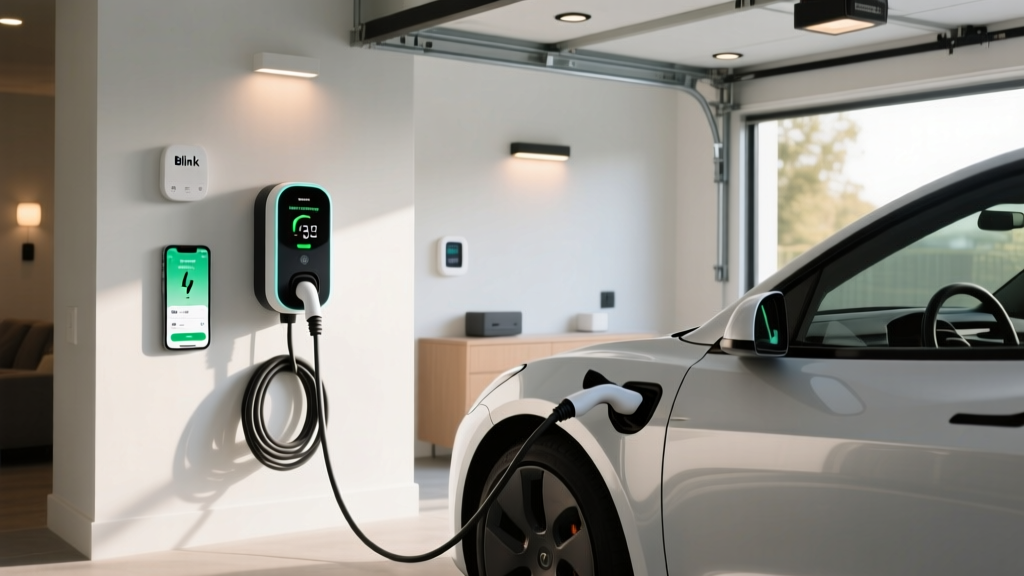
Blink offers two primary residential chargers for home installation in 2026:
Blink HQ 200
- Power: Up to 19.2 kW (80A) on a 100A circuit; also configurable to 48A (11.5 kW) or 40A (9.6 kW)
- Connector: J1772 (NACS adapter included or available)
- Cable length: 25 feet
- Smart features: Wi-Fi connected, Blink app scheduling, energy monitoring, load management
- Price: ~$649–$799 (unit only)
- Best for: Homes with 200A+ panels wanting maximum Level 2 speed
Blink HQ 150
- Power: Up to 40A / 9.6 kW on a 50A circuit
- Connector: J1772 (NACS adapter available)
- Cable length: 18 feet
- Smart features: Wi-Fi, Blink app, basic scheduling
- Price: ~$449–$549 (unit only)
- Best for: Standard home installs on a 50A breaker
Both units are NEMA 4-rated for indoor/outdoor use and are UL-listed for safety compliance. The HQ 200 is the stronger pick for EV owners with larger batteries (80+ kWh) who want a full overnight charge even in cold weather, when charging efficiency drops.
How Much Does It Cost to Install a Home EV Charger?
The charger itself is often the cheapest part of a home charging setup. Installation costs depend on your home's electrical panel capacity, the distance from the panel to the garage or driveway, and local permitting requirements. Here's a realistic breakdown for 2026:
| Component | Typical Cost Range | Notes |
|---|---|---|
| Charger unit (Blink HQ 150 or HQ 200) | $449–$799 | Varies by model and retailer |
| Electrician labor (standard install) | $500–$1,500 | Assumes panel is nearby, conduit run under 30 ft |
| Electrical permit | $50–$250 | Required in most jurisdictions; varies by municipality |
| 240V circuit (50A or 100A breaker + wiring) | $200–$600 | Materials: breaker, THHN wire, conduit, junction box |
| Panel upgrade (if needed) | $1,500–$4,000+ | Older homes with 100A service may need 200A upgrade |
| Total (no panel upgrade) | $1,200–$3,150 | Most common scenario for homes built after 2000 |
| Total (with panel upgrade) | $2,700–$6,500+ | Common in homes built before 1990 with 100A service |
What Electrical Upgrades Might I Need?
At minimum, you need a dedicated 240V circuit with the correct amperage breaker (50A for the HQ 150; 100A for the HQ 200 at full power). The National Electrical Code (NEC) requires EV chargers to be on a dedicated circuit — you cannot share it with other appliances. For outdoor installations, a GFCI (ground-fault circuit interrupter) breaker is required in most jurisdictions for safety. Your electrician will also ensure the wiring gauge matches the circuit: typically 6 AWG copper for a 50A circuit and 3 AWG copper (or 1 AWG aluminum) for a 100A circuit.
Connector Compatibility: Will Blink Work With My EV?
The North American charging connector landscape has shifted dramatically. Tesla opened its Supercharger network to non-Tesla EVs via the North American Charging Standard (NACS), and as of 2025–2026, most automakers have adopted NACS as the native connector on new vehicles. Here's how Blink fits in:
| Connector | EV Brands (2026 Models) | Blink Compatibility |
|---|---|---|
| NACS (Tesla-style) | Tesla (all), Ford, GM, Rivian, Volvo, Polestar, Nissan (new models) | Blink HQ 200 ships with NACS adapter; newer Blink stations offer native NACS cables |
| J1772 (Level 2 standard) | All EVs (with adapter for NACS vehicles) | Native on all Blink Level 2 stations and home chargers |
| CCS1 (DC fast) | Hyundai, Kia, BMW, VW, older Ford/GM models | Blink DC fast stations offer CCS1 connectors |
| CHAdeMO | Nissan Leaf (legacy), Mitsubishi Outlander PHEV | Limited — some older Blink DC stations retain CHAdeMO; being phased out |
If you drive a 2025+ Ford, GM, or Rivian with a native NACS port, you can use Blink's Level 2 stations with the included J1772-to-NACS adapter (most automakers include one in the vehicle). For Blink's DC fast chargers, look for the CCS1 or NACS cable on the unit. CHAdeMO is effectively a legacy connector in 2026 — if you drive a Nissan Leaf, plan your routes carefully, as CHAdeMO availability on new stations is declining.
How Much Does Charging Cost Per Mile vs. Gas?
One of the strongest arguments for home charging is cost. Here's a comparison using real 2026 electricity and fuel prices:
| Scenario | Rate | Cost per Mile (250 Wh/mi EV) | Cost per Mile (30 MPG Gas Car @ $3.40/gal) |
|---|---|---|---|
| Home (off-peak utility rate) | $0.10–$0.14/kWh | $0.025–$0.035 | $0.113 |
| Home (standard rate) | $0.15–$0.18/kWh | $0.038–$0.045 | $0.113 |
| Blink Level 2 (public) | $0.39–$0.59/kWh (varies) | $0.098–$0.148 | $0.113 |
| Blink DC Fast | $0.49–$0.69/kWh (varies) | $0.123–$0.173 | $0.113 |
The math is clear: home charging is 3–4x cheaper per mile than gasoline, even at standard residential rates. Public Blink Level 2 stations are often cost-competitive with gas, while Blink DC fast charging can exceed gas costs per mile. This is the core economic tradeoff of EV ownership — you save dramatically at home but pay a premium for public convenience.
One important caveat: Blink's pricing is set by the station owner (the property or business hosting the charger), not by Blink centrally. That means a Blink station at a hotel might charge $0.59/kWh while one at a municipal lot 5 miles away charges $0.39/kWh. Always check the Blink app or the station's screen before plugging in.
Using the Blink Network: App, Payment, and Reliability
To use Blink public stations, download the Blink app (iOS/Android), create an account, and add a payment method. You can start a session via the app, an RFID membership card, or (at newer stations) by tapping a credit card on the built-in reader. The app shows real-time station availability, pricing, and connector types.
In our experience and based on owner community reports, Blink's Level 2 station uptime is generally solid — roughly 92–95% operational availability — because Level 2 hardware is simpler and more robust than DC fast equipment. Blink's DC fast chargers have had more mixed reviews, with some owners reporting communication errors or connector issues at older installations. Blink has been rolling out its newer Blink Series 9 DC fast charger (up to 360 kW) which addresses many of these legacy reliability complaints.
Compared to Tesla's Supercharger network (consistently rated the most reliable) or Electrify America (improving but still criticized for payment glitches), Blink occupies a middle ground. Its strength is ubiquity at destination locations; its weakness is inconsistency in DC fast-charger maintenance across different host properties.
Safety, Code, and Installation Best Practices
Whether you choose Blink or another brand, every home EV charger installation must meet these requirements:
- Dedicated circuit: NEC Article 625 requires a dedicated branch circuit for EVSE — no sharing with other loads.
- GFCI protection: Required for all outdoor receptacles and hardwired EVSE installations in most jurisdictions (NEC 2023+).
- NEMA 4 rating: If installing outdoors, the charger enclosure must be rated for weather resistance (rain, snow, dust). Both Blink HQ models carry a NEMA 4 rating.
- Permitting: Most municipalities require an electrical permit for a new 240V circuit. Your electrician typically handles this, and an inspector will verify the work. Skipping the permit can void homeowner's insurance coverage for electrical fires.
- Load management: If your panel is near capacity, consider a charger with built-in load management (the Blink HQ 200 supports this) that dynamically adjusts charging amperage based on other household loads.
Is Blink Charging Right for You? Decision Framework
- You want a competitively priced smart charger with app scheduling and energy monitoring
- You need a 25-foot cable for driveway parking flexibility
- You value a U.S.-based company with publicly traded accountability
- Your local utility offers time-of-use rates you want to optimize via scheduling
- You need native NACS cable without an adapter (consider the Tesla Wall Connector or Emporia Vue)
- You want the absolute lowest-cost dumb charger (the Lectron V-BOX Pro at ~$320 is a budget alternative)
- You need V2H (vehicle-to-home) capability — Blink does not currently offer bidirectional charging hardware
Frequently Asked Questions
How much does it cost to install a Blink home charger?
Expect $1,200–$3,150 total for a standard installation (Blink HQ 150 or HQ 200 unit, electrician labor, permit, and wiring) if your electrical panel has sufficient capacity. If you need a panel upgrade from 100A to 200A service, add $1,500–$4,000+ to that total. Always get a load calculation from a licensed electrician before purchasing equipment.
How fast will a Blink Level 2 charger add range?
The Blink HQ 150 at 9.6 kW (40A) adds approximately 35–40 miles of range per hour for a typical EV consuming 250 Wh/mile. The Blink HQ 200 at 19.2 kW (80A) adds approximately 70–75 miles per hour. For context, an overnight charge (8 hours) on the HQ 150 replenishes roughly 280–320 miles — more than enough for any daily commute.
Can I use a Blink station with my Tesla?
Yes. Tesla vehicles can use Blink Level 2 stations with a J1772-to-Tesla adapter (included with every Tesla). For Blink DC fast chargers with a CCS1 connector, Tesla provides a CCS adapter (sold separately or included with newer models). Newer Blink stations are beginning to offer native NACS cables, eliminating the adapter requirement entirely.
How does Blink's public pricing compare to other networks?
Blink Level 2 stations typically charge $0.39–$0.59/kWh depending on the host property. That's comparable to ChargePoint ($0.35–$0.55/kWh) and generally less than Electrify America's DC fast rates ($0.48–$0.69/kWh). However, because Blink pricing is set by individual station hosts, always verify the rate on the Blink app before initiating a session.
Does Blink offer free charging anywhere?
Some Blink stations are subsidized by the host property (hotels, workplaces, shopping centers) and offer free Level 2 charging as an amenity. Use the Blink app's filter to search for free stations near you. Availability varies significantly by market — urban areas with strong EV adoption tend to have more free options.
Is Blink Charging eligible for the federal tax credit?
The IRS §30C Alternative Fuel Vehicle Refueling Property Credit offers up to $1,000 (30% of cost, capped) for home EV charger equipment and installation. Both the Blink HQ 150 and HQ 200 qualify when installed at your primary residence. Income caps and census-tract eligibility rules apply — consult a tax professional and review current IRS guidance before claiming.