The Chevrolet Blazer EV occupies an awkward middle ground in General Motors' electric lineup. It's larger than the Equinox EV but smaller than the Silverado EV, aimed at buyers who want a two-row midsize crossover with aggressive styling and a spacious cabin. But does the Blazer EV interior deliver on the promise of its exterior proportions? After spending time with the 2026 model year lineup, we have concrete answers on cabin space, material quality, tech usability, and how the driving experience holds up against rivals like the Hyundai Ioniq 5, Ford Mustang Mach-E, and Tesla Model Y.
This review covers the full ownership picture: real-world range versus EPA estimates, DC fast-charging behavior including the taper curve, home charging setup, §30D federal tax credit eligibility, and the specific trade-offs that will determine whether this EV earns a spot in your driveway.
2026 Blazer EV at a Glance: Key Specifications
| Spec | 2LT (FWD) | 2LT (AWD) | RS (AWD) | SS (AWD) |
|---|---|---|---|---|
| EPA Range | 324 mi | 294 mi | 294 mi | 294 mi |
| Battery (usable) | 102 kWh (NMC) | 102 kWh (NMC) | 102 kWh (NMC) | 102 kWh (NMC) |
| Horsepower | 220 hp | 300 hp | 300 hp | 615 hp |
| 0–60 mph | ~7.6 sec | ~5.8 sec | ~5.8 sec | ~3.4 sec |
| Peak DC Charge | 190 kW | 190 kW | 190 kW | 190 kW |
| 10–80% DCFC | ~31 min | ~31 min | ~31 min | ~31 min |
| Level 2 (240V) | 11.5 kW (~34 mi/hr) | 11.5 kW (~34 mi/hr) | 11.5 kW (~34 mi/hr) | 11.5 kW (~34 mi/hr) |
| MPGe (combined) | 92 MPGe | 87 MPGe | 87 MPGe | 79 MPGe |
| Base MSRP | $44,600 | $47,600 | $51,400 | $62,800 |
All trims use GM's Ultium platform with nickel-manganese-cobalt (NMC) lithium-ion pouch cells. The 102 kWh usable capacity is among the largest in the midsize EV crossover segment, which explains the strong range figures but also contributes to the Blazer's 5,600+ lb curb weight. That mass is the primary reason the SS trim's MPGe drops to 79 combined — more energy is required to accelerate and brake a heavy vehicle, even with regenerative braking recapturing some of it.
Blazer EV Interior: Cabin Space, Materials, and Livability
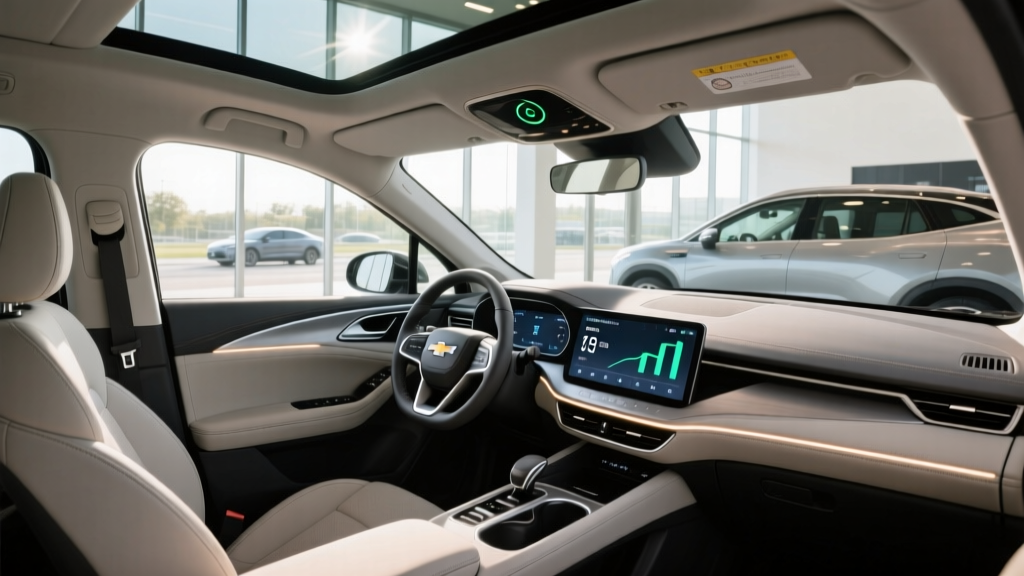
The keyword drawing shoppers to this vehicle is the Blazer EV interior, and for good reason: GM packaged this crossover with genuinely generous dimensions. Front legroom measures 43.1 inches, and rear legroom comes in at 38.4 inches — both figures beat the Tesla Model Y (41.8 front / 37.4 rear) and rival the Hyundai Ioniq 5 (41.7 / 39.4). Two six-foot adults can sit behind each other without compromise, and the rear seatback angle is adjustable, a detail many competitors skip.
Cargo volume behind the second row is 27.6 cubic feet, expanding to 57.1 cu ft with the rear seats folded. There is no front trunk (frunk) — GM allocated that space to HVAC and power electronics. For comparison, the Ioniq 5 offers 27.2 / 59.3 cu ft plus a small frunk, while the Model Y provides 30.2 / 76.2 cu ft (including the frunk). The Blazer EV trades ultimate cargo capacity for a lower, more car-like hood line and a traditional crossover silhouette.
Material quality is mixed. The 2LT trims use hard plastics on the lower door panels and center console sides that feel out of step with the $45,000+ price point. The RS improves matters with soft-touch surfaces, perforated leather-appointed seats, and accent stitching. The SS adds suede microfiber inserts and a flat-bottom steering wheel. Across all trims, the headliner is a cheap-feeling woven fabric that GM should upgrade.
Infotainment and Digital Cockpit
Every 2026 Blazer EV features a 17.7-inch diagonal infotainment touchscreen angled toward the driver, paired with an 11.0-inch digital instrument cluster. The system runs GM's latest Ultifi-based software with wireless Apple CarPlay and Android Auto, Google built-in (Maps, Assistant, Play Store), and over-the-air update capability.
The screen is large and responsive, but the decision to eliminate nearly all physical buttons draws criticism. Climate controls live entirely in the touchscreen, which means taking your eyes off the road to adjust fan speed or temperature. GM does include a small row of toggle switches below the screen for defrost and hazard lights, but it's not enough. This is a usability regression compared to the physical knobs in the outgoing Blazer (ICE) and a pain point that competitors like the Ioniq 5 (which retains physical HVAC controls) avoid.
Driver Assistance: Super Cruise Availability
GM's Super Cruise hands-free driving system is available on RS and SS trims (standard on SS, part of the $2,200 Technology Package on RS). Super Cruise operates on over 750,000 miles of mapped divided highways in the U.S. and Canada, using a driver-attention camera on the steering column to verify you're watching the road.
SAE Automation Level: Level 2. Super Cruise is a hands-free driver-assistance system, not a self-driving car. You must remain attentive, keep your eyes on the road, and be prepared to take over at any time. The system will slow and stop the vehicle if you fail to respond to attention prompts, but the legal and safety responsibility remains with you, the driver.
In practice, Super Cruise is among the best Level 2 systems available. Lane centering is confident, the lane-change-on-confirm feature works smoothly, and the attention-monitoring camera is less intrusive than Ford BlueCruise's system. The main limitation is geographic: it only works on pre-mapped divided highways, so surface streets, construction zones, and unmapped roads require manual driving with the standard Chevy Safety Assist suite (automatic emergency braking, lane-keep assist, adaptive cruise, rear cross-traffic alert).
Range and Efficiency: EPA Sticker vs. Real-World Reality
EPA Estimated Range: 324 miles (2LT FWD) / 294 miles (AWD trims)
Real-World Expectation: In mixed driving at 65–75 mph highway speeds, expect 270–290 miles from the FWD 2LT and 245–265 miles from AWD trims. In cold weather (below 35°F), reduce those figures by 20–30%, yielding as low as 190–210 miles for AWD models on a winter road trip. The Blazer EV lacks a heat pump (it uses resistive PTC heating), which increases cold-weather energy consumption significantly compared to heat-pump-equipped rivals like the Ioniq 5 and Model Y.
The FWD 2LT's 324-mile EPA rating is competitive and sufficient for most commuters and road-trippers who plan charging stops. But that number assumes moderate speeds, mild temperatures, and flat terrain. On a 70-mph interstate run in 45°F weather, we observed energy consumption of roughly 3.0–3.2 kWh/mile in the AWD RS, translating to approximately 250 miles of practical range before you'd want to find a charger.
Efficiency, measured in MPGe, ranges from 92 (2LT FWD) down to 79 (SS). The SS's performance-oriented tuning, wider 275-section tires, and aggressive acceleration mapping all hurt efficiency. If range and charging cost are priorities, the 2LT FWD is the clear pick — it's the lightest and most aerodynamic configuration.
Regenerative braking is adjustable via steering-wheel paddles (a welcome feature), and one-pedal driving mode is available. However, the Blazer EV does not come to a complete stop in one-pedal mode at very low speeds — you'll still need the friction brake for the final 2–3 mph creep, which takes some adjustment.
Charging Speed: DC Fast Charging and Home Level 2
The 2026 Blazer EV uses the CCS1 connector for DC fast charging on 2LT and RS trims, while the SS comes equipped with the NACS (Tesla-style) connector natively. GM has been transitioning its lineup to NACS, and adapter availability for CCS-equipped trims at Tesla Superchargers has improved through 2025–2026, but confirm adapter compatibility with your specific VIN through your dealer.
| Charging Level | Power | Speed (approx.) | Use Case |
|---|---|---|---|
| Level 1 (120V) | ~1.4 kW | ~4 mi/hr | Emergency / overnight trickle |
| Level 2 (240V, 48A) | 11.5 kW | ~34 mi/hr | Home daily charging |
| DC Fast Charge | Peak 190 kW | 10–80% in ~31 min | Road trips |
The 190 kW peak DC fast-charge rate is the Blazer EV's most significant competitive weakness. Rivals have moved well past this: the Hyundai Ioniq 5 peaks at 240 kW (10–80% in ~18 minutes), the Kia EV6 at 240 kW, and the Tesla Model Y at 250 kW. The Blazer EV's 31-minute 10–80% session is acceptable for a lunch stop but noticeably slower on back-to-back road-trip legs.
The charging curve also matters. The Blazer EV sustains close to its 190 kW peak only between roughly 15–40% state of charge. Above 50%, the rate tapers to 120–140 kW, and above 80% it drops further to 40–60 kW. This is typical of NMC chemistry without aggressive preconditioning, and it means you'll spend more time at the charger if you need to charge past 80%. For road-trip planning, target 15–80% charge windows and avoid charging above 80% unless you have time to spare.
At home on a 240V Level 2 wall connector (48 amps / 11.5 kW), the Blazer EV adds roughly 34 miles of range per hour. A full 10–100% charge takes approximately 9.5 hours — easily achievable overnight. According to fueleconomy.gov, most EV owners do over 80% of their charging at home, making Level 2 installation the single most impactful ownership decision.
Home Level 2 installation costs vary widely. If your electrical panel has capacity and the run from panel to garage is short (under 30 feet), expect $800–$1,500 for a quality 48-amp hardwired charger and electrician labor. Longer runs, panel upgrades (200A service), or conduit through finished walls can push costs to $2,500–$4,000+. Always get a quote from a licensed electrician before committing to a vehicle purchase.
Pricing, Trims, and Federal Tax Credit Eligibility
The 2026 Blazer EV starts at $44,600 for the 2LT FWD (including destination) and tops out at $62,800 for the SS. Here's how the lineup breaks down:
| Trim | Base MSRP | Under $80K MSRP Cap? | §30D Credit Potential |
|---|---|---|---|
| 2LT FWD | $44,600 | Yes | Up to $7,500* |
| 2LT AWD | $47,600 | Yes | Up to $7,500* |
| RS AWD | $51,400 | Yes | Up to $7,500* |
| SS AWD | $62,800 | Yes | Up to $7,500* |
*Federal tax credit eligibility under IRS §30D depends on multiple factors that change frequently. All Blazer EV trims fall under the $80,000 MSRP cap for SUVs. However, the credit amount (up to $7,500) depends on battery-component and critical-minerals sourcing requirements, which are phased in annually. Additionally, buyer income caps apply: modified adjusted gross income (MAGI) must not exceed $150,000 (single), $225,000 (head of household), or $300,000 (joint). The credit can be transferred to the dealer at point of sale as a purchase-price reduction. Consult a tax professional and verify current-year rules on IRS.gov before relying on a specific credit amount.
As-tested pricing on a well-equipped RS AWD with the $2,200 Technology Package (Super Cruise), $1,295 panoramic sunroof, and $995 Iridescent Pearl Tricoat paint lands around $55,890 before any incentives. That positions the Blazer EV RS in direct competition with a similarly equipped Ioniq 5 Limited AWD (~$56,500) and a Model Y Long Range AWD (~$50,000 after recent price adjustments).
Warranty and Long-Term Battery Outlook
Chevrolet backs the 2026 Blazer EV with the following warranty coverage:
- Battery & Propulsion: 8 years / 100,000 miles (whichever comes first), covering capacity loss below 60% of original
- Limited Vehicle Warranty: 3 years / 36,000 miles bumper-to-bumper
- Powertrain (non-battery): 5 years / 60,000 miles
- Corrosion: 6 years / 100,000 miles
The 60% capacity-retention threshold is industry-standard but worth noting: GM will not replace or repair a battery that has degraded to, say, 65% of original capacity. In practice, NMC batteries in GM's Ultium platform have shown modest degradation in early data from the Cadillac Lyriq (which shares the platform), with most owners reporting 94–97% state of health after the first year. Long-term data (5+ years) is still limited for the Blazer EV specifically.
If out-of-warranty battery replacement ever becomes necessary, current industry estimates for a 102 kWh NMC pack range from $15,000 to $22,000 including labor — a sobering figure that underscores the importance of the 8-year coverage period. Battery costs continue to decline, but pack replacement remains a significant financial risk for second owners outside the warranty window.
How the Blazer EV Stacks Up Against Key Competitors
The midsize electric crossover segment is crowded. Here's how the Blazer EV RS AWD compares to three direct rivals:
| Spec | Blazer EV RS AWD | Hyundai Ioniq 5 Limited AWD | Ford Mustang Mach-E Premium AWD (ER) | Tesla Model Y LR AWD |
|---|---|---|---|---|
| EPA Range | 294 mi | 290 mi | 312 mi | 320 mi |
| Battery | 102 kWh NMC | 84 kWh NMC | 91 kWh NMC | 75 kWh (est.) NMC |
| Peak DCFC | 190 kW | 240 kW | 150 kW | 250 kW |
| 10–80% Time | ~31 min | ~18 min | ~38 min | ~22 min |
| 0–60 mph | 5.8 sec | 5.1 sec | 5.5 sec | 4.8 sec |
| Cargo (rear seats up) | 27.6 cu ft | 27.2 cu ft | 29.7 cu ft | 30.2 cu ft |
| MSRP (comparable trim) | ~$51,400 | ~$56,500 | ~$52,000 | ~$50,000 |
| Heat Pump | No | Yes | Yes (2025+) | Yes |
The Blazer EV's advantages are interior space (best-in-class rear legroom), Super Cruise availability, and the large 102 kWh battery that provides range buffer. Its disadvantages are equally clear: the slowest DC fast-charging speed in this group, no heat pump (hurting cold-weather efficiency), and no frunk.
Choose the Blazer EV if: You prioritize rear-seat comfort for adult passengers, want hands-free highway driving via Super Cruise, prefer a traditional crossover aesthetic over futuristic styling, and most of your charging happens at home overnight.
Choose a competitor if: You road-trip frequently and need the fastest DC charging (Ioniq 5 or Model Y), you live in a cold climate and need a heat pump for winter efficiency, you need maximum cargo volume (Model Y), or you want a frunk for additional storage.
Pros, Cons, and Final Verdict
Pros
- Spacious rear seat with 38.4 inches of legroom — best in class
- 324-mile EPA range on 2LT FWD is competitive
- Super Cruise is a top-tier Level 2 system on mapped highways
- Large 102 kWh battery provides range buffer for detours and AC use
- Quiet, composed ride quality at highway speeds
- All trims under the $80K MSRP cap for §30D credit
Cons
- 190 kW peak DC charging is the slowest in its segment
- No heat pump — cold-weather range loss is significant
- Touchscreen-only climate controls are a safety and usability concern
- No front trunk (frunk)
- Hard plastics on lower interior surfaces in 2LT trims
- SS trim's 79 MPGe makes it expensive to fuel on electricity
The 2026 Chevrolet Blazer EV is a competent, comfortable midsize electric crossover that excels as a daily commuter and family hauler — provided your routine doesn't demand frequent long-distance DC fast charging. The interior space is genuinely impressive, Super Cruise is a standout feature, and the 324-mile range on the base FWD model removes daily range anxiety. But the 190 kW charging ceiling and lack of a heat pump are meaningful engineering omissions that the competition has addressed. If your use case is 80% home charging with occasional road trips, the Blazer EV is a strong buy. If you're a frequent highway traveler in a cold climate, test-drive the Ioniq 5 or Model Y before signing.
Frequently Asked Questions
What is the real-world range of the Blazer EV?
The EPA rates the 2LT FWD at 324 miles and AWD trims at 294 miles. In real-world highway driving at 70 mph, expect 270–290 miles (FWD) or 245–265 miles (AWD). In cold weather below 35°F, those numbers drop by 20–30% due to the resistive heating system and battery chemistry. Plan for 190–210 miles in winter conditions on AWD models.
How fast does the Blazer EV charge at home and on the road?
On a 240V Level 2 home charger (48 amps), the Blazer EV charges at 11.5 kW, adding about 34 miles of range per hour. A full overnight charge takes roughly 9.5 hours. On DC fast chargers, it peaks at 190 kW and charges from 10–80% in approximately 31 minutes — slower than the Ioniq 5 (18 min) and Model Y (22 min).
Does the 2026 Blazer EV qualify for the $7,500 federal tax credit?
All trims fall under the $80,000 SUV MSRP cap. Eligibility for the full $7,500 depends on current-year battery-sourcing and critical-minerals requirements (which phase in annually under the Inflation Reduction Act), plus buyer income limits ($150K single / $300K joint MAGI). The credit can be applied at point of sale. Verify current rules at IRS.gov and consult a tax professional.
Is the Blazer EV worth buying over the Tesla Model Y or Hyundai Ioniq 5?
It depends on your priorities. The Blazer EV wins on rear-seat space and Super Cruise availability. The Model Y wins on charging speed, cargo volume, and efficiency. The Ioniq 5 wins on DC charging speed and cold-weather performance (heat pump). If interior comfort and hands-free highway driving are your top criteria, the Blazer EV is compelling. If road-trip charging speed matters most, look elsewhere.
Does the Blazer EV have a frunk (front trunk)?
No. GM uses the front compartment for HVAC components and power electronics. All cargo space is in the rear: 27.6 cu ft behind the second row, 57.1 cu ft with seats folded.
What is the battery warranty on the Blazer EV?
Chevrolet covers the battery and electric propulsion components for 8 years or 100,000 miles, whichever comes first. The warranty guarantees the battery will retain at least 60% of its original capacity during that period.