Quick Verdict: A Spacious Midsize EV With a Few Quirks
The 2026 Chevrolet Blazer EV slots into one of the most competitive segments in the electric-vehicle market — the midsize two-row electric crossover. Buyers searching for Blazer EV dimensions are typically cross-shopping it against the Hyundai Ioniq 5, Ford Mustang Mach-E, and Tesla Model Y, all of which offer similar footprints but very different packaging philosophies. The Blazer EV leans into its traditional SUV proportions: it's longer, wider, and more conventionally styled than its dedicated-EV-platform rivals, which translates to generous interior volume but also a heavier curb weight that impacts efficiency and range.
After spending time with the 2026 Blazer EV across multiple trims, our take is that it excels as a comfortable daily driver and family hauler with standout interior space, but its charging performance and real-world efficiency trail the best in class. If cabin room and a familiar SUV driving position are your top priorities, the Blazer EV deserves a serious look. If you want maximum range per dollar or the fastest DC charging in the segment, keep cross-shopping.
Blazer EV Dimensions and Exterior Footprint
Chevrolet built the Blazer EV on GM's Ultium platform (BEV3 architecture), which uses a skateboard-style battery pack beneath the floor. Despite sharing underpinnings with more futuristic-looking EVs, the Blazer EV wears a conventional crossover body that prioritizes interior space over aerodynamic optimization. Here's how the exterior measurements break down:
| Measurement | Blazer EV | Hyundai Ioniq 5 | Ford Mustang Mach-E |
|---|---|---|---|
| Wheelbase | 121.8 in | 118.1 in | 117.5 in |
| Overall Length | 191.5 in | 182.7 in | 186.7 in |
| Overall Width (w/o mirrors) | 77.8 in | 74.4 in | 74.1 in |
| Overall Height | 64.2 in | 63.0 in | 63.9 in |
| Ground Clearance | 7.9 in | 6.1 in | 5.7 in |
| Curb Weight (AWD) | ~5,600 lbs | ~4,600 lbs | ~4,900 lbs |
The Blazer EV's 121.8-inch wheelbase is notably long for this class, and Chevrolet uses that length to deliver excellent rear-seat legroom. The 7.9 inches of ground clearance also gives it an edge over lower-riding competitors if you deal with steep driveways or light unpaved roads. The tradeoff: that extra size and weight — roughly 700-1,000 lbs more than an Ioniq 5 — works against efficiency, as we'll see in the range section.
Interior Space: Cargo Volume, Legroom, and Passenger Comfort
This is where the Blazer EV's dimensions pay dividends. The cabin feels genuinely roomy, with a commanding seating position and ample shoulder room up front. Rear passengers benefit from the long wheelbase with generous knee clearance and a nearly flat floor thanks to the Ultium skateboard architecture.
| Dimension | Specification |
|---|---|
| Front Headroom | 40.3 in |
| Front Legroom | 43.1 in |
| Rear Headroom | 38.7 in |
| Rear Legroom | 39.0 in |
| Cargo Volume (behind 2nd row) | 27.8 cu ft |
| Cargo Volume (2nd row folded) | 59.3 cu ft |
| Front Trunk (Frunk) | Not available |
The 27.8 cubic feet of cargo space behind the rear seats is competitive with the segment, and the 59.3 cu ft with seats folded is solid for weekend gear runs or a Costco haul. However, the absence of a frunk is a notable omission — the Ioniq 5 and Mach-E both offer front trunks for additional storage. Chevrolet packaged the power electronics and HVAC components under the hood instead, which is a common Ultium-platform decision but limits utility for smaller items you'd want separated from the main cargo area.
Seat comfort is a strong point. The available ventilated front seats and heated rear seats are well-bolstered, and the cabin materials in the RS and SS trims feel appropriately premium for the price point. Road noise insulation is above average for the segment.
Battery, Range, and Efficiency
The 2026 Blazer EV uses GM's Ultium battery modules with NMC (nickel manganese cobalt) chemistry. The standard battery pack provides approximately 85 kWh of usable capacity in the 2LT and RS trims, while the performance-oriented SS trim carries a larger pack at roughly 102 kWh usable.
Blazer EV 2LT (RWD): EPA 293 miles — Expect ~245–265 miles on sustained highway driving at 70+ mph; ~220–240 miles in freezing temperatures with cabin heat.
Blazer EV RS (AWD): EPA 279 miles — Expect ~230–250 miles highway; ~205–225 miles in cold weather.
Blazer EV SS (AWD): EPA 292 miles — Expect ~240–260 miles highway; ~215–235 miles in cold weather.
The Blazer EV's boxy styling and 5,600-lb curb weight create real aerodynamic and mass penalties at highway speeds. City driving with regenerative braking recovers more energy, so mixed commuting will trend closer to EPA numbers than long road trips.
Efficiency ratings from fueleconomy.gov place the RWD 2LT at approximately 97 MPGe combined (roughly 34 kWh/100 mi), while AWD trims drop to about 89–92 MPGe combined (37–39 kWh/100 mi). These figures trail the Hyundai Ioniq 5 AWD (around 110 MPGe) and the Tesla Model Y Long Range (around 122 MPGe), reflecting the Blazer EV's weight and less aerodynamic profile.
Charging Speed: DC Fast Charging and Home Level 2
Charging is where buyer expectations need careful calibration. The Blazer EV supports DC fast charging at a peak rate of approximately 190 kW on the larger battery pack. That's respectable but not class-leading — the Ioniq 5 and Kia EV6 can peak at 240+ kW on 800V architectures, and the Tesla Model Y sustains strong rates on the Supercharger network.
| Charging Method | Rate | Speed / Time |
|---|---|---|
| Level 1 (120V household) | ~1.4 kW | ~3–4 miles per hour |
| Level 2 (240V, 48A home charger) | 11.5 kW | ~28–31 miles per hour |
| Level 2 (240V, 32A portable) | 7.7 kW | ~19–21 miles per hour |
| DC Fast Charge (peak) | 190 kW | 10–80% in ~32 minutes |
| DC Fast Charge (sustained avg.) | ~120–130 kW | ~180 miles in 30 min |
The critical nuance here is the charge curve. Like most NMC-based Ultium vehicles, the Blazer EV hits its 190 kW peak only between roughly 10–30% state of charge, then tapers progressively. From 50–80%, expect rates closer to 80–100 kW. On a road trip, this means your 10–80% session takes about 32 minutes — acceptable but noticeably longer than the 18-minute sessions you'll get in an Ioniq 5 or EV6.
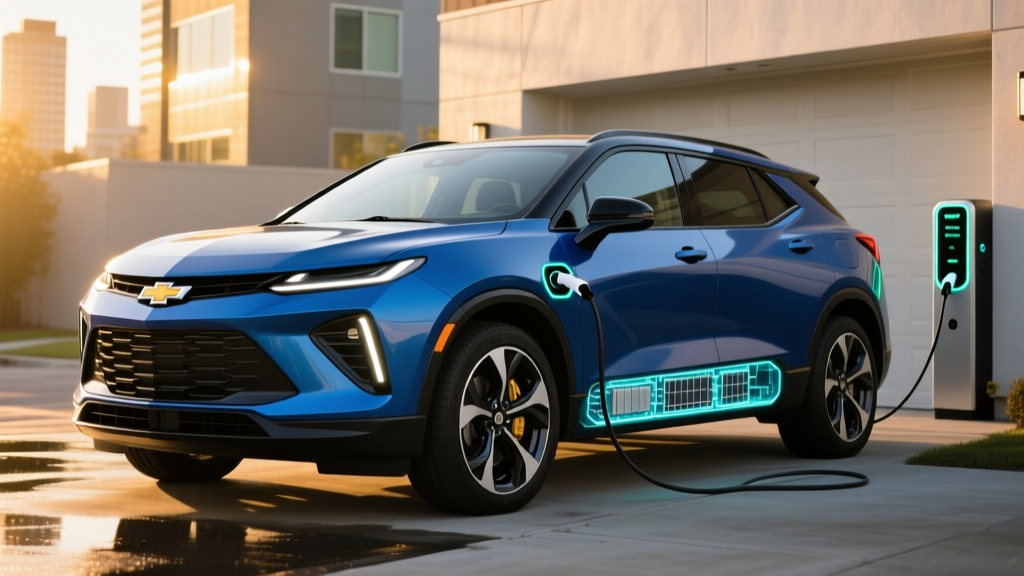
For home charging, the 11.5 kW Level 2 rate (on a hardwired 48-amp, 240V circuit) is practical: a full overnight charge from 20% to 100% takes roughly 7 hours. You'll need a NACS (North American Charging Standard) connector for 2026 models, as GM completed its transition to NACS for all new EVs. A quality Level 2 home charger installation typically runs $800–$2,000 total (equipment plus licensed electrician), depending on your panel capacity and run distance.
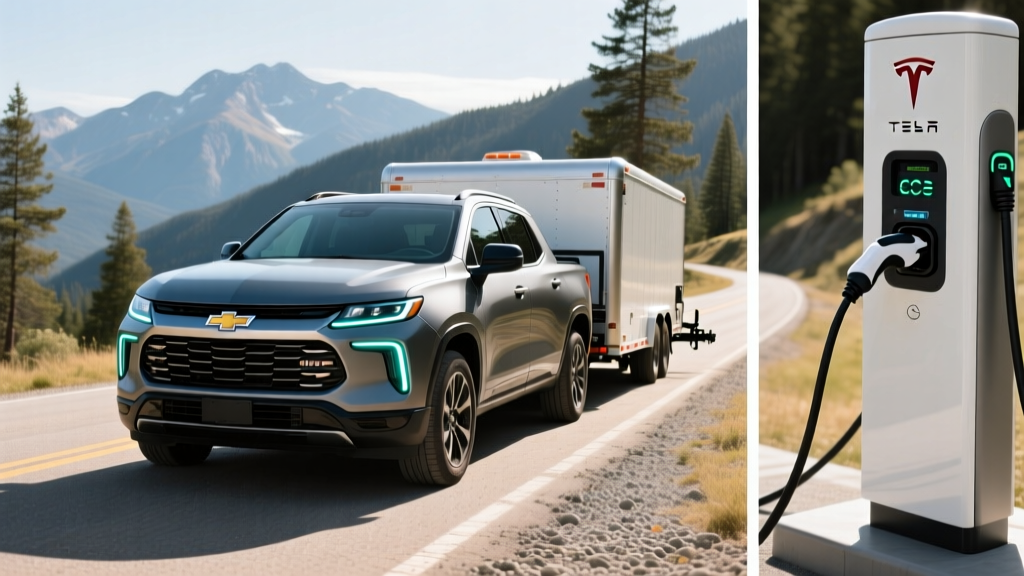
For public DC fast charging, the NACS connector gives you native access to Tesla Supercharger stations (now open to non-Tesla EVs via the NACS standard), which is a significant network advantage in 2026. You'll also find CCS-to-NACS adapters useful at legacy Electrify America and EVgo stations that haven't fully transitioned.
Performance and Drivetrain
The 2026 Blazer EV offers three distinct drivetrain configurations depending on trim:
| Trim | Drivetrain | Horsepower | Torque (lb-ft) | 0–60 mph |
|---|---|---|---|---|
| 2LT | RWD (rear motor) | 288 hp | 325 | ~6.8 sec |
| RS | AWD (dual motor) | 340 hp | 325 | ~5.6 sec |
| SS | AWD (dual motor, performance) | 557 hp | 648 | ~3.9 sec |
The RWD 2LT is the efficiency play — lighter, slightly longer range, and adequate acceleration for merging and passing. The RS AWD adds all-weather capability and a modest power bump. The SS is the headline performer: 557 hp and a sub-4-second 0–60 time make it genuinely quick, rivaling the Tesla Model Y Performance and Ford Mustang Mach-E GT.
Ride quality across all trims is composed and comfortable, with well-tuned damping that absorbs highway expansion joints without feeling floaty. Steering is light and predictable — this is a cruiser, not a canyon carver, even in SS trim. Regenerative braking offers multiple modes including a one-pedal driving option that brings the vehicle to a complete stop, though the brake pedal feel under blended regen-to-friction transitions could be more linear.
Pricing, Trims, and Federal Tax Credit
The 2026 Blazer EV lineup starts in the mid-$40,000s and climbs to the low $60,000s for the SS. Here's the trim-by-trim breakdown with current pricing:
| Trim | Base MSRP | As-Tested (typical) | §30D Credit Eligible? |
|---|---|---|---|
| 2LT (RWD) | $44,600 | $47,500 | Up to $7,500* |
| RS (AWD) | $49,400 | $53,800 | Up to $7,500* |
| SS (AWD) | $60,600 | $63,200 | Up to $7,500* |
*Federal tax credit eligibility under IRS §30D depends on multiple factors that change periodically. As of 2026, key requirements include:
- MSRP cap: SUVs/crossovers must be under $80,000 — all Blazer EV trims qualify.
- Buyer income cap: Modified AGI must not exceed $150,000 (single), $225,000 (head of household), or $300,000 (joint filers).
- Battery sourcing: A percentage of critical minerals and battery components must be sourced from the U.S. or free-trade-agreement countries. GM has worked to qualify the Ultium packs, but sourcing rules tighten annually — verify current-year eligibility at the point of sale.
- Point-of-sale transfer: As of 2024+, you can transfer the credit to the dealer at purchase for an immediate price reduction rather than waiting to claim it on your tax return.
We recommend confirming your specific eligibility with a tax professional and checking the latest fueleconomy.gov tax credit database before purchasing, as battery-component sourcing determinations can shift mid-year.
Technology, Safety, and Driver Assistance
The Blazer EV's cabin tech centers on a 17.7-inch diagonal infotainment touchscreen running Google Built-In, which includes native Google Maps navigation, Google Assistant voice control, and access to the Play Store for apps. The system is responsive and the large display is easy to read in direct sunlight, though some users may find the heavy reliance on touchscreen controls (with few physical buttons for climate) distracting while driving.
A 11.0-inch digital driver display sits behind the steering wheel, offering configurable layouts for range, navigation, and driver-assist information.
Standard driver-assistance features under the Chevy Safety Assist suite include:
- Automatic emergency braking with pedestrian detection
- Lane-keeping assist with lane-departure warning
- Adaptive cruise control
- Blind-spot monitoring with rear cross-traffic alert
- Rear parking sensors with automatic braking
Available Super Cruise — GM's hands-off-wheel, eyes-on-road Level 2 driver-assistance system — is offered on RS and SS trims. It enables hands-free driving on over 750,000 miles of compatible pre-mapped highways in North America. This is a genuine differentiator for frequent highway commuters. However, it remains a Level 2 system requiring continuous driver attention — it is not autonomous driving.
Safety ratings from NHTSA and IIHS should be verified for the specific 2026 model year at time of purchase, as testing protocols and ratings are updated continuously.
Warranty Coverage
| Coverage | Term |
|---|---|
| Bumper-to-Bumper | 3 years / 36,000 miles |
| Powertrain | 5 years / 60,000 miles |
| Battery Pack | 8 years / 100,000 miles |
| Battery Capacity Retention | Minimum 70% over 8 yr / 100k mi |
| Corrosion | 6 years / 100,000 miles |
| Roadside Assistance | 5 years / 60,000 miles |
The 8-year/100,000-mile battery warranty with a 70% capacity retention threshold is industry-standard and aligns with federal requirements. GM's Ultium packs have shown promising early degradation data, with most owners reporting less than 5% capacity loss in the first two years of ownership — though long-term data across high-mileage examples is still maturing.
Pros and Cons
Pros
- Spacious cabin with class-leading rear legroom
- Comfortable ride quality and strong noise insulation
- SS trim delivers genuine sports-car acceleration (3.9s 0–60)
- Super Cruise hands-free driving on mapped highways
- NACS connector for native Tesla Supercharger access
- All trims under the $80K MSRP cap for §30D credit
- High ground clearance for the segment (7.9 in)
Cons
- No front trunk (frunk) — lost utility vs. competitors
- DC charging peaks at 190 kW — slower than 800V rivals
- Heavy curb weight hurts efficiency (89–97 MPGe)
- Real-world highway range noticeably below EPA sticker
- Limited physical buttons — heavy touchscreen reliance
- Software refinement still catching up to Tesla/Hyundai
- RWD-only base trim limits all-weather appeal
Who Should Buy the 2026 Blazer EV?
- You prioritize interior space and a traditional SUV seating position over sporty handling
- You need rear-seat comfort for adults or tall teens on a regular basis
- You commute on Super Cruise-compatible highways and want hands-free assist
- You value access to the Tesla Supercharger network via NACS
- You want SS-level performance without paying Porsche or BMW EV prices
- Maximum range and efficiency are your top priorities (consider Ioniq 5 or Model Y)
- You take frequent 300+ mile road trips and want the fastest possible DC charging
- You need a frunk for gear separation or front storage
- You prefer physical climate controls over touchscreen-only operation
Frequently Asked Questions
What is the real-world range of the 2026 Blazer EV?
The EPA rates the RWD 2LT at 293 miles, the AWD RS at 279 miles, and the SS at 292 miles. In real-world highway driving at 70+ mph, expect roughly 15–18% less than the EPA sticker — so around 240–265 miles depending on trim. Cold weather (below 32°F) can reduce range an additional 15–25% due to cabin heating demands and battery chemistry limitations. City driving with regenerative braking will trend closer to EPA numbers.
How fast does the Blazer EV charge at home and on the road?
At home on a 240V Level 2 charger (48A hardwired), the Blazer EV charges at 11.5 kW, adding roughly 28–31 miles of range per hour — a full overnight charge is practical. On DC fast chargers, it peaks at 190 kW and achieves a 10–80% charge in approximately 32 minutes. The charge curve tapers significantly above 50% SoC, so road-trip planning should account for sustained rates closer to 120–130 kW on average.
Does the 2026 Blazer EV qualify for the $7,500 federal tax credit?
All trims fall under the $80,000 MSRP cap for SUVs, making them potentially eligible. However, the full $7,500 credit depends on your income (AGI caps apply), the battery's critical-mineral and component sourcing compliance for the current tax year, and whether you've already reached your lifetime credit limit. The credit can be transferred to the dealer at point of sale for an immediate price reduction. Confirm eligibility with your tax advisor and check IRS.gov for the latest rules.
Is the Blazer EV worth buying vs. the Ioniq 5, Mach-E, or Model Y?
It depends on your priorities. The Blazer EV wins on interior volume, ride comfort, and available Super Cruise. The Ioniq 5 wins on charging speed (800V architecture, ~18 min 10–80%) and efficiency. The Model Y wins on range, Supercharger network maturity, and software polish. The Mach-E is a sportier handler but has less rear-seat room. Test-drive all four — the Blazer EV's comfort and space may outweigh its efficiency trade-offs for your specific commute and family needs.
Does the Blazer EV have a frunk?
No. The 2026 Blazer EV does not include a front trunk. The space under the hood houses power electronics, the onboard charger, and HVAC components. All cargo must go in the 27.8 cu ft rear cargo area (59.3 cu ft with seats folded).
What connector does the 2026 Blazer EV use?
The 2026 model year uses the NACS (North American Charging Standard) connector natively, giving direct access to Tesla Supercharger stations without an adapter. For legacy CCS1 public chargers, a NACS-to-CCS adapter may be needed — check with your dealer for included adapter availability.