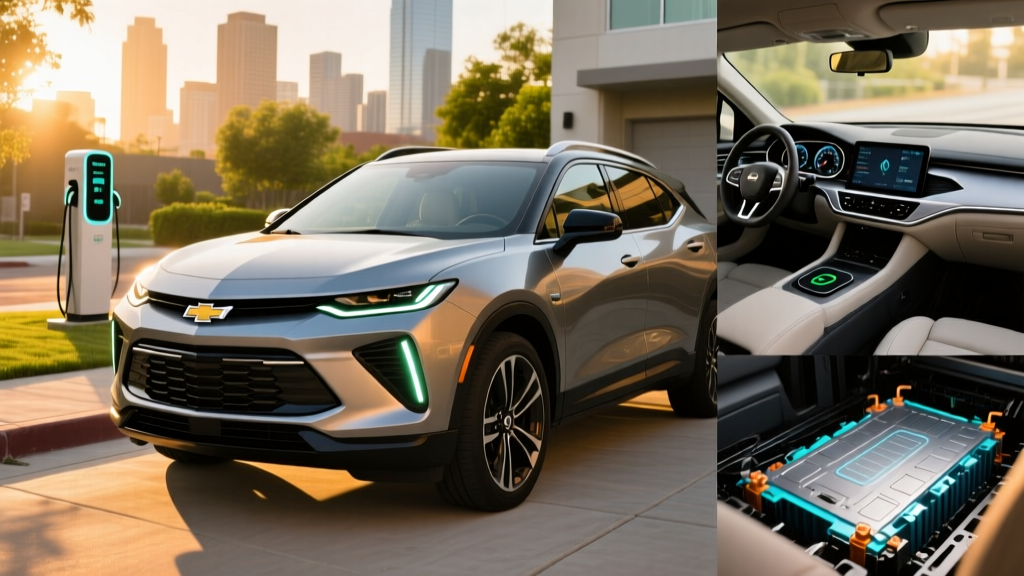
Quick Answer: The 2026 Chevrolet Blazer EV is a midsize electric crossover with up to 324 miles of EPA-estimated range (FWD trim), a 102 kWh usable Ultium battery, and DC fast charging that peaks at 190 kW (10–80% in roughly 30 minutes). Base pricing starts around $44,600 before destination. It qualifies for up to $7,500 in federal tax credits under IRS §30D if you meet income, MSRP, and battery-sourcing requirements — and the credit can transfer to the dealer at point of sale. Real-world highway range drops to approximately 250–270 miles, and cold-weather driving can shave another 15–25% off that figure.
What the Blazer EV Actually Offers in 2026
Chevrolet positioned the Blazer EV as a mainstream two-row midsize crossover built on GM's Ultium platform — the same architecture underpinning the Cadillac Lyriq and GMC Sierra EV. For the 2026 model year, the Blazer EV is available in LT, RS, and SS trims with front-wheel drive, all-wheel drive, and the performance-oriented SS AWD configuration.
| Spec | LT FWD | RS AWD | SS AWD |
|---|---|---|---|
| EPA Range | 324 mi | 283 mi | 293 mi |
| Battery (usable) | 102 kWh (NMC) | 102 kWh (NMC) | 102 kWh (NMC) |
| Horsepower | 340 hp | 288 hp | 557 hp |
| 0–60 mph | ~6.8 sec | ~7.0 sec | ~4.0 sec |
| Peak DC Charge Rate | 190 kW | 190 kW | 190 kW |
| 10–80% DC Fast Charge | ~30 min | ~30 min | ~30 min |
| Level 2 (240V / 48A) | 11.5 kW | 11.5 kW | 11.5 kW |
| Base MSRP | $44,600 | $48,600 | $56,200 |
| EPA MPGe (combined) | 93 MPGe | 87 MPGe | 89 MPGe |
| Battery Warranty | 8 yr / 100,000 mi | 8 yr / 100,000 mi | 8 yr / 100,000 mi |
The 102 kWh NMC (nickel-manganese-cobalt) Ultium pack is liquid-cooled with active thermal management. Chevrolet's battery warranty guarantees that capacity will not fall below 70% of original within the 8-year / 100,000-mile coverage window, per Chevrolet's official configurator.
Real-World Range Reality: The EPA sticker says 324 miles for the LT FWD, but expect roughly 250–270 miles at sustained 70–75 mph highway speeds. In freezing temperatures (below 32°F), range can drop another 15–25%, putting a realistic cold-weather highway figure around 200–220 miles. Preconditioning the battery while plugged in mitigates some of this loss and also improves DC fast-charge speeds.
Charging the Blazer EV: Home and Public Networks
The Blazer EV uses the NACS (North American Charging Standard) connector natively on 2026 models, giving it direct access to Tesla Supercharger stalls equipped with NACS cables — a significant practical advantage over older CCS-only vehicles. For Electrify America and other CCS-only networks, GM provides an adapter.
Home Charging Setup
Level 2 home charging at 11.5 kW (48 amps on a 240V / 60A circuit) adds roughly 35 miles of range per hour. A full 10–100% charge from a depleted state takes approximately 9.5 hours — practical for overnight charging if you have a Level 2 wallbox installed.
If you're only using a standard 120V outlet (Level 1), expect about 1.3 kW and roughly 4 miles of range per hour. That's enough for overnight replenishment only if your daily driving stays under 30–40 miles. For most Blazer EV owners, a Level 2 home installation is essential.
Typical Level 2 Home Install Costs:
- Level 2 wallbox (Emporia, ChargePoint, Wallbox): $400–$700
- Electrician labor + 240V circuit run: $500–$2,000
- Electrical panel upgrade (if needed for 200A service): $1,500–$3,500
- Permit and inspection: $50–$300
- Total typical range: $950–$2,500 (without panel upgrade); $2,500–$6,000 (with panel upgrade)
Always have a licensed electrician assess your panel capacity before committing to equipment. A 200-amp panel is generally sufficient for a 48A EV circuit plus normal household loads, but older homes with 100A or 150A service may need an upgrade.
DC Fast Charging in Practice
The Blazer EV's 190 kW peak charge rate is competitive but not class-leading. The Hyundai Ioniq 5, for example, peaks at 240 kW on an 800V architecture and completes 10–80% in about 18 minutes. The Blazer EV takes roughly 30 minutes for the same 10–80% session.
Critically, 190 kW is a peak rate, not a sustained one. Expect the Blazer EV to hold approximately 150–170 kW between 10–50% state of charge, then taper progressively through 50–80%. Above 80%, the charge rate drops sharply — a characteristic of all lithium-ion batteries to protect cell longevity. Plan your road-trip stops around the 10–80% window rather than topping off to 100%.
Blazer EV vs. Gas Blazer: Cost of Ownership Breakdown
The most common question from shoppers cross-referencing the Blazer EV against the gas-powered Blazer is whether the electric version saves money. Here's a data-driven comparison based on 15,000 miles per year, $0.14/kWh average home electricity, $3.40/gallon regular unleaded, and the gas Blazer's 24 MPG combined EPA rating (per fueleconomy.gov).
| Category | Blazer EV (LT FWD) | Gas Blazer (2LT AWD) |
|---|---|---|
| Base MSRP | $44,600 | $42,400 |
| Federal Tax Credit (§30D) | −$7,500* | $0 |
| Effective Purchase Price | $37,100 | $42,400 |
| Fuel/Energy (5 years) | $4,725 | $10,625 |
| Maintenance (5 years) | ~$1,800 | ~$3,500 |
| Insurance (5 years, avg) | ~$9,500 | ~$8,200 |
| Total 5-Year Cost | ~$53,125 | ~$64,725 |
| Cost Per Mile | ~$0.71 | ~$0.86 |
*Tax credit eligibility depends on your modified adjusted gross income, the vehicle's battery sourcing compliance, and MSRP caps. Confirm eligibility via IRS §30D guidelines or a tax professional.
The Blazer EV comes out approximately $11,600 ahead over five years, driven primarily by the tax credit and lower energy and maintenance costs. However, EV insurance premiums tend to run 10–20% higher than comparable gas vehicles — a factor that narrows the gap. Depreciation is not included here because EV residual values remain volatile and trim-dependent.
| Factor | Blazer EV | Gas Blazer |
|---|---|---|
| Energy Cost Per Mile | ~$0.063 (home charging) | ~$0.142 |
| Refueling/Recharging Time | 8–10 hrs (home L2); 30 min (DC fast) | 5 min (gas station) |
| Oil Changes | None | 2–3 per year |
| Brake Wear | Minimal (regen braking) | Standard replacement cycle |
| Cargo Space (rear seats up) | 25.5 cu ft | 30.3 cu ft |
| Towing Capacity | 1,500 lbs | 4,500 lbs |
The gas Blazer retains advantages in towing (4,500 lbs vs. 1,500 lbs) and cargo volume. If you regularly tow a boat or camper, the gas model remains the practical choice. For daily commuting and grocery-hauling, the EV's lower running costs dominate.
Federal Tax Credit: Does the Blazer EV Qualify?
Under current IRS §30D rules, the Blazer EV may qualify for up to $7,500 in federal tax credits, but eligibility is not automatic. The credit is split into two $3,750 halves based on critical-mineral sourcing and battery-component manufacturing requirements. GM has worked to shift Ultium battery sourcing to North America, and the Blazer EV has generally qualified for the full $7,500 — but supply-chain shifts can change this on short notice.
- Income cap: MAGI must not exceed $150,000 (single), $225,000 (head of household), or $300,000 (joint filers)
- MSRP cap: SUVs/crossovers must not exceed $80,000 — all Blazer EV trims clear this threshold
- Point-of-sale transfer: You can transfer the credit to the dealer at purchase, reducing your out-of-pocket cost immediately rather than waiting for a tax refund
- Battery sourcing: Check the current critical-mineral and component requirements on fueleconomy.gov before purchasing, as eligibility can shift between model years
If you don't qualify for the federal credit due to income limits, check your state's EV incentive programs — many states offer rebates of $1,000–$5,000 that stack independently.
Common Misconceptions About the Blazer EV
| Myth | Fact |
|---|---|
| "The battery will need replacing in 5 years." | GM's Ultium batteries are warrantied for 8 years/100,000 miles at ≥70% capacity. Industry data shows most NMC packs retain 85–90% capacity at 100,000 miles. |
| "I can't road-trip in an EV." | With 283–324 miles of range and NACS access to Tesla Superchargers, the Blazer EV handles road trips with a 20–30 minute charging stop every 2.5–3 hours. |
| "Charging at home is too expensive to install." | Most Level 2 installations cost $950–$2,500 if your panel can handle it. The energy savings vs. gas typically recoup this within 2–3 years. |
| "EVs are worse in winter." | Range drops 15–25% in freezing temps, but the Blazer EV's heat pump and preconditioning mitigate this. You still have 200+ miles of practical winter range. |
| "Public charging is always broken." | NACS Supercharger network uptime exceeds 95%. CCS networks (Electrify America, EVgo) have improved but still trail in reliability. |
Who Should Buy the Blazer EV — And Who Shouldn't
Choose the Blazer EV if:
- You have access to Level 2 home charging (garage or driveway with a 240V outlet)
- Your daily commute is under 100 miles round-trip
- You want a midsize crossover with strong acceleration (SS trim) or strong range (LT FWD)
- You value NACS Supercharger access for road trips
- You qualify for the §30D tax credit, bringing the effective price below $40,000
Stick with the gas Blazer (or consider a hybrid) if:
- You regularly tow more than 1,500 lbs
- You live in an apartment or condo with no charging access and rely on unreliable public infrastructure
- You frequently drive 400+ mile one-way trips in cold climates where charging stops would add significant time
- You need maximum cargo volume for gear, pets, or equipment
For buyers who want electric commuting flexibility without full EV commitment, a plug-in hybrid like the Toyota RAV4 Prime (42 miles electric-only, 38 MPG combined on gas) offers a middle ground — though it sacrifices the Blazer EV's acceleration and tech-forward interior.
First-Time EV Buyer Essentials
If the Blazer EV is your first electric vehicle, here's what the brochures don't emphasize:
Plan charging around your life, not the other way around. Plug in when you get home, wake up to a full battery. For 90% of daily driving, public charging is irrelevant. Reserve DC fast charging for road trips.
Learn your charge curve. The difference between charging from 10–80% vs. 10–100% on a DC fast charger can be 20+ extra minutes for only 20% more range. Plan stops to the 80% mark.
Precondition before fast charging. Use the Blazer EV's navigation to route to a DC fast charger — the car will automatically warm the battery to optimize charge speed. Arriving at a fast charger with a cold battery can cut your peak charge rate in half.
Understand regenerative braking. The Blazer EV offers adjustable regen and one-pedal driving mode. This recaptures energy during deceleration, reduces brake wear, and becomes intuitive within a few days of driving.
Budget for higher insurance. EV insurance premiums run 10–20% higher on average. Get quotes from multiple carriers before purchasing — some insurers now offer specific EV discounts.
Frequently Asked Questions
What is the real-world range of the 2026 Blazer EV?
The EPA rates the LT FWD at 324 miles and the RS AWD at 283 miles. In real-world highway driving at 70–75 mph, expect approximately 250–270 miles (LT) or 220–240 miles (RS). Cold weather (below freezing) reduces these figures by an additional 15–25%.
Does the Blazer EV use NACS or CCS?
The 2026 Blazer EV comes with the NACS (Tesla-style) charge port natively, granting direct access to Tesla Supercharger stalls. For CCS-only public chargers, GM provides a NACS-to-CCS adapter.
How long does it take to charge the Blazer EV at home?
On a Level 2 home charger (11.5 kW / 48A), a full charge from 10% to 100% takes approximately 9.5 hours. On a standard 120V outlet (Level 1, ~1.3 kW), a full charge takes roughly 3 days — only practical for topping off low-mileage days.
Is the Blazer EV eligible for the $7,500 federal tax credit?
The Blazer EV has generally qualified for the full $7,500 under §30D, but eligibility depends on your income, the vehicle's battery-sourcing compliance at time of purchase, and MSRP caps. Verify current status on fueleconomy.gov and consult a tax professional.
How does the Blazer EV compare to the Tesla Model Y?
The Model Y Long Range offers 310 miles EPA range, a 250 kW peak charge rate, and access to the full Supercharger network natively. The Blazer EV counters with a more traditional crossover design, a quieter cabin, and competitive pricing after the tax credit. The Model Y's charging speed and software ecosystem remain advantages; the Blazer EV's ride comfort and GM dealer support appeal to different buyers.
What does the Blazer EV battery replacement cost?
Out-of-warranty Ultium battery replacement is estimated at $12,000–$18,000 depending on pack size and labor. However, GM's 8-year/100,000-mile warranty (with a 70% capacity retention threshold) covers premature degradation, and industry data suggests most packs outlast the warranty period with gradual, manageable capacity loss.