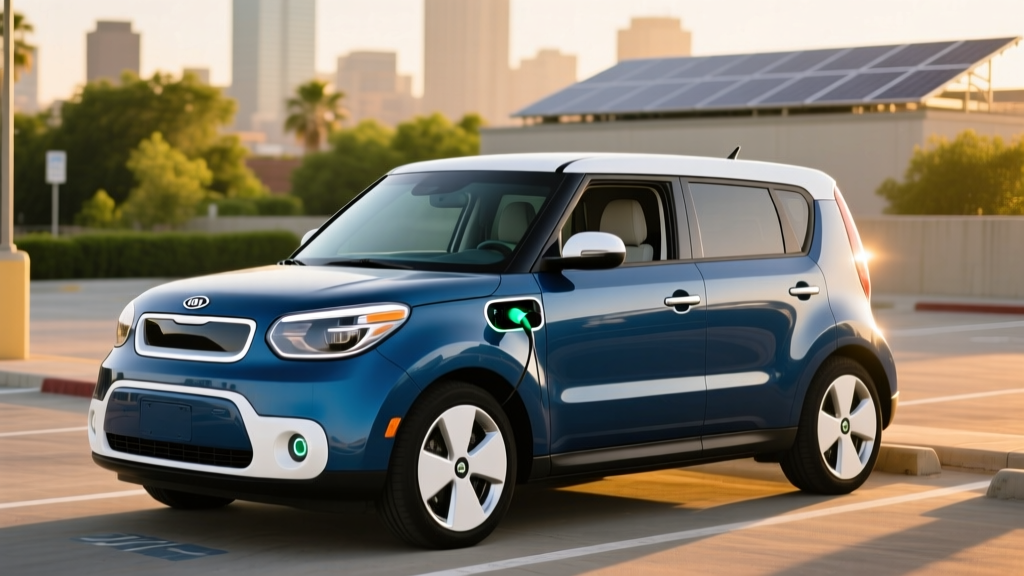
Quick Answer: The 2016 Kia Soul EV is a discontinued compact electric hatchback with an EPA-rated range of 93 miles, a 27 kWh (usable) lithium-ion polymer battery, and DC fast charging up to ~50 kW (CHAdeMO). In 2026, it works as a low-cost city commuter or second car — but its short range, aging battery, and CHAdeMO connector (increasingly rare at new public stations) make it a niche buy. Expect to pay $6,000–$10,000 used. It does not qualify for the federal §30D new-EV tax credit, though the up-to-$4,000 used-EV credit may apply if you meet IRS income and dealer requirements.
What the 2016 Kia Soul EV Actually Delivers
Kia sold the first-generation Soul EV from the 2015 through 2019 model years in select US markets (primarily California, Oregon, Texas, and a handful of other states). The 2016 model year carried over the original powertrain with no major changes.
| Spec | 2016 Kia Soul EV |
|---|---|
| EPA Range | 93 miles |
| Battery (Usable) | 27 kWh (lithium-ion polymer, NMC chemistry) |
| Motor Output | 109 hp / 210 lb-ft torque |
| 0–60 mph | ~11.2 seconds |
| EPA Efficiency | 105 MPGe combined (31 kWh/100 mi) |
| DC Fast Charge (Peak) | ~50 kW (CHAdeMO) |
| Level 2 Charge Rate | 6.6 kW (J1772) |
| 10–80% DCFC Time | ~33 minutes (estimated) |
| Level 2 Full Charge | ~4.5 hours (0–100%) |
| Cargo Volume | 24.4 cu ft (rear seats up) / 49.6 cu ft (folded) |
| Original MSRP (2016) | ~$33,650 (before incentives) |
| Battery Warranty (Original) | 10 years / 100,000 miles (capacity retention ≥70%) |
These are the sticker numbers. The real story for a 2026 buyer is what happens once this battery is 9–10 years old and the car has lived through hundreds of charge cycles.
Real-World Range: What to Actually Expect
EPA Sticker: 93 miles
Real-World Expectation (2026, used battery): 65–85 miles in moderate weather; 45–60 miles in freezing temperatures or sustained highway driving above 65 mph.
Even when new, the 2016 Soul EV's 93-mile EPA rating assumed a mix of city and highway driving at moderate temperatures. In EPA testing documented at fueleconomy.gov, the Soul EV achieved 105 MPGe combined. That's efficient, but efficiency can't overcome a small battery.
Here's where aging matters. Lithium-ion batteries degrade with time, heat exposure, charge cycles, and frequent DC fast charging. A 2016 Soul EV in 2026 is 10 years old. Based on degradation data from early-adopter EV batteries of this era, expect 15–25% capacity loss — meaning your usable battery may now hold 20–23 kWh instead of 27 kWh. That directly reduces range.
Cold weather compounds the problem. Lithium-ion batteries lose efficiency in freezing temperatures, and the Soul EV uses a resistive PTC heater rather than a heat pump. Running cabin heat in winter can cut range by 30–40%. If your commute is 35 miles each way in January in Minneapolis, this car will be a stressful ownership experience.
Highway driving also hurts. The Soul EV's boxy shape creates significant aerodynamic drag. At 75 mph, efficiency drops sharply — expect roughly 70–75 real-world miles on a full charge in warm weather on the interstate, less if the battery has degraded heavily.
Charging: The CHAdeMO Problem
This is the single biggest ownership consideration that most listings don't mention.
The 2016 Soul EV uses CHAdeMO for DC fast charging. In 2016, CHAdeMO was common — Nissan, Mitsubishi, and Kia all used it. But by 2026, the North American charging landscape has shifted dramatically toward NACS (Tesla's connector, now adopted by Ford, GM, Hyundai, Rivian, and others) and CCS1. Electrify America, the largest non-Tesla DCFC network, deployed CCS exclusively. Many new charging stations in 2024–2026 skipped CHAdeMO entirely.
| Charging Level | Connector | Power (kW) | Estimated Miles Added per Hour |
|---|---|---|---|
| Level 1 (120V) | J1772 | ~1.2 kW | ~4–5 miles |
| Level 2 (240V) | J1772 | 6.6 kW | ~22–25 miles |
| DC Fast Charge | CHAdeMO | ~50 kW peak | ~150+ miles/hr (to 80%) |
Home charging is where this car lives or dies. With a 27 kWh battery and a 6.6 kW onboard charger, a Level 2 home station (240V, 30-amp circuit) fills the Soul EV from empty to full in about 4.5 hours. That's fast enough for overnight top-ups. If you only have a standard 120V outlet (Level 1), a full charge takes roughly 22 hours — functionally limiting unless your daily driving is under 20 miles.
For public DC fast charging, check your local networks before buying. Open the PlugShare or ChargePoint app and search for CHAdeMO connectors within your typical routes. If you're in a metro area with legacy CHAdeMO stations (common in California, the Pacific Northwest, and parts of the Northeast), you'll still find chargers. In newer charging-desert regions, CHAdeMO availability may be sparse or nonexistent.
Charging cost: At the US average residential electricity rate of ~$0.16/kWh (EIA data, early 2026), a full home charge costs roughly $4.32 (27 kWh × $0.16). That gives you ~70–85 real-world miles, or about $0.05–0.06 per mile. Compare that to a gas-powered 2016 Kia Soul (rated 24 city / 30 highway MPG) at $3.20/gallon — roughly $0.11–0.13 per mile. Home charging saves about 50–60% per mile on energy.
Battery Health: The Critical Used-EV Question
When buying any used EV, battery State of Health (SoH) is the most important number. The 2016 Soul EV's original battery warranty guaranteed ≥70% capacity retention for 10 years / 100,000 miles. In 2026, most 2016 models have aged out of the time portion of that warranty (10 years from the original in-service date).
Before purchasing, do the following:
- Check SoH via the dashboard: The Soul EV displays a battery capacity bar indicator (out of 12 bars). A car showing 10/12 bars has roughly 83% SoH; 9/12 bars suggests ~75%. Below 9 bars, range will be noticeably compromised.
- Request an OBD-II battery scan: A tool like SoulEVOBD or a generic EV scanner can read actual pack voltage, cell balance, and precise SoH percentage. Don't rely solely on the dashboard bars.
- Check for battery replacement history: Some high-mileage examples may have had warranty battery replacements. Ask for service records.
- Inspect for recall campaigns: Kia issued recalls on certain model-year Soul EVs for battery-related concerns. Check the VIN at NHTSA.gov before purchase.
Battery replacement cost: If the pack fails outside warranty, a replacement from Kia runs approximately $10,000–$15,000 (parts and labor, based on 2025–2026 dealer estimates). Third-party refurbished packs may be available for $5,000–$8,000, but availability for this specific model is limited. At current used-car values ($6,000–$10,000), a battery replacement would likely total the vehicle economically.
Cost Breakdown: 2016 Soul EV vs. Gas Soul
Here's a 3-year ownership comparison assuming 10,000 miles/year, home Level 2 charging, and moderate battery degradation.
| Cost Category | 2016 Kia Soul EV (Used) | 2016 Kia Soul Gas (Used, 2.0L) |
|---|---|---|
| Purchase Price (avg.) | $8,000 | $9,500 |
| Fuel/Energy (3 yrs, 30k mi) | $1,500 (home charging) | $3,800 ($3.20/gal, 27 MPG avg) |
| Maintenance (3 yrs) | $600 (tires, cabin filter, brake fluid) | $2,400 (oil, filters, brakes, belts) |
| Insurance (3 yrs, avg.) | $4,200 | $3,600 |
| Tax Credit (Used EV, §25E) | Up to $4,000 (if eligible) | $0 |
| Estimated 3-Year Net Cost | ~$10,300 | ~$19,300 |
The EV wins on operating costs — energy and maintenance savings total roughly $4,100 over three years. The potential §25E used-EV credit (up to $4,000 or 30% of sale price, whichever is less, subject to income caps of $75K single / $150K joint and purchase from a licensed dealer) can further tilt the economics. However, insurance costs tend to run 10–20% higher for EVs, and the Soul EV's battery risk adds uncertainty.
The hidden risk: If the battery degrades below usable thresholds and needs replacement, that $10,000+ expense erases years of savings instantly. This is why a pre-purchase battery scan is non-negotiable.
Who Should (and Shouldn't) Buy a 2016 Soul EV
Buy the 2016 Soul EV if:
- Your daily round-trip commute is under 50 miles
- You have reliable home Level 2 charging (garage or driveway with 240V access)
- You live in a moderate climate (rarely below 25°F in winter)
- You need a second car for errands, school runs, and local trips
- You find one with ≥9/12 battery bars and under 60,000 miles
- Your local public charging still has accessible CHAdeMO stations
Skip the 2016 Soul EV if:
- Your commute exceeds 50 miles round-trip or includes long highway stretches
- You rely exclusively on apartment/curbside parking with no home charging
- You live in a cold climate with sustained sub-freezing winters
- You need road-trip capability (93-mile range makes intercity travel impractical)
- The battery shows 8 or fewer bars, or the car has over 80,000 miles
- CHAdeMO chargers are scarce in your area
Common Misconceptions About the 2016 Soul EV
| Myth | Fact |
|---|---|
| "It qualifies for the $7,500 federal tax credit" | No. The §30D new-EV credit applies only to new vehicles. The §25E used-EV credit offers up to $4,000, with income limits and dealer-sale requirements (IRS source). |
| "93 miles of range is enough for anyone" | It covers the US median daily commute (~35 miles round-trip), but leaves no margin for detours, cold weather, or battery degradation. Plan for 65–85 real-world miles in a 10-year-old pack. |
| "I can use any public fast charger" | The Soul EV uses CHAdeMO, not CCS or NACS. Many newer public DCFC stations (especially Electrify America and Tesla Superchargers) do not offer CHAdeMO. |
| "EV batteries always last 200,000 miles" | Modern LFP and NMC packs in 2024+ EVs are more durable, but early-2010s NMC batteries like the Soul EV's can lose 20–30% capacity within 10 years, especially in hot climates or with frequent DCFC use. |
| "Maintenance-free means zero costs" | You'll still need tires (EVs wear tires faster due to instant torque and weight), cabin air filters, brake fluid flushes, wiper blades, and 12V auxiliary battery replacement every 3–5 years. |
Frequently Asked Questions
Is the 2016 Kia Soul EV still being sold new?
No. Kia discontinued the first-generation Soul EV after the 2019 model year. Kia has not released a direct second-generation electric Soul as of early 2026. The Soul is currently sold only as a gas-powered model in the US. If you want a new Kia EV, the Niro EV (239 miles EPA, CCS/NACS charging) and EV6 (up to 310 miles, 800V architecture) are the current options.
Can I charge a 2016 Soul EV at a Tesla Supercharger?
Not natively. Tesla Superchargers use the NACS connector. You would need a CHAdeMO-to-NACS adapter, and as of 2026, reliable adapters for this specific combination are limited and not widely supported. Tesla's "Magic Dock" CCS adapter at some Supercharger stations also does not support CHAdeMO. Plan your public charging around CHAdeMO-compatible networks.
What happens if the battery dies completely?
If the high-voltage traction battery fails outside warranty, replacement costs $10,000–$15,000 from a Kia dealer. Given that a used 2016 Soul EV sells for $6,000–$10,000, a battery failure would likely make the car uneconomical to repair. This is the primary financial risk of buying an early-generation EV with an aging battery. Always verify SoH before purchase.
How does the 2016 Soul EV compare to a 2016 Nissan Leaf?
The 2016 Nissan Leaf (original 24 kWh battery) had an EPA range of 84 miles — slightly less than the Soul EV's 93 miles. The Leaf used passive air cooling for its battery, which led to faster degradation in hot climates. The Soul EV has active liquid cooling, giving it a battery longevity edge. However, both use CHAdeMO and face the same public-charging limitations in 2026.
Does the 2016 Soul EV support one-pedal driving?
Partially. It has regenerative braking with adjustable levels, but it does not come to a complete stop without using the brake pedal (unlike modern one-pedal EVs). You'll still use the friction brake for final stopping. The regen is strong enough to significantly reduce brake wear in city driving, however.
Should I buy a used 2016 Soul EV or a newer used EV instead?
If your budget allows $15,000–$25,000, a 2019+ Chevrolet Bolt EV (259 miles EPA, CCS), 2020+ Hyundai Kona Electric (258 miles, CCS), or 2021+ Nissan Leaf Plus (226 miles, CHAdeMO but with a larger 62 kWh battery) offers substantially more range, newer battery chemistry, and better charging compatibility. The 2016 Soul EV makes sense only at the sub-$10,000 price point for buyers who need the absolute cheapest electric commuter available and can accept the range and charging trade-offs.