The Quick Answer
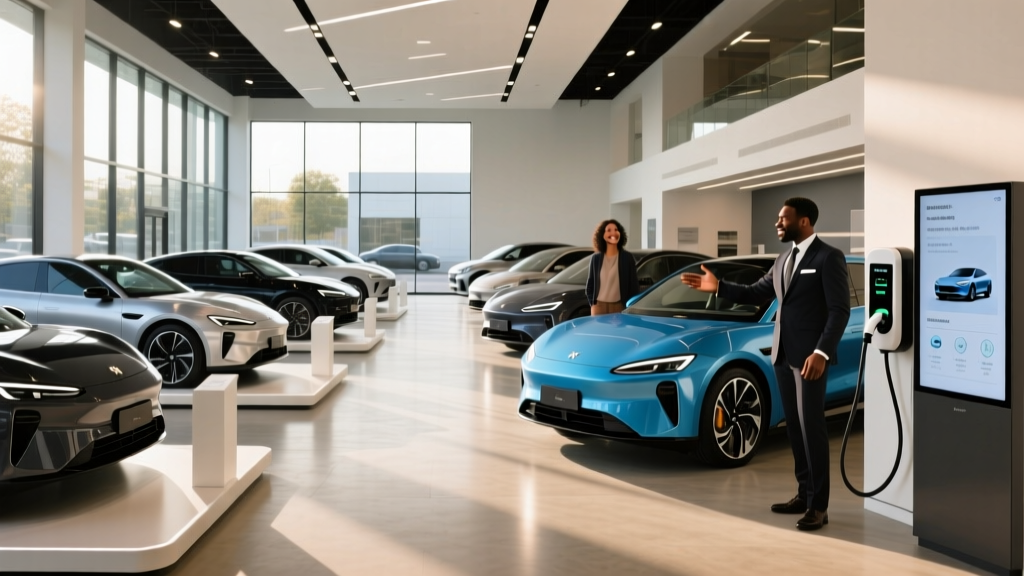
There are very few Black-owned electric car dealerships in the U.S. as of 2026. The most prominent is John H. Johnson Chevrolet in Atlanta, GA (a historically Black-owned franchise dealer that now stocks Chevrolet EVs like the Equinox EV and Blazer EV). Beyond franchise stores, a growing number of Black-owned independent used-car lots specialize in pre-owned EVs (Nissan Leaf, Chevy Bolt, Tesla Model 3). If you're searching for a "Black-owned electric car" retailer, your best path is to: (1) identify a Black-owned franchise dealer in your metro that carries EV inventory, (2) verify current §30D tax-credit eligibility on the specific VIN via the IRS Energy Credits portal, and (3) confirm the vehicle's EPA range, battery health (for used EVs), and home-charging feasibility before signing. Below is a full buyer's guide with real numbers.
Why This Search Matters — and What Buyers Actually Need
The query "black owned electric car" usually signals one of two intents: (a) a buyer wants to support a Black-owned dealership when purchasing an EV, or (b) a buyer is researching whether EVs are accessible and economical for Black households specifically. Both are legitimate, and both deserve data — not marketing.
According to the National Automobile Dealers Association, fewer than 3% of U.S. new-car franchise dealerships are Black-owned. EV inventory at those locations depends on the franchise brand. A Black-owned Chevrolet dealer, for example, will have access to the Equinox EV (EPA 319 mi, $33,600 base MSRP) and Blazer EV (EPA 324 mi, $44,600 MSRP). A Black-owned Ford dealer would stock the Mustang Mach-E (EPA 250–320 mi depending on battery) and F-150 Lightning. Independent Black-owned lots, meanwhile, often carry 2–5-year-old EVs where the used-EV tax credit (§25E, up to $4,000) can apply.
The key decision isn't just where to buy — it's whether a specific EV fits your driving pattern, housing situation, and budget. Let's break that down with real numbers.
EV vs Gas vs Hybrid: The Real Cost Comparison
Before choosing a model, here's what ownership actually costs over five years. This table compares a typical compact EV (2026 Chevrolet Equinox EV 2LT), a comparable gas SUV (2026 Chevy Equinox gas), and a hybrid (2026 Toyota RAV4 Hybrid) — all popular on dealer lots nationwide.
| Metric | 2026 Equinox EV 2LT | 2026 Equinox Gas (1.5T) | 2026 RAV4 Hybrid XLE |
|---|---|---|---|
| Base MSRP | $33,600 | $28,600 | $33,400 |
| EPA Efficiency | 114 MPGe (29 kWh/100mi) | 28 MPG combined | 39 MPG combined |
| EPA Range / Tank | 319 mi | 406 mi (14.5 gal) | 580 mi (14.5 gal) |
| Fuel/Energy Cost (5 yr / 75k mi) | ~$3,200 (home L2, $0.14/kWh) | ~$8,900 ($3.30/gal) | ~$6,400 ($3.30/gal) |
| Maintenance (5 yr) | ~$1,800 | ~$4,200 | ~$3,600 |
| Federal Tax Credit | Up to $7,500 (§30D)* | $0 | Up to $7,500 (§30D)* |
| Est. 5-Year Total Cost | ~$31,100 | ~$41,700 | ~$39,500 |
* §30D credit eligibility depends on MSRP caps ($80k SUVs / $55k sedans), buyer income limits ($150k single / $300k joint), and battery critical-mineral sourcing. The Equinox EV qualifies; the RAV4 Hybrid does not (it's a standard hybrid, not a PHEV). Verify at IRS.gov.
The EV wins on operating cost — by roughly $5,700 over five years versus gas, and $2,100 versus hybrid — but only if you can charge at home. Public DC fast charging at $0.35–$0.55/kWh erases most of the savings. This is the single most important variable for any buyer, regardless of which dealership you visit.
Real-World EV Ownership: What Dealerships Won't Tell You
Whether you're buying from a Black-owned franchise dealer, a corporate mega-dealer, or an independent lot, these are the ownership realities that determine whether an EV actually works for you.
Home Charging Access Is the Dealbreaker
According to the U.S. Energy Information Administration, roughly 30% of U.S. households lack access to dedicated off-street parking — a figure that's higher in urban and multi-family housing, where many Black households are concentrated. If you can install a Level 2 (240V, 7–11.5 kW) home charger, you'll wake up every morning with a full battery and pay $0.10–$0.18/kWh depending on your utility. If you're apartment-dwelling or street-parking, you'll rely on public charging, which costs 2–4× more and requires route planning.
Installation cost: A typical Level 2 home charger install runs $800–$2,200 total (charger hardware $350–$700, electrician labor $400–$1,500, possible panel upgrade $1,500–$3,500 if your panel is 100A or older). The §25C residential energy credit covers 30% of charger hardware + install, up to $1,000.
Cold Weather Cuts Range 20–35%
If you live in Chicago, Detroit, Atlanta, or anywhere with freezing winters, expect your EPA-rated 319-mile Equinox EV to deliver roughly 210–255 real-world highway miles in January. This is physics, not a defect — lithium-ion batteries lose efficiency and cabin heating draws 2–5 kW continuously. EVs with heat pumps (standard on Hyundai/Kia/Genesis, optional on some GM and Ford models) lose 15–20% instead of 30–35%.
Charging Speeds: The Curve Matters
A vehicle's "peak" DC fast-charge rate (e.g., 190 kW on the Equinox EV) is only sustained between roughly 10–50% state of charge. Above 80%, charging slows dramatically to protect the battery. Here's what a real session looks like:
| Charge Segment | Time at 190 kW Peak (Equinox EV) | Miles Added |
|---|---|---|
| 10–50% SoC | ~10 min | ~130 mi |
| 50–80% SoC | ~15 min | ~95 mi |
| 80–100% SoC | ~35 min | ~65 mi |
| Total 10–80% | ~25 min | ~225 mi |
Plan road trips around 10–80% stops. Charging to 100% at a DC fast charger wastes time and accelerates battery wear.
What to Look for When Buying from Any Dealer
Whether the dealership is Black-owned, corporate, or independent, insist on these data points before signing:
EV Buyer Decision Framework
- If you have a garage or dedicated parking + a 200A panel: Buy a new EV. Install Level 2 charging. Claim the §30D credit (up to $7,500 at point of sale). Models to consider: Chevy Equinox EV (319 mi, $33,600), Hyundai Ioniq 5 (315 mi, $42,600), Tesla Model 3 (363 mi, $42,380).
- If you rent or lack off-street parking: Consider a PHEV instead (Toyota RAV4 Prime, 42 mi electric + 38 MPG gas) or wait until your building installs chargers. Public-only EV charging is expensive and inconvenient.
- If your budget is under $25,000: Look at used EVs — Chevy Bolt (259 mi EPA, often $14,000–$19,000 used), Nissan Leaf (149–212 mi), or older Tesla Model 3. The §25E used-EV credit gives you 30% of the sale price, up to $4,000, if the car is under $25,000 and sold by a licensed dealer.
- If you drive 400+ miles between stops regularly: Either choose an EV with 320+ mi EPA range and NACS compatibility (for Tesla Supercharger access) or stick with a hybrid. The Toyota Camry Hybrid (51 MPG combined) remains unbeatable for long-distance flexibility.
- If you live in a cold climate and tow: Expect 40–50% range loss when towing in winter. The F-150 Lightning (EPA 240–320 mi) drops to ~130 mi real-world towing range in cold. Plan accordingly or keep a gas truck for heavy-duty use.
Common Misconceptions — Fact-Checked
| Myth | Fact (with data) |
|---|---|
| "EV batteries need replacing every 5 years" | Modern NMC and LFP batteries retain 85–95% capacity at 100,000 miles. Federal law mandates an 8-year / 100,000-mile battery warranty (10 yr / 150k mi in CARB states). Full replacements cost $5,000–$18,000 but are rarely needed. (fueleconomy.gov) |
| "EVs are worse for the environment because of battery mining" | Over a 150,000-mile lifetime, an EV produces 60–68% fewer lifecycle emissions than a comparable gas car, even on the U.S. average grid (Union of Concerned Scientists, 2024). As the grid decarbonizes, that gap widens. |
| "The tax credit is $7,500 for everyone" | The §30D credit has income caps ($150k single / $300k joint AGI), MSRP caps ($55k sedans / $80k SUVs and trucks), and battery sourcing requirements. Many vehicles qualify for partial credit ($3,750) or none. Check the specific VIN at fueleconomy.gov. |
| "Public charging is just as cheap as home charging" | Home L2: $0.10–$0.18/kWh (~$0.03–$0.05/mi). Public DCFC: $0.35–$0.55/kWh (~$0.10–$0.16/mi). Public-only EV drivers spend 2–3× more on energy. |
| "EVs are slower than gas cars" | The Equinox EV (213 hp) does 0–60 in ~8.0 sec — comparable to its gas counterpart. Performance EVs (Tesla Model 3 Performance: 2.9 sec, Hyundai Ioniq 5 N: 3.4 sec) outrun nearly any gas car in their price class. |
Finding a Black-Owned Dealership: Practical Steps
Because Black-owned franchise dealerships are rare (estimated 60–80 nationwide across all brands), here's how to locate one that sells EVs:
- Check the National Association of Minority Automobile Dealers (NAMAD): Their member directory lists minority-owned franchise dealers by state and brand.
- Search "Black-owned [brand] dealer near me": Brands with the most accessible EV lineups in 2026 include Chevrolet (Equinox EV, Blazer EV, Silverado EV), Hyundai (Ioniq 5, Ioniq 6, Kona EV), Ford (Mustang Mach-E, F-150 Lightning), and Kia (EV6, EV9, Niro EV).
- Call ahead about EV inventory: Not every franchise dealer stocks EVs. Confirm specific trims, battery sizes, and whether the lot has functioning Level 2 chargers for test-drive preconditioning.
- Verify §30D eligibility on the exact VIN: Use the IRS Energy Credits portal. The dealer can also run this at point of sale and apply the credit as a price reduction (point-of-sale transfer, available since Jan 2024).
- For used EVs: Black-owned independent lots in major metros (Atlanta, Houston, Chicago, D.C.) increasingly stock Bolts, Leafs, and older Model 3s. Request a battery health report (state of health / SoH percentage) from the dealer or a third-party service like Recurrent.
Specs Snapshot: Top EVs Available at Franchise Dealers in 2026
| Model | EPA Range | Battery (kWh / Chemistry) | Peak DC Charge | 10–80% Time | 0–60 mph | Base MSRP | §30D Eligible? |
|---|---|---|---|---|---|---|---|
| Chevy Equinox EV 2LT | 319 mi | 85 kWh / NMC | 190 kW | ~25 min | 8.0 sec | $33,600 | Yes (full $7,500)* |
| Hyundai Ioniq 5 SE | 315 mi | 77.4 kWh / NMC | 240 kW | ~18 min | 5.1 sec | $42,600 | Partial ($3,750)* |
| Ford Mustang Mach-E Select | 250 mi | 72 kWh / NMC | 150 kW | ~30 min | 6.1 sec | $39,995 | Partial ($3,750)* |
| Kia EV6 Light | 274 mi | 58 kWh / NMC | 175 kW | ~22 min | 7.2 sec | $38,600 | Partial ($3,750)* |
| Tesla Model 3 RWD | 363 mi | 60 kWh / LFP | 170 kW | ~28 min | 5.8 sec | $42,380 | Partial ($3,750)* |
| Chevy Bolt EV (used) | 259 mi | 65 kWh / NMC | 55 kW | ~55 min | 6.5 sec | ~$16,000 (used) | §25E: up to $4,000 |
* Credit amounts reflect 2026 IRS rules with critical-mineral and battery-component sourcing requirements. Amounts vary by VIN build date and buyer income. Confirm at IRS.gov.
Frequently Asked Questions
Are there any Black-owned Tesla dealerships?
No. Tesla sells exclusively through its own company-owned stores and does not franchise to independent dealers of any background. To support Black-owned businesses when buying a Tesla, consider Black-owned independent used-car dealers that carry pre-owned Model 3 and Model Y vehicles (eligible for the §25E used-EV credit if priced under $25,000).
Can I get the $7,500 tax credit if I buy from a Black-owned dealer?
Yes — the §30D federal tax credit applies regardless of dealership ownership. Eligibility depends on the vehicle's VIN (battery sourcing, MSRP cap), your adjusted gross income (single ≤$150k, head of household ≤$225k, joint ≤$300k), and the vehicle class (sedan ≤$55k MSRP, SUV/truck ≤$80k). Since January 2024, you can transfer the credit to the dealer at point of sale as an instant price reduction. Confirm eligibility at IRS.gov before signing.
What's the cheapest EV I can buy in 2026?
The cheapest new EV is the Nissan Leaf S at $28,140 (EPA 149 mi, 40 kWh battery, CHAdeMO connector). The best value new EV is the Chevy Equinox EV at $33,600 (319 mi, 85 kWh, NACS/CCS). For used EVs, the Chevy Bolt EV can be found for $14,000–$19,000 with the §25E credit potentially reducing that to $10,000–$15,000.
Do EVs cost more to insure?
Yes, typically 15–25% more than an equivalent gas car, due to higher repair costs and battery replacement risk. Average annual EV insurance: $1,800–$2,600 depending on model and state. Shop quotes from Geico, Progressive, and State Farm — and ask about EV-specific discounts for low annual mileage or garage-kept vehicles.
Is a hybrid better if I don't have home charging?
Almost certainly, yes. A standard hybrid like the Toyota Camry Hybrid (51 MPG combined, no plug needed) eliminates fuel-cost anxiety without requiring any infrastructure change. A PHEV like the RAV4 Prime (42 mi electric, then 38 MPG gas) is a strong middle ground if you occasionally have access to a 120V outlet overnight. Full EV ownership without home charging is feasible but expensive and inconvenient — plan for $150–$250/month in public charging costs versus $50–$90/month at home.
How long do EV batteries actually last?
Data from Recurrent Auto (tracking 15,000+ EVs) shows average battery degradation of 5–8% over the first 100,000 miles across NMC chemistries, and 3–5% for LFP chemistries (Tesla Model 3 RWD, standard-range BYD). Federal warranty mandates require 70% capacity retention at 8 years / 100,000 miles. Most EVs will outlast their original owners with 80%+ battery health at 150,000 miles.
Bottom Line: Support + Smart Buying
Buying from a Black-owned electric car dealership is a meaningful way to direct your dollars — but the vehicle itself still needs to fit your life. Confirm you have home charging (or a realistic public-charging plan), verify the exact VIN's tax-credit eligibility, check battery SoH on any used EV, and compare total 5-year cost against the gas or hybrid alternative. The numbers above give you the framework. The dealership you choose is where you put it into practice.