What Is an Electric Motor? The Short Answer
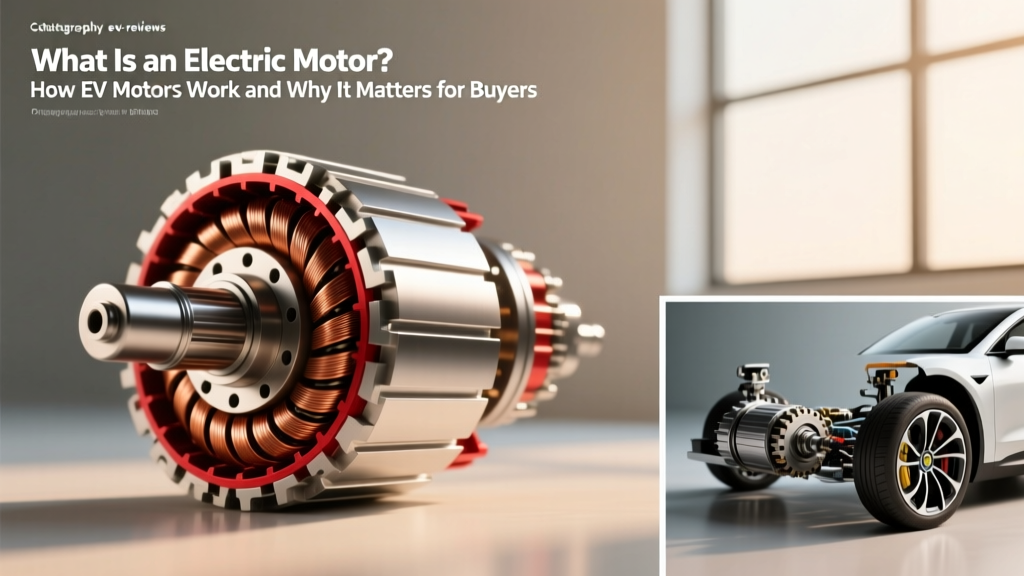
An electric motor in an EV is a device that converts electrical energy from the battery pack into rotational mechanical energy to drive the wheels. Unlike a gasoline engine — which relies on hundreds of moving parts, controlled explosions, and a complex transmission — an EV motor typically has just one moving part (the rotor), delivers maximum torque from 0 RPM, and operates at 85–95% efficiency. That's roughly three to four times more efficient than a gas engine's 20–35% thermal efficiency. For buyers, this translates to instant acceleration, dramatically lower maintenance costs, and a fundamentally simpler drivetrain.
How an EV Electric Motor Actually Works
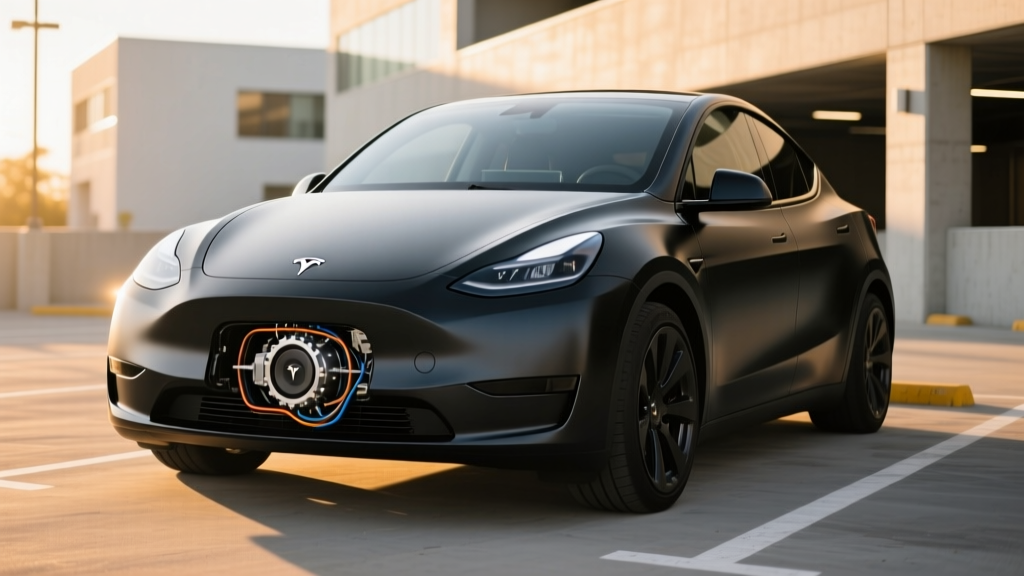
At its core, an electric motor exploits electromagnetic force. When current flows through wire coils (the stator) surrounding a central rotor, it generates a magnetic field. That field pushes against magnets or induced currents in the rotor, causing it to spin. The spinning rotor connects to a reduction gear (usually single-speed) and then to the wheels.
There's no combustion, no pistons, no crankshaft, no multi-speed transmission, and no exhaust system. The motor controller — a power electronics module — precisely meters current from the battery pack to regulate speed and torque. When you lift off the accelerator, the motor reverses role and becomes a generator, converting kinetic energy back into electricity to recharge the battery. This is regenerative braking, and it's why EVs can achieve one-pedal driving in many models.
The Two Main Motor Types in Modern EVs
| Motor Type | How It Works | Used In (2026 Examples) | Trade-offs |
|---|---|---|---|
| Permanent Magnet Synchronous Motor (PMSM) | Uses rare-earth magnets in the rotor for high efficiency and power density | Tesla Model 3/Y (rear), Hyundai Ioniq 5, BMW iX, most mainstream EVs | Highest efficiency; relies on rare-earth materials (neodymium, dysprosium) with supply-chain cost risk |
| AC Induction Motor (ACIM) | Induces current in the rotor via electromagnetic induction — no permanent magnets needed | Tesla Model S/X (front motor), older Tesla Model 3 AWD front, some commercial EVs | Slightly lower efficiency at low loads; no rare-earth dependency; excellent at high speeds; can be "switched off" for coasting efficiency in dual-motor setups |
Many dual-motor AWD EVs use a PMSM on one axle and an ACIM on the other, combining the efficiency of permanent magnets with the drag-free coasting ability of an induction motor. Tesla pioneered this approach, and it's now common across the industry.
Electric Motor vs. Gasoline Engine: By the Numbers
The differences between an electric motor and an internal combustion engine (ICE) aren't just philosophical — they're measurable in almost every metric that matters to a car buyer.
| Metric | EV Electric Motor | Gas Engine (Typical 4-Cyl Turbo) |
|---|---|---|
| Energy Efficiency | 85–95% (battery to wheels) | 20–35% (fuel to wheels) |
| Moving Parts (drivetrain) | ~1 (rotor) + single-speed reduction gear | ~200+ (pistons, valves, camshafts, crankshaft, multi-speed transmission) |
| Peak Torque Delivery | 0 RPM (instant) | 1,500–4,500 RPM (requires revving) |
| Horsepower Range (consumer vehicles) | 150–1,020 HP | 150–700 HP |
| Maintenance Intervals | No oil changes, no spark plugs, no timing belts; coolant check every ~100k miles | Oil every 5k–10k mi; spark plugs ~60k–100k mi; transmission fluid ~60k mi |
| Estimated 10-Year Drivetrain Maintenance | ~$500–$1,200 (coolant, brake fluid, cabin air) | ~$3,500–$6,000 (oil, filters, plugs, belts, transmission service) |
| Noise at Idle | Silent | ~40–55 dB |
| Typical Lifespan | 300,000–500,000+ miles (motor itself rarely fails) | 150,000–250,000 miles before major overhaul |
The efficiency gap is the most consequential number here. According to fueleconomy.gov, EVs convert over 77% of the electrical energy from the grid to power at the wheels. Conventional gasoline vehicles only convert about 12–30% of the energy stored in gasoline to power at the wheels. The rest is lost as heat, friction, and parasitic drag. This is why an EV with a 75 kWh battery can match or exceed the real-world range of a gas car with a 15-gallon tank in city driving — the motor simply wastes far less energy.
Real Costs: What the Electric Motor Means for Your Wallet
The electric motor's simplicity is the main reason EVs have lower ongoing maintenance costs. But total ownership involves more than just the drivetrain. Here's a realistic 5-year cost comparison using a 2026 Tesla Model 3 Long Range (single PMSM rear motor, 341-mile EPA range, ~$44,990 MSRP) versus a comparably equipped 2026 Toyota Camry LE (2.5L 4-cylinder, 32 MPG combined, ~$29,995 MSRP).
| Cost Category (5 Years / 75,000 Miles) | 2026 Tesla Model 3 LR (EV) | 2026 Toyota Camry LE (Gas) |
|---|---|---|
| Purchase Price (MSRP) | $44,990 | $29,995 |
| Federal Tax Credit (§30D, if eligible) | −$7,500 (point-of-sale) | $0 |
| Effective Purchase Price | $37,490 | $29,995 |
| Fuel / Electricity (75k mi) | ~$2,800 (home L2, $0.14/kWh avg) | ~$8,200 ($3.50/gal, 32 MPG) |
| Maintenance (drivetrain + scheduled) | ~$600 | ~$2,800 |
| Insurance (avg) | ~$9,500 | ~$7,200 |
| Tires (EVs are heavier, higher torque) | ~$1,600 | ~$1,100 |
| 5-Year Total Cost of Ownership | ~$51,990 | ~$49,295 |
Key takeaway: The EV wins on fuel and maintenance by roughly $6,600 over five years, but loses ground on insurance (+$2,300) and tires (+$500). With the full $7,500 federal tax credit applied at point of sale under current IRS §30D rules, the effective purchase gap narrows to ~$7,500, and the 5-year TCO nearly equalizes. Without the credit, the gas car still costs less overall in this comparison — the motor's savings are real but don't always overcome a higher upfront price in five years.
Note: §30D eligibility depends on buyer income caps ($150k single / $300k joint MAGI), vehicle MSRP caps ($55k sedans / $80k SUVs/trucks), and battery critical-mineral and component sourcing requirements. Rules are subject to legislative change. Consult a tax professional and verify current-year eligibility at irs.gov.
What the Electric Motor Means for Real-World Driving
Motor type and power output shape how an EV feels on the road, but the motor is only one piece of the efficiency puzzle. Here's what first-time EV buyers should understand about the driving experience the motor enables — and where its limits lie.
Torque and Acceleration
Because an electric motor delivers peak torque at 0 RPM, even modestly powered EVs feel quicker off the line than their gas counterparts. A 2026 Hyundai Ioniq 5 SEL (225 HP, single rear PMSM) hits 0–60 mph in about 7.0 seconds — comparable to a turbocharged gas sedan with 50 more horsepower. Step up to the dual-motor AWD Ioniq 5 (320 HP) and 0–60 drops to roughly 5.0 seconds.
Regenerative Braking and Efficiency
The motor's ability to act as a generator during deceleration recovers energy that a gas car would waste as brake heat. In stop-and-go city driving, regen can extend effective range by 10–20% compared to highway-only driving. This is why EVs often achieve higher MPGe in the city than on the highway — the opposite of a gas car.
Cold Weather and Motor Efficiency
The motor itself remains highly efficient in cold weather. Range loss in winter (typically 20–35% below EPA at 20°F) comes from the battery's reduced ability to accept and deliver charge, plus cabin heating demands — not from the motor. EVs with a heat pump (standard on most 2026 Hyundai/Kia, Tesla, and BMW EVs) mitigate cabin-heating losses significantly, recovering roughly 5–10% of winter range compared to resistive heaters.
Highway Efficiency and the Motor's Sweet Spot
Electric motors are efficient across a wide RPM band, but at sustained highway speeds (75–85 mph), aerodynamic drag dominates energy consumption. Expect real-world highway range to run 10–15% below the EPA combined figure. For a 341-mile EPA-rated Model 3 LR, plan for roughly 280–300 miles of real-world highway range in moderate weather.
Common Misconceptions About EV Motors — Corrected
| Myth | Fact |
|---|---|
| "Electric motors are weak compared to gas engines." | Electric motors deliver more torque per pound than gas engines. A dual-motor Tesla Model S Plaid produces 1,020 HP and 0–60 in 1.99 seconds — faster than virtually any production gas car ever built. |
| "EV motors need regular maintenance like oil changes." | The motor itself is essentially maintenance-free. There's no oil, no filters, no spark plugs. The only drivetrain fluid is a reduction-gear oil that's typically checked or replaced at 100,000+ mile intervals. |
| "If the motor fails, you need a whole new car." | EV motor failures are extremely rare. When they do occur, the motor is a modular component that can be replaced independently of the battery. Under federal law, the motor is covered under the EV's powertrain warranty — typically 8 years / 100,000 miles, and many manufacturers extend this further. |
| "All EV motors are the same." | Motor type (PMSM vs. induction), placement (front, rear, dual), and power output vary significantly. A single-motor RWD EV drives very differently from a tri-motor AWD performance model. Motor choice affects efficiency, acceleration, and even regenerative braking behavior. |
| "Electric motors wear out quickly from high torque." | The motor's rotor and stator have no physical contact — there's no friction to cause wear. The bearings are the primary wear item, and they're rated for 300,000+ miles. What does wear faster on EVs are tires (due to vehicle weight and instant torque) and, in some cases, suspension components. |
Decision Framework: Does the Electric Motor Work for Your Situation?
Understanding what an electric motor offers — and what it requires — helps you decide whether a full EV, a PHEV, or a hybrid is the right fit.
Choose a full EV (BEV) with an electric motor if:
- You have access to Level 2 home charging (a 240V outlet or installed wall connector adding ~25–44 miles of range per hour)
- Your daily driving is under 250 miles round-trip, or you're willing to plan DC fast charging stops on longer trips
- You want the lowest per-mile fuel cost (~$0.04–$0.06/mi on home electricity vs. ~$0.12–$0.16/mi on gas) and near-zero drivetrain maintenance
- You qualify for the §30D federal tax credit, narrowing the upfront price gap
- You value instant torque, quiet operation, and one-pedal driving
Choose a PHEV (plug-in hybrid) if:
- You want electric-motor efficiency for short daily commutes (20–45 miles electric-only) but gas-engine range for frequent long road trips
- Your home charging access is limited or unreliable
- You live in an area with sparse DC fast-charging infrastructure
- You want to reduce fuel consumption without full EV range-planning commitment
Choose a conventional hybrid (HEV) if:
- You cannot charge at home and have no access to workplace or public Level 2 charging
- You want better fuel economy (45–55 MPG combined) without any plug-in behavior
- Upfront cost is the primary constraint and you don't qualify for EV incentives
First-Time EV Buyer Essentials: What the Motor Means for Ownership
If you're considering your first EV, the electric motor is arguably the least worrisome component. It's the battery, charging logistics, and ownership economics that demand your attention. Here's what to prioritize:
- Home charging is non-negotiable for most owners. A Level 2 home charger (7.2–11.5 kW) is the backbone of convenient EV ownership. Expect $800–$2,500 for a quality wall connector plus $500–$2,000 for electrician installation, depending on panel capacity and conduit run. If your electrical panel is maxed out, a panel upgrade ($1,500–$3,500) may be required. Without home charging, public-charging dependency adds cost and time.
- The battery matters more than the motor. The motor will likely outlast the car. The battery degrades over time — expect 85–92% capacity retention at 100,000 miles for most NMC packs, and 90–95% for LFP chemistry. All 2026 EVs carry a minimum 8-year/100,000-mile battery warranty (federally mandated), with many manufacturers warranting 70% capacity retention over that period.
- Insurance costs more for EVs. Higher repair costs, specialized parts, and total-loss thresholds push EV insurance premiums 15–30% above comparable gas vehicles. Shop quotes before buying — the difference between insurers can be $500–$1,200/year.
- DC fast charging is for road trips, not daily use. Frequent DC fast charging (150–350 kW) can accelerate battery degradation slightly. Plan to charge at home on Level 2 for daily needs and reserve DC fast charging for trips. A typical 2026 EV charges from 10–80% in 18–30 minutes at a compatible fast charger (peak rates of 150–250 kW), but charging slows significantly above 80% due to the charge curve taper.
- Verify tax credit eligibility before committing. The §30D credit can reduce your effective price by up to $7,500 (or $4,000 for used EVs under §25E), but eligibility hinges on income, MSRP, and battery-sourcing rules that shift annually. Confirm your specific vehicle and tax situation at irs.gov or with a tax professional.
Do electric motors in EVs ever need to be replaced?
Extremely rarely. Electric motors have one primary moving part (the rotor) supported by bearings rated for 300,000+ miles. Motor replacement under warranty is uncommon; when it does happen, it's usually due to a manufacturing defect caught early. The motor is covered under the powertrain warranty (typically 8 years/100,000 miles). In practice, the battery pack is a far more likely — and far more expensive — component to require attention over the vehicle's lifetime.
Why do EVs have so much instant torque compared to gas cars?
An electric motor generates maximum electromagnetic force at any RPM, including zero. A gas engine must spin up to a specific RPM range (typically 1,500–4,500 RPM for turbocharged engines) to reach peak torque, and it needs a multi-speed transmission to stay in that band. The EV motor eliminates both the lag and the transmission, which is why a 200 HP electric motor can feel more responsive than a 300 HP gas engine in real-world driving.
Does the type of electric motor affect range?
Yes, modestly. Permanent magnet synchronous motors (PMSM) are generally 2–5% more efficient than AC induction motors at low-to-moderate loads, which translates to roughly 5–15 extra miles of EPA range on a 300-mile vehicle. This is why most 2026 single-motor RWD EVs use PMSMs for maximum range. However, dual-motor AWD setups often pair a PMSM with an induction motor — the induction unit can be fully de-energized during cruising to eliminate drag, partially offsetting its lower peak efficiency.
How does regenerative braking work with the electric motor?
When you lift off the accelerator or press the brake pedal, the motor controller reverses the motor's function: instead of consuming electricity to spin the rotor, the spinning rotor (driven by the car's momentum) generates electricity that flows back into the battery. This slows the car while recovering energy. Depending on the vehicle and settings, regen can handle 80–100% of typical deceleration without engaging the friction brakes — which is why EV brake pads often last 100,000+ miles.
Are EV electric motors affected by water or flooding?
EV motors are sealed units rated to IP67 or higher, meaning they're protected against dust ingress and temporary submersion. Driving through heavy rain or shallow standing water is not a concern for the motor itself. However, the battery pack and high-voltage electronics have their own sealing requirements, and any EV (like any gas car) can suffer severe damage from deep flooding. No consumer EV is rated for submersion beyond the manufacturer's specified wading depth.