What Is a Bi-Directional EV?
A bi-directional EV is an electric vehicle capable of sending power out of its battery — not just drawing it in. This means your car can act as a mobile power station to run appliances (V2L), back up your home during an outage (V2H), or even sell electricity back to the grid (V2G). As of the 2026 model year, vehicles like the Ford F-150 Lightning, Hyundai Ioniq 5, Kia EV9, and Chevrolet Silverado EV support various forms of bi-directional charging, with V2L being the most widely available and V2H requiring specific home hardware.
The Three Types of Bi-Directional Charging
Not all bi-directional capability is equal. The technology breaks into three distinct categories, each with different hardware requirements, use cases, and cost implications.
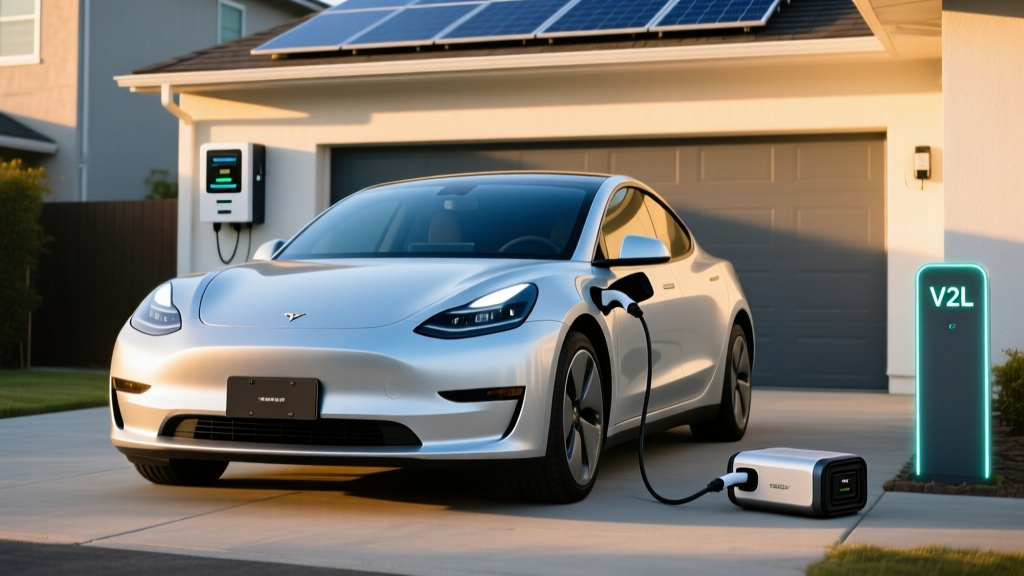
V2L (Vehicle-to-Load): The simplest form. Your EV provides standard 120V or 240V AC outlets — either inside the cabin or via an adapter on the charge port — to power tools, appliances, or camping gear. Typical output ranges from 1.9 kW to 3.6 kW. Think of it as a massive portable battery. No special home equipment is needed.
V2H (Vehicle-to-Home): Your EV connects to your home's electrical panel through a dedicated bi-directional charger and automatic transfer switch, supplying 200A/240V service during an outage. A 77 kWh battery (like the Ioniq 5's) can power an average US home (roughly 29 kWh/day per EIA data) for approximately 2.5 days. This requires a compatible bi-directional wallbox (such as the Ford Charge Station Pro or Wallbox Quasar) and professional installation with a transfer switch.
V2G (Vehicle-to-Grid): The most advanced tier. Your EV communicates with the utility to discharge power during peak demand and recharge during off-peak hours, potentially earning you money or credits. V2G requires utility support, specific tariff structures, and compatible hardware on both ends. As of 2026, V2G is available only through select pilot programs — it is not yet a mainstream consumer feature.
2026 Vehicles With Bi-Directional Charging
Here's a data-driven look at which current models support bi-directional capability and what type:
| Vehicle | Battery (kWh usable) | V2L | V2H | V2G Ready | Max V2L Output | Starting MSRP |
|---|---|---|---|---|---|---|
| Ford F-150 Lightning (Extended Range) | 131 | ✓ | ✓ (with Charge Station Pro) | ✓ | 9.6 kW (Pro Power Onboard) | $62,995 |
| Hyundai Ioniq 5 (Long Range AWD) | 77.4 | ✓ | ✓ (with V2L adapter + compatible panel) | Limited pilot | 3.6 kW | $49,950 |
| Kia EV9 (GT-Line AWD) | 99.8 | ✓ | ✓ (planned, hardware dependent) | Limited pilot | 3.6 kW | $60,900 |
| Chevrolet Silverado EV (4WT) | 200+ | ✓ | ✓ (Energy Transfer Pro) | ✓ | 9.6 kW | $74,800 |
| Ford E-Transit (Commercial) | 68 | ✓ | ✓ | ✓ | 7.2 kW | $55,995 |
| VW ID.4 (AWD Pro S) | 77 | ✗ (2026 US models) | ✗ | ✗ | N/A | $49,295 |
Key takeaway: V2L is the most common and requires zero infrastructure investment beyond the vehicle itself. V2H demands a compatible wallbox ($2,500–$6,500 for hardware) plus electrical work. V2G remains largely pilot-stage in the US.
Real Costs: Bi-Directional Home Setup Breakdown
If you want V2H backup power, here's what you're actually spending. These are 2026 estimates based on national averages — your electrician's quote will vary by region, panel condition, and local permitting.
| Component | Low Estimate | High Estimate | Notes |
|---|---|---|---|
| Bi-directional wallbox (e.g., Wallbox Quasar 2, Ford Charge Station Pro) | $2,500 | $6,500 | Price varies by brand and power rating (7.2–19.2 kW AC) |
| Automatic transfer switch + subpanel | $1,500 | $3,500 | Required to isolate home circuits during outage |
| Electrical labor (licensed electrician) | $2,000 | $5,000 | Depends on panel location, conduit runs, complexity |
| Main panel upgrade (if needed) | $1,500 | $4,000 | Older 100A panels often need upgrade to 200A |
| Permitting and inspection | $200 | $800 | Varies by municipality |
| Total installed | $7,700 | $19,800 | Most homeowners report $10,000–$14,000 |
Compared to a gas generator: A 22 kW standby generator (Generac or Kohler) with professional installation typically costs $8,000–$14,000. The V2H system costs more upfront but doubles as your daily EV charger and uses a battery you already own — no propane or natural gas contract, no fuel degradation, no exhaust. Over a 10-year period, the V2H system can be more economical if you factor in fuel savings and the avoided cost of a separate Level 2 charger.
Bi-Directional EV vs. Gas Generator vs. Home Battery
How does your EV stack up against other backup power options? Here's a direct comparison with real numbers:
| Factor | Bi-Directional EV (V2H) | Standby Generator (22 kW) | Home Battery (Tesla Powerwall 3) |
|---|---|---|---|
| Usable energy capacity | 77–131 kWh (vehicle battery) | Unlimited (while fueled) | 13.5 kWh per unit |
| Backup duration (avg home, 29 kWh/day) | 2.5–4.5 days | Weeks (with fuel supply) | ~11 hours per unit |
| Continuous power output | 7.2–19.2 kW | 22 kW | 11.5 kW |
| Installed system cost | $7,700–$19,800 | $8,000–$14,000 | $12,000–$18,000 |
| Fuel / energy cost | ~$0.13–$0.30/kWh (grid) | ~$0.25–$0.45/kWh (natural gas/propane) | ~$0.13–$0.30/kWh (grid/solar) |
| Noise during operation | Silent | 65–70 dB | Silent |
| Daily utility (beyond backup) | EV charging + possible V2G income | None | Time-of-use arbitrage, solar storage |
| Maintenance | Minimal (EV drivetrain) | Annual service, oil changes, fuel stabilization | Minimal |
The F-150 Lightning's 131 kWh extended-range battery is the standout here — it can power an average home for over four days. That's a genuinely meaningful advantage in regions with multi-day outages from hurricanes, ice storms, or grid failures. For comparison, you'd need three Tesla Powerwalls to approach similar capacity, at roughly $36,000–$54,000 installed.
Impact on Battery Degradation and Warranty
This is the most common concern among buyers considering a bi-directional EV: will using my car as a home battery wear out the traction battery faster?
The honest answer: yes, any additional charge-discharge cycles contribute to degradation, but the impact is smaller than most drivers fear. Here's why:
- Cycle math: A typical NMC lithium-ion battery is rated for 1,500–2,500 full charge-discharge cycles before reaching 70–80% State of Health (SoH). If you use V2H for 10 outage events per year, each consuming 40% of the battery, that's roughly 4 equivalent full cycles annually — or 40 cycles over a decade.
- Depth of discharge limits: Most V2H systems won't drain your battery below 10–20% SoC. The battery management system (BMS) protects the pack from deep discharge damage.
- Warranty coverage: Federal law mandates that EV batteries carry a minimum warranty of 8 years/100,000 miles (10 years/150,000 miles in CARB states). Most manufacturers guarantee 70% capacity retention within this period. Ford, Hyundai, and Kia all honor warranty coverage even when bi-directional features are used as designed.
- Real-world data: Fleet vehicles using V2G in pilot programs (such as school buses in California and delivery vans in the UK) have shown degradation rates of approximately 1–2% additional capacity loss per year compared to charge-only vehicles, according to NREL studies.
Bottom line: occasional V2H use during outages is a negligible factor in battery longevity. Daily V2G cycling is a different story — but that's why utilities offering V2G programs typically provide battery degradation guarantees or financial compensation.
Federal Tax Credits and Incentives for Bi-Directional Setup
As of the 2026 tax year, the IRS §30D Clean Vehicle Credit applies to the EV itself — up to $7,500, subject to MSRP caps ($80,000 for trucks/vans/SUVs, $55,000 for sedans), buyer income limits ($300K joint / $150K single AGI), and battery critical-mineral and component sourcing requirements. Point-of-sale transfer is available, reducing your dealer price directly.
For the home charging and bi-directional equipment, the §30C Alternative Fuel Vehicle Refueling Property Credit covers up to 30% of hardware and installation costs, capped at $1,000 for residential property. This credit applies to bidirectional charging equipment installed at your primary residence, provided you live in a qualifying census tract (generally non-urban or low-income areas — check the IRS eligibility tool).
Some utilities also offer rebates for V2H-capable equipment. Pacific Gas & Electric, ConEdison, and Xcel Energy have all run programs offering $500–$2,000 toward compatible wallboxes. Check with your local utility before purchasing.
Decision Framework: Is a Bi-Directional EV Right for You?
Choose a Bi-Directional EV With V2H If:
- You live in an area with frequent multi-hour or multi-day power outages (storm-prone, wildfire PSPS zones, unreliable grid)
- You're already planning to buy an EV and want backup power as a secondary benefit — avoiding a separate generator purchase
- You have a 200A electrical panel (or are willing to upgrade) and can accommodate a bi-directional wallbox
- You value silent, zero-emission backup power with no fuel storage or maintenance
- You drive a truck or large SUV and need the vehicle for work — the F-150 Lightning or Silverado EV pulls double duty
Stick With V2L Only (Skip V2H Hardware) If:
- You just want portable power for camping, tailgating, job sites, or occasional appliance use
- Your outages are typically under 6 hours — a UPS or small portable battery handles this
- You rent your home or can't modify the electrical panel
- The $10,000–$15,000 V2H installation cost doesn't justify the outage frequency in your area
Wait on V2G If:
- Your utility doesn't currently offer a V2G tariff or buyback program
- You're concerned about accelerated battery degradation from daily grid cycling
- The financial return doesn't yet justify the hardware premium — most V2G pilots pay $10–$30/month, which takes years to recoup installation costs
Common Misconceptions About Bi-Directional Charging
| Myth | Fact |
|---|---|
| "Bi-directional charging will void my battery warranty." | Using OEM-approved V2L/V2H features as designed does not void the battery warranty. The 8-year/100,000-mile federal minimum still applies. |
| "Any EV can do bi-directional charging with an adapter." | False. The vehicle's onboard charger and BMS must be specifically engineered for reverse power flow. A CCS adapter alone doesn't enable this. |
| "V2H will drain my car and leave me stranded." | V2H systems include configurable reserve limits (typically 20–30% SoC minimum). The system stops discharging before your driving range is compromised. |
| "I can power my entire house indefinitely." | A 77 kWh battery powers an average home for about 2.5 days. Extended outages require rationing circuits or a secondary source. The F-150 Lightning's 131 kWh pack extends this to ~4.5 days. |
| "V2G is widely available and I can sell power back to my utility." | As of 2026, V2G is available only through select utility pilot programs. Widespread V2G with consumer compensation is still years away in most markets. |
Frequently Asked Questions
Can I use V2L to power my home without a transfer switch?
Technically, you can plug individual appliances directly into the V2L outlet (e.g., a refrigerator, space heater, or lights), but you cannot backfeed your home's electrical panel without a proper transfer switch and bi-directional charger. Backfeeding through a dryer outlet or similar "hack" is dangerous, illegal in most jurisdictions, and risks electrocuting utility workers on the line.
Does bi-directional charging work with solar panels?
Yes. A V2H system integrates well with rooftop solar. During the day, your solar array charges the EV; during an outage, the EV discharges to your home. Some systems (like the Wallbox Quasar 2) manage solar + EV + home load automatically. This creates a resilient microgrid — but the integration hardware and commissioning add $1,000–$3,000 to your installation cost.
Which NACS or CCS vehicles support bi-directional charging?
Bi-directional capability depends on the vehicle's onboard electronics, not the connector type. Both NACS-equipped (Ford, Tesla's upcoming Cybertruck V2H features are announced but not yet shipping as of early 2026) and CCS-equipped vehicles (Hyundai Ioniq 5, Kia EV9) support bi-directional charging. The Tesla Powerwall and Cybertruck bi-directional ecosystem is anticipated but not yet available for consumer purchase.
How fast does V2H charge my car back up after an outage?
When grid power returns, the bi-directional wallbox switches back to charging mode. At 19.2 kW (the max for most residential bi-directional chargers like the Ford Charge Station Pro), a 131 kWh F-150 Lightning recharges from 20% to 80% in roughly 4 hours. At 7.2 kW (more common for bidirectional wallboxes), expect 8–10 hours for the same range.
Is a bi-directional EV a better investment than a home battery like the Powerwall?
If you already need an EV and want backup power, a bi-directional EV is often the more cost-effective choice — you're leveraging a battery you already paid for. A standalone Powerwall makes more sense if you have rooftop solar, want time-of-use arbitrage, or need backup power without tying it to a vehicle that might not be parked at home during an outage. The two systems can also complement each other.