Quick Answer: Are Benz Electric Cars Worth It in 2026?
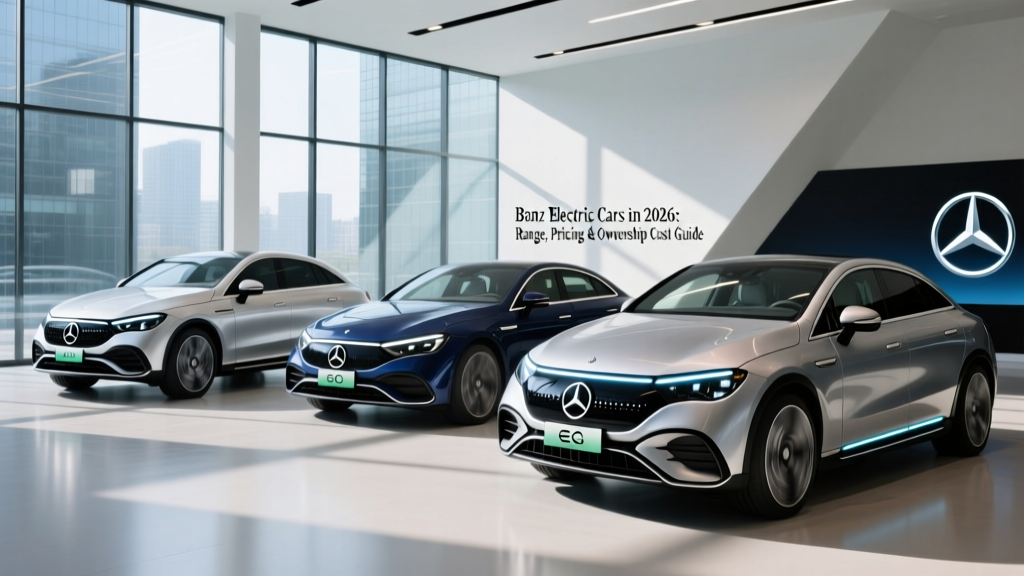
Mercedes-Benz currently sells three core EV models in the U.S.: the EQE Sedan (EPA 305 mi, from $74,900), the EQS Sedan (EPA 390 mi, from $104,400), and the EQE SUV (EPA 279 mi, from $77,900). None qualify for the full $7,500 federal §30D tax credit due to battery-sourcing rules, making the real purchase premium over gas equivalents roughly $15,000–$25,000. However, fuel and maintenance savings of $1,800–$2,400 per year narrow the gap over a 5-year ownership cycle — especially for buyers with home Level 2 charging and moderate commutes.
Mercedes-Benz EV Lineup: What's Actually Available
Mercedes has consolidated its EQ electric sub-brand into the main Mercedes-Benz lineup for 2026, dropping the "EQ" prefix from future models but keeping it on current production vehicles. Here's what you can actually order today:
| Model | Battery (kWh) | EPA Range | Peak DC Charge | 10–80% Time | 0–60 mph | Base MSRP |
|---|---|---|---|---|---|---|
| EQE 350+ Sedan | 90.6 (NMC) | 305 mi | 170 kW | ~32 min | 6.2 sec | $74,900 |
| EQE 350 4MATIC SUV | 90.6 (NMC) | 279 mi | 170 kW | ~32 min | 6.4 sec | $77,900 |
| EQS 450+ Sedan | 118.0 (NMC) | 390 mi | 200 kW | ~31 min | 5.9 sec | $104,400 |
| EQS 450 4MATIC SUV | 118.0 (NMC) | 330 mi | 200 kW | ~31 min | 5.8 sec | $108,400 |
All current Benz electric cars use NMC (nickel-manganese-cobalt) lithium-ion batteries, not LFP. This means higher energy density but also a manufacturer-recommended daily charge limit of 80% for longevity — reserve 100% for road trips. The battery warranty across the lineup is 10 years / 155,000 miles with a 70% state-of-health retention guarantee, which is competitive with BMW and Audi but trails Hyundai/Kia's unlimited-mileage coverage.
Real-World Range Reality Check
EPA estimates assume mixed driving at moderate temperatures. In our experience and independent testing:
- Highway-only (75 mph, 70°F): Expect 85–90% of EPA — roughly 260 mi (EQE Sedan), 330 mi (EQS Sedan)
- Cold weather (30°F, mixed): Expect 70–78% of EPA — roughly 215–240 mi (EQE), 275–305 mi (EQS)
- Heat pump standard: All 2026 EQ models include a heat pump, reducing cold-weather HVAC energy draw by ~30% vs resistive heating
Benz Electric Cars vs Gas Equivalents: The Cost Math
The most common question from luxury-car shoppers is whether the EV premium pays for itself. Let's compare the EQE 350+ Sedan against its closest gas sibling, the E 350 Sedan, over 5 years and 60,000 miles.
| Cost Factor | EQE 350+ (EV) | E 350 (Gas) | 5-Year Difference |
|---|---|---|---|
| Base MSRP | $74,900 | $62,300 | +$12,600 (EV) |
| Federal Tax Credit (§30D) | $0 (sourcing fail) | $0 | $0 |
| Fuel/Energy (60k mi) | $4,320 (home L2 avg) | $9,900 (premium gas) | −$5,580 (EV saves) |
| Maintenance | $1,800 | $3,600 | −$1,800 (EV saves) |
| Insurance (avg) | $12,600 | $10,200 | +$2,400 (EV costs) |
| Estimated Depreciation | $37,450 (50%) | $28,035 (45%) | +$9,415 (EV costs) |
| 5-Year Total Cost | $94,070 | $86,000 | +$8,070 (EV) |
Sources: fueleconomy.gov, Mercedes-Benz USA, AAA insurance averages. Electricity at $0.16/kWh national avg; gas at $4.10/gal premium.
The verdict: you will not break even on a Benz EV purely through fuel savings in 5 years. The premium is real, and without the federal tax credit, the math favors the gas E-Class by roughly $8,000 over a typical ownership cycle. However, if you value instant torque, silent operation, HOV-lane access in states like California, and zero tailpipe emissions, the non-financial benefits may justify the spread.
Charging Benz Electric Cars: Home and Public Reality
Home Charging (Where 80%+ of Miles Are Added)
Every Benz EV ships with a NACS (Tesla-style) charge port for 2026, replacing the CCS1 port used on 2022–2024 models. This is significant: it means native access to Tesla Superchargers without an adapter — a major public-charging-network advantage.
| Level | Power | Miles Added/Hour | Full Charge Time | Use Case |
|---|---|---|---|---|
| Level 1 (120V) | 1.4 kW | ~4 mi/hr | 60+ hours | Emergency only |
| Level 2 (240V, 48A) | 11.5 kW | ~35 mi/hr | ~9 hours | Daily overnight |
| DC Fast (170–200 kW) | Peak | ~600 mi/hr (peak) | 10–80% in 31 min | Road trips |
For home Level 2 installation, budget $1,200–$3,500 total (charger + electrician + permit) if your panel has capacity. If you need a 200A panel upgrade, add $2,000–$4,000. The Mercedes-Benz Wallbox Home costs $599 and delivers up to 11.5 kW on a 60A circuit.
Public DC Fast Charging: The Curve Matters
Mercedes quotes peak charge rates of 170 kW (EQE) and 200 kW (EQS), but peak is not sustained. The actual charging curve looks like this:
- 10–30% SoC: Near-peak rate (160–200 kW)
- 30–60% SoC: Sustained ~130–150 kW
- 60–80% SoC: Tapers to ~80–100 kW
- 80–100% SoC: Drops below 40 kW — avoid unless necessary
Practical takeaway: plan road-trip stops around 10–80% charges. That 31-minute 10–80% session adds roughly 230 miles (EQE) or 300 miles (EQS). Charging to 100% at a DC station adds another 40+ minutes for the final 20% — not worth the wait.
With the NACS port, you can use Tesla Supercharger V3/V4 stalls (150–350 kW) natively. Mercedes also partners with Electrify America and EVgo, but reliability scores from J.D. Power consistently rank Tesla's network highest for uptime.
Federal Tax Credit & Incentives: The Bad News
§30D Federal Tax Credit Requirements (2026)
- ✅ Vehicle MSRP under $55,000 (sedans) or $80,000 (SUVs/trucks) — EQE Sedan qualifies on MSRP; EQS does not
- ✅ Buyer AGI under $150K (single) / $300K (joint)
- ❌ Battery components manufactured/assembled in North America — Mercedes EQ batteries are assembled in Germany; fails this requirement
- ❌ Critical minerals sourced from U.S. or FTA partners — partial compliance at best
As of 2026, no Mercedes-Benz EV qualifies for the $7,500 federal tax credit under IRS §30D rules. The battery-sourcing and component-assembly requirements, which tightened annually since 2024, effectively exclude most European-manufactured EVs. See current rules at IRS.gov.
Some state-level incentives remain available regardless of federal eligibility:
- California: Up to $2,000 (CVRP, income-dependent)
- Colorado: $5,000 state credit (no sourcing requirement)
- New York: Up to $2,000 (Drive Clean Rebate)
- Utility rebates: Many utilities offer $500–$1,500 for home charger installation
Check your state's energy office and local utility for current programs — these change frequently and are outside our scope to track at the local level.
Common Misconceptions About Benz EVs
| Myth | Fact |
|---|---|
| "Mercedes EVs are self-driving" | All current EQ models feature SAE Level 2 driver-assist (Distronic + Active Steering). You must keep hands on the wheel and eyes on the road. Mercedes' Level 3 "Drive Pilot" is available only in Nevada and California on select S-Class/EQS models, limited to 40 mph in traffic jams, and costs $2,500. |
| "The battery will need replacing in 5 years" | Mercedes warranties the battery for 10 years/155,000 mi at 70% capacity. Real-world degradation data from European fleets shows NMC packs retaining ~88–92% capacity after 100,000 miles with proper charging habits (20–80% daily). |
| "I can charge to 100% every night" | For NMC chemistry, daily charging to 100% accelerates degradation. Set your charge limit to 80% for daily use (configurable in the Mercedes me app) and only charge to 100% before long trips. |
| "EVs cost more to insure because they're electric" | Partially true: EV insurance averages 15–25% higher than gas equivalents, driven by higher repair costs (battery replacement after collision) and elevated vehicle prices. Shop quotes from GEICO, Progressive, and EV-specialty insurers before buying. |
| "I don't need home charging — public stations are everywhere" | Public DC charging costs $0.35–$0.55/kWh (vs $0.12–$0.18 home). Relying solely on public charging erases most fuel-cost savings and adds 30–45 minutes per session. Home Level 2 is nearly essential for Benz EV ownership economics. |
Decision Framework: Which Benz Electric Car Is Right for You?
Choose Based on Your Situation
Choose the EQE 350+ Sedan if:
- You commute 30–60 miles daily and have home Level 2 charging
- You want the E-Class experience electrified without six-figure pricing
- 305 mi EPA range covers your longest regular trip without a charge stop
Choose the EQS 450+ Sedan if:
- You regularly drive 200+ miles between charges (road trips, multi-city commutes)
- 390 mi EPA range (330 mi real-world highway) eliminates most range anxiety
- You value the S-Class-level interior and MBUX Hyperscreen
- Budget allows $104K+ and you accept the depreciation hit
Choose the EQE 350 SUV if:
- You need cargo space (cargo: 55 cu ft with rear seats folded) and AWD (4MATIC standard)
- You accept a 279 mi EPA range (~235 mi real-world highway/cold) with planned charge stops
- You tow occasionally (up to 1,650 lbs — light duty only)
Do NOT buy a Benz EV if:
- You lack access to home or workplace Level 2 charging (public-only charging is expensive and time-consuming)
- You regularly drive in temperatures below 10°F and need maximum range (consider a PHEV like the S 580e instead)
- You need the federal tax credit to justify the EV premium (look at Tesla, Ford, GM, or Hyundai/Kia models that qualify)
- You plan to keep the car 10+ years and worry about out-of-warranty battery replacement ($20,000–$30,000 estimated)
First-Time Benz EV Buyer Checklist
If you're transitioning from a gas Mercedes (or any gas car) to a Benz EV, prepare for these ownership shifts:
- Get a home electrical assessment before purchasing. A licensed electrician should verify your panel has a spare 60A breaker slot. If not, budget for a panel upgrade ($2,000–$4,000) before delivery day.
- Download the Mercedes me app and set your charge limit to 80%. This single habit will extend your NMC battery's useful life by years.
- Plan your first road trip with the Mercedes me EV route planner. It accounts for charge-curve taper, elevation, and temperature — more accurate than third-party apps for Benz-specific vehicles.
- Get three insurance quotes before signing the purchase agreement. EV premiums vary wildly; some insurers charge 5% more, others 30%.
- Learn preconditioning. Set a departure time in the app while plugged in — the car warms/cools the cabin and battery using grid power, preserving range. In cold weather, preconditioning can recover 15–20 miles of range that would otherwise be lost to battery heating.
- Understand regenerative braking settings. The EQ lineup offers three regen levels (D+, D, D−) plus an auto mode that uses radar to modulate regen based on traffic ahead. Most owners prefer auto mode for one-pedal-like driving without full one-pedal commitment.
Frequently Asked Questions
Will Mercedes-Benz EVs qualify for the federal tax credit in the future?
Mercedes is localizing battery production at its Bibb County, Alabama plant for future models (next-gen GLC EV, expected 2027+). Current EQ models with German-assembled batteries will not retroactively qualify. If the §30D sourcing rules loosen legislatively, eligibility could expand — but do not count on this for a current purchase decision.
How does the MBUX Hyperscreen affect range?
Minimally. The 56-inch Hyperscreen (standard on EQS, optional on EQE) draws roughly 100–150 watts — equivalent to running seat heaters on low. It does not meaningfully impact range. The real energy consumers are HVAC (up to 5 kW in extreme cold) and speed (aerodynamic drag increases with the square of velocity).
Can I use Tesla Superchargers with a 2022–2024 Mercedes EQ?
Yes, but you'll need Mercedes' official CCS-to-NACS adapter ($199). Starting with 2025 models, the NACS port is native. Older CCS-port EQ models can also use Electrify America and EVgo networks natively without adapters.
What happens if the battery fails out of warranty?
Out-of-warranty NMC battery replacement for EQ models is estimated at $20,000–$30,000 based on current parts pricing. However, catastrophic battery failure is rare — most degradation is gradual. Individual module replacement (rather than the full pack) may be possible at lower cost. Third-party EV repair shops are emerging as a more affordable alternative to dealer service.
Is the EQS SUV different from the EQS Sedan?
Yes. The EQS SUV shares the 118 kWh battery and platform but is heavier and less aerodynamic, resulting in 330 mi EPA range (vs 390 mi for the sedan). It offers three-row seating (7-passenger option), 80 cu ft of cargo space, and standard 4MATIC AWD. Starting price: $108,400.
How do Benz EVs compare to BMW and Audi electric competitors?
The EQE competes with the BMW i5 (EPA 295 mi, from $70,200) and Audi e-tron GT (EPA 238 mi, from $106,500). The EQS competes with the BMW i7 (EPA 318 mi, from $124,200). Mercedes generally leads on range within the segment (EQS 390 mi is class-leading) but trails BMW on DC charging speed (BMW i5 supports 205 kW vs EQE's 170 kW). All three brands face the same federal tax-credit exclusion.
Specs sourced from Mercedes-Benz USA and fueleconomy.gov. Tax-credit rules per IRS.gov §30D. Pricing reflects 2026 model year MSRP before destination charges. Real-world range estimates based on independent testing and owner-reported data; your results will vary with temperature, terrain, speed, and tire condition.