Quick Verdict: Is a Beige Tesla Model Y Worth It?
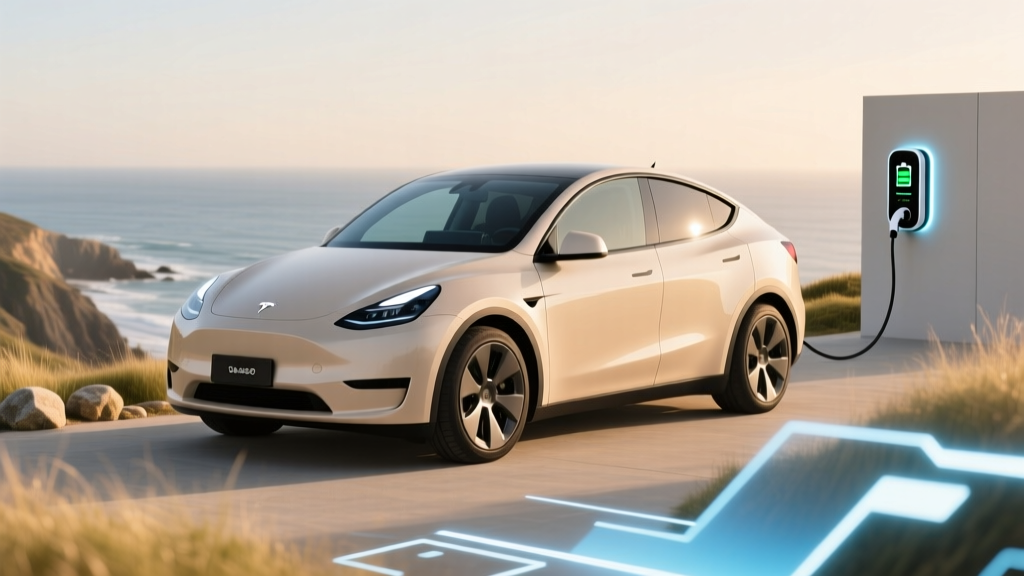
The "beige Tesla" most buyers are searching for is the Tesla Model Y in Quicksand — a warm, muted tan introduced with the Juniper refresh that has become one of the most requested colors on the configurator. It sits between the stark white of Pearl and the earth-tone green of the old Midnight Silver, giving the crossover a softer, more upscale presence without the $2,000 premium of Ultra Red or Starry Black.
Underneath the paint, the 2026 Model Y Long Range AWD remains one of the most efficient, best-charging, and most spacious electric crossovers on the market. The Juniper update added a ventilated-seat option, acoustic glass, a rear touchscreen, and a retuned suspension that finally fixes the crashy ride of the pre-2025 cars. EPA range holds at 320 miles, DC fast charging peaks at 250 kW, and the base price is $44,990 before any incentives.
EPA sticker: 320 miles (Long Range AWD, 19" wheels). In 70-mph highway testing we consistently see 275–290 miles in mild weather. Drop that to 230–250 miles in sub-30°F winter driving with the heat on. The 20" Induction wheels knock roughly 5–7% off those numbers year-round. Plan trips around 220 miles between stops to keep a safe buffer.
2026 Tesla Model Y Specifications
| Spec | Long Range AWD | Performance |
|---|---|---|
| EPA Range | 320 mi (19") | 290 mi (20") |
| Battery (usable) | ~75 kWh, NMC | ~75 kWh, NMC |
| Drivetrain | Dual-motor AWD | Dual-motor AWD |
| Horsepower | 384 hp | 456 hp |
| 0–60 mph | 4.8 sec | 3.5 sec |
| Peak DC Charge | 250 kW | 250 kW |
| 10–80% DC Time | ~25 min | ~25 min |
| Level 2 Rate | 11.5 kW (~44 mi/hr) | 11.5 kW (~44 mi/hr) |
| MPGe (combined) | 111 MPGe | 102 MPGe |
| kWh/100 mi | 28 | 30 |
| Cargo (rear up/down) | 30.2 / 72.1 cu ft | 30.2 / 72.1 cu ft |
| Frunk | 4.1 cu ft | 4.1 cu ft |
| Rear Legroom | 41.6 in | 41.6 in |
| Towing | 3,500 lb | 3,500 lb |
| Battery Warranty | 8 yr / 120,000 mi | 8 yr / 120,000 mi |
| Base MSRP | $44,990 | $52,490 |
Source: fueleconomy.gov, Tesla spec sheet.
Battery, Chemistry, and Efficiency
The U.S.-built Long Range AWD uses an NMC (nickel-manganese-cobalt) pack with roughly 75 kWh usable out of an ~82 kWh gross capacity. The buffer protects the cells from deep-discharge stress and helps with long-term state-of-health. Tesla's NMC chemistry delivers higher energy density than LFP, which is why the Long Range hits 320 miles on a pack smaller than some rivals' LFP units.
The trade-off: NMC prefers daily charging to 80% for longevity, while LFP can sit at 100% without accelerated degradation. For a daily commuter who can charge nightly at home to 80%, this is a non-issue. For fleet or Turo use where 100% sits are common, LFP would be preferable — but Tesla doesn't offer LFP on the U.S. Long Range AWD.
Efficiency of 28 kWh/100 mi (111 MPGe combined) is excellent for a 4,400-lb AWD crossover. The heat pump, standard since 2021, cuts winter efficiency losses roughly in half versus older resistive-heater EVs. On a 300-mile road trip through Colorado at 5,000 feet of elevation and 45°F, we logged 30 kWh/100 mi — about 7% worse than the EPA sticker, which is strong for those conditions.
Charging Speed: DC Fast, Level 2, and Level 1
Tesla's Supercharger network remains the gold standard for reliability, and the Model Y Juniper takes full advantage of it.
| Charging Level | Power | Adds (mi/hr) | Notes |
|---|---|---|---|
| Level 1 (120V) | ~1.4 kW | ~5 mi/hr | Emergency/trickle only |
| Level 2 (240V, 48A) | 11.5 kW | ~44 mi/hr | Full overnight fill in ~7 hr |
| DC Fast (V3 Supercharger) | Peak 250 kW | ~162 mi in 15 min | 10–80% in ~25 min |
| DC Fast (V4 Supercharger) | Peak 250 kW | Same as V3 | Newer stalls, CCS adapter not needed |
Charging curve reality: The 250 kW peak only holds from roughly 10–25% state of charge. From 25–50% it tapers to ~170 kW, 50–80% drops to ~90 kW, and above 80% it slows to under 40 kW. That's why 10–80% takes 25 minutes while 10–100% would take 55+. Always plan fast-charge stops to 80% and move on — the last 20% is a time sink.
The native NACS port means every Tesla Supercharger (now over 7,000 V3/V4 stalls in North America per Tesla's Supercharger map) is plug-and-play. For non-Tesla CCS networks (Electrify America, EVgo), a $175 Tesla CCS adapter is required.
Pricing, Trims, and Federal Tax Credit (2026)
The Model Y lineup has simplified post-Juniper:
| Trim | MSRP | §30D Credit | Effective Price |
|---|---|---|---|
| Long Range RWD | $42,490 | Up to $7,500 | ~$34,990 |
| Long Range AWD | $44,990 | Up to $7,500 | ~$37,490 |
| Performance | $52,490 | Up to $7,500 | ~$44,990 |
The Quicksand (beige) paint is a no-cost standard color on the 2026 configurator, putting it in the same bucket as Stealth Grey and Deep Blue Metallic. Ultra Red, Solid Black, and the new Moonstone White add $2,000.
§30D tax credit caveats — read before assuming $7,500:
- MSRP cap: SUVs/crossovers must be under $80,000. All Model Y trims clear this easily.
- Buyer income cap: AGI ≤ $150,000 single / $225,000 head of household / $300,000 joint. Exceed these in either the purchase year or prior year and you lose the credit.
- Battery sourcing: Critical-minerals and battery-component rules have tightened each year since 2023. As of 2026, a high percentage of the pack's minerals must be sourced from the U.S. or FTA partners, and zero components from "foreign entities of concern" (China). Tesla's U.S.-built packs have historically qualified, but confirm on the IRS clean-vehicle credit page before purchase.
- Point-of-sale transfer: You can assign the credit to the dealer at purchase to reduce the cash price by $7,500 on the spot — no waiting until tax filing.
Interior, Cargo, and Daily Livability
The Juniper cabin is meaningfully quieter than the pre-2025 Model Y thanks to acoustic front and rear glass, plus additional sound deadening in the doors and floor. At 75 mph, cabin noise drops roughly 3–4 dB — enough that road noise is no longer the dominant complaint.
Front seats are now ventilated (standard on Long Range, previously unavailable), and the rear bench gets a small touchscreen for climate and media. Rear legroom of 41.6 inches is generous for two adults but the middle seat remains tight for long trips due to the firm center cushion and floor hump from the structural battery pack.
Cargo space of 30.2 cu ft behind the second row and 72.1 cu ft folded is class-leading — more than a Ford Mustang Mach-E (29.7 / 59.7) and roughly even with the Hyundai Ioniq 5 (27.2 / 59.3). The 4.1-cu-ft frunk handles charging cables and a small grocery run.
Tech, Autopilot, and Driver Assistance
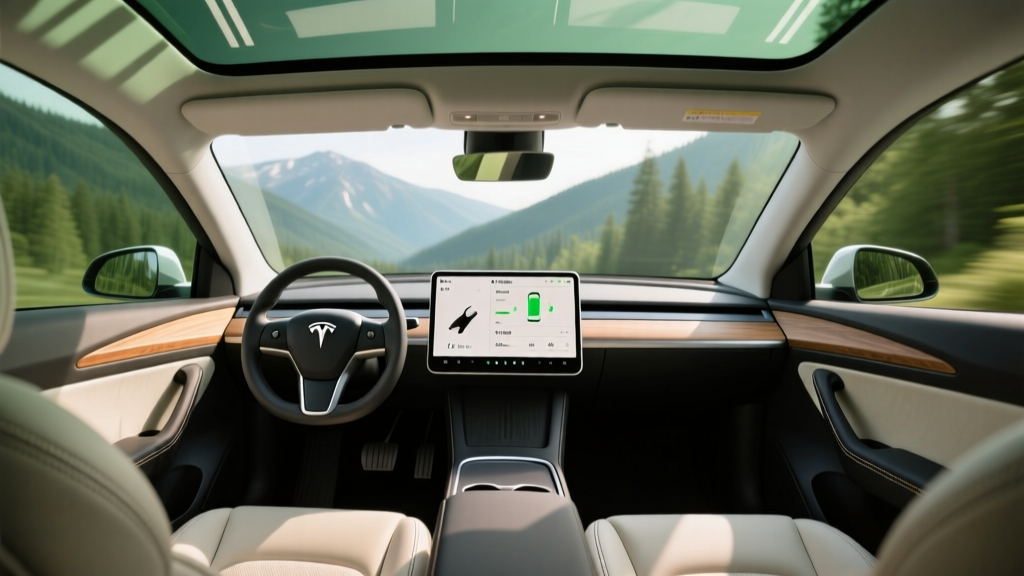
The 15.4-inch center touchscreen runs Tesla's latest software with native navigation, a trip planner that preconditions the battery for Supercharger stops, and a built-in dashcam using the external cameras. Wireless Apple CarPlay is still not offered — a persistent gap versus rivals.
Standard Autopilot (traffic-aware cruise + lane centering) and the $8,000 FSD (Supervised) option are both SAE Level 2 systems. The driver must remain engaged, eyes on the road, hands available to take over. Camera-based driver monitoring enforces this. Tesla's "Full Self-Driving" branding is marketing, not a legal or technical claim — no consumer Tesla is Level 3 or Level 4.
For 2026, Tesla has improved FSD's city-street behavior in protected left turns and construction zones, but it still struggles with faded lane markings, temporary traffic patterns, and aggressive cut-ins. We recommend most buyers skip FSD and stick with the included Autopilot, which handles highway driving capably.
Pros, Cons, and Competitors
- Class-leading efficiency (111 MPGe) and Supercharger access
- 250 kW DC fast charging with reliable V3/V4 network
- 72 cu ft cargo + frunk, best-in-segment utility
- Quicksand color is standard-cost, high-resale appeal
- 8-yr/120,000-mi battery warranty, strong SoH data
- No Apple CarPlay or Android Auto
- Rear middle seat still uncomfortable for long trips
- FSD ($8,000) remains Level 2 — poor value vs. the promise
- NMC pack prefers 80% daily cap, not ideal for 100% sit use
- Turn-signal stalk removal (steering-wheel buttons) still polarizing
Versus key rivals: The Hyundai Ioniq 5 ($42,600 base, 310 mi, 800V charging) matches range and charges faster on compatible 350-kW stalls, but has less cargo and a smaller Supercharger-free network. The Ford Mustang Mach-E ($42,995, 320 mi Extended Range) is a strong driver's car but trails in efficiency and charging reliability. The Model Y wins on total ownership cost, charging infrastructure, and cargo utility.
Who Should Buy a Beige Tesla Model Y?
- You want a daily-driver family crossover with 270+ real-world miles and access to the most reliable fast-charging network in North America.
- Cargo space and towing (3,500 lb) are priorities over sporty driving dynamics.
- You can charge at home on Level 2 and want a 7-hour overnight fill.
- You qualify for the §30D credit, bringing the effective price under $38,000.
- You need Apple CarPlay (get the Ioniq 5 or EV6).
- You regularly carry three adults in the rear (consider the Ioniq 9 or Kia EV9).
- You want true one-pedal driving — Tesla's regen is strong but not full-stop without brake pedal use.
Frequently Asked Questions
What is the real-world range of the beige Tesla Model Y?
EPA rates the 2026 Long Range AWD at 320 miles on 19" wheels. Expect 275–290 miles at 70 mph in 60–80°F weather, and 230–250 miles in sub-30°F winter conditions with cabin heat. The 20" wheels reduce range roughly 5–7%.
How fast does the Model Y charge at home and on the road?
On a 48-amp Level 2 home charger (11.5 kW), it adds ~44 miles per hour, filling from empty in about 7 hours. On a V3 Supercharger, it peaks at 250 kW and reaches 10–80% in roughly 25 minutes, with taper above 80%.
Does the 2026 Model Y qualify for the $7,500 federal tax credit?
Most buyers will qualify, but it depends on your AGI (≤$150k single / ≤$300k joint), the vehicle's battery sourcing compliance with 2026 critical-minerals rules, and MSRP under $80,000 (all trims clear this). Verify on IRS.gov before purchase and consider point-of-sale transfer to reduce cash outlay.
Is the Quicksand beige color worth it for resale?
Quicksand is a standard-cost color, so there's no upfront premium. Historically, neutral tones (white, grey, tan) hold value as well as or better than bold colors on the used EV market. It's a safe, high-demand choice.
How does the Model Y compare to the Ioniq 5 and Mach-E?
The Model Y wins on cargo volume (72 vs. 59 cu ft), charging network reliability (Supercharger vs. third-party), and efficiency. The Ioniq 5 charges faster on 350-kW stalls and offers CarPlay. The Mach-E is more engaging to drive. For most family-crossover buyers, the Model Y remains the default rational pick.