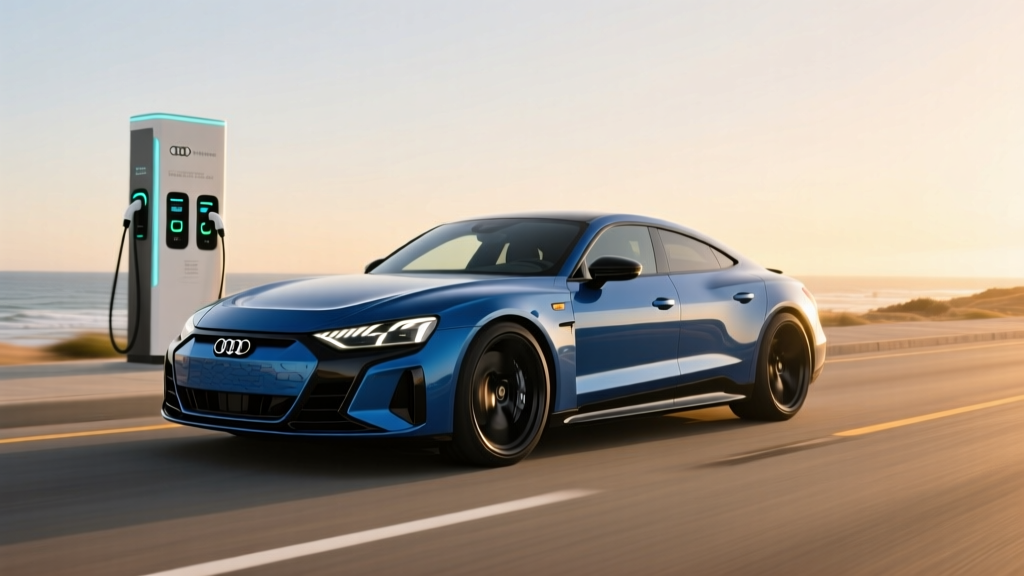
The 2026 Audi RS e-tron GT occupies a rare corner of the electric-vehicle market: a four-door grand tourer that delivers supercar acceleration while wearing a tailored suit. Built on the same J1 Performance platform as the Porsche Taycan, the RS variant cranks output to 916 horsepower in Launch Control mode and charges at rates most EVs can only dream of. But with a starting price near $149,000, prospective buyers need more than brochure stats — they need real-world range, honest charging data, and a clear picture of federal tax-credit eligibility. Here's everything that matters.
2026 Audi RS e-tron GT at a Glance
| Spec | Value |
|---|---|
| EPA Range | 270 miles (est.) |
| Battery (usable / gross) | ~105 kWh usable / 114 kWh gross (NMC) |
| Peak DC Fast-Charge Rate | 320 kW |
| 10–80% DC Charge Time | ~18 minutes |
| Level 2 (AC) Charge Rate | 11 kW (~29 mi/hr) |
| 0–60 mph | 2.5 seconds (Launch Control) |
| Horsepower | 916 hp (boost) / 680 hp (normal) |
| Drivetrain | Dual-motor AWD |
| Efficiency | 79 MPGe combined / 42 kWh/100 mi |
| Cargo (rear + frunk) | 9.2 cu ft trunk + 3.5 cu ft frunk |
| Base MSRP | $149,900 (incl. destination) |
| Battery Warranty | 8 years / 100,000 miles |
Range: What the EPA Sticker Doesn't Tell You
Audi equips the 2026 RS e-tron GT with an upgraded NMC (nickel-manganese-cobalt) battery pack rated at approximately 114 kWh gross, with about 105 kWh usable. The J1 platform's 800-volt architecture not only enables blistering charge speeds but also improves thermal management, helping the pack sustain performance during repeated hard launches — something lower-voltage platforms struggle with.
Efficiency lands around 42 kWh per 100 miles, or 79 MPGe combined per fueleconomy.gov. That's respectable for a 5,100-pound performance sedan, but it trails lighter rivals like the Lucid Air Grand Touring (131 MPGe) by a wide margin. If range-per-kWh matters to you, the RS e-tron GT prioritizes power delivery over efficiency — and that's a deliberate engineering trade-off.
Charging Speed: 320 kW Peak, but Watch the Curve
| Charging Level | Power | Speed / Time |
|---|---|---|
| Level 1 (120V household) | ~1.4 kW | ~3 mi/hr — emergency use only |
| Level 2 (240V home) | 11 kW | ~29 mi/hr; full charge in ~10 hrs |
| DC Fast Charge (peak) | 320 kW | 10–80% in ~18 min; ~200 mi in 10 min |
| DC Fast Charge (typical 150 kW station) | ~150 kW | 10–80% in ~32 min |
The headline number — 320 kW peak — is genuinely impressive and among the fastest in production. However, peak rate is not sustained rate. In real-world DC fast-charging sessions, the RS e-tron GT holds above 270 kW from roughly 10% to 40% State of Charge, then tapers progressively. You'll still reach 80% in about 18 minutes on a 350 kW-capable charger (like Electrify America's latest stalls), but don't expect the full 320 kW for the entire session.
Preconditioning matters. Use the MMI navigation to route to a DC fast charger and the car will warm or cool the battery to its optimal charging temperature before you arrive. Skip this step and your peak rate might drop to 200 kW or below, especially in cold weather. For home charging, the 11 kW onboard charger is adequate — a full overnight top-up takes roughly 10 hours on a 48-amp Level 2 circuit.
Performance: 916 Horsepower, Dual-Motor AWD Precision
The 2026 RS e-tron GT pairs a front and rear permanent-magnet synchronous motor for standard all-wheel drive. In normal driving, output sits at 680 hp. Engage Launch Control and the car unlocks a temporary overboost of 916 hp and approximately 738 lb-ft of torque, rocketing the sedan from 0–60 mph in 2.5 seconds — a figure that puts it in the same territory as a Lamborghini Huracán.
Top speed is electronically limited to 155 mph. The two-speed rear transmission (a J1 platform hallmark) gives strong initial thrust in first gear, then shifts to second for efficient highway cruising. Adaptive air suspension, rear-axle steering (up to 2.8 degrees), and a torque-vectoring rear differential all come standard, making the RS e-tron GT surprisingly agile for its size on canyon roads.
Regenerative braking offers two modes: a coasting mode that freewheels when you lift off the accelerator, and a stronger regen setting that recovers up to 0.3 g. Unlike some competitors, Audi does not offer true one-pedal driving — you'll still use the brake pedal for full stops, which some enthusiasts prefer for the feel of the carbon-ceramic brakes (optional on the RS).
Pricing, Trims & Federal Tax Credit Eligibility
| Trim | MSRP (incl. destination) | Federal §30D Credit | Effective Price |
|---|---|---|---|
| RS e-tron GT | $149,900 | $0 (exceeds MSRP cap) | $149,900 |
| RS e-tron GT performance (if offered) | ~$165,000 | $0 | ~$165,000 |
Under current IRS §30D rules, the new clean-vehicle credit has an MSRP cap of $80,000 for sedans. The RS e-tron GT's $149,900 sticker blows past that limit, making it ineligible for the federal $7,500 tax credit regardless of your income or the battery's critical-mineral sourcing. This is a straightforward disqualification — no workaround exists at the federal level.
Buyers should also note the §30D income caps ($150,000 single / $300,000 joint filing) and battery-sourcing requirements, which are moot here but relevant if you're cross-shopping with lower-priced EVs. Some states offer their own luxury-EV or performance-vehicle incentives — check your local DMV or energy office for specifics, but don't count on them offsetting a six-figure purchase meaningfully.
- Vehicle MSRP ≤ $80,000 for sedans — RS e-tron GT fails
- Buyer AGI ≤ $150K single / $225K HOH / $300K joint
- Battery critical minerals & component sourcing thresholds
- Vehicle assembled in North America
- Point-of-sale transfer available for eligible vehicles
Interior, Tech & Daily Livability
The RS e-tron GT cabin uses Audi's latest MMI touch-response infotainment system with a 10.1-inch upper display and an 8.6-inch lower climate-control screen. The 12.3-inch Virtual Cockpit Plus instrument cluster is standard, along with a head-up display. Wireless Apple CarPlay and Android Auto are included, as is a Bang & Olufsen 710-watt surround-sound system.
Driver-assistance tech includes Audi adaptive cruise with stop-and-go, lane-centering assist, intersection assist, and a surround-view camera system. These features operate at SAE Level 2 — meaning you must keep your hands on the wheel and eyes on the road at all times. Audi does not currently offer a hands-off highway system comparable to GM's Super Cruise or Ford's BlueCruise, which is a notable gap at this price point.
Practicality is the RS e-tron GT's weakest suit. Rear legroom measures 32.6 inches — tight for adults on longer trips. The trunk holds 9.2 cubic feet, supplemented by a small 3.5-cubic-foot frunk. Compare that to the Tesla Model S (28 cu ft liftback) or even the Porsche Taycan Cross Turismo (15.7 cu ft), and the Audi's cargo limitations become clear. This is a driver's car first; family hauler, it is not.
Pros, Cons & the Competition
- Sub-2.5-second 0–60 with repeatable launch performance
- 320 kW peak charging is among the fastest in production
- 800V architecture enables superior thermal management
- Build quality and materials exceed most EV rivals
- Rear-axle steering and air suspension standard
- 8-year/100,000-mile battery warranty
- 270-mile EPA range trails Lucid Air, Tesla Model S
- No federal tax credit (MSRP cap disqualification)
- Rear seat and cargo space are cramped
- No hands-off Level 2+ highway driving system
- Efficiency of 42 kWh/100 mi is below class leaders
- Insurance premiums are steep for this performance tier
Key competitors: The Porsche Taycan Turbo GT (similar platform, sharper track focus, ~280-mi range) and the Lucid Air Sapphire (1,234 hp, 427-mi range, more interior room) are the closest rivals. The Tesla Model S Plaid undercuts on price (~$90k) and offers more range (402 mi) but can't match the Audi's build quality or charging speed. If you value a driver-focused cockpit and the fastest DC charging available, the RS e-tron GT earns its spot. If range and rear-seat comfort top your list, look to Lucid or Tesla.
Who Should Buy the 2026 RS e-tron GT?
- You want supercar acceleration in a four-door daily driver
- Ultra-fast DC charging (320 kW) is a top priority for road trips
- Build quality, fit-and-finish, and brand prestige matter to you
- Your typical trips fall within 220–250 miles or you have reliable fast-charging access
- You need maximum range (Lucid Air Grand Touring: 516 mi EPA)
- Rear-seat passenger comfort is non-negotiable
- Federal tax-credit eligibility factors into your purchase decision
- You want a hands-off Level 2+ highway driving feature
The RS e-tron GT is best suited for the enthusiast-commuter who values acceleration, charging speed, and craftsmanship over maximum range and practicality. It's a car for someone who already has a Level 2 charger at home, takes occasional road trips along well-serviced DC fast-charging corridors, and doesn't regularly haul rear-seat passengers. As a second car in a multi-vehicle household, it's exceptional. As a sole family vehicle, its space and range limitations are real constraints.
Frequently Asked Questions
What is the real-world range of the 2026 Audi RS e-tron GT?
The EPA estimates 270 miles. In real-world highway driving at 70+ mph, expect 235–255 miles. Cold weather (below 30°F) can reduce range to roughly 200–220 miles. City driving with regenerative braking can slightly exceed the EPA figure.
How fast does the RS e-tron GT charge at home and on the road?
On DC fast chargers, it peaks at 320 kW and reaches 10–80% in approximately 18 minutes on a 350 kW-capable station. At home on a 240V Level 2 charger (11 kW), expect about 29 miles of range per hour, or a full charge in roughly 10 hours.
Does the 2026 RS e-tron GT qualify for the federal EV tax credit?
No. Under current IRS §30D rules, the new-vehicle credit has an $80,000 MSRP cap for sedans. The RS e-tron GT's $149,900 starting price exceeds this cap, making it ineligible regardless of buyer income or battery sourcing.
Is the RS e-tron GT worth buying over the Porsche Taycan Turbo GT?
They share the J1 platform but differ in tuning. The Taycan Turbo GT is more track-focused with slightly sharper handling; the RS e-tron GT leans more toward grand-touring comfort. Pricing is similar. If track days matter, lean Porsche. If daily drivability and Audi's interior quality appeal more, the RS e-tron GT is the pick.
What is the battery warranty?
Audi covers the high-voltage battery for 8 years or 100,000 miles (whichever comes first), with a capacity-retention threshold of 70%. The general vehicle warranty is 4 years / 50,000 miles.
Does it have one-pedal driving?
No. The RS e-tron GT offers moderate regenerative braking (up to 0.3 g) but does not bring the car to a complete stop without using the brake pedal. Audi's philosophy prioritizes a natural braking feel over one-pedal convenience.