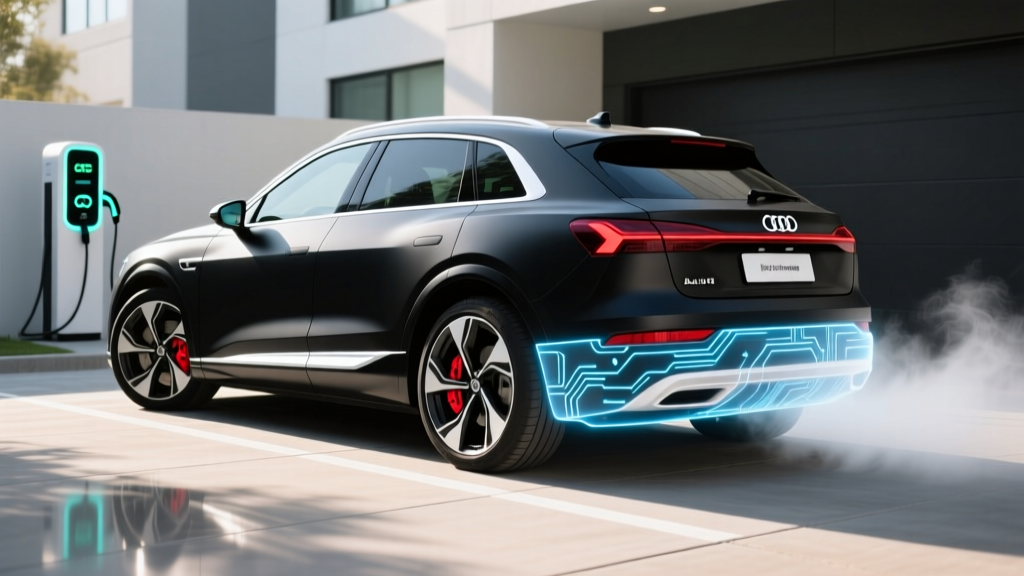
If you're researching the Audi Q8 e-tron towing capacity, you've likely narrowed your search to a small club: electric SUVs that can actually pull a camper, boat, or utility trailer without compromise. The Q8 e-tron (Audi's rebranded and upgraded successor to the original e-tron) delivers a maximum tow rating of 4,000 pounds when properly equipped — enough for a mid-size travel trailer, a pair of personal watercraft, or a loaded utility hauler. But towing is only one chapter in this luxury electric SUV's story. Below, we break down every spec that matters to a buyer in 2026: real-world range, charging speed, battery chemistry, pricing after federal incentives, and whether it out-hauls rivals like the BMW iX, Rivian R1S, and Tesla Model X.
Audi Q8 e-tron Core Specs at a Glance
| Spec | Value |
|---|---|
| EPA Range | 285 miles (SUV), 281 miles (Sportback) |
| Battery (usable) | 106 kWh (114 kWh gross), NMC lithium-ion |
| Max DC Fast Charge | 170 kW peak |
| 10–80% DC Charge Time | ~31 minutes (manufacturer claim) |
| Level 2 Home Charge Rate | 19.2 kW (optional) / 11.5 kW (standard) |
| Drivetrain | Dual-motor AWD (quattro) |
| Horsepower (Boost Mode) | 402 hp / 490 lb-ft torque |
| 0–60 mph | 5.5 seconds |
| MPGe (combined) | 73 MPGe (EPA) |
| Efficiency | 46 kWh/100 mi |
| Towing Capacity | 4,000 lbs (factory tow package required) |
| Cargo Volume | 28.5 cu ft (behind 2nd row) / 57.1 cu ft (folded) |
| Base MSRP (55 Premium Plus) | $75,595 (incl. destination) |
| Battery Warranty | 8 years / 100,000 miles (70% capacity retention) |
Towing Capacity and Trailering Hardware
The Audi Q8 e-tron towing capacity peaks at 4,000 pounds with the factory-installed towing package, which includes a Class III hitch receiver, a 7-pin trailer wiring harness, and trailer stability control integrated into the ESC system. That rating applies to both the standard SUV body and the Sportback variant, though Audi requires the tow package at time of order — it is not a dealer-add accessory you can retrofit with full factory integration.
What can you actually pull at 4,000 lbs? A mid-size single-axle travel trailer (think Airstream Bambi or similar ~3,500-lb loaded models), a small boat on a tandem-axle trailer, or a utility trailer loaded with landscaping equipment. You won't be pulling a 7,000-lb fifth-wheel, but for weekend recreational towing, the Q8 e-tron sits in the upper tier of luxury electric crossovers.
How does it compare? The BMW iX xDrive50 is not rated for towing in the U.S. market at all. The Tesla Model X offers a higher 5,000-lb rating. The Rivian R1S (Dual-Motor) tows up to 7,700 lbs, though it occupies a different price and size class. Among direct luxury-midsize competitors, the Q8 e-tron's 4,000-lb figure is a meaningful differentiator against the iX and competitive with the Mercedes-Benz EQE SUV (no U.S. tow rating currently listed).
A critical towing consideration: expect range to drop 25–40% when trailering, depending on trailer aerodynamics and weight. A 285-mile EPA range realistically becomes 170–210 miles on the highway with a 3,500-lb camper in tow. Plan charging stops accordingly.
Real-World Range vs. EPA Estimates
Audi's 106 kWh usable battery pack uses NMC (nickel manganese cobalt) chemistry — the industry standard for energy-density-focused packs in premium EVs. NMC delivers more range per kilogram than LFP (lithium iron phosphate), though it comes with a slightly narrower daily charging recommendation. Audi's battery management system includes a top and bottom buffer to protect long-term health, meaning the 114 kWh gross capacity yields 106 kWh usable to the driver.
The Q8 e-tron's 73 MPGe combined and 46 kWh/100 mi efficiency rating, per fueleconomy.gov, places it in the middle of the luxury EV SUV pack. It's less efficient than a Tesla Model X (102 MPGe combined) but comparable to the Mercedes EQE 350 4MATIC SUV (74 MPGe). The heavy battery pack and quattro all-wheel-drive system trade some efficiency for traction and towing stability.
Charging Speed: DC Fast Charging and Home Setup
The Q8 e-tron supports a peak DC fast-charge rate of 170 kW on CCS1-equipped public chargers (or NACS, depending on model-year adapter availability). Audi's charge curve is one of the flattest in the industry — the battery sustains close to peak rate from roughly 10% to 60% SoC before tapering. The result: a 10–80% charge in approximately 31 minutes at a capable 175+ kW station.
| Level | Power | Charge Time | Miles Added per Hour |
|---|---|---|---|
| Level 1 (120V household) | ~1.4 kW | ~72 hours (0–100%) | ~3–4 mi/hr |
| Level 2 (240V, standard onboard) | 11.5 kW | ~9.5 hours (0–100%) | ~25 mi/hr |
| Level 2 (240V, optional onboard) | 19.2 kW | ~5.5 hours (0–100%) | ~42 mi/hr |
| DC Fast Charge (CCS/NACS) | 170 kW peak | ~31 min (10–80%) | Up to ~340 mi/hr at peak |
For home charging, the standard 11.5 kW onboard charger adds roughly 25 miles of range per hour — adequate if you park overnight for 8+ hours. The optional 19.2 kW onboard charger (requires a 100-amp dedicated circuit) cuts full-charge time nearly in half and is worth the upgrade if your electrical panel supports it. Budget $800–$2,500 for a professional Level 2 home installation, depending on whether your panel needs an upgrade to 200A service.
One ownership note: preconditioning matters. Use the Q8 e-tron's navigation-based battery preconditioning when routing to a DC fast charger — the vehicle will warm the pack to optimal temperature, ensuring you hit peak charge rate on arrival. Skipping preconditioning in cold weather can add 10+ minutes to your 10–80% charge time.
Performance and Driving Dynamics
The Q8 e-tron 55 quattro's dual-motor all-wheel-drive system produces 402 horsepower and 490 lb-ft of torque in Boost Mode (engaged via the drive-select system for 60-second bursts). Standard output is 355 hp. The 0–60 mph sprint takes 5.5 seconds — brisk for a 5,800-lb luxury SUV, though not sports-car territory.
Where the Q8 e-tron shines is low-end torque delivery. Electric motors produce peak torque from 0 RPM, which translates to confident highway merging and, critically, strong low-speed pulling power when starting from a stop with a trailer hitched. The air suspension (standard on Premium Plus and Prestige trims) automatically levels the vehicle under load and offers adjustable ride height — useful for hitching and for clearing rough terrain at a campsite.
The S e-tron variant (the performance-oriented SQ8 e-tron) bumps output to 496 hp and drops 0–60 to 4.4 seconds, though it carries a higher MSRP and slightly reduced range (274 miles EPA). For towing purposes, the standard 55 quattro is the recommended choice — the SQ8's sport tuning offers no trailering advantage.
Pricing, Trims, and Federal Tax Credit Eligibility
The 2026 Audi Q8 e-tron lineup starts at $75,595 for the 55 Premium Plus trim (including $1,195 destination). The Prestige trim adds approximately $6,000, and the Sportback body style carries a modest premium. The SQ8 e-tron starts around $90,495.
| Trim | MSRP | Est. After §30D Credit* |
|---|---|---|
| 55 Premium Plus | $75,595 | $68,095 |
| 55 Prestige | $81,595 | $74,095 |
| Sportback Premium Plus | $77,595 | $70,095 |
| SQ8 e-tron Premium Plus | $90,495 | $82,995 |
*Federal tax credit estimates assume full eligibility under IRS §30D rules. Actual credit amount depends on battery critical-mineral and component sourcing requirements, buyer income caps ($150K single / $300K joint MAGI), and MSRP caps ($80,000 for SUVs/VANs/pickups). The Q8 e-tron 55 trims fall under the $80K SUV cap. The SQ8 e-tron exceeds the MSRP cap and does not qualify. Credit can be transferred to the dealer at point of sale for an instant price reduction. Always verify current eligibility on IRS.gov and consult a tax professional.
The Q8 e-tron's eligibility for the full $7,500 federal credit has varied by model year as battery sourcing rules tightened under the Inflation Reduction Act. For 2026, Audi has worked to qualify critical-mineral and battery-component requirements, but the exact credit amount ($3,750 for meeting one requirement, $7,500 for both) should be confirmed at the dealership before purchase. The point-of-sale transfer option means you don't need to wait until tax filing — the credit reduces your purchase price directly at signing.
Interior, Cargo, and Technology
The Q8 e-tron cabin is unmistakably Audi: triple-screen MMI touch response infotainment (10.1" upper, 8.6" lower, 12.3" Virtual Cockit Plus), available head-up display with augmented-reality navigation, and Nappa leather upholstery on Prestige trims. Rear-seat legroom measures 38.0 inches — generous for adults on long trips.
Cargo space behind the second row is 28.5 cubic feet in the SUV body (27.2 in the Sportback due to the sloping roofline), expanding to 57.1 cu ft with seats folded. There is no front trunk (frunk) — the space under the hood houses power electronics. For towing families, the cargo area accommodates two large suitcases and camping gear behind the second row, though a Rivian R1S offers substantially more total volume.
Driver-assistance technology includes Audi Adaptive Cruise Assist with lane centering (SAE Level 2 — the driver must remain engaged and hands on or near the wheel at all times), intersection assist, and traffic-sign recognition. Audi does not currently offer a hands-free highway driving system comparable to GM's Super Cruise or Ford's BlueCruise. The available Park Assist Plus with remote parking is useful for tight garage maneuvers but does not replace driver attention.
Pros, Cons, and the Verdict
- 4,000-lb towing capacity with integrated trailer stability control
- Flat DC charge curve sustains ~170 kW longer than most competitors
- Air suspension auto-levels under trailer load
- Quiet, refined cabin with premium materials
- Optional 19.2 kW onboard charger cuts home charge time significantly
- 285-mile EPA range trails Tesla Model X (348 mi) and is average for the class
- Efficiency of 46 kWh/100 mi means higher electricity cost per mile
- No frunk; cargo space is adequate but not class-leading
- No hands-free Level 2+ driving system (e.g., Super Cruise equivalent)
- SQ8 e-tron exceeds §30D MSRP cap, eliminating tax credit eligibility
- Range drops 25–40% when towing — requires careful trip planning
Frequently Asked Questions
What is the Audi Q8 e-tron towing capacity?
The 2026 Audi Q8 e-tron has a maximum towing capacity of 4,000 pounds when equipped with the factory towing package (Class III hitch, 7-pin connector, trailer stability control). This applies to both the SUV and Sportback body styles in the 55 quattro trim.
What is the real-world range of the Audi Q8 e-tron?
The EPA estimates 285 miles for the 2026 Q8 e-tron 55 quattro. Real-world highway driving at 65–70 mph typically yields 245–260 miles. In freezing temperatures, expect 200–225 miles. When towing a loaded trailer, range drops to approximately 170–210 miles depending on trailer weight and aerodynamics.
How fast does the Q8 e-tron charge at a DC fast charger?
The Q8 e-tron peaks at 170 kW on a DC fast charger and sustains a notably flat charge curve, reaching 10–80% in approximately 31 minutes at a 175+ kW station. Battery preconditioning via navigation routing is critical for achieving peak rates, especially in cold weather.
Does the Audi Q8 e-tron qualify for the federal EV tax credit?
The Q8 e-tron 55 trims (MSRP under $80,000) are potentially eligible for up to $7,500 under IRS §30D, subject to buyer income limits ($300K joint / $150K single MAGI), battery critical-mineral sourcing requirements, and point-of-sale transfer rules. The SQ8 e-tron exceeds the $80,000 SUV MSRP cap and is ineligible. Verify current eligibility at IRS.gov before purchasing.
Is the Q8 e-tron worth buying over the Tesla Model X or Rivian R1S?
It depends on priorities. The Q8 e-tron wins on cabin refinement, build quality, and flat DC charge curves. The Tesla Model X offers more range (348 mi EPA) and a higher 5,000-lb tow rating. The Rivian R1S dominates on towing (7,700 lbs), off-road capability, and cargo space, though at a higher price point. For luxury-first daily driving with moderate weekend towing, the Q8 e-tron is a strong fit.
What is the battery warranty on the Q8 e-tron?
Audi covers the Q8 e-tron's high-voltage battery for 8 years or 100,000 miles (whichever comes first), guaranteeing a minimum of 70% capacity retention. The powertrain (motors, power electronics) carries the same 8-year/100,000-mile coverage. The vehicle limited warranty is 4 years / 50,000 miles.