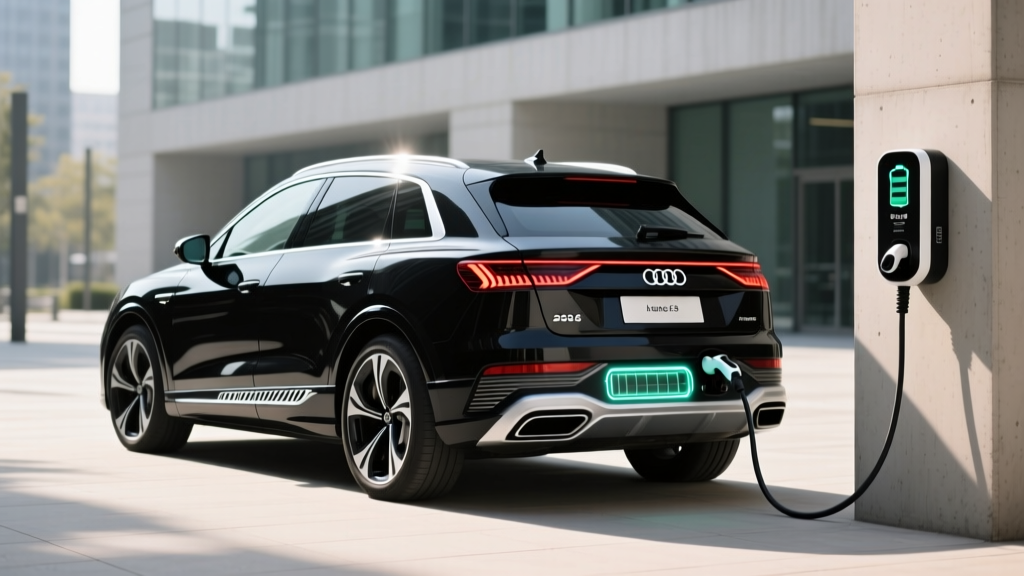
The Audi Q8 e-tron occupies a specific niche: a luxury midsize electric SUV that prioritizes refinement, cabin quietness, and build quality over headline-grabbing acceleration or maximum range. For 2026, Audi continues the nameplate established when the original e-tron was rebranded, offering both the standard SUV body style and the sleeker Sportback variant. But with competitors like the BMW iX, Mercedes EQE SUV, and Tesla Model X pushing performance boundaries, buyers searching for the Audi Q8 e-tron 0-60 time want to know exactly where this EV lands on the spectrum.
This review breaks down every number that matters — from real-world range and charging curves to federal tax credit eligibility — so you can decide whether the Q8 e-tron earns a spot in your garage.
Quick Verdict: Who the Q8 e-tron Is For
The 2026 Audi Q8 e-tron is best suited for luxury buyers who value ride comfort, premium materials, and understated design over outright speed or class-leading range. If your daily routine involves a mix of city commuting and highway cruising with regular access to home Level 2 charging, the Q8 e-tron delivers a polished experience. It is less ideal for buyers who prioritize maximum range per dollar, the fastest DC charging in the segment, or third-row seating.
Look elsewhere if: You need 320+ miles of range, the fastest charging speeds, or a third row — consider the BMW iX xDrive50, Rivian R1S, or Tesla Model X.
Audi Q8 e-tron Performance: 0-60, Powertrain, and Drivetrain
The 2026 Q8 e-tron comes in two main powertrain configurations. The base Q8 55 e-tron uses a dual-motor all-wheel-drive setup producing 402 horsepower and 490 lb-ft of torque in boost mode. Audi quotes a 0-60 mph time of 5.5 seconds for the SUV body style and 5.4 seconds for the Sportback.
Step up to the SQ8 e-tron and output jumps to 496 hp and 718 lb-ft, dropping the 0-60 sprint to 4.3 seconds. The SQ8 adds a sport-tuned air suspension and more aggressive throttle mapping, but the trade-off is reduced efficiency and range.
| Specification | Q8 55 e-tron | SQ8 e-tron |
|---|---|---|
| Drivetrain | Dual-motor AWD | Dual-motor AWD |
| Horsepower (boost) | 402 hp | 496 hp |
| Torque (boost) | 490 lb-ft | 718 lb-ft |
| 0-60 mph | 5.5 sec | 4.3 sec |
| Top Speed | 124 mph | 130 mph |
| Towing Capacity | 4,000 lbs | 4,000 lbs |
The Q8 e-tron's 0-60 time of 5.5 seconds is respectable for a 5,800-pound SUV, though it trails the BMW iX xDrive50 (4.4 seconds) and the Tesla Model X Dual Motor (3.8 seconds). Where the Audi shines is in how it delivers that performance: the acceleration is linear, the cabin stays whisper-quiet, and the air suspension absorbs road imperfections with a composure that makes the Q8 feel lighter than its curb weight suggests.
Range, Efficiency, and Real-World Expectations
The 2026 Q8 55 e-tron carries a 114 kWh gross battery pack (approximately 106 kWh usable) using NMC (nickel manganese cobalt) chemistry. This is one of the largest battery packs in the luxury midsize SUV segment, and it translates to an EPA-estimated range of 285 miles for the SUV and 291 miles for the Sportback, per fueleconomy.gov.
Real-World Expectation: Plan for approximately 240–265 miles in mixed highway driving at 70–75 mph. In cold weather (below 32°F), expect a further 15–25% reduction, bringing usable range down to roughly 195–225 miles depending on cabin heating demands and terrain. The Q8 e-tron's heat pump (standard on 2026 models) helps mitigate cold-weather losses compared to resistive heating systems.
Efficiency is rated at 81 MPGe combined (SUV), which equates to approximately 41 kWh per 100 miles. This is middling for the class — the BMW iX xDrive50 achieves 86 MPGe combined with a smaller battery, and the Tesla Model X Long Range hits 102 MPGe. The Q8 e-tron's weight and aerodynamic profile (despite active grille shutters and a flat underbody) work against it on the efficiency front.
For the SQ8 e-tron, the EPA range drops to 254 miles due to the performance-oriented tuning and stickier tire compound. Real-world highway range for the SQ8 typically falls between 210–230 miles.
Charging Speed: DC Fast Charging and Home Level 2
Charging is where the Q8 e-tron shows both its strengths and its limitations relative to newer competitors built on 800-volt architectures.
| Charging Level | Power / Rate | Time / Miles Added |
|---|---|---|
| Level 1 (120V household) | ~1.4 kW | ~3–4 miles per hour |
| Level 2 (240V home/public) | 19.2 kW (max onboard) | ~48 miles per hour / full charge in ~6.5 hours |
| DC Fast Charge (peak) | 170 kW | 10–80% in ~31 minutes |
| DC Fast Charge (sustained avg) | ~125 kW average | 10–80% realistic: ~35 minutes |
The Q8 e-tron's 170 kW peak DC fast-charge rate is competitive with the BMW iX (200 kW peak) but falls well short of vehicles on 800V platforms like the Hyundai Ioniq 5 (240 kW) or Porsche Macan EV (270 kW). The 400-volt architecture limits the ceiling.
What Audi does well is charge curve management. The Q8 e-tron sustains close to its peak rate from roughly 10% to 55% state of charge before tapering. From 55% to 80%, the rate drops to approximately 100–110 kW, and above 80% it slows significantly to protect battery health — typical behavior, but worth budgeting for on road trips. Plan charging stops around the 10–80% window for the best time efficiency; pushing past 80% at a DC fast charger adds diminishing returns.
At home on a 48-amp Level 2 charger (hardwired, requiring a 60-amp circuit), the Q8 e-tron's 19.2 kW onboard charger is among the fastest in the segment. Most competitors max out at 11.5 kW. This means a full overnight charge from near-empty takes roughly 6.5 hours instead of the 10+ hours common with 11.5 kW onboard chargers. If your home electrical panel supports a 60-amp dedicated circuit, this is a genuine daily-ownership advantage.
Pricing, Trims, and Federal Tax Credit Eligibility
The 2026 Q8 e-tron lineup starts at $75,595 (including destination) for the Premium Plus trim of the SUV body style. The Sportback variant commands a slight premium. The SQ8 e-tron starts around $90,195.
| Trim / Body | Base MSRP | As-Tested (typical) |
|---|---|---|
| Q8 55 e-tron Premium Plus (SUV) | $75,595 | $82,000–$88,000 |
| Q8 55 e-tron Prestige (SUV) | $81,195 | $88,000–$95,000 |
| Q8 55 e-tron Sportback Premium Plus | $77,495 | $84,000–$90,000 |
| SQ8 e-tron Premium Plus | $90,195 | $97,000–$105,000 |
Options that push as-tested prices upward include the Executive package, Night Vision assistant, 22-inch wheels, and the towing package. A fully loaded Q8 55 Prestige can approach $95,000.
Does the Q8 e-tron Qualify for the Federal EV Tax Credit?
This is where 2026 buyers need to pay close attention. Under current IRS §30D rules, the federal tax credit for new clean vehicles is up to $7,500, but eligibility depends on several factors:
- MSRP cap: SUVs must have an MSRP at or below $80,000. The Q8 55 e-tron Premium Plus at $75,595 clears this threshold, but the Prestige ($81,195) and all SQ8 trims exceed it and are not eligible.
- Buyer income cap: Modified adjusted gross income must not exceed $150,000 (single), $225,000 (head of household), or $300,000 (joint filers).
- Battery sourcing: Critical minerals and battery components must meet phased-in percentage thresholds for North American or FTA-partner sourcing. These thresholds tighten annually. Verify current-year compliance on the DOE/EPA qualified vehicles list before purchasing.
- Point-of-sale transfer: Eligible buyers can transfer the credit to the dealer at purchase, reducing the out-of-pocket price immediately rather than waiting for a tax refund.
Bottom line: the base Q8 55 e-tron Premium Plus may qualify for up to $7,500 depending on your income and the current battery-sourcing compliance status. Always verify with your tax professional and the IRS qualified-vehicle list before signing a purchase agreement. Higher trims and the SQ8 are priced above the MSRP cap and do not qualify.
Interior, Cargo, and Technology
The Q8 e-tron's cabin is where Audi's engineering investment is most visible. Materials quality is excellent — standard leather upholstery, genuine aluminum or wood inlays, and tight panel gaps throughout. The dual-touchscreen MMI setup (10.1-inch upper, 8.6-inch lower) handles infotainment and climate controls, though the lower screen's haptic-feedback buttons can be distracting while driving.
The Virtual Cockpit Plus 12.3-inch digital instrument cluster is one of the best in the business, with crisp graphics and configurable layouts including a dedicated EV energy-flow display.
Cargo and Passenger Dimensions
| Dimension | Q8 e-tron SUV | Q8 e-tron Sportback |
|---|---|---|
| Cargo (behind 2nd row) | 28.5 cu ft | 26.0 cu ft |
| Cargo (2nd row folded) | 56.4 cu ft | 53.0 cu ft |
| Front legroom | 40.4 in | 40.4 in |
| Rear legroom | 38.0 in | 37.2 in |
| Front headroom | 39.0 in | 38.1 in |
Cargo volume trails the BMW iX (35.5 cu ft behind the second row) and the Rivian R1S significantly. The Q8 e-tron does not offer a front trunk (frunk), which is a missed opportunity for additional storage. The Sportback's sloping roofline further reduces rear cargo practicality for taller items.
Driver Assistance and Tech
Audi equips the Q8 e-tron with its Adaptive Cruise Assist with Lane Guidance, which combines adaptive cruise control and lane-centering. This is an SAE Level 2 system — it requires the driver to keep hands on the wheel and remain fully engaged. It is not a self-driving system. The Q8 e-tron also offers:
- Intersection assist with turn-across-traffic braking
- Park Assist Plus with remote parking via the myAudi app
- Surround-view cameras with curb-side views
- Traffic sign recognition with predictive speed adaptation
Notably absent: a hands-free highway driving system comparable to GM's Super Cruise or Ford's BlueCruise. Audi has been conservative in this area, and for 2026, the Q8 e-tron still requires hands-on-wheel operation at all times.
Battery Warranty, Degradation, and Long-Term Ownership
Audi provides an 8-year / 100,000-mile battery warranty that guarantees the high-voltage pack will retain at least 70% of its original capacity. The general powertrain warranty covers 4 years / 50,000 miles, which is standard for the luxury segment but less generous than Hyundai/Kia's 10-year coverage.
The NMC chemistry in the Q8 e-tron is well-established, and real-world degradation data from earlier e-tron models (2019–2023) suggests approximately 8–12% capacity loss over 100,000 miles with typical charging habits. To maximize longevity:
- Set daily charge limits to 80% for routine use; charge to 100% only before long trips
- Use DC fast charging sparingly — rely on Level 2 home charging as your primary method
- Precondition the battery before fast charging (the Q8 e-tron does this automatically when a charger is set in the navigation system)
- Avoid prolonged storage at very low or very high states of charge
Out-of-warranty battery replacement for the Q8 e-tron is estimated at $18,000–$25,000 based on current parts pricing, though individual module replacement may be possible at lower cost depending on the failure mode.
Pros, Cons, and How It Compares
Pros
- Exceptional cabin quietness and ride comfort — among the best in the segment
- 19.2 kW onboard charger enables fast Level 2 home charging
- Strong build quality and premium materials throughout
- Smooth, linear power delivery; composed handling for its weight
- Heat pump standard for improved cold-weather efficiency
- 4,000-lb towing capacity is practical for light trailers
Cons
- Range (285 mi EPA) trails BMW iX, Tesla Model X, and Rivian R1S
- 170 kW peak DC charging is outpaced by 800V competitors
- No frunk; cargo volume below class leaders
- No hands-free driving assist (Level 2 hands-on only)
- Premium Plus is the only trim likely to clear the §30D MSRP cap
- Heavy at ~5,800 lbs — efficiency suffers accordingly
Against the BMW iX xDrive50 (EPA 324 mi, 200 kW DC, 0-60 in 4.4 sec, starting ~$87,000), the Q8 e-tron gives up measurable range and performance but counters with a quieter ride and a more traditional luxury interior. The Tesla Model X offers far more range and a frunk, but its interior quality and service network remain pain points for luxury buyers. The Mercedes EQE 350+ SUV (EPA 305 mi, RWD) is a closer rival in comfort but offers less power and AWD only on the 350 4Matic variant.
Frequently Asked Questions
What is the real-world range of the 2026 Audi Q8 e-tron?
Expect roughly 240–265 miles in mixed highway driving at moderate speeds. In cold weather below freezing, plan for 195–225 miles depending on heating use and road conditions. The EPA sticker reads 285 miles for the SUV, but real-world highway and cold-weather driving consistently reduce that figure by 10–30%.
How fast does the Q8 e-tron charge at home and on the road?
At home on a 48-amp Level 2 charger, the Q8 e-tron adds about 48 miles of range per hour and fully charges in roughly 6.5 hours, thanks to its 19.2 kW onboard charger. On DC fast chargers, it peaks at 170 kW and reaches 10–80% in approximately 31–35 minutes. Plan to stay in the 10–80% SoC window for efficient road-trip stops.
How much does the Q8 e-tron cost after the federal tax credit?
The base Q8 55 e-tron Premium Plus starts at $75,595. If you qualify for the full $7,500 federal credit under §30D (income within limits, battery sourcing compliant, MSRP under $80,000 for SUVs), your effective price drops to approximately $68,095. Higher trims and the SQ8 exceed the MSRP cap and do not qualify.
Is the Audi Q8 e-tron worth buying over the BMW iX or Tesla Model X?
If cabin quietness, ride comfort, and traditional luxury build quality are your top priorities, the Q8 e-tron makes a compelling case. If you prioritize maximum range, faster charging, or more cargo space, the BMW iX or Tesla Model X are stronger choices. The Q8 e-tron is a comfort-first EV, not a spec-sheet champion.
Does the Q8 e-tron have a frunk or third-row seating?
No to both. The Q8 e-tron has no front trunk, and it is strictly a two-row, five-passenger SUV. If you need a frunk or third row, look at the Tesla Model X or Rivian R1S.
What is the Audi Q8 e-tron's 0-60 mph time?
The Q8 55 e-tron reaches 0-60 mph in 5.5 seconds in boost mode. The SQ8 e-tron does it in 4.3 seconds. Both figures are for the SUV body style; the Sportback shaves approximately 0.1 seconds off each.