The Short Answer
There is no Audi Q7 electric car. The Audi Q7 remains a mild-hybrid gasoline SUV (turbocharged V6 with a 48-volt system) in the 2026 model year. If you want a three-row Audi electric SUV, the closest current production model is the Audi Q8 e-tron (two-row) or the upcoming Audi Q9 e-tron (expected late 2026/2027, three-row, announced but not yet on sale). For a true three-row electric luxury SUV available now, buyers cross-shop the Rivian R1S, Tesla Model X, or Mercedes EQS SUV.
Why Buyers Search for an "Audi Q7 Electric Car"
The Q7 has been Audi's family-hauler benchmark since 2007 — three rows, understated luxury, and a premium badge without the full-size bulk of a Q8. As electrification accelerates, loyal Q7 owners naturally assume an electric variant exists. It doesn't. Audi's naming convention separates its ICE (internal combustion engine) lineup from its EVs with the "e-tron" suffix and, more recently, the new even-number naming strategy: Q6 e-tron, Q8 e-tron, and the announced Q9 e-tron.
This creates a real decision point for 2026 buyers: do you stay with the gasoline Q7, switch to a smaller two-row Audi EV, jump to a competitor's three-row EV, or wait for the Q9 e-tron? The answer depends on your driving patterns, charging access, and budget. Let's break down the numbers.
The Gas Q7 vs. Audi's Electric SUVs: Spec-by-Spec
Before we get to ownership costs, here's what's actually in Audi showrooms for 2026. Note: the Q9 e-tron specs below are preliminary/announced and subject to change before production begins.
| Spec | 2026 Audi Q7 55 TFSI (Gas MHEV) | 2026 Audi Q8 e-tron (EV, 2-row) | Audi Q9 e-tron (Announced, 3-row EV) |
|---|---|---|---|
| Powertrain | 3.0L Turbo V6 + 48V MHEV | Dual-motor AWD BEV | Dual/Tri-motor AWD BEV (PPE platform) |
| Horsepower | 335 hp | 402 hp | ~450-550 hp (est.) |
| 0-60 mph | 5.5 sec | 4.5 sec | ~4.0-5.0 sec (est.) |
| EPA Range / MPG | 20 MPG combined | 285 mi (EPA est.) | ~320-370 mi (preliminary) |
| Battery / Fuel Tank | 19.8 gal fuel tank | 114 kWh usable (NMC) | ~120 kWh (est., NMC) |
| Max DC Fast Charge | N/A | 170 kW peak | ~270 kW (est., 800V PPE) |
| 10-80% DC Charge Time | N/A | ~31 min | ~20-25 min (est.) |
| Level 2 Charge Rate | N/A | 19.2 kW (9.6 kW std.) | ~11-22 kW (est.) |
| Seating | 7 passengers (3 rows) | 5 passengers (2 rows) | 6-7 passengers (3 rows) |
| Cargo (behind 3rd/2nd row) | 14.2 / 35.7 cu ft | 28.5 cu ft (rear seats up) | TBD |
| Base MSRP | $63,300 | $75,600 | ~$85,000-$95,000 (est.) |
| Federal §30D Tax Credit | Not eligible | Check current IRS eligibility* | Check current IRS eligibility* |
| Battery Warranty | N/A (powertrain: 4yr/50k mi) | 8 yr / 100,000 mi (≥70% capacity) | 8 yr / 100,000 mi (expected) |
*Federal §30D credit eligibility depends on MSRP caps ($80,000 for SUVs), buyer income limits ($300k MFJ / $150k single), battery component and critical-mineral sourcing requirements, and point-of-sale transfer rules. Always verify current-year rules at irs.gov and consult a tax professional.
Real Costs: Gas Q7 vs. Electric SUV Ownership
The sticker price tells only part of the story. A five-year ownership comparison reveals where EVs save — and where they don't.
| 5-Year Cost Category | Audi Q7 55 TFSI (Gas) | Audi Q8 e-tron (EV) |
|---|---|---|
| Base MSRP | $63,300 | $75,600 |
| Est. Federal Tax Credit | $0 | $0 - $7,500* |
| Fuel / Electricity (60k mi)** | $9,450 (premium gas @ $4.20/gal, 20 MPG) | $3,300 (home L2 @ $0.14/kWh) to $6,600 (public DC @ $0.35/kWh) |
| Maintenance (60k mi) | $3,200 (oil, filters, brakes, spark plugs) | $1,100 (cabin filter, wipers, tire rotation, brake fluid) |
| Insurance (avg. 5 yr) | $10,500 | $12,000 (EV premium ~10-15%) |
| Est. Depreciation (5 yr) | $28,500 (~45%) | $34,000 (~45-50%) |
| 5-Year Total (est.) | $114,950 | $117,500 - $121,300 |
**Based on 12,000 miles/year. Gas cost assumes national premium average; electricity cost varies widely by state utility rate and public charging network pricing. Source: fueleconomy.gov for efficiency data.
The Q8 e-tron costs roughly $2,500-$6,300 more over five years, primarily due to higher upfront cost, steeper depreciation, and elevated insurance premiums. However, the fuel and maintenance savings are real: approximately $6,150-$7,800 less on energy and $2,100 less on maintenance. If you qualify for the full §30D credit and charge primarily at home, the gap narrows considerably — and if the Q9 e-tron arrives with competitive pricing and three-row utility, the calculus shifts again.
EV vs. Gas: What the Data Actually Shows
| Factor | Audi Q7 (Gas MHEV) | Audi EV (Q8 e-tron / future Q9) |
|---|---|---|
| Cost per mile (energy) | ~$0.21/mi (premium gas) | ~$0.04-0.05/mi (home L2) / ~$0.11/mi (public DC) |
| Refueling / recharge time | 5 min at any gas station | 10-12 hr (L2 home) / 31 min 10-80% (DC fast) |
| Cold-weather range loss | ~10-15% MPG drop | ~20-35% range drop (no heat pump on Q8 e-tron base) |
| Highway efficiency | ~22-24 MPG highway | ~2.0-2.4 kWh/mi at 70 mph (range drops to ~220-250 mi) |
| Home "refueling" convenience | None (must visit gas station) | Plug in nightly — wake up "full" every morning |
| Road-trip convenience | Excellent — ubiquitous fueling | Requires planning; Electrify America network reliability varies |
| Towing impact | ~30% MPG reduction towing | ~40-50% range reduction towing (real-world) |
| Emissions (tailpipe) | ~4.6 metric tons CO₂/year | Zero tailpipe; upstream depends on grid mix |
Real-World Ownership: What First-Time EV Buyers Must Know
If you're considering moving from a Q7 to any electric SUV, these practical realities determine whether EV ownership works for you.
Home Charging Access Is the Single Biggest Factor
EV ownership satisfaction correlates almost perfectly with reliable home Level 2 charging. If you have a garage or driveway with access to a 240V circuit (NEMA 14-50 or hardwired), you'll do 90%+ of your charging at home at $0.10-$0.18/kWh. A Level 2 home charger installation typically runs $500-$2,200 (charger: $400-$700; electrician: $300-$1,500; panel upgrade if needed: $1,500-$3,000). Without home charging, you'll rely on public DC fast chargers at $0.30-$0.50/kWh — eliminating most of the EV cost advantage and adding significant time to your routine.
Cold Climate Buyers: Expect Real Range Loss
In sustained sub-freezing temperatures (below 30°F), lithium-ion batteries lose efficiency and the cabin heater draws substantial power. Expect 20-35% range reduction in winter conditions. A Q8 e-tron rated at 285 miles EPA may deliver 185-225 miles on a cold January highway drive. Preconditioning the battery while plugged in mitigates this somewhat, but the physics is unavoidable. If you live in Minnesota, Montana, or upstate New York and regularly drive 200+ miles in winter, an EV requires more planning than a gas Q7.
Driving Patterns Matter More Than You Think
EVs are most efficient in stop-and-go city driving (regenerative braking recovers energy) and least efficient at sustained 75-80 mph highway speeds. If your commute is 30 miles of mixed driving and you charge at home nightly, an EV is nearly ideal. If you regularly drive 350+ miles between cities without overnight stops, the gas Q7's 380-mile range and 5-minute refueling remain advantages.
Myths vs. Facts: Audi EV Ownership
| Myth | Fact |
|---|---|
| "Audi makes an electric Q7." | No. The Q7 is gas-only (mild hybrid). Audi's EV SUVs use the e-tron designation: Q8 e-tron, Q6 e-tron, and the announced Q9 e-tron. |
| "EV batteries need replacing every 5 years." | Modern NMC batteries in Audis are warranted for 8 years/100,000 miles at ≥70% capacity. Real-world degradation data shows ~10-15% loss over 8 years with normal use. Replacement cost, if needed out of warranty: $15,000-$25,000. |
| "Electric SUVs can't tow." | The Q8 e-tron is rated to tow 4,000 lbs. However, towing cuts range by 40-50% — a 285-mile EV becomes a 145-170 mile EV when pulling a trailer. Plan accordingly. |
| "The federal tax credit is $7,500 for everyone." | The §30D credit has strict rules: SUV MSRP cap of $80,000, buyer income limits ($300k MFJ / $150k single), and battery sourcing requirements. Many luxury Audi EVs may partially or fully lose eligibility depending on current critical-mineral and component rules. Verify at irs.gov. |
| "EVs cost more to insure." | Generally true — 10-20% higher premiums due to repair costs, battery replacement risk, and higher MSRP. Get a quote before buying; the difference varies significantly by insurer and ZIP code. |
| "DC fast charging damages the battery." | Occasional DC fast charging has minimal impact. Audi's battery management system (BMS) limits peak charge rates and manages thermal conditions. Daily exclusive DCFC use may accelerate degradation by 1-3% over 5 years compared to primarily L2 charging. |
The Decision Framework: Should You Buy, Switch, or Wait?
Choose the Gas Audi Q7 If:
- You need three rows now and want an Audi badge
- You lack reliable home Level 2 charging access
- You regularly tow 4,000+ lbs over long distances
- You live in a cold climate and frequently drive 250+ miles in winter
- Your budget is under $70,000 and you want a new vehicle
Choose the Audi Q8 e-tron If:
- Two rows are sufficient for your family
- You have (or can install) home Level 2 charging
- Your daily driving is under 200 miles with occasional longer trips
- You value instant torque, quiet operation, and lower per-mile energy cost
- You want to reduce tailpipe emissions and have grid electricity from increasingly clean sources
Wait for the Audi Q9 e-tron If:
- You need three rows and want an Audi electric SUV
- You can defer your purchase to late 2026 or 2027
- You want the 800V PPE platform for faster DC charging (~270 kW peak, 10-80% in ~20 min)
- You're willing to pay an estimated $85,000-$95,000+ starting MSRP
Look at Competitors If:
- Rivian R1S — three rows, 352-mile EPA range (Dual-Motor Max Pack), ~$83,000+, genuine off-road capability
- Tesla Model X — three rows, 326-mile EPA range, ~$82,000+, Supercharger network access, but aging interior
- Mercedes EQS 580 SUV — three rows, 305-mile EPA range, ~$105,000+, exceptional ride comfort
- Kia EV9 — three rows, 304-mile EPA range (LR RWD), ~$60,000+, strong value but less luxury refinement
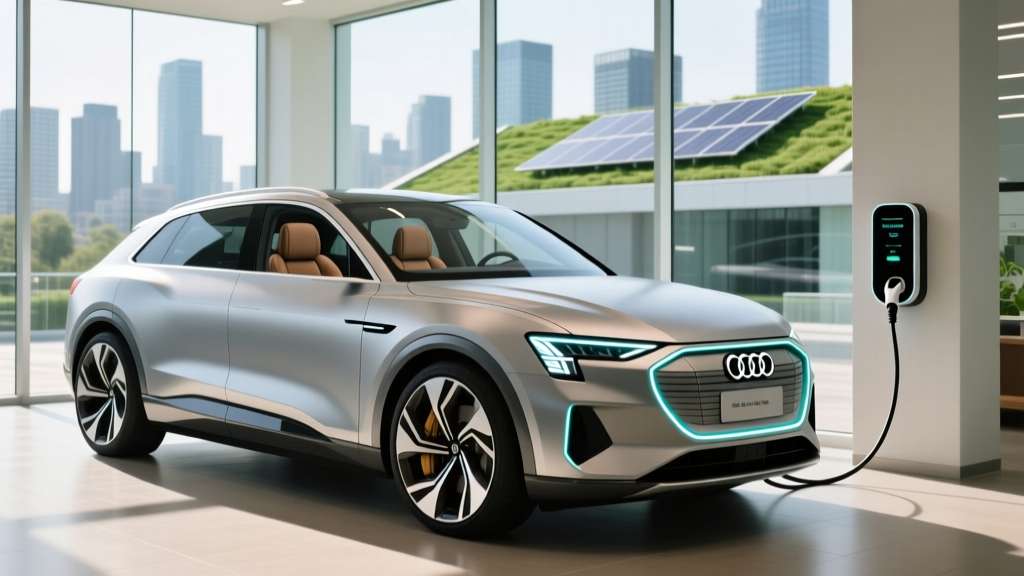
Charging the Q8 e-tron: What to Expect
For buyers seriously considering the Q8 e-tron as their Q7 replacement, understanding the charging profile is essential.
| Charging Level | Power (kW) | Miles Added per Hour | Typical Use Case |
|---|---|---|---|
| Level 1 (120V outlet) | 1.4 kW | ~4-5 mi/hr | Emergency / overnight trickle |
| Level 2 (240V, 40A circuit) | 9.6 kW | ~28-32 mi/hr | Standard home charging |
| Level 2 (240V, 80A circuit) | 19.2 kW | ~55-62 mi/hr | Fast home / workplace charging |
| DC Fast (peak) | 170 kW | ~450+ mi/hr (peak) | Road trips; 10-80% in ~31 min |
Charge curve reality: The Q8 e-tron's 170 kW peak rate is not sustained. Charging follows a curve — peak rate holds from roughly 10-40% State of Charge (SoC), then tapers to ~100 kW by 60%, and ~50 kW above 80%. The advertised "10-80% in 31 minutes" assumes optimal battery temperature (preconditioned) and a capable charger. In cold weather without preconditioning, expect 40-50 minutes for the same session.
Frequently Asked Questions
Will Audi ever make an electric Q7?
Audi has not announced an "e-tron" version of the Q7 specifically. Instead, Audi's strategy uses new model designations for EVs. The Q9 e-tron (announced, expected late 2026/2027) is effectively the electric three-row SUV that Q7 buyers have been waiting for. It will ride on the PPE (Premium Platform Electric) architecture co-developed with Porsche, supporting 800V charging.
Can I get a tax credit on the Audi Q8 e-tron?
Possibly, but it's not guaranteed. The §30D federal credit requires the SUV's MSRP to be at or below $80,000 (the Q8 e-tron starts at $75,600 but climbs above $80k on higher trims), your adjusted gross income to fall below $300,000 (married filing jointly) or $150,000 (single), and the battery to meet critical-mineral and component sourcing thresholds that change annually. The credit can now be transferred to the dealer at point of sale for an immediate price reduction. Always verify current eligibility on fueleconomy.gov and with a tax professional.
How does the Q8 e-tron handle road trips compared to the Q7?
The gas Q7 can cover 380+ highway miles on a tank and refuel in 5 minutes at any of the 145,000+ US gas stations. The Q8 e-tron covers ~220-250 real-world highway miles before needing a 25-35 minute DC fast charge. On a 600-mile trip, the Q7 requires one 5-minute stop; the Q8 e-tron requires two to three 25-35 minute stops. Electrify America stations (Audi's partner network) are improving in reliability but still experience occasional downtime — always have a backup charger in your route plan.
Is the Q8 e-tron's battery reliable long-term?
Audi warranties the battery for 8 years or 100,000 miles against degradation below 70% of original capacity. Industry data from similar NMC batteries (including earlier e-tron models) suggests typical degradation of 8-12% over 150,000 miles with normal charging habits. To maximize longevity: avoid routinely charging to 100% (set daily limit to 80%), minimize exclusive DCFC use, and precondition the battery in extreme temperatures.
What if I can't charge at home?
Public-only EV charging is significantly more expensive ($0.30-$0.50/kWh vs. $0.12-$0.18/kWh at home), more time-consuming, and less reliable. If you live in an apartment without charging access and your workplace doesn't offer chargers, a gas Q7 or a plug-in hybrid (like the related Audi Q5 PHEV) may be a more practical choice until your charging situation improves.
Sources: fueleconomy.gov (EPA range and efficiency data), irs.gov (§30D clean vehicle credit rules), Audi USA (manufacturer specifications). All pricing and specs reflect 2026 model-year data available at time of publication. Q9 e-tron specifications are preliminary estimates based on Audi announcements and PPE platform data.