Quick Verdict: The Audi Q6 e-tron at a Glance
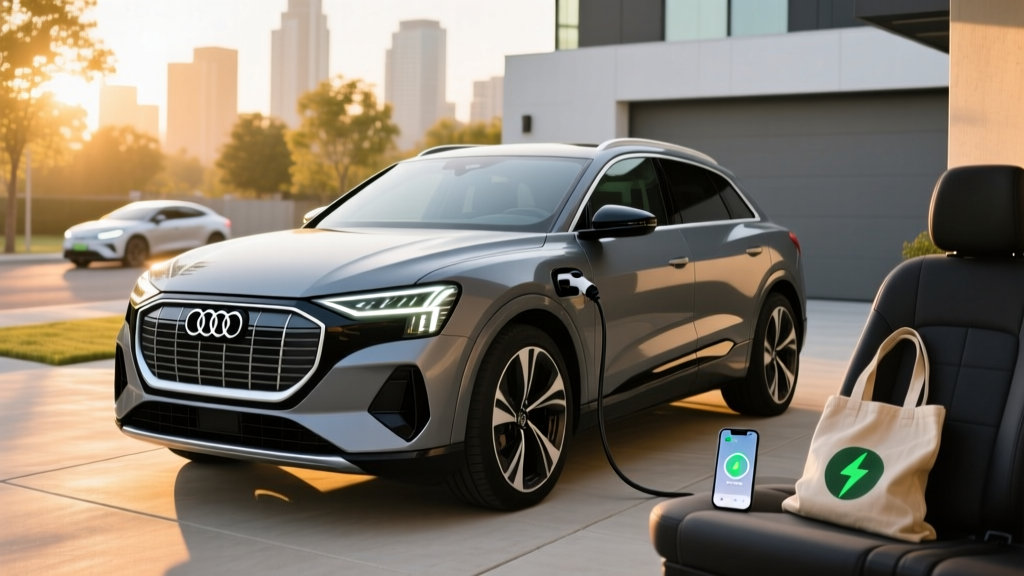
The 2026 Audi Q6 e-tron is the brand's first vehicle built on the Volkswagen Group's Premium Platform Electric (PPE), co-developed with Porsche. It slots between the Q4 e-tron and the larger Q8 e-tron in Audi's lineup, targeting the luxury compact electric SUV segment occupied by the BMW iX3, Mercedes EQB, and Tesla Model Y. With an EPA-estimated range of up to 308 miles, a peak DC fast-charge rate of 270 kW, and a starting MSRP of $65,095, the Q6 e-tron brings legitimate long-distance capability to Audi's EV portfolio for the first time.
The real story is the 800-volt electrical architecture. This enables sustained fast-charging speeds that most competitors in this price bracket cannot match, and it future-proofs the vehicle as public charging infrastructure continues to upgrade. However, buyers should weigh the Q6 e-tron's premium pricing against rivals that offer similar range for less, and understand the nuances of federal tax credit eligibility before signing paperwork.
| Spec | Q6 e-tron quattro (Premium) | SQ6 e-tron |
|---|---|---|
| EPA Range | 308 miles | 280 miles |
| Battery (usable) | 94.9 kWh (NMC) | 94.9 kWh (NMC) |
| Drivetrain | Dual-motor AWD | Dual-motor AWD |
| Horsepower | 422 hp (with launch control) | 509 hp (with launch control) |
| 0-60 mph | 4.9 seconds | 4.3 seconds |
| Peak DC Charge Rate | 270 kW | 270 kW |
| 10-80% DC Charge Time | ~21 minutes | ~21 minutes |
| Level 2 Charge Rate | 11.5 kW (~30 mi/hr) | 11.5 kW (~30 mi/hr) |
| MPGe (combined) | 100 MPGe | 89 MPGe |
| Base MSRP | $65,095 | $73,095 |
| Battery Warranty | 8 yr / 100,000 mi | 8 yr / 100,000 mi |
Range and Efficiency: EPA Numbers vs. Real-World Driving
The Q6 e-tron quattro carries a 100 kWh gross battery pack (94.9 kWh usable) using nickel-manganese-cobalt (NMC) chemistry. NMC offers higher energy density than lithium iron phosphate (LFP), which is why Audi can pack this much capacity into a compact SUV footprint. The trade-off is that NMC cells are more sensitive to sustained high-state-of-charge storage and extreme heat over long time horizons — though Audi's thermal management system actively mitigates this.
Real-World Expectation: Plan for 260-280 miles on a mixed highway trip at 70-75 mph. In freezing temperatures (below 32°F), expect a 20-30% reduction, bringing usable range down to roughly 215-245 miles before you'll want to find a charger. City driving with regenerative braking can match or slightly exceed the EPA sticker. The SQ6 e-tron's EPA rating drops to 280 miles due to its higher-output motors and stickier tires.
The Q6 e-tron quattro achieves an EPA-rated 100 MPGe combined, translating to approximately 34 kWh per 100 miles of driving. That's competitive with the BMW iX xDrive50 (roughly 86 MPGe combined) and meaningfully better than the Mercedes EQE SUV. Efficiency matters because it determines how far each kilowatt-hour takes you — and how much you'll spend charging over the life of the vehicle.
One practical note from real-world driving: the Q6 e-tron's heat pump is standard equipment, which helps preserve range in cold weather by efficiently heating the cabin without drawing heavily from the traction battery. Many competitors still charge extra for this feature or omit it entirely.
Charging Speed: Where the 800-Volt Platform Pays Off
This is where the PPE platform's 800-volt architecture distinguishes the Q6 e-tron from most rivals operating on 400-volt systems. Higher voltage allows the vehicle to accept more power at a given amperage, reducing heat buildup and enabling faster sustained charging.
| Charging Level | Power / Rate | Miles Added per Hour | Notes |
|---|---|---|---|
| Level 1 (120V household) | ~1.4 kW | ~4 mi/hr | Emergency/trickle only |
| Level 2 (240V home/public) | 11.5 kW max | ~30 mi/hr | Full charge in ~9 hours |
| DC Fast Charge (peak) | 270 kW | N/A (see 10-80%) | Requires 350 kW station |
| DC 10-80% time | ~21 minutes | — | Under ideal conditions |
| DC 10-90% time | ~27 minutes | — | Useful for road trips |
The 270 kW peak charge rate is among the highest in this class. For context, the Tesla Model Y peaks around 250 kW, and the BMW iX at roughly 200 kW. However, peak rate is not sustained rate. The Q6 e-tron holds above 200 kW through approximately 40% state of charge, then tapers progressively. The 10-80% time of roughly 21 minutes assumes you arrive at a functioning 350 kW charger with a preconditioned battery — use the vehicle's navigation-based preconditioning feature to ensure the pack is at optimal temperature before plugging in.
For home charging, the onboard charger maxes out at 11.5 kW on Level 2. With a 48-amp hardwired home charger (the most common residential setup), you'll add roughly 30 miles of range per hour of charging. A full overnight session from 20% to 100% takes approximately 9 hours, which works well for drivers who plug in upon arriving home each evening.
The Q6 e-tron uses the NACS (North American Charging Standard) connector for the 2026 model year, meaning direct access to Tesla Supercharger stations with no adapter required. This dramatically expands the available fast-charging network compared to CCS-only vehicles. According to Audi's official specifications, the vehicle also supports Plug & Charge at compatible Electrify America stations, eliminating the need to open an app or swipe a credit card.
Performance and Driving Dynamics
The Q6 e-tron quattro pairs two electric motors — one on each axle — for standard all-wheel drive. Combined output is 422 horsepower when using launch control (376 hp in normal driving). The 0-60 mph sprint takes 4.9 seconds, which is quick by any measure but not class-leading; the Tesla Model Y Performance manages the same run in roughly 3.5 seconds.
The SQ6 e-tron steps up to 509 hp (with launch control) and a 4.3-second 0-60 time, courtesy of more powerful rear motor tuning and a sport-tuned air suspension. Both models feature a single-speed transmission with strong regenerative braking that supports one-pedal-style driving in most conditions, though Audi stops short of a true one-pedal mode that brings the car to a complete stop — you'll still need the brake pedal at very low speeds.
Ride quality is where the Q6 e-tron earns its luxury badge. The standard steel-spring suspension (adaptive dampers on higher trims) absorbs highway imperfections with composure, and cabin noise isolation is excellent. The optional air suspension on the Prestige trim adds adjustable ride height, useful for clearing snow or improving aerodynamic efficiency at highway speeds. Steering is precise but light — this is a comfort-oriented GT, not a canyon carver.
Interior, Cargo, and Technology
The Q6 e-tron's cabin represents a significant generational leap over the outgoing e-tron (now called Q8 e-tron). The centerpiece is Audi's new E3 1.2 electronics architecture, which powers a curved display panel consisting of an 11.9-inch digital instrument cluster and a 14.5-inch central touchscreen angled toward the driver. An optional 10.9-inch front passenger display is available, allowing the passenger to stream media or manage navigation without distracting the driver.
The infotainment system runs a new Android Automotive-based OS with native Google Maps navigation, Google Assistant voice control, and access to the Play Store for apps. Wireless Apple CarPlay and Android Auto are standard. The system is responsive, though some climate and seat-heater controls require navigating touchscreen menus rather than using physical buttons — a common complaint in modern Audi interiors.
Cargo and passenger space:
- Rear cargo volume (behind second row): 25.7 cubic feet
- Cargo volume (second row folded): 52.6 cubic feet
- Front trunk (frunk): 2.3 cubic feet — enough for charging cables and a small bag
- Rear legroom: 37.2 inches
- Front headroom: 39.4 inches
These numbers are competitive with the BMW iX3 and slightly behind the Tesla Model Y (which offers 30.2 cu ft rear cargo). The frunk is modest — Audi prioritized cabin space over front storage. The rear seat comfortably fits two adults on long trips, with a third passenger possible in the center position for shorter drives.
Driver assistance: The Q6 e-tron comes standard with Audi's Adaptive Cruise Assist, which combines adaptive cruise control with lane centering. This is an SAE Level 2 system — the driver must remain attentive and keep hands on or near the wheel at all times. It is not self-driving. Available features include a surround-view camera, automated parking assist, and intersection assist, which warns of cross-traffic when pulling into busy intersections.
Pricing, Trims, and Federal Tax Credit Eligibility
The 2026 Q6 e-tron is offered in three trim levels for the standard model and two for the SQ6:
| Trim | Base MSRP | Est. After §30D Credit* |
|---|---|---|
| Q6 e-tron Premium | $65,095 | $57,595 (if eligible) |
| Q6 e-tron Premium Plus | $70,095 | $62,595 (if eligible) |
| Q6 e-tron Prestige | $75,095 | $67,595 (if eligible) |
| SQ6 e-tron Premium Plus | $73,095 | $65,595 (if eligible) |
| SQ6 e-tron Prestige | $78,095 | $70,595 (if eligible) |
*All trims fall under the $80,000 SUV MSRP cap for §30D eligibility. Credit availability depends on buyer income, battery component sourcing, and critical mineral requirements. See checklist below.
The IRS §30D federal tax credit offers up to $7,500 for qualifying new EVs, but eligibility is not automatic. For the 2026 tax year, the Q6 e-tron must satisfy several requirements:
- MSRP cap: The vehicle must have an MSRP at or below $80,000 (SUV classification). All Q6 e-tron trims qualify.
- Buyer income cap: Modified adjusted gross income must not exceed $150,000 (single), $225,000 (head of household), or $300,000 (married filing jointly).
- Battery component sourcing: A percentage of battery components must be manufactured or assembled in North America. This threshold increases annually — verify current-year compliance on fueleconomy.gov.
- Critical minerals: A percentage of critical minerals in the battery must be sourced from the U.S. or a free-trade agreement partner.
- Point-of-sale transfer: As of 2024, buyers can transfer the credit to the dealer at purchase, reducing the upfront price rather than waiting to claim it on a tax return. The dealer must be IRS-registered.
Because battery sourcing rules tighten each year, a trim that qualifies in January may not qualify by December. Always confirm eligibility with your dealer and a tax professional before finalizing a purchase. Audi's battery cells for the Q6 e-tron are produced in partnership with CATL and other suppliers, and the North American content percentage is a moving target subject to IRS guidance updates.
Warranty and Long-Term Battery Outlook
Audi provides the following warranty coverage for the 2026 Q6 e-tron:
- Battery pack: 8 years / 100,000 miles (whichever comes first), covering defects and capacity loss below 70% of original capacity
- Powertrain (motors, power electronics): 8 years / 100,000 miles
- Bumper-to-bumper: 4 years / 50,000 miles
- Corrosion perforation: 12 years, unlimited mileage
The 70% capacity retention threshold at 8 years / 100,000 miles is standard for the industry. In practice, NMC packs with active thermal management — like the Q6 e-tron's — typically degrade 8-12% over the first 100,000 miles based on data from similar PPE and MEB platform vehicles. That means you might see roughly 275-285 miles of range at the 100,000-mile mark, well above the warranty floor.
To maximize long-term battery health, Audi recommends setting a daily charge limit of 80% and only charging to 100% when preparing for a long trip. The vehicle's built-in charge scheduler and preconditioning features make this easy to automate. Battery replacement cost, should it be needed out of warranty, is estimated at $15,000-$22,000 based on current PPE platform pricing, though this figure is expected to decline as the supply chain matures.
Pros, Cons, and Who Should Buy the Q6 e-tron
Pros
- 270 kW DC fast charging — among the fastest in its class
- NACS connector provides direct Tesla Supercharger access
- 308-mile EPA range is sufficient for most road trips with one brief stop
- Standard heat pump preserves cold-weather range
- Quiet, refined ride quality with excellent cabin isolation
- Modern E3 1.2 electronics with Android Automotive OS
- All trims fall under the $80,000 §30D MSRP cap
Cons
- Base price of $65,095 is steep vs. Tesla Model Y ($47,990) and Hyundai Ioniq 5 ($42,975)
- Small 2.3 cu ft frunk wastes front-axle space
- Tax credit eligibility depends on evolving battery sourcing rules — not guaranteed
- No true one-pedal driving mode (vehicle creeps at low speed)
- Touchscreen-dependent climate controls frustrate some drivers
- SQ6 range drops to 280 miles — performance costs efficiency
Who the Q6 e-tron suits best: This EV is ideal for luxury-oriented buyers who want a refined daily driver that can also handle 300+ mile road trips without excessive charging downtime. It fits two-adult households or small families who value build quality, ride comfort, and access to the broadest possible fast-charging network (NACS + Superchargers). It's less ideal for buyers on a strict budget — the Tesla Model Y and Hyundai Ioniq 5 deliver comparable range and faster acceleration for $20,000+ less, though with less premium interior execution.
Who should look elsewhere: If your priority is maximum cargo space, the Tesla Model Y or Rivian R2 (when available) offer more room. If you want the longest possible range, the Lucid Gravity or a long-range Tesla Model Y may serve you better. And if the federal tax credit is essential to your budget, verify eligibility before committing — the Hyundai Ioniq 5, built in Georgia, currently has more predictable credit qualification.
Frequently Asked Questions
What is the real-world range of the 2026 Audi Q6 e-tron?
The EPA estimates 308 miles for the Q6 e-tron quattro and 280 miles for the SQ6. In real-world highway driving at 70-75 mph, expect 260-280 miles (quattro) or 240-260 miles (SQ6). Cold weather below freezing reduces range by 20-30%, so plan for 215-245 miles in winter conditions. The standard heat pump helps mitigate this loss compared to EVs without one.
How fast does the Q6 e-tron charge at home and on the road?
On a DC fast charger rated at 350 kW, the Q6 e-tron can charge from 10% to 80% in approximately 21 minutes, peaking at 270 kW. At home on a Level 2 (240V, 48-amp) charger, it accepts up to 11.5 kW, adding roughly 30 miles of range per hour. A full overnight charge from near-empty takes about 9 hours.
How much does the Q6 e-tron cost after the federal tax credit?
If you qualify for the full $7,500 §30D credit and transfer it at point of sale, the Q6 e-tron Premium starts at an effective price of approximately $57,595. However, eligibility depends on your income (below $150K single / $300K joint), the vehicle's battery sourcing compliance, and the MSRP staying under $80,000. Always verify current eligibility on fueleconomy.gov and consult a tax professional.
Does the Audi Q6 e-tron qualify for the $7,500 federal EV tax credit?
All Q6 e-tron trims fall under the $80,000 MSRP cap for SUVs, which is the first requirement. However, the credit also requires that battery components and critical minerals meet annually increasing North American sourcing thresholds, and that the buyer's income falls below IRS limits. Because these sourcing rules change yearly, eligibility is not guaranteed — check the latest IRS guidance and fueleconomy.gov listings for the specific model year and build date.
Is the Q6 e-tron worth buying over the Tesla Model Y or BMW iX?
It depends on your priorities. The Q6 e-tron offers a more premium interior, faster DC charging (270 kW vs. Model Y's ~250 kW), and a quieter ride than the Model Y, but costs $17,000+ more before incentives. Against the BMW iX, the Q6 e-tron is similarly priced, offers more range (308 vs. ~300 miles for the iX xDrive50), and charges faster. If luxury build quality and charging speed matter most, the Q6 e-tron is compelling. If value and cargo space lead your decision, the Model Y wins.
What connector does the 2026 Q6 e-tron use?
The 2026 Q6 e-tron uses the NACS (North American Charging Standard) connector, the same connector used by Tesla vehicles. This provides direct access to the Tesla Supercharger network without an adapter, in addition to Electrify America and other NACS-equipped networks. A CCS adapter may be available for legacy charging stations.
How long will the Q6 e-tron's battery last?
Audi warrants the battery for 8 years or 100,000 miles against defects and capacity loss below 70%. Based on data from similar NMC packs with active thermal management, typical degradation is 8-12% over 100,000 miles. With proper care (daily charge limit of 80%, avoiding frequent DC fast charging to 100%), the battery should provide reliable service well beyond 150,000 miles before approaching the warranty threshold.