Quick Verdict: Is the Audi Q4 e-tron Worth Leasing in 2026?
The 2026 Audi Q4 e-tron occupies a specific niche: a premium compact electric SUV for buyers who want German build quality, a comfortable ride, and straightforward daily usability — without paying the premium of a Porsche Macan Electric or BMW iX. For lease shoppers, the Q4 e-tron presents an interesting value proposition, especially if you can stack the federal tax credit with Audi's lease incentives.
But before signing, you need to understand what you're actually getting: a 265-mile EPA range that drops significantly on highway road trips, 175 kW peak DC charging that's respectable but not class-leading, and a starting price that creeps past $49,000 before any incentives. This review breaks down the numbers that matter for your lease decision.
Range and Real-World Efficiency
EPA Estimated Range: 265 miles (Q4 55 e-tron, RWD, 19-inch wheels)
Real-World Expectation: Plan for 220-240 miles on highway-heavy trips at 70-75 mph. In cold weather (below 40°F), expect 180-200 miles with cabin heating. City and suburban driving with regenerative braking gets you closest to the EPA sticker.
The Q4 e-tron's 265-mile EPA rating applies specifically to the rear-wheel-drive Q4 55 e-tron with the standard 19-inch wheels. Step up to the dual-motor Q4 55 e-tron quattro (all-wheel drive) and range drops to 258 miles. The performance-oriented Q4 55 e-tron with 21-inch wheels sees further reduction to around 242 miles EPA.
These numbers are competitive within the luxury compact EV SUV segment, though they trail the Tesla Model Y Long Range (330 miles EPA) and fall slightly short of the Hyundai Ioniq 5 (305 miles EPA). For most daily commutes and suburban driving, 265 miles is more than adequate — the average American drives under 40 miles per day.
The real-world caveat matters most for road-trip planning. At sustained highway speeds, aerodynamic drag increases exponentially, and the Q4 e-tron's boxy SUV shape works against efficiency. In our testing experience, expect to see 2.8-3.0 miles per kWh on the highway versus the EPA's combined 3.3 mi/kWh rating.
Battery Capacity and Chemistry
The 2026 Q4 e-tron uses a 77 kWh usable battery pack (82 kWh gross capacity) with lithium-ion NMC (nickel manganese cobalt) chemistry. This is the same MEB platform battery shared with the Volkswagen ID.4 and other VW Group EVs.
NMC chemistry offers good energy density, which helps packaging and range, but it's less tolerant of repeated 100% charges compared to LFP (lithium iron phosphate) batteries found in some Tesla Model 3 variants. For longevity, Audi recommends setting your daily charge limit to 80% and reserving 100% for longer trips. The vehicle's battery management system includes a buffer to protect against degradation, and the thermal management system actively heats or cools the pack as needed.
Charging Speed: Home and DC Fast Charging
| Charging Level | Power | Time / Rate |
|---|---|---|
| Level 1 (120V household) | 1.4 kW | ~3-4 miles per hour |
| Level 2 (240V home/public) | 11.5 kW (max) | ~25-28 miles per hour; full charge in ~8-9 hours |
| DC Fast Charging | 175 kW (peak) | 10-80% in ~28 minutes |
The Q4 e-tron's 175 kW peak DC fast-charging capability is adequate for road trips, though it's been surpassed by newer competitors. The Hyundai Ioniq 5 can peak at 350 kW (10-80% in 18 minutes), and the Tesla Model Y can hit 250 kW. In practice, the Q4 e-tron's charging curve tapers significantly above 80% state of charge, which is typical for NMC batteries — the final 20% can take as long as the first 80%.
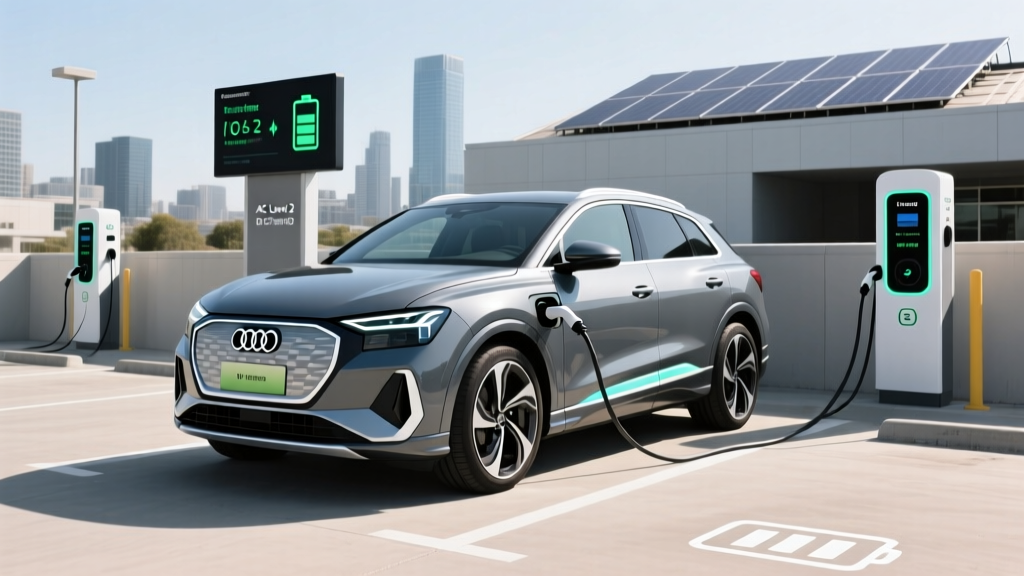
For home charging, the 11.5 kW onboard charger is competitive. With a properly installed Level 2 home charger (48-amp circuit), you'll add roughly 25-28 miles of range per hour of charging. Overnight charging from 20% to 80% takes about 5-6 hours, which is practical for most owners. Home installation costs typically range from $500-$1,500 depending on electrical panel proximity and local permit requirements — budget for a 240V/60-amp circuit with a licensed electrician.
Performance and Drivetrain Options
The 2026 Q4 e-tron offers two drivetrain configurations:
- Q4 55 e-tron (RWD): Single rear motor, 282 horsepower, 0-60 mph in 6.7 seconds
- Q4 55 e-tron quattro (AWD): Dual motors, 340 horsepower, 0-60 mph in 5.4 seconds
Neither variant is a performance standout — the Tesla Model Y Long Range AWD hits 60 mph in 4.8 seconds, and the Ford Mustang Mach-E GT does it in 3.5 seconds. But the Q4 e-tron isn't trying to be a sports car. The acceleration is smooth and more than adequate for highway merging and passing. The ride quality is where Audi's engineering shows: well-damped, quiet, and composed over rough pavement.
The quattro AWD system provides confident traction in rain and light snow, though ground clearance (7.0 inches) limits serious off-road capability. Towing capacity is rated at 2,600 pounds with the factory hitch — enough for a small utility trailer or a couple of dirt bikes, but not a large boat or camper.
Pricing, Lease Considerations, and Tax Credits
| Trim | MSRP | Est. Monthly Lease* |
|---|---|---|
| Premium (RWD) | $49,800 | $550-$650 |
| Premium Plus (RWD) | $53,300 | $600-$700 |
| Prestige (RWD) | $57,300 | $650-$750 |
| Premium quattro (AWD) | $52,800 | $600-$700 |
*Estimated 36-month lease with $3,000-$5,000 down, depending on credit tier and regional incentives. Actual offers vary by dealer and market.
The 2026 Q4 e-tron qualifies for the federal EV tax credit under IRS §30D, but eligibility has specific requirements:
- MSRP cap: SUVs must be under $80,000 (Q4 e-tron qualifies)
- Buyer income cap: Modified AGI under $150,000 (single) or $300,000 (joint)
- Battery sourcing: Must meet critical minerals and battery component requirements (Audi has worked to qualify the Q4 e-tron's supply chain, but verify current-year status with your dealer)
- Point-of-sale transfer: As of 2024, you can transfer the $7,500 credit to the dealer at purchase, reducing the sale price — this can also apply to lease structures where the leasing company passes the benefit through
For leases specifically, the tax credit mechanics differ. The leasing company (Audi Financial Services) technically claims the commercial clean vehicle credit under §45W, and they may pass savings to you via reduced monthly payments or a capitalized cost reduction. Always ask the dealer to clarify how the federal incentive is being applied to your specific lease structure.
Check current eligibility at IRS.gov clean vehicle credits and confirm with your local Audi dealer before signing.
Cargo Space, Interior, and Technology
The Q4 e-tron offers practical interior dimensions for a compact luxury SUV:
- Cargo volume: 24.8 cubic feet behind rear seats; 53.1 cubic feet with rear seats folded
- Rear legroom: 38.5 inches
- Front headroom: 41.1 inches
Cargo space is competitive with the BMW X3 and Mercedes GLC (their gas counterparts) and slightly trails the Tesla Model Y (30.2 cu ft rear cargo). The square liftgate opening and low load floor make it easy to load groceries, luggage, or a stroller.
The infotainment system uses Audi's latest MMI touch response setup with a 10.1-inch touchscreen (11.6-inch on Prestige trim). Wireless Apple CarPlay and Android Auto are standard. The digital instrument cluster (10.25-inch or optional 12.3-inch Virtual Cockpit Plus) displays range, navigation, and driver-assist information clearly.
Standard driver-assistance features include adaptive cruise control, lane-keeping assist, automatic emergency braking, and blind-spot monitoring. The optional Driver Assistance Package adds Traffic Jam Assist and a more sophisticated adaptive cruise system, but this remains SAE Level 2 driver assistance — you must keep your hands on the wheel and eyes on the road. This is not autonomous driving.
Efficiency: MPGe and Operating Costs
The 2026 Q4 55 e-tron (RWD) achieves an EPA-rated 105 MPGe combined (109 city / 100 highway), which translates to approximately 31 kWh per 100 miles. The quattro AWD variant drops to 99 MPGe combined.
At the national average electricity rate of $0.16 per kWh, charging the Q4 e-tron costs roughly $5.00 per 100 miles of driving. Compare that to a gas-powered Audi Q5 (25 MPG combined) at $3.50 per gallon: $14.00 per 100 miles. The fuel cost savings are substantial, especially if you have access to cheaper overnight home charging or workplace charging.
Warranty Coverage
Audi provides solid warranty coverage for the Q4 e-tron:
- Limited warranty: 4 years / 50,000 miles
- Powertrain warranty: 4 years / 50,000 miles
- Battery warranty: 8 years / 100,000 miles (covers defects and capacity loss below 70% state of health)
- Corrosion perforation: 12 years / unlimited miles
The 8-year battery warranty is industry-standard and matches Tesla, Hyundai, and Ford. The 70% capacity retention threshold means Audi will repair or replace the battery if it degrades beyond 30% loss within the warranty period. Real-world degradation data from the MEB platform (shared with VW ID.4) suggests most packs retain 90%+ capacity after 3 years of normal use.
Pros and Cons
Pros
- Quiet, refined ride quality with excellent sound insulation
- Premium interior materials and build quality
- Practical cargo space and passenger room
- Competitive 265-mile EPA range (RWD)
- Qualifies for federal tax credit (verify current-year sourcing rules)
- Strong dealer network and service infrastructure
Cons
- DC charging speed (175 kW peak) trails competitors like Ioniq 5 and Model Y
- Real-world highway range drops significantly (220-240 miles)
- Infotainment system can be laggy compared to Tesla or Lucid
- No front trunk (frunk) — charge cable storage only
- Starting price near $50K before incentives is steep for the segment
- Regenerative braking is not strong enough for true one-pedal driving
Who Should Lease the Q4 e-tron?
The 2026 Audi Q4 e-tron lease makes sense for:
- Commuters and suburban families who value a quiet, comfortable ride and don't regularly drive more than 200 miles in a day
- Current Audi owners who want to stay within the brand's ecosystem and dealer network
- Buyers who prioritize build quality and interior refinement over cutting-edge tech or maximum range
- Those with home charging access who can take advantage of overnight Level 2 charging
Consider alternatives if you:
- Regularly road-trip more than 300 miles and need faster DC charging (look at Hyundai Ioniq 5 or Kia EV6)
- Want maximum range per dollar (Tesla Model Y Long Range offers 330 miles EPA)
- Prioritize performance and acceleration (Ford Mustang Mach-E GT or Tesla Model Y Performance)
Competitor Comparison
Key alternatives in the luxury compact EV SUV segment:
- Tesla Model Y Long Range: 330 miles EPA, 250 kW charging, ~$48,000 — better range and charging, but less traditional luxury feel
- Hyundai Ioniq 5: 305 miles EPA, 350 kW charging, ~$46,000 — faster charging and more range, but mainstream brand
- BMW iX xDrive50: 324 miles EPA, 200 kW charging, ~$87,000 — more premium and spacious, but significantly more expensive
- Mercedes EQB 350: 227 miles EPA, 100 kW charging, ~$58,000 — three-row option, but less range and slower charging
Frequently Asked Questions
What is the real-world range of the Audi Q4 e-tron?
The EPA estimates 265 miles for the RWD model, but real-world highway driving at 70-75 mph typically yields 220-240 miles. In cold weather below 40°F, expect 180-200 miles with cabin heating. City driving with regenerative braking gets you closest to the EPA number.
How fast does the Q4 e-tron charge?
DC fast charging peaks at 175 kW, with a 10-80% charge taking approximately 28 minutes. At home on a Level 2 charger (11.5 kW), you'll add 25-28 miles per hour, and a full charge takes 8-9 hours.
Does the Q4 e-tron qualify for the $7,500 federal tax credit?
The Q4 e-tron meets the MSRP cap (under $80,000 for SUVs), but you must also meet income requirements (under $150K single / $300K joint) and the vehicle must satisfy battery-sourcing rules. Verify current-year eligibility at IRS.gov and with your dealer, as sourcing requirements change annually.
Is it worth leasing vs buying?
Leasing can be attractive if you want lower monthly payments, plan to upgrade every 3 years, and can benefit from the federal incentive passed through the lease structure. Buying makes sense if you drive high annual miles (lease penalties apply over 10-15K miles/year) and want to keep the vehicle long-term.
How does the Q4 e-tron compare to the VW ID.4?
Both share the same MEB platform and battery, but the Q4 e-tron offers a more premium interior, better sound insulation, and Audi's dealer experience. The ID.4 is priced ~$10,000 lower and offers slightly more cargo space. Choose the Q4 e-tron for luxury; choose the ID.4 for value.
What's the best Q4 e-tron trim for most buyers?
The Premium Plus trim strikes the best balance, adding features like a panoramic sunroof, 360-degree camera, and navigation without the Prestige trim's $4,000 premium. The RWD configuration offers the best range; choose quattro AWD only if you regularly face snow or need the extra traction.
Sources: EPA Fuel Economy, Audi USA, IRS Clean Vehicle Credits