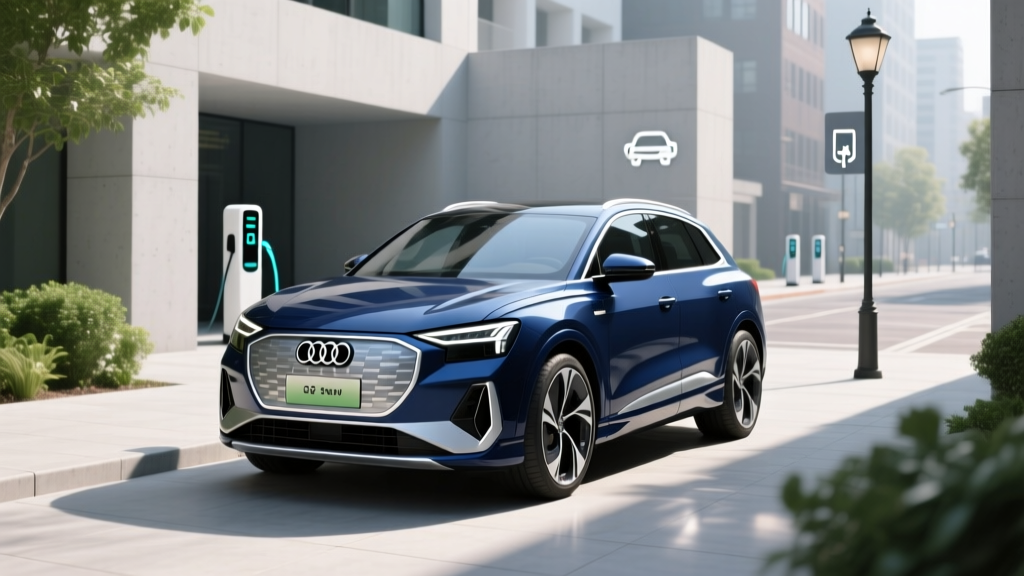
If you are searching for an Audi entry-level EV, the 2026 Audi Q4 e-tron is currently the most accessible battery-electric vehicle in Audi's U.S. lineup. Starting at $49,800 (before destination), the Q4 e-tron delivers an EPA-estimated 265 miles of range in its rear-wheel-drive configuration, DC fast-charging capability up to 175 kW, and the brand's premium interior at a price point that undercuts the larger Q8 e-tron by over $20,000. For 2026, Audi has refreshed the model with a slightly larger battery pack and updated infotainment, making it a serious contender for luxury EV buyers who do not need full-size SUV space.
2026 Audi Q4 e-tron: The Core Specs That Matter
Before evaluating costs and ownership, here are the exact numbers that define the Q4 e-tron as Audi's entry-level electric offering. These figures reflect the 2026 model year with the updated 82 kWh usable battery (up from 77 kWh in earlier models).
| Spec | Q4 45 e-tron (RWD) | Q4 55 e-tron (quattro AWD) |
|---|---|---|
| Base MSRP | $49,800 | $55,200 |
| EPA Range | 265 miles | 242 miles |
| Battery (usable) | 82 kWh (NMC) | 82 kWh (NMC) |
| Horsepower | 282 hp | 340 hp |
| 0–60 mph | 6.3 sec | 4.7 sec |
| Peak DC Charge Rate | 175 kW | 175 kW |
| 10–80% DCFC Time | ~28 min | ~28 min |
| Level 2 (AC) Rate | 11 kW | 11 kW |
| Combined MPGe | 105 MPGe | 95 MPGe |
| Battery/Powertrain Warranty | 8 yr / 100,000 mi | 8 yr / 100,000 mi |
| Connector | CCS1 (NACS adapter available) | CCS1 (NACS adapter available) |
Source: EPA fueleconomy.gov and Audi USA
Q4 e-tron vs. Gas Compact Luxury SUVs: The Cost Breakdown
The natural cross-shops for the Q4 e-tron are internal-combustion competitors like the BMW X3, Mercedes-Benz GLC, and Audi's own Q5. Here is how a five-year ownership comparison looks against a similarly priced gas alternative — we will use the Audi Q5 45 TFSI (starting ~$46,500) as the baseline since many Q4 e-tron buyers are already in the Audi ecosystem.
| 5-Year Cost Category | 2026 Q4 45 e-tron (RWD) | 2026 Q5 45 TFSI (Gas) |
|---|---|---|
| Purchase Price (base) | $49,800 | $46,500 |
| Est. Federal Tax Credit (§30D) | $0–$7,500* | $0 |
| Fuel/Energy (60,000 mi) | $3,200–$5,400** | $7,800 |
| Maintenance (5 yr) | $1,200 | $3,500 |
| Insurance (est. avg) | $12,500 | $10,800 |
| Total (before credit) | $66,700–$68,900 | $68,600 |
| Total (with max credit) | $59,200–$61,400 | $68,600 |
* §30D eligibility depends on battery critical-mineral sourcing, buyer income caps ($150K single / $300K joint), and MSRP caps ($80K for SUVs). The Q4 e-tron's eligibility has fluctuated as Audi adjusts supply chains. Verify on IRS.gov before purchasing.
** Energy cost range: $3,200 assumes 80% home Level 2 charging at $0.14/kWh; $5,400 assumes 50% public DC fast charging at $0.35–$0.48/kWh. Gas estimate uses 25 MPG combined at $3.25/gal.
The takeaway: without a tax credit, the Q4 e-tron roughly breaks even with the Q5 on five-year cost, primarily because higher EV insurance premiums offset fuel and maintenance savings. With the full $7,500 credit applied at point of sale, the EV pulls ahead by $7,000–$9,000. Your charging mix — home versus public — is the single biggest variable in your actual energy spend.
Charging the Q4 e-tron: What You Actually Need at Home
The Q4 e-tron ships with a CCS1 charge port. For 2026, Audi offers a NACS adapter (approximately $200–$300) that unlocks access to Tesla Supercharger V3 stations, significantly expanding your public charging network. Here is what charging looks like across the three levels:
| Level | Power (kW) | Miles Added Per Hour | Full Charge Time (0–100%) | Where |
|---|---|---|---|---|
| Level 1 (120V) | ~1.4 kW | ~4 mi/hr | ~58 hours | Standard outlet |
| Level 2 (240V) | 11 kW (max) | ~33 mi/hr | ~8 hours | Home / workplace |
| DC Fast Charge | 175 kW (peak) | ~190 mi in 10 min | 10–80% in ~28 min | Public stations |
The charging curve matters: The Q4 e-tron peaks at 175 kW only between roughly 10–30% state of charge. From 50–80%, the rate tapers to 80–100 kW, and above 80% it drops sharply. This is normal lithium-ion behavior to protect cell longevity, but it means a "10–80%" time is the useful metric — not a 0–100% DCFC time, which would be well over an hour.
Home charging installation: To unlock the Q4 e-tron's 11 kW Level 2 capability, you need a 48-amp hardwired wallbox (or a 40-amp unit on a 50-amp circuit for plug-in models like the ChargePoint Home Flex or Emporia Level 2). Expect to pay $500–$800 for the charger unit and $800–$2,500 for electrician labor, depending on your panel proximity and whether a 200-amp service upgrade is needed. Total home install: $1,300–$3,300 in most cases.
Federal Tax Credit: Does the Q4 e-tron Qualify?
The §30D new clean vehicle credit offers up to $7,500, but eligibility is a three-part test that changes as manufacturers shift battery sourcing. For the 2026 Q4 e-tron, here is the current framework:
- MSRP Cap: SUVs must be under $80,000. The Q4 e-tron (max ~$62,000 fully loaded) passes. ✓
- Buyer Income Cap: AGI must not exceed $150,000 (single) / $225,000 (HOH) / $300,000 (joint). Check your tax return.
- Battery Sourcing: The $3,750 critical-minerals half and $3,750 battery-components half depend on where materials are extracted and assembled. Audi's supply chain has been in flux due to FEOC (Foreign Entity of Concern) restrictions. Confirm current eligibility on fueleconomy.gov before signing paperwork.
- Point-of-Sale Transfer: If eligible, you can transfer the credit to the dealer at purchase for an immediate price reduction — you do not need to wait until tax filing.
Do not assume the full $7,500 applies. Many European-built EVs have lost one or both halves of the credit as FEOC rules tightened in 2024–2025. The Q4 e-tron is assembled in Zwickau, Germany, which affects component-sourcing calculations. Consult a tax professional for your specific situation.
Common Misconceptions About the Q4 e-tron
| Myth | Fact |
|---|---|
| "It's just a rebadged VW ID.4." | Both ride on the MEB platform, but the Q4 e-tron has distinct suspension tuning, a different interior (higher-grade materials, Audi's MMI interface), unique exterior styling, and different software calibration. The driving experience is noticeably more refined, though the underlying architecture is shared. |
| "265 miles is not enough for road trips." | With 175 kW DCFC capability and a NACS adapter unlocking Superchargers, a 500-mile trip requires one 25–30 minute charge stop — comparable to a gas-car rest break. The constraint is not range but charging-desert coverage in rural areas. Plan routes using A Better Routeplanner or PlugShare. |
| "Battery replacement will cost $20,000." | The 82 kWh NMC pack is covered by an 8-year/100,000-mile warranty against degradation below 70% capacity. Real-world MEB-platform data from European fleets shows ~5–8% degradation at 60,000 miles. Full replacement (rarely needed) runs $12,000–$16,000 at current pricing, and module-level repair is often possible for less. |
| "EV insurance is always double." | EV insurance premiums are typically 15–25% higher than equivalent gas vehicles, not double. For the Q4 e-tron, expect roughly $2,400–$2,800/year nationally (vs. ~$2,000–$2,200 for a Q5). Shop multiple carriers — some now offer EV-specific discounts. |
Who Should (and Should Not) Buy the Q4 e-tron
The Q4 e-tron occupies a specific niche: it is the gateway to Audi's electric lineup for buyers who want premium badging, a comfortable ride, and practical compact-SUV utility without stepping up to the $75,000+ Q8 e-tron or e-tron GT.
Decision Framework
Choose the Q4 45 e-tron (RWD, $49,800) if:
- You have home Level 2 charging and drive under 50 miles daily
- You live in a moderate climate (rarely below 20°F)
- Maximum range (265 mi) matters more than acceleration
- You want the lowest entry price into an Audi EV
Choose the Q4 55 e-tron (quattro, $55,200) if:
- You regularly drive in snow, rain, or mountainous terrain
- You need the 4.7-second 0–60 time for highway merging confidence
- You frequently carry rear passengers or cargo (AWD traction helps in loaded conditions)
Look elsewhere if:
- You lack any home or workplace charging access (relying solely on public DCFC is expensive and time-consuming)
- You regularly tow — the Q4 e-tron is rated for only 2,650 lbs, below many gas compact SUVs
- You need 300+ miles of range — consider the Tesla Model Y Long Range (320 mi EPA) or Hyundai Ioniq 5 (303 mi EPA) instead
- You want Level 4 autonomy — the Q4 e-tron's adaptive cruise and lane-keeping is SAE Level 2, requiring full driver attention at all times
First-Time EV Buyer Essentials for the Q4 e-tron
If the Q4 e-tron is your first electric vehicle, here is what dealership brochures will not emphasize:
Preconditioning is critical for fast charging. The Q4 e-tron's battery thermal management system works best when the pack is warmed to optimal temperature before a DCFC session. Use the MMI navigation to set a charge stop as your destination — the car will begin preconditioning the battery 15–30 minutes before arrival, enabling the full 175 kW peak. Without preconditioning (e.g., pulling into a random charger), your peak rate may be limited to 100–120 kW, adding 10+ minutes to your stop.
Regenerative braking is adjustable, not one-pedal. Unlike some EVs, the Q4 e-tron does not default to aggressive one-pedal driving. You select regen intensity via steering-wheel paddles (0, 1, 2, 3, or Auto). "Auto" mode uses the front radar to adjust regen based on traffic ahead — it is effective once you trust it, but plan for a two-week adaptation period if you are coming from a gas car.
The 12V battery can still strand you. The Q4 e-tron has a conventional 12V auxiliary battery that powers electronics, door locks, and the contactors that connect the main high-voltage pack. If the 12V dies, the car will not start even if the main battery is full. Audi uses a lithium-ion 12V in 2026 models (more reliable than lead-acid), but keep jumper-pack awareness in your emergency kit.
Your electrical panel may need an upgrade. A 48-amp Level 2 charger draws roughly 11.5 kW continuously. If your home has a 100-amp main panel that is already near capacity (electric dryer, range, HVAC), your electrician may recommend a $1,500–$3,000 panel upgrade to 200 amps. Get a load calculation before committing to a charger purchase.
Frequently Asked Questions
Is the Audi Q4 e-tron the cheapest Audi EV available in 2026?
Yes. At $49,800 base, the Q4 45 e-tron is the lowest-priced new Audi EV in the U.S. market. The next step up is the Q6 e-tron (starting ~$63,800) and then the Q8 e-tron (~$75,000+). The discontinued e-tron GT is no longer in production for 2026.
Can the Q4 e-tron use Tesla Superchargers?
Yes, with Audi's official NACS adapter (sold separately, ~$200–$300). The Q4 e-tron retains its native CCS1 port, so it can also use Electrify America, EVgo, and other CCS networks without an adapter. The NACS adapter expands your network by roughly 20,000+ Supercharger stalls nationwide.
How does the Q4 e-tron compare to the Hyundai Ioniq 5 or Tesla Model Y?
The Ioniq 5 ($42,600 base) offers 303 miles of range and 240 kW peak charging — both superior to the Q4 e-tron — at a lower price. The Model Y Long Range ($44,990) delivers 320 miles and access to the Supercharger network natively. The Q4 e-tron's advantages are interior material quality, ride refinement, and the Audi brand cachet. If driving dynamics and luxury feel matter more than spec-sheet efficiency, the Q4 holds its own. If value-per-mile is your priority, the Korean and American alternatives are objectively stronger on paper.
What happens if the Q4 e-tron battery degrades significantly?
Audi's battery warranty guarantees at least 70% capacity retention for 8 years or 100,000 miles. If your usable range drops below ~185 miles (70% of 265) within that window, Audi will repair or replace the battery at no cost. Real-world MEB data suggests most packs retain 90%+ capacity at 60,000 miles under normal use. Avoid routinely charging to 100% or draining below 10% to maximize longevity — the 20–80% daily window is ideal for NMC chemistry.
Is the Q4 e-tron eligible for any state incentives beyond the federal credit?
Potentially, but this varies significantly by state. California, Colorado, Massachusetts, and others offer additional rebates ($1,000–$5,000) that may stack with the federal credit. Some utilities offer off-peak charging rebates or free Level 2 charger installations. Check your state's energy office and local utility for current programs — these change frequently and often have income-based tiers.