Quick Verdict: The ID. Buzz Is a Statement, Not a Bargain
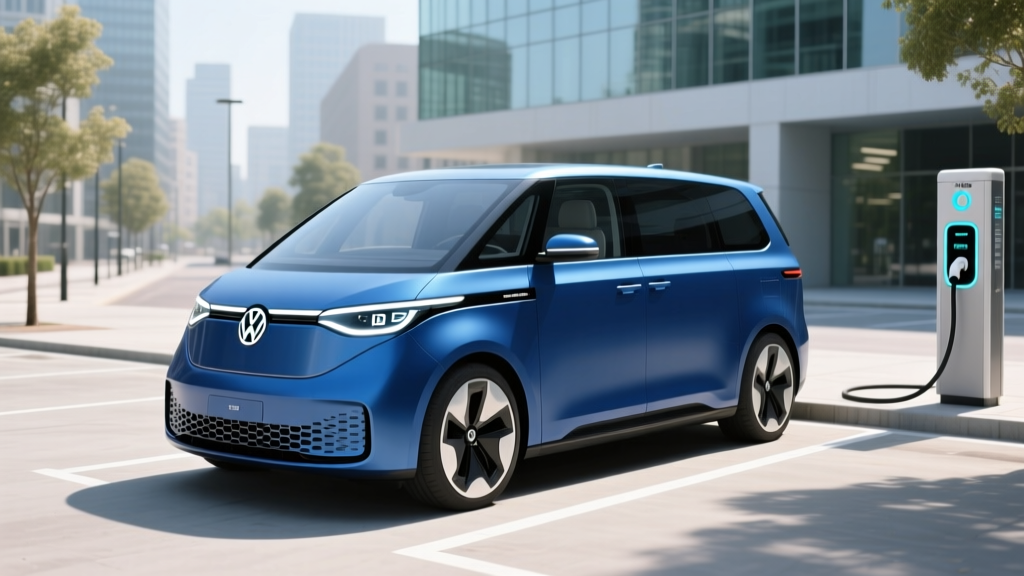
The 2025 Volkswagen ID. Buzz arrives in the U.S. as a three-row electric van that trades on nostalgia while delivering practical family-hauler credentials. With EPA-estimated range up to 234 miles, seating for seven, and distinctive Microbus-inspired styling, it occupies a unique niche. But at a starting MSRP near $60,000 and with real-world range that can dip below 200 miles on the highway, the ID. Buzz demands careful consideration—especially if you're weighing lease versus purchase and factoring in federal tax credit eligibility.
Real-World Range Reality Check
EPA Estimate: 234 miles (RWD), 231 miles (AWD 4Motion)
Real-World Expectation: Expect 190-210 miles on sustained highway driving at 70+ mph. In cold weather (below 40°F), range drops 20-30%, potentially leaving you with 160-180 miles of usable range. City driving with regenerative braking can push closer to EPA numbers or slightly above.
Range, Battery & Efficiency: What the Numbers Mean
The U.S.-spec ID. Buzz uses a 91 kWh gross battery pack (86 kWh usable) with NMC (nickel-manganese-cobalt) chemistry. This is larger than the European version's 77 kWh pack, addressing American buyers' range concerns. The rear-wheel-drive model achieves an EPA-estimated 87 MPGe combined (38 kWh/100 miles), while the AWD 4Motion variant drops to 84 MPGe combined (40 kWh/100 miles).
| Specification | RWD | AWD 4Motion |
|---|---|---|
| EPA Range | 234 miles | 231 miles |
| Battery (usable/gross) | 86 kWh / 91 kWh | 86 kWh / 91 kWh |
| Chemistry | NMC | NMC |
| Horsepower | 282 hp | 330 hp |
| 0-60 mph | 7.9 sec (est.) | 6.5 sec (est.) |
| MPGe (combined) | 87 MPGe | 84 MPGe |
| Efficiency | 38 kWh/100mi | 40 kWh/100mi |
| Drivetrain | Rear-wheel drive | Dual-motor AWD |
Efficiency-wise, the ID. Buzz consumes more energy per mile than smaller EVs like the Tesla Model Y (28 kWh/100mi) or Hyundai Ioniq 5 (30 kWh/100mi), but that's expected given its boxy aerodynamics and 5,000+ pound curb weight. For context, that 38 kWh/100mi translates to roughly $0.11-0.15 per mile at average U.S. electricity rates—still cheaper than gasoline at $3.50/gallon in a comparable minivan getting 22 MPG combined.
Charging Speed: DC Fast Charge & Home Level 2
The ID. Buzz supports DC fast charging at up to 170 kW peak power using the CCS1 connector (Volkswagen has not adopted NACS/Tesla's connector for this model year). In optimal conditions with battery preconditioning, you'll see 10-80% charging in approximately 26 minutes. However, the charge curve tapers significantly above 80%—plan for 40+ minutes if you need a full charge at a DC station.
| Charging Method | Power (kW) | Time / Rate |
|---|---|---|
| DC Fast Charge (10-80%) | Up to 170 kW peak | ~26 minutes |
| DC Fast Charge (10-100%) | Variable (tapered) | ~45 minutes |
| Level 2 Home (240V, 48A) | 11 kW | ~8.5 hours (0-100%) |
| Level 2 Home (240V, 32A) | 7.7 kW | ~11 hours (0-100%) |
| Level 1 (120V) | 1.4 kW | ~60+ hours (0-100%) |
For home charging, the ID. Buzz's onboard charger maxes out at 11 kW on Level 2 power. With a 48-amp hardwired home charger, you'll add roughly 30-35 miles of range per hour of charging—meaning an overnight session easily replenishes a full day's driving. Most buyers will want a Level 2 installation (expect $500-1,500 for equipment and electrician work, plus potential panel upgrades in older homes).
Pricing, Trims & Federal Tax Credit Eligibility
The 2025 ID. Buzz launches in two main trims: the 1st Edition (loaded with features) and a base Pro S model arriving later. Pricing starts at $59,995 for the Pro S RWD, climbing to $65,495 for the 1st Edition RWD and $69,995 for the 1st Edition AWD. Destination charges add $1,395.
| Trim | MSRP | After $7,500 Credit | Effective Monthly (60-mo, 5% APR) |
|---|---|---|---|
| Pro S RWD | $59,995 | $52,495 | ~$990 |
| 1st Edition RWD | $65,495 | $57,995 | ~$1,094 |
| 1st Edition AWD | $69,995 | $62,495 | ~$1,179 |
Federal Tax Credit (§30D) Eligibility
The ID. Buzz may qualify for the full $7,500 federal tax credit, but eligibility depends on several factors that change annually:
- MSRP Cap: Vans must be under $80,000 MSRP (ID. Buzz qualifies)
- Income Limits: Modified AGI must be ≤$300,000 (joint), $225,000 (head of household), or $150,000 (single)
- Battery Sourcing: Critical minerals and battery components must meet escalating percentage thresholds from North America or FTA partners
- Point-of-Sale Transfer: As of 2024, you can transfer the credit to the dealer for an immediate price reduction rather than claiming it on your tax return
Check IRS.gov's clean vehicle credit page for current-year sourcing requirements and use the DOE's vehicle lookup tool to confirm specific VIN eligibility before purchase.
Interior Space, Cargo & Practicality
The ID. Buzz's three-row layout seats seven passengers (2+2+3 configuration). Cargo volume measures 18.3 cubic feet behind the third row, expanding to 75.5 cu ft with the third row folded and up to 137.4 cu ft with both rear rows down. For comparison, the Chrysler Pacifica Hybrid offers 32.3 cu ft behind its third row but less maximum cargo space overall.
Second-row captain's chairs slide and recline, with available heated and ventilated seats on higher trims. The third row accommodates adults for short trips but feels tighter than a full-size minivan on long journeys. Legroom specs: 41.1 inches (front), 39.4 inches (second row), 32.7 inches (third row).
Notable features include a panoramic fixed glass roof (with electrochromic dimming on 1st Edition), power sliding doors, a power tailgate, and VW's latest ID. Software 4.0 infotainment with a 12.9-inch touchscreen. The digital cockpit uses a 5.3-inch driver display, which some reviewers find undersized for the vehicle's premium positioning.
Performance & Driving Impressions
The RWD ID. Buzz delivers 282 horsepower from its rear-mounted electric motor, achieving 0-60 mph in approximately 7.9 seconds. The dual-motor AWD 4Motion bumps output to 330 hp and drops the 0-60 time to around 6.5 seconds. Top speed is electronically limited to 99 mph.
Driving dynamics prioritize comfort over sportiness—the suspension soaks up bumps effectively, and the low center of gravity (thanks to the floor-mounted battery) minimizes body roll. Steering feels light and vague, which suits the van's family-focused mission but won't satisfy enthusiasts. The turning circle of 41.3 feet is reasonable for the vehicle's 195.3-inch length.
Driver assistance includes Travel Assist (adaptive cruise with lane centering), Front Assist with automatic emergency braking, Lane Assist, and Park Assist Plus. These are SAE Level 2 systems requiring continuous driver supervision—not autonomous driving capabilities.
Pros, Cons & Who Should Consider the ID. Buzz
Pros
- Distinctive retro-modern styling stands out in a sea of crossover SUVs
- Comfortable ride quality with well-isolated cabin
- Practical three-row seating with flexible cargo configurations
- Competitive 234-mile EPA range for the class
- 170 kW DC fast charging is adequate for road trips
- Available AWD for all-weather confidence
- Strong build quality and premium interior materials
Cons
- Starting price near $60K is steep, even after tax credits
- Real-world highway range drops below 200 miles
- CCS1 connector (not NACS) limits Tesla Supercharger access
- Small driver display feels dated for the price point
- Third-row space is tighter than traditional minivans
- No frunk (front trunk) for additional storage
- Limited dealer inventory at launch may mean wait times
Best Suited For:
The ID. Buzz works best for families who value style and comfort over maximum range or cargo space, primarily drive in suburban/urban environments with home charging access, and take road trips of 200 miles or less between charging stops. It's also a strong choice for those who want three rows without the minivan stigma—or who simply love the Microbus heritage.
Consider Alternatives If:
You need maximum range (Tesla Model X: 348 miles), maximum cargo space (Rivian R1S or traditional minivans), or the lowest price point (Kia EV9 starts ~$55K with similar seating). The ID. Buzz's charm comes at a premium.
Warranty & Ownership Costs
Volkswagen covers the ID. Buzz with a 4-year/50,000-mile limited warranty and an 8-year/100,000-mile battery and powertrain warranty. The battery warranty guarantees at least 70% capacity retention over that period—a standard but not class-leading commitment (Hyundai/Kia offer 10-year/100,000-mile coverage).
Expected 5-year ownership costs include:
- Electricity: ~$3,500-4,500 (15,000 miles/year at $0.13/kWh average)
- Maintenance: ~$500-800 (tire rotations, cabin air filter, no oil changes)
- Insurance: ~$10,000-14,000 (EVs typically cost 15-25% more to insure than gas equivalents)
- Depreciation: Highly variable; early ID.4 data suggests 40-50% over 5 years
Is the VW ID. Buzz Worth Leasing or Buying?
The ID. Buzz makes more sense as a lease than a purchase for most buyers. Here's why:
- Depreciation Risk: EVs have shown steeper depreciation than gas vehicles, and the ID. Buzz's premium pricing amplifies this risk
- Tax Credit Certainty: Lease deals often factor in the $7,500 credit as a capitalized cost reduction, sidestepping the complexity of battery-sourcing eligibility
- Technology Refresh: VW's ID. software and charging tech will likely evolve significantly within 3-4 years
- Mileage Limits: Standard 10,000-12,000 mile/year lease limits work for most family use cases
Expect lease payments in the $700-900/month range for 36-month terms with $3,000-5,000 down, depending on trim and local incentives. Compare this to purchase payments of $1,000-1,200/month (60 months, 5% APR after tax credit), and the cash-flow advantage of leasing becomes clear—especially if you don't plan to keep the vehicle beyond 4-5 years.
Competitive Comparison: ID. Buzz vs. Alternatives
| Vehicle | EPA Range | Starting MSRP | Seating | Max Cargo (cu ft) |
|---|---|---|---|---|
| VW ID. Buzz RWD | 234 mi | $59,995 | 7 | 137.4 |
| Kia EV9 (LR RWD) | 304 mi | $54,900 | 6-7 | 81.7 |
| Tesla Model X (LR) | 348 mi | $79,990 | 5-7 | 92.3 |
| Rivian R1S (Dual) | 321 mi | $75,900 | 7 | 104.7 |
The Kia EV9 offers better range and lower pricing but less cargo volume and a more conventional SUV design. The Tesla Model X wins on range and Supercharger access but costs significantly more. The Rivian R1S provides superior off-road capability and cargo space at a premium price. The ID. Buzz carves out its own lane with retro styling, van practicality, and a more car-like driving position than the SUV alternatives.
Frequently Asked Questions
Does the VW ID. Buzz qualify for the $7,500 federal tax credit?
The ID. Buzz may qualify for the full $7,500 credit under IRS §30D rules, but eligibility depends on your income (≤$300K joint, $150K single), the vehicle's MSRP (must be under $80K for vans—ID. Buzz qualifies), and battery component/critical mineral sourcing requirements that change annually. Use the DOE's vehicle lookup tool and verify with your dealer before finalizing purchase or lease.
What is the real-world range of the VW ID. Buzz?
While EPA-estimated at 234 miles (RWD), expect 190-210 miles in mixed highway driving and 160-180 miles in cold weather below 40°F. City driving with regenerative braking can approach or exceed EPA numbers. Plan road trips with 150-180 mile segments between chargers for comfort.
How fast does the ID. Buzz charge at home and on the road?
DC fast charging peaks at 170 kW, achieving 10-80% in about 26 minutes under optimal conditions. Home Level 2 charging at 11 kW (48 amps) takes roughly 8.5 hours for a full charge, adding 30-35 miles of range per hour. Most owners will charge overnight and rarely need public charging for daily use.
Is the ID. Buzz bigger than a traditional minivan?
No. At 195.3 inches long, the ID. Buzz is actually shorter than the Chrysler Pacifica (202.8 in) and Honda Odyssey (205.7 in). It's closer in length to a midsize SUV. This makes it easier to park but means third-row and cargo space are more limited than full-size minivans.
Can I tow with the VW ID. Buzz?
The U.S.-spec ID. Buzz has a maximum towing capacity of 2,500 pounds when properly equipped—suitable for small utility trailers, bike racks, or light camping trailers but not boats or large campers. Towing will significantly reduce range, potentially by 30-50%.
Should I lease or buy the ID. Buzz?
Leasing often makes more financial sense given EV depreciation uncertainty, the ability to factor in the $7,500 tax credit as a cap cost reduction, and the likelihood of improved EV technology within 3-4 years. If you drive under 12,000 miles annually and prefer lower monthly payments, leasing is likely the better choice.
Does the ID. Buzz have a front trunk (frunk)?
No. Unlike some EVs, the ID. Buzz does not offer a front trunk. All cargo space is in the rear cargo area. VW cites packaging constraints with the HVAC system and 12V battery in the front compartment.
What's the difference between ID. Buzz RWD and AWD 4Motion?
The RWD model uses a single 282-hp rear motor with 234 miles of range. The AWD 4Motion adds a front motor for 330 hp total, faster acceleration (6.5 vs 7.9 seconds 0-60), and all-weather traction—but reduces range slightly to 231 miles and costs about $4,500 more. For most buyers in mild climates, RWD is sufficient; choose AWD if you regularly drive in snow or need the extra performance.
For more on the ID. Buzz's European launch and technical details, see Volkswagen's official newsroom. For EPA efficiency data, check the fueleconomy.gov comparison tool.