The Quick Answer on Audi EV Models
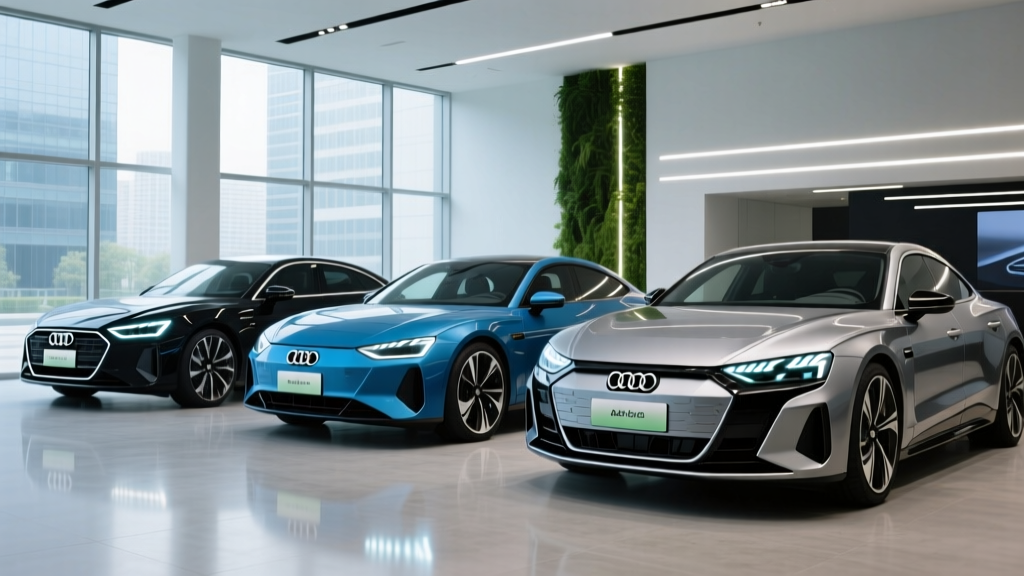
Audi sells three core EV families in the U.S. for 2026: the Q4 e-tron (compact SUV, 265-mile EPA range, starting ~$49,800), the Q6 e-tron (midsize SUV on the new PPE platform, 308-mile EPA range, starting ~$63,800), and the e-tron GT / RS e-tron GT (performance sedan, 238–270-mile range, starting ~$106,000). None currently qualify for the full federal §30D tax credit due to battery-sourcing and MSRP cap rules. The Q4 e-tron and Q6 e-tron are the volume plays for daily driving and road trips; the GT is a low-volume performance flagship. If you have Level 2 home charging and drive under 300 miles daily, an Audi EV is a compelling luxury option — but expect to pay a premium over non-luxury EVs and budget for higher insurance.
Audi's 2026 EV Lineup at a Glance
Audi has consolidated its electric portfolio after retiring the original e-tron SUV (rebranded as Q8 e-tron, now discontinued in the U.S. after 2025). The current lineup targets three distinct buyer profiles: entry luxury, tech-forward family hauling, and high-performance grand touring. Here's how the numbers stack up across the range.
| Model | Battery (usable kWh) | EPA Range | Max DC Charge (kW) | 10–80% Time | 0–60 mph | Starting MSRP |
|---|---|---|---|---|---|---|
| Q4 e-tron 55 quattro | 77 kWh (NMC) | 265 mi | 175 kW | ~28 min | 5.8 sec | $49,800 |
| Q4 Sportback e-tron 55 | 77 kWh (NMC) | 258 mi | 175 kW | ~28 min | 5.8 sec | $52,300 |
| Q6 e-tron quattro | 94 kWh (NMC) | 308 mi | 270 kW | ~21 min | 5.0 sec | $63,800 |
| SQ6 e-tron | 94 kWh (NMC) | 288 mi | 270 kW | ~21 min | 4.3 sec | $72,800 |
| e-tron GT quattro | 84 kWh (NMC) | 270 mi | 270 kW | ~22 min | 3.9 sec | $106,300 |
| RS e-tron GT performance | 84 kWh (NMC) | 238 mi | 320 kW | ~18 min | 2.5 sec | $149,800 |
Sources: EPA fueleconomy.gov, Audi USA press specifications. Ranges reflect 2026 model-year EPA estimates; real-world highway range typically runs 10–15% lower, with additional 15–25% loss in sub-freezing temperatures.
Real-World Range Reality Check
The Q6 e-tron's 308-mile EPA sticker is legitimate for mixed suburban driving at 65°F. On a 75-mph highway run in summer, expect roughly 260–275 miles before the low-battery warning. In winter (20–30°F), cabin heating and battery conditioning drop usable range to approximately 220–240 miles. The Q4 e-tron, with its smaller battery, will see similar proportional losses — plan for ~210 miles of real-world winter highway range. The e-tron GT, being lower and more aerodynamic, holds highway efficiency better but its RS variant trades range for output.
Charging Infrastructure: What Audi Owners Actually Need
Audi's 2026 EVs use the NACS (Tesla-style) connector for DC fast charging and Level 2 AC charging, following the industry-wide transition from CCS1. This is a significant advantage: NACS gives Audi owners native access to the Tesla Supercharger network (over 20,000 stalls in North America) without an adapter.
| Charging Level | Power (kW) | Miles Added per Hour | Typical Use Case | Cost Range |
|---|---|---|---|---|
| Level 1 (120V) | 1.4 kW | ~4 mi/hr | Overnight top-up, emergencies | $0 (included cord) |
| Level 2 (240V, 48A) | 11.5 kW | ~35 mi/hr | Daily home charging | $500–$1,500 install |
| DC Fast (NACS) | 175–320 kW | ~180–250 mi in 20 min | Road trips | $0.30–$0.55/kWh public |
Home charging is essential for Audi EV ownership. Without a Level 2 home setup, you'll rely entirely on public charging — feasible in dense metro areas with reliable Electrify America or Supercharger access, but impractical for most suburban and rural owners. A 240V/48A Level 2 installation typically costs $800–$1,800 including a hardwired wallbox and electrician labor, assuming your electrical panel has spare capacity. Older homes with 100A panels may need a $2,000–$4,000 panel upgrade.
Charging curve reality: The Q6 e-tron's 270 kW peak rate only sustains from roughly 10–35% State of Charge. Above 50%, the rate tapers to ~150 kW, and above 80% it drops below 50 kW to protect battery health. The 21-minute 10–80% claim assumes a preconditioned battery and a 350 kW-capable charger — at a 150 kW station, expect 30–35 minutes.
Audi EV vs Gas Equivalent: The Ownership Cost Breakdown
The most common question from luxury SUV shoppers: does going electric actually save money versus a gas-powered Audi Q5 or Q7? The honest answer depends on your mileage, electricity rate, and how long you keep the vehicle. Here's a five-year comparison for the Q4 e-tron versus the similarly sized Q5 45 TFSI.
| Cost Category (5 Years / 75,000 Miles) | Q4 e-tron 55 quattro | Q5 45 TFSI (Gas) |
|---|---|---|
| Purchase Price (MSRP) | $49,800 | $46,100 |
| Federal Tax Credit (§30D) | $0 (sourcing rules) | $0 |
| Fuel/Energy Cost | $4,200 (home charging @ $0.14/kWh) | $9,400 (@ $3.60/gal, 25 MPG) |
| Maintenance | $1,800 | $4,200 |
| Insurance (avg) | $9,500 | $7,200 |
| Estimated Depreciation | $22,000 | $18,500 |
| Total 5-Year Cost | $87,300 | $85,400 |
Assumptions: 15,000 miles/year, 85% home charging at national average residential rate ($0.14/kWh per EIA), 15% public DC charging at $0.45/kWh. Gas price based on AAA national average. Insurance reflects luxury EV premium (~25–30% higher than gas equivalent). Depreciation estimates based on historical luxury EV retention data.
The verdict: Over five years, the Q4 e-tron costs roughly $1,900 more than a gas Q5 when you factor in higher insurance and steeper depreciation. However, fuel savings alone total $5,200, and maintenance savings add another $2,400. If you keep the vehicle 8–10 years, the EV pulls ahead on total cost. If you lease every 3 years, the gas Q5 likely wins on pure economics.
Federal Tax Credit and Incentive Reality for Audi EVs
This is where many luxury EV shoppers face disappointment. Under current IRS §30D rules, the Q4 e-tron, Q6 e-tron, and e-tron GT do not qualify for the $7,500 federal tax credit. The reasons are twofold:
- MSRP cap: SUVs must be under $80,000; sedans under $55,000. The Q4 e-tron clears this, but the e-tron GT and most Q6 trims exceed it.
- Battery sourcing requirements: Audi's battery cells (sourced from suppliers like Samsung SDI and SK On) do not currently meet the critical-minerals and battery-component thresholds that phase in through 2026. Most Audi EVs fail the battery-component requirement.
- Buyer income cap: Even if a model qualified, buyers must have AGI under $150K (single) or $300K (joint) to claim the credit.
State incentives vary significantly. Some states (California, Colorado, Massachusetts) offer additional rebates of $2,000–$5,000 that stack with federal credits, and some have no MSRP or sourcing restrictions. Check your state energy office or AFDC state incentive database for current local programs.
Common Misconceptions About Audi EVs — Fact vs Fiction
| Myth | Fact |
|---|---|
| "Audi EVs use proprietary chargers you can only find at dealerships" | All 2026 Audi EVs use the NACS connector, compatible with Tesla Superchargers, Electrify America (with adapter at older CCS stations), and most public networks. |
| "The battery will need replacing in 5 years and cost $20,000" | Audi provides an 8-year/100,000-mile battery warranty covering capacity below 70%. NMC degradation data shows ~10–12% capacity loss at 100K miles with normal use. Full replacement is $18,000–$25,000 but is rarely needed within the warranty period. |
| "I can charge on any standard household outlet quickly" | Level 1 (120V) charging adds only ~4 miles of range per hour. A full Q6 e-tron charge from 10% on 120V takes over 60 hours. Level 2 (240V) home charging is effectively mandatory for practical daily use. |
| "The e-tron GT is a practical daily driver" | At $106K+ with 270 miles of range and a stiff ride, the GT is a performance grand tourer. For daily commuting and family hauling, the Q4 or Q6 e-tron is far more practical. |
| "Audi's driver assist is self-driving" | Audi's Adaptive Cruise Assist with Lane Guidance is SAE Level 2 — it requires continuous driver supervision, hands on or near the wheel, and does not handle all road scenarios autonomously. |
SAE Automation Level: Audi Adaptive Cruise Assist
Audi's most advanced driver-assistance system, available on Q6 e-tron and e-tron GT, is SAE Level 2. It combines adaptive cruise control and lane-centering to manage speed and steering on highways. The driver must remain fully engaged, monitor traffic, and be prepared to take over instantly. This is not autonomous driving. Only Level 4 services (Waymo, Zoox) operate without a human driver, and those are limited to geo-fenced urban areas.
Decision Framework: Which Audi EV Model Fits You?
Choose the Q4 e-tron if:
- Your budget is $48K–$58K and you want a compact luxury electric SUV
- You commute under 50 miles daily and road-trip 2–3 times per year
- You want the most affordable entry into Audi's EV lineup
- You prioritize parking ease and city maneuverability over cargo space
Choose the Q6 e-tron if:
- Your budget is $62K–$78K and you need midsize SUV space (28.5 cu ft cargo)
- You want the latest PPE platform with 270 kW charging and the newest MMI infotainment
- Regular 250+ mile road trips are part of your routine
- You want the best balance of range, tech, and daily practicality
Choose the e-tron GT if:
- Your budget exceeds $100K and performance is your primary motivation
- You want a low-slung grand tourer, not an SUV
- You accept the range trade-off (238–270 mi) for 637+ HP and sub-4-second 0–60
- This is a second or third vehicle, not your sole daily driver
Do NOT choose an Audi EV if:
- You lack access to home Level 2 charging AND your area has sparse public DC fast charging
- You regularly tow more than 4,000 lbs (Q4 e-tron max tow: 2,650 lbs; Q6 e-tron: 4,400 lbs)
- You need the absolute lowest total cost of ownership — a Hyundai Ioniq 5, Tesla Model Y, or Toyota RAV4 Hybrid will cost significantly less
- You drive 400+ miles daily in rural areas with limited charging infrastructure
First-Time EV Buyer Checklist: What You Need Before Ordering
If this is your first electric vehicle, run through these practical items before signing a purchase or lease agreement:
- Confirm home charging feasibility. Have an electrician assess your panel capacity (200A preferred; 100A may require an upgrade). Budget $800–$1,800 for a Level 2 wallbox installation, or $3,000–$5,000 if a panel upgrade is needed.
- Map your common routes. Use the PlugShare or Tesla app to verify Supercharger and Electrify America coverage on your regular long-distance routes. Audi's MMI navigation will route through chargers, but pre-planning reduces anxiety.
- Check your insurance rate early. Luxury EVs typically cost 25–35% more to insure than gas equivalents. Get quotes from your current provider and at least two competitors before committing.
- Understand your lease vs. buy math. Audi frequently offers aggressive lease deals on EVs ($499–$699/month for Q4 e-tron). If you lease, the dealer captures any applicable tax credit — confirm this in your lease terms. Buying makes more sense if you keep cars 6+ years.
- Learn preconditioning. On cold mornings, precondition the battery while plugged in (via the myAudi app) to warm it before driving and before DC fast charging. This preserves range and enables peak charge rates.
- Set charge limits. For daily driving, set your maximum State of Charge to 80% to extend long-term battery health. Only charge to 100% before road trips. (Note: this applies to NMC chemistry; if Audi introduces LFP variants, 100% daily charging is acceptable.)
Frequently Asked Questions
Are Audi EV batteries reliable long-term?
Audi's NMC battery packs carry an 8-year/100,000-mile warranty guaranteeing at least 70% capacity retention. Industry data from similar VW Group battery platforms shows approximately 10–12% degradation at 100,000 miles with normal charging habits. Avoid frequent DC fast charging above 80% and habitual 100% charges to maximize longevity.
How does the Q6 e-tron compare to the Tesla Model Y?
The Q6 e-tron offers more premium materials, a quieter cabin, and Audi's build quality. The Model Y Long Range beats it on range (320 vs. 308 EPA miles), charging network density (Superchargers natively), and price ($48K vs. $64K). The Q6 wins on interior refinement and dealer service experience. It's a premium-vs-value tradeoff.
Can I tow with an Audi EV?
Yes, but capacity is limited. The Q4 e-tron is rated for 2,650 lbs — enough for a small utility trailer but not a boat or camper. The Q6 e-tron tows up to 4,400 lbs, handling a light travel trailer. Expect 30–40% range reduction when towing near maximum capacity. The e-tron GT is not rated for towing.
What happens if I can't charge at home?
Public-only EV ownership is viable in cities with dense DC fast charging (e.g., Los Angeles, San Francisco, New York) but adds 30–60 minutes per week of dedicated charging time and costs 2–3x more per mile than home charging. If home charging is impossible, a plug-in hybrid (like the discontinued Audi Q5 TFSI e) or a conventional hybrid may be a better fit until your charging situation changes.
Is the Audi Q8 e-tron still available?
No. Audi discontinued the Q8 e-tron (formerly the original e-tron) in the U.S. market after the 2025 model year due to slow sales and the transition to the PPE platform. The Q6 e-tron effectively replaces it in the lineup with better range, faster charging, and modern electronics.