Quick Answer: Are Audi EV Cars Worth It in 2026?
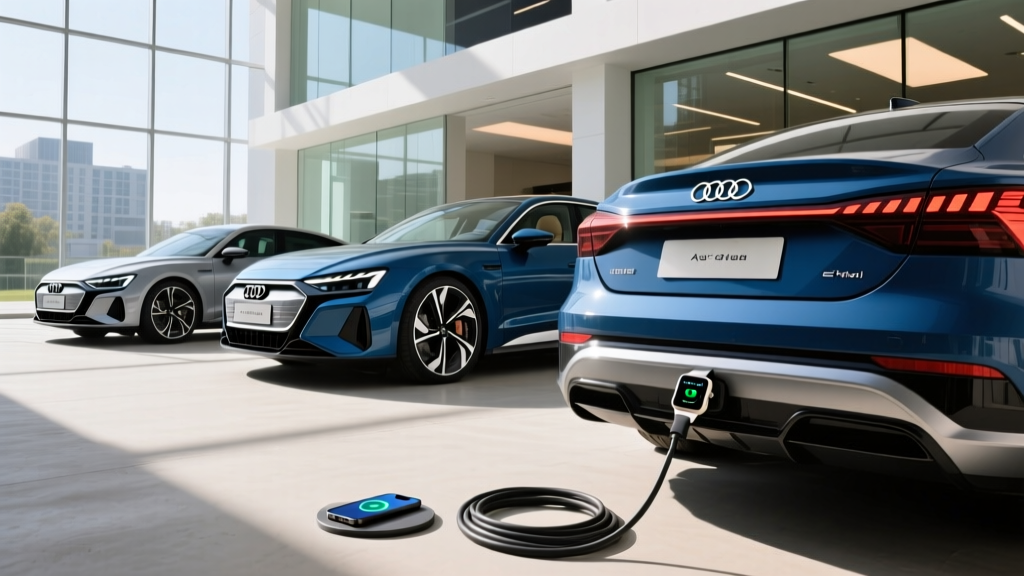
Audi's 2026 EV lineup spans three core models: the Q4 e-tron (compact SUV, ~265 mi EPA, from ~$49,800), the Q6 e-tron (mid-size SUV on the PPE platform, ~308 mi EPA, from ~$63,800), and the e-tron GT / RS e-tron GT (performance sedan, ~270 mi EPA, from ~$106,500). All use 800-volt or high-capacity architectures for fast DC charging (up to 270 kW on the Q6/e-tron GT). Federal tax credit eligibility under IRS §30D varies by model, trim, battery sourcing, and buyer income — check current IRS guidance before assuming a flat $7,500 credit. For buyers with home Level 2 charging and daily commutes under 80 miles, an Audi EV can cut fuel and maintenance costs significantly versus an equivalent gas Audi Q5 or A7. Apartment dwellers without reliable charging access should weigh convenience carefully.
The 2026 Audi EV Lineup at a Glance
Audi has consolidated its electric portfolio around dedicated EV platforms. The original "e-tron" SUV (based on the MLB Evo architecture) has been retired, replaced by the PPE-based (Premium Platform Electric, co-developed with Porsche) Q6 e-tron and the MEB-based Q4 e-tron shared with Volkswagen. The e-tron GT continues on the J1 performance platform alongside the Porsche Taycan.
| Model | EPA Range | Battery (usable kWh) | Peak DC Charge (kW) | 10–80% DC Time | 0–60 mph | Starting MSRP |
|---|---|---|---|---|---|---|
| Q4 e-tron (RWD) | ~265 mi | 77 kWh (NMC) | 175 kW | ~28 min | 7.9 sec | $49,800 |
| Q4 e-tron quattro | ~242 mi | 77 kWh (NMC) | 175 kW | ~28 min | 5.8 sec | $56,300 |
| Q6 e-tron (RWD) | ~308 mi | 94 kWh (NMC) | 270 kW | ~21 min | 6.5 sec | $63,800 |
| Q6 e-tron quattro | ~284 mi | 94 kWh (NMC) | 270 kW | ~21 min | 5.0 sec | $68,800 |
| e-tron GT quattro | ~270 mi | 84 kWh (NMC) | 270 kW | ~22 min | 3.9 sec | $106,500 |
| RS e-tron GT performance | ~256 mi | 93 kWh (NMC) | 320 kW | ~18 min | 2.5 sec | $142,400 |
Sources: fueleconomy.gov, Audi USA. Specs vary by wheel/option package. EPA range is a laboratory estimate — see real-world notes below.
Real-World Range vs. EPA Sticker
EPA estimates assume mixed driving at moderate temperatures. Expect:
- Highway (75 mph, 70°F): Subtract ~10–15% from EPA.
- Cold weather (30°F, highway): Subtract ~20–30%, depending on heat-pump use and cabin preconditioning.
- City/regen-heavy driving: You may match or slightly exceed EPA.
For the Q6 e-tron quattro (EPA ~284 mi), plan on ~230–250 mi in real highway use, and as low as ~200 mi in freezing conditions. This is enough for most commutes but requires planning on 300+ mile road trips.
Charging Speed and Infrastructure: What Audi EV Owners Actually Experience
Audi's 800-volt architecture on the Q6 e-tron and e-tron GT enables class-leading DC fast charging, but real-world charge speeds depend on battery temperature, state of charge (SoC), and charger capability. kW measures power (how fast energy flows); kWh measures energy capacity (how much the battery holds). A 270 kW peak doesn't mean the car charges at that rate the entire session — charging tapers significantly above ~80% SoC to protect the battery.
| Charging Level | Power (kW) | Typical Miles Added per Hour | Use Case |
|---|---|---|---|
| Level 1 (120V household) | ~1.4 kW | 3–5 mi/hr | Emergency/overnight top-up only |
| Level 2 (240V home, 48A) | ~11.5 kW | 30–40 mi/hr | Daily home charging (full overnight) |
| DC Fast (Q4 e-tron) | Up to 175 kW | ~200 mi in 30 min (10–80%) | Road trips, public stations |
| DC Fast (Q6 / e-tron GT) | Up to 270–320 kW | ~250 mi in 20 min (10–80%) | Road trips on 350 kW chargers |
Preconditioning matters. Use the Audi MMI or myAudi app to warm the battery before arriving at a DC fast charger. Without preconditioning, a cold battery may only accept 50–80 kW initially, adding 10–15 minutes to your stop. On Electrify America's 350 kW chargers, the Q6 e-tron sustains over 200 kW through ~50% SoC before tapering.
Connector note: Audi's 2026 U.S. models still ship with CCS1 ports. Audi has announced a transition to NACS (Tesla-style) on future models, but for now, you'll use the CCS adapter (included) at Tesla Superchargers or charge natively at Electrify America, EVgo, and ChargePoint networks.
Audi EV vs. Gas Audi: Cost of Ownership Compared
The strongest argument for an Audi EV isn't performance — it's running cost. Let's compare a 2026 Q6 e-tron quattro (~$68,800) against a similarly equipped 2026 Audi Q5 45 TFSI quattro (gas, ~$52,000 MSRP, ~25 MPG combined).
| Category | Q6 e-tron quattro | Q5 45 TFSI (Gas) |
|---|---|---|
| Purchase Price | $68,800 | $52,000 |
| Estimated Federal Tax Credit (§30D) | $0–$3,750* | $0 |
| Fuel/Energy (60k mi) | $4,800 (home L2 + some DCFC) | $8,400 (25 MPG @ $3.50/gal) |
| Maintenance (60k mi) | $1,200 (cabin filter, wipers, tires) | $3,800 (oil, brakes, filters, fluids) |
| Insurance (5 yr avg) | $12,500 | $9,500 |
| Depreciation (est. 5 yr) | $28,000 | $22,000 |
| Total 5-Year Cost | ~$111,300 | ~$95,700 |
*§30D credit depends on battery sourcing, critical-mineral rules, MSRP caps ($80,000 for SUVs), and buyer income caps ($300k joint / $150k single). Verify current rules at irs.gov. The Q6 e-tron may qualify for a partial $3,750 credit if critical-mineral sourcing requirements are only partially met.
Key takeaway: The EV saves roughly $7,400 on energy and maintenance over five years, but higher purchase price, insurance premiums (~30% more for EVs on average), and steeper depreciation close the gap. The math improves substantially if you qualify for the full $7,500 credit, have cheap utility rates ($0.10–0.13/kWh), or drive more than 12,000 miles/year.
Who Should Buy an Audi EV (and Who Shouldn't)
Choose an Audi EV If:
- You have access to Level 2 home charging (garage or driveway with a 240V/48A circuit).
- Your daily driving is under 80 miles round-trip, with occasional road trips under 300 miles.
- You value cabin refinement, instant torque, and lower running costs over lowest purchase price.
- You live in a moderate or warm climate, or you're willing to precondition and accept ~20% winter range loss.
- You want to pair your EV with a utility time-of-use rate to charge at $0.08–0.12/kWh overnight.
Consider a Gas or PHEV Audi Instead If:
- You live in an apartment or street-park with no reliable charging access.
- You regularly drive 400+ mile routes through charging-desert regions (rural Mountain West, parts of the Plains).
- You frequently tow over 3,500 lbs — EV towing range can drop 40–50%.
- Your budget prioritizes lowest upfront cost and you drive under 8,000 miles/year (fuel savings won't offset the EV premium).
- You live in extreme cold (below 0°F regularly) and cannot garage the vehicle.
Common Misconceptions About Audi EV Cars
| Myth | Fact |
|---|---|
| "Audi EVs have terrible range." | The Q6 e-tron RWD achieves ~308 mi EPA — competitive with the BMW iX and Genesis GV70 Electrified. Earlier "e-tron" SUVs (2019–2023) had ~204–222 mi, which was below average. |
| "I can't charge at Tesla Superchargers." | With the included CCS-to-NACS adapter, Audi EVs can access Tesla's non-Tesla Supercharger network (over 15,000 U.S. stalls as of 2026). Speeds may be limited vs. native NACS vehicles. |
| "The battery will need replacing in 5 years." | Audi's high-voltage battery warranty covers 8 years/100,000 miles against degradation below ~70% capacity. Real-world data from MEB and PPE platforms shows ~5–8% degradation at 100k miles with normal use. |
| "EVs cost more to insure always." | Generally true (~20–35% higher premiums due to repair costs), but gap is narrowing. Shop quotes from EV-friendly carriers (e.g., State Farm, USAA, Tesla Insurance where available). |
| "I'll get the full $7,500 tax credit." | Few EVs qualify for the full amount in 2026 due to battery-sourcing and critical-mineral rules. Many Audi models may qualify for $3,750 (half credit) or $0 depending on the supply chain. Check the fueleconomy.gov tax credit tool. |
Home Charging Setup: What You'll Spend
Most Audi EV owners charge 85–95% of their miles at home. Budget for a professional Level 2 installation:
- Level 2 charger hardware: $400–$700 (ChargePoint Home Flex, Emporia Vue, Wallbox Pulsar Plus)
- Electrical panel capacity check: You need a 200A main panel with ~60A spare capacity for a 48A continuous circuit. Panel upgrades run $1,500–$3,500 if needed.
- Electrician labor + permit: $800–$2,500 depending on run length and local code.
- Total typical install: $1,200–$3,200 (up to $6,000+ with panel upgrade).
Audi does not currently bundle a home charger with new EV purchases (unlike BMW's past programs). However, Audi often partners with Electrify America for complimentary public charging credits (typically 250–500 kWh) on new vehicle purchases.
ADAS and Driver Assistance: What Audi Actually Offers
SAE Automation Level: Level 2
Audi's Adaptive Cruise Assist and Active Lane Guidance are SAE Level 2 driver-assist systems. The driver must remain fully engaged, hands on or near the wheel, eyes on the road. This is not self-driving. Unlike GM's Super Cruise or Ford's BlueCruise, Audi does not currently offer hands-free highway driving on U.S. models.
What Audi's Driver Assist Does NOT Do
- Does not navigate on its own — you must confirm lane changes and exits.
- Does not handle construction zones, unmapped roads, or severe weather reliably.
- Does not eliminate driver responsibility — NHTSA requires you to remain in control at all times.
- No hands-free mode available in the U.S. as of 2026 (Audi's "Traffic Jam Pilot" Level 3 system is not approved for U.S. roads).
Frequently Asked Questions
Do Audi EV cars qualify for the $7,500 federal tax credit in 2026?
It depends on the model, trim, battery sourcing, and your income. Under IRS §30D, SUVs must be under $80,000 MSRP, and buyers must be under $300,000 (joint) or $150,000 (single) modified AGI. Battery components and critical minerals must meet phased-in domestic-sourcing thresholds. Most Audi EVs in 2026 qualify for either $0 or a partial $3,750 credit. Always verify on irs.gov and consult a tax professional. Point-of-sale transfer is available if eligible.
How long does the Audi EV battery last?
Audi's high-voltage battery warranty covers 8 years or 100,000 miles against capacity loss below approximately 70%. Real-world degradation on the MEB and PPE platforms (NMC chemistry) typically runs 5–8% over 100,000 miles with normal use. To maximize longevity: avoid frequent 100% charges (set daily limit to 80%), use DC fast charging sparingly in hot weather, and precondition in extreme temperatures.
Which Audi EV is best for road trips?
The Q6 e-tron quattro offers the best balance of range (~284 mi EPA), 270 kW DC fast charging (10–80% in ~21 min), and cargo space. On a 500-mile trip with two fast-charge stops, you'll add roughly 40–45 minutes of total charging time vs. a gas Q5. Plan stops at Electrify America or EVgo stations using the myAudi route planner.
Can I charge an Audi EV at Tesla Superchargers?
Yes, with the CCS-to-NACS adapter Audi provides or sells as an accessory. Audi EVs can access Tesla's "open" Supercharger stalls (those enabled for non-Tesla vehicles via the Tesla app). Expect slightly slower peak speeds than native NACS vehicles, and not all Supercharger stalls are open to non-Tesla cars yet.
Is the Q4 e-tron or Q6 e-tron a better value?
The Q4 e-tron starts ~$14,000 lower but rides on the VW MEB platform with slower DC charging (175 kW vs. 270 kW), less power, and a smaller battery. If your budget is under $55,000 and your commute is short, the Q4 e-tron is a solid luxury EV. If you want 300+ mile road-trip capability, faster charging, and Audi's newest tech architecture, the Q6 e-tron is the stronger long-term buy.