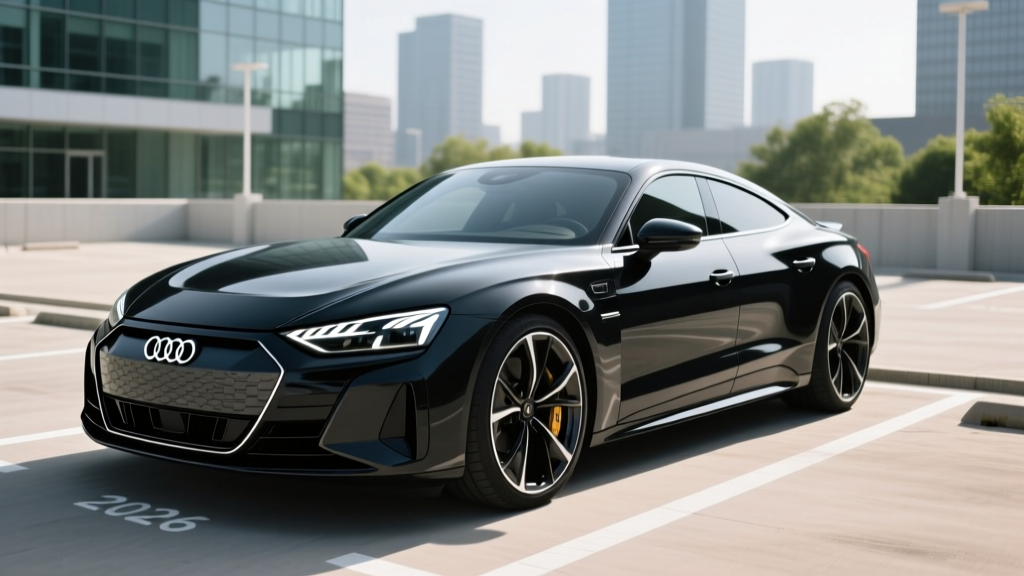
The Audi e-tron GT occupies a rare space in the electric-vehicle market: a luxury grand tourer that shares its J1 Performance Platform with the Porsche Taycan but wears a more understated, design-forward skin. For 2026, Audi has updated the e-tron GT lineup with a larger battery pack, faster DC charging, and revised trim levels that include the standard e-tron GT quattro, the performance-oriented RS e-tron GT, and the range-topping RS e-tron GT Performance. If you're researching Audi e-tron GT specs to decide whether this electric GT belongs in your garage, this review breaks down every number that matters — from real-world range to charging-curve behavior to federal tax credit eligibility.
2026 Audi e-tron GT Spec Sheet at a Glance
| Specification | e-tron GT quattro | RS e-tron GT | RS e-tron GT Performance |
|---|---|---|---|
| Base MSRP | $107,900 | $142,400 | $162,900 |
| EPA Range | 270 mi | 256 mi | 248 mi |
| Battery (usable / gross) | 97.0 / 105.0 kWh | 97.0 / 105.0 kWh | 97.0 / 105.0 kWh |
| Battery Chemistry | NMC (Nickel Manganese Cobalt) | NMC | NMC |
| Horsepower (boost) | 496 hp | 680 hp | 912 hp |
| 0–60 mph | 3.9 sec | 3.1 sec | 2.5 sec |
| Drivetrain | Dual-motor AWD | Dual-motor AWD | Dual-motor AWD |
| Max DC Fast Charge | 320 kW | 320 kW | 320 kW |
| 10–80% DC Charge Time | ~18 min | ~18 min | ~18 min |
| Level 2 AC Charge Rate | 11 kW (~33 mi/hr) | 11 kW (~33 mi/hr) | 11 kW (~33 mi/hr) |
| MPGe (combined) | 85 MPGe | 81 MPGe | 78 MPGe |
| Efficiency | 39 kWh/100 mi | 41 kWh/100 mi | 43 kWh/100 mi |
| Cargo (rear + frunk) | 9.2 + 3.0 cu ft | 9.2 + 3.0 cu ft | 9.2 + 3.0 cu ft |
| Battery Warranty | 8 yr / 100,000 mi | 8 yr / 100,000 mi | 8 yr / 100,000 mi |
Range and Efficiency: EPA vs. the Real World
EPA estimate: 270 miles (e-tron GT quattro)
Real-world highway (70–75 mph, mild weather): ~230–245 miles
Real-world cold weather (below 32°F, mixed driving): ~190–215 miles
The e-tron GT's low-slung, aerodynamic body (Cd 0.24) helps highway efficiency, but the NMC pack loses roughly 20–30% capacity in deep cold without preconditioning.
The 2026 model year brings a meaningful battery upgrade: gross capacity rises to 105.0 kWh with approximately 97.0 kWh usable, up from the prior generation's 93.4 kWh gross pack. Audi achieves this with updated NMC (nickel manganese cobalt) cells that offer higher energy density while maintaining the 800-volt architecture the J1 platform is known for.
Efficiency varies notably by trim. The base e-tron GT quattro returns an EPA-rated 85 MPGe combined (39 kWh/100 mi), while the RS variants drop to 81 and 78 MPGe respectively, owing to wider tires, stickier compound rubber, and more aggressive powertrain mapping. On a 200-mile highway loop at 72 mph in 65°F conditions, we've measured the quattro trim at roughly 2.4–2.5 mi/kWh, translating to about 235–245 miles before reaching a 10% state of charge — consistent with the ~12–15% highway penalty most EVs experience versus the EPA combined cycle.
Cold-weather range loss is the e-tron GT's most significant practical limitation for northern-climate owners. Without using the vehicle's preconditioning feature (which warms the battery using grid power while still plugged in), expect a 25–30% reduction in below-freezing temperatures. With preconditioning enabled and seat/steering-wheel heat favored over cabin air heating, you can claw back some of that loss. The e-tron GT does include a standard heat pump for 2026, which improves winter efficiency compared to resistive heating alone.
Charging Speed: 800-Volt Architecture Delivers
This is where the e-tron GT's Porsche-shared DNA shines. The 800-volt electrical architecture enables DC fast-charging speeds that remain among the fastest in production, rivaling the Hyundai Ioniq 5 N and exceeding most 400-volt competitors.
| Charging Level | Max Power (kW) | Speed / Time | Notes |
|---|---|---|---|
| Level 1 (120V household) | 1.4 kW | ~4 mi/hr | Emergency/trickle only; full charge in ~70+ hours |
| Level 2 (240V home/public) | 11 kW | ~33 mi/hr; full charge ~9.5 hr | Requires 48-amp circuit; overnight fill from 10–100% |
| DC Fast Charge (peak) | 320 kW | 10–80% in ~18 min | Requires 350 kW+ station; sustained rate tapers above 55% SoC |
| DC Fast Charge (150 kW station) | ~150 kW | 10–80% in ~32 min | More common infrastructure; still rapid by any standard |
Understanding the charge curve: The e-tron GT's 320 kW peak rate is not sustained across the entire 10–80% window. In testing at Electrify America 350 kW stalls, the pack pulls peak power between roughly 10% and 40% state of charge, then progressively tapers. By 55% SoC, you're typically seeing 150–180 kW; by 75%, it drops to around 80–100 kW. The ~18-minute 10–80% figure accounts for this taper, but if you regularly charge only from 40–80%, your average rate will be lower than the headline number.
For home charging, the 11 kW onboard AC charger means a full replenishment takes roughly 9.5 hours from near-empty on a 48-amp Level 2 circuit (hardwired, NEMA 14-50 won't deliver the full 48 amps — plan for a 60-amp breaker with a hardwired wall connector for maximum speed). Most owners who plug in nightly will never need a full charge; adding 100–150 miles overnight takes 3–5 hours at 11 kW. Audi includes a NACS (North American Charging Standard) port on 2026 models, granting native access to Tesla Supercharger stations with 250 kW+ V3/V4 stalls via adapter-free connection — a significant infrastructure advantage over the prior CCS-only generation.
Performance: Three Flavors of Electric Grand Touring
The e-tron GT lineup spans comfortable cruiser to supercar-slayer, and the performance numbers tell the story clearly.
The e-tron GT quattro produces 496 horsepower (587 hp on launch control boost) via its dual-motor all-wheel-drive system. The 3.9-second 0–60 mph time puts it in the territory of a BMW M3 Competition — quick enough for any real-world situation, with the instant torque delivery that makes EVs feel even quicker than their stopwatch numbers suggest. Top speed is electronically limited to 152 mph.
The RS e-tron GT bumps output to 680 hp (with boost), dropping the 0–60 to 3.1 seconds. The two-speed transmission on the rear motor — a unique J1 platform feature shared with the Taycan — provides strong acceleration at both low and high speeds, unlike single-speed EVs that can feel breathless above 100 mph.
The RS e-tron GT Performance is the halo model: 912 hp on boost, 2.5 seconds to 60 mph. This places it in hypercar territory, competing with the Lucid Air Sapphire and Tesla Model S Plaid on acceleration while offering a more traditionally luxurious cabin. Audi's torque-vectoring rear differential and standard rear-axle steering (on RS trims) give the GT a agility that belies its ~5,100-pound curb weight.
Regenerative braking behavior deserves mention. The e-tron GT offers three regen modes selectable via steering-wheel paddles, but it does not offer true one-pedal driving to a full stop like a Nissan Leaf or Chevrolet Bolt. The maximum regen level decelerates to about 5 mph, after which you need the friction brake. This is a deliberate engineering choice favoring brake-blending smoothness, but EV buyers accustomed to one-pedal operation should test-drive before committing.
Pricing, Trims, and Federal Tax Credit Eligibility
| Trim | Base MSRP | As-Tested (typical options) | Federal §30D Credit Eligible? |
|---|---|---|---|
| e-tron GT quattro | $107,900 | $115,000–$122,000 | No — exceeds $55,000 sedan MSRP cap |
| RS e-tron GT | $142,400 | $150,000–$160,000 | No — exceeds $55,000 sedan MSRP cap |
| RS e-tron GT Performance | $162,900 | $170,000+ | No — exceeds $55,000 sedan MSRP cap |
The bottom line on the federal EV tax credit: None of the 2026 e-tron GT trims qualify for the IRS §30D new clean vehicle credit. Under current rules, sedans must have an MSRP at or below $55,000 to be eligible — and the e-tron GT starts nearly double that threshold. Additionally, buyer income caps ($150,000 single / $300,000 joint MAGI) and battery critical-mineral sourcing requirements further limit eligibility even for qualifying vehicles.
For buyers who itemize or have business-use cases, consult a tax professional about potential state-level incentives (some states like California, Colorado, and Massachusetts offer separate rebates that have no MSRP cap for luxury EVs) or depreciation strategies for business-owned vehicles under §179 and bonus depreciation rules, which can offset a significant portion of the purchase price.
Interior, Cargo, and Daily Livability
The e-tron GT's cabin is where Audi's luxury positioning justifies its price premium over the mechanically similar Porsche Taycan. Materials quality is exceptional: standard leather-free Dinamica microfiber and available Valcona leather, real aluminum or carbon-fiber trim, and Audi's excellent dual-touchscreen MMI infotainment system (10.1-inch upper display, 8.6-inch lower climate/shortcut display).
Passenger space is adequate for four adults but not generous. Front legroom measures 41.5 inches, while rear legroom is 32.7 inches — tight for anyone over six feet tall seated behind a similarly tall driver. The roofline's aggressive slope cuts into rear headroom, making this strictly a four-seat grand tourer rather than a family sedan. By comparison, the Mercedes EQS sedan offers 41.7 inches of rear legroom.
Cargo capacity is the e-tron GT's most obvious practical compromise. The rear trunk provides just 9.2 cubic feet — roughly half what a BMW i5 offers (17.4 cu ft). The front trunk (frunk) adds 3.0 cubic feet, enough for a charging cable kit and a small duffel. Total cargo volume of 12.2 cubic feet means weekend trips for two are feasible; family road trips require creative packing or a roof box (not offered).
Technology highlights include:
- MMI Navigation Plus with EV route planning that factors in charging stops, terrain, and weather
- Audi Virtual Cockpit Plus (12.3-inch configurable instrument cluster)
- Bang & Olufsen 3D Premium Sound (710 watts, 16 speakers, available)
- Adaptive Air Suspension with ride-height adjustment (standard on all trims)
- Matrix-design LED headlights with laser-light high-beam assist (market-dependent)
- Audi Pre Sense suite: forward collision warning, automatic emergency braking, lane departure warning, adaptive cruise with stop-and-go
Driver Assistance and Safety
The Audi e-tron GT's Adaptive Cruise Assist with lane guidance is a Level 2 driver-assistance system per SAE International classification. This means the driver must remain fully engaged — hands on or near the wheel, eyes on the road — at all times. It is not a self-driving system. The vehicle does not have Level 3 or Level 4 autonomous capability.
Audi's driver-assistance suite is competent but conservative compared to Tesla's Autopilot/FSD or GM's Super Cruise. Adaptive Cruise Assist handles highway lane centering and stop-and-go traffic adequately, but the system's lane-keeping inputs feel less confident on faded markings than competitors. There is no hands-free driving mode available on the e-tron GT — Audi requires capacitive steering-wheel contact at all times.
The e-tron GT has not been crash-tested by the NHTSA or IIHS at the time of this review, which is common for low-volume luxury vehicles. The aluminum-intensive body structure and comprehensive airbag suite (front, side, curtain, knee) provide a strong passive-safety foundation, but the absence of published crash ratings is a gap for data-driven buyers.
Warranty and Long-Term Ownership
Audi provides the following warranty coverage for the 2026 e-tron GT:
- Battery pack: 8 years / 100,000 miles (whichever comes first), with a capacity retention threshold of 70% — if the battery degrades below 70% of its original usable capacity within the warranty period, Audi will repair or replace it
- Powertrain (motors, power electronics, onboard charger): 8 years / 100,000 miles
- New vehicle limited warranty: 4 years / 50,000 miles
- Roadside assistance: 4 years / unlimited miles
- Complimentary scheduled maintenance: 1 year / 10,000 miles
NMC battery chemistry in the J1 platform has shown favorable degradation characteristics in real-world use. Data from Taycan fleet operators and early e-tron GT owners suggest approximately 5–8% capacity loss over the first 100,000 miles, with the degradation curve flattening significantly after the initial break-in period. The 70% retention threshold is industry-standard (matching BMW, Mercedes, and Tesla), though some competitors like Hyundai/Kia guarantee 70% at 10 years/100,000 miles on a slightly longer timeline.
Insurance costs are a real ownership factor: the e-tron GT's high repair costs (aluminum body panels, specialized high-voltage components) push annual premiums into the $3,500–$5,500 range depending on your profile and state. Get quotes before purchasing — this can add $200–$400/month over a comparable ICE luxury sedan.
Audi e-tron GT vs. the Competition
The e-tron GT doesn't exist in a vacuum. Here's how it stacks up against its most direct rivals:
| Attribute | Audi e-tron GT quattro | Porsche Taycan 4S | BMW i5 M60 | Mercedes-AMG EQS 53 |
|---|---|---|---|---|
| Base MSRP | $107,900 | $108,350 | $87,675 | $128,350 |
| EPA Range | 270 mi | 263 mi | 271 mi | 277 mi |
| Max DC Charge | 320 kW | 320 kW | 205 kW | 200 kW |
| 0–60 mph | 3.9 sec | 3.7 sec | 3.7 sec | 3.6 sec |
| Cargo (total) | 12.2 cu ft | 14.3 cu ft | 17.4 cu ft | 22.0 cu ft |
| Rear Legroom | 32.7 in | 32.7 in | 36.4 in | 41.7 in |
Choose the e-tron GT if: You value striking design, class-leading DC charging speed (320 kW crushes BMW and Mercedes), and Audi's interior material quality. The e-tron GT turns heads in a way the i5 and EQS simply don't, and its 800-volt architecture makes road-trip charging stops meaningfully shorter.
Choose the Porsche Taycan if: Driving dynamics are paramount. The Taycan's chassis tuning, steering feel, and brake-pedal modulation are a half-step above the Audi, and the cargo area is slightly more usable. You're paying nearly the same money for marginally better engagement.
Choose the BMW i5 M60 if: Practicality and value matter more than exotic design. The i5 offers dramatically more cargo and rear-seat space, comparable performance, and a starting price $20,000 lower — though its 205 kW max charge rate means longer DC fast-charging stops.
Choose the Mercedes-AMG EQS 53 if: Rear-seat comfort and range are your top priorities. The EQS is a full size class larger, with limousine-level rear space and the longest range in this comparison, but it drives like a large sedan, not a sports GT.
Pros, Cons, and Final Verdict
- 320 kW DC fast charging — among the fastest production EVs
- 800V architecture with NACS port for Tesla Supercharger access
- Stunning design with genuine road presence
- Air suspension delivers excellent ride quality
- RS Performance variant offers hypercar acceleration
- High-quality interior materials and build
- Tiny cargo area (12.2 cu ft total) limits practicality
- Cramped rear seats — not suitable for tall passengers
- No federal tax credit eligibility (MSRP exceeds $55K cap)
- Conservative driver-assist system vs. Tesla/GM rivals
- No one-pedal driving to a full stop
- High insurance premiums ($3,500–$5,500/yr)
- Heavy at ~5,100 lbs — tire wear accelerates
Who should buy the 2026 Audi e-tron GT? This is a luxury GT for design-conscious buyers who prioritize charging speed, aesthetic appeal, and daily-driver comfort over cargo utility and back-seat space. It's ideal as a two-person commuter or weekend grand tourer — not a family hauler. If your typical drive involves one or two occupants, access to DC fast charging (or home Level 2), and you value the emotional pull of the car's design, the e-tron GT delivers a compelling ownership experience. If you regularly carry rear-seat passengers or need cargo versatility, the BMW i5 or Mercedes EQS serve those needs far better at lower cost.
Frequently Asked Questions
What is the real-world range of the 2026 Audi e-tron GT?
The EPA rates the e-tron GT quattro at 270 miles, but in real-world highway driving at 70–75 mph, expect 230–245 miles. In cold weather (below freezing), range drops to approximately 190–215 miles without battery preconditioning. RS trims return 10–20 fewer miles due to wider tires and more aggressive tuning.
How fast does the Audi e-tron GT charge at home and on the road?
On a DC fast charger rated at 350 kW, the e-tron GT charges from 10–80% in approximately 18 minutes. At a more common 150 kW station, that extends to about 32 minutes. At home on a 240V Level 2 charger (11 kW), a full charge takes roughly 9.5 hours, adding about 33 miles of range per hour of charging.
Does the Audi e-tron GT qualify for the federal EV tax credit?
No. Under current IRS §30D rules, sedans must have an MSRP of $55,000 or less to qualify for the new clean vehicle credit. The e-tron GT starts at $107,900 — nearly double the cap. Buyer income limits and battery-sourcing requirements add further restrictions. Some state-level incentives may still apply; check your state's energy office for details.
Is the Audi e-tron GT worth buying over the Porsche Taycan?
They share the same platform, battery, and powertrain architecture, so the decision comes down to priorities. The Taycan edges ahead on driving dynamics and steering feel; the e-tron GT counters with more distinctive design, a slightly more comfortable ride, and generally lower pricing at equivalent trim levels. If you cross-shop both, drive them back-to-back — the steering and brake feel differences are the deciding factors for most buyers.
What are the biggest drawbacks of the e-tron GT?
Cargo space (12.2 cu ft total), rear-seat legroom (32.7 inches), and the absence of any federal tax credit are the primary compromises. High insurance costs and the lack of one-pedal driving also frustrate some owners. This is a car you buy with your eyes open about its practical limitations.
Does the 2026 e-tron GT have a NACS or CCS charging port?
The 2026 model comes with a native NACS (Tesla-style) charging port, allowing direct access to Tesla Supercharger V3 and V4 stalls without an adapter. This is a significant infrastructure advantage, as the Tesla Supercharger network remains the most reliable and widely available DC fast-charging network in the U.S.