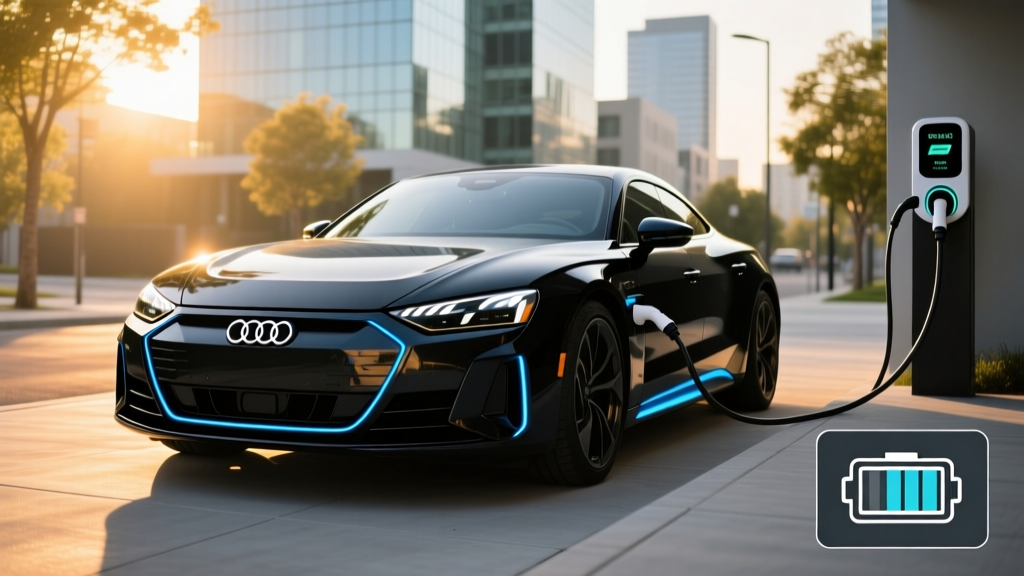
The 2025 Audi e-tron GT occupies a rare position in the EV market: a luxury grand tourer that pairs Porsche Taycan underpinnings with Audi's design language and a price that undercuts its Stuttgart cousin by thousands. But does the real-world experience match the spec sheet? After examining EPA data, charging behavior, and ownership economics, here's what buyers need to know before signing the paperwork.
Quick Verdict: Who the e-tron GT Is For
The 2025 Audi e-tron GT is a driver's luxury sedan first and an efficiency champion second. If your priorities skew toward 0-60 times, build quality, and 800-volt charging architecture over maximum cargo space or lowest cost-per-mile, this car delivers. If you need 300+ miles of range, family-friendly rear seats, or federal tax credit eligibility, look elsewhere.
- You want sub-4-second 0-60 performance in a luxury sedan
- You value 800V architecture and ultra-fast DC charging
- Most trips are under 200 miles with access to home Level 2 charging
- You need 300+ miles EPA range (Tesla Model S, Lucid Air)
- Rear-seat space and cargo volume are priorities (BMW i5, Mercedes EQS)
- Federal tax credit eligibility is a dealbreaker
Range and Efficiency: EPA vs. Real-World
| Metric | Value |
|---|---|
| EPA Range (e-tron GT quattro) | 238 miles |
| EPA Range (RS e-tron GT) | 232 miles |
| Battery Capacity (gross / usable) | 93.4 kWh / 85.0 kWh |
| Battery Chemistry | NMC (Nickel Manganese Cobalt) |
| MPGe (combined, GT quattro) | 82 MPGe |
| Efficiency | 41 kWh/100 mi |
The EPA 238-mile estimate assumes mixed driving. Expect 200-215 miles on highway-only trips at 70+ mph, where aerodynamic drag penalizes the GT's wide stance. In cold weather (below 32°F), range drops 15-25% depending on cabin heating use — figure 175-195 miles on a full charge in winter conditions. The heat pump (standard on 2025 models) mitigates this somewhat versus vehicles without one, but physics wins in deep cold.
The 85 kWh usable capacity (from a 93.4 kWh gross pack) reflects Audi's conservative buffer strategy — roughly 9% top and bottom buffer to protect long-term battery health. This is more conservative than Tesla's ~5% buffer but aligns with Porsche's approach, prioritizing longevity over maximum range.
Charging Speed: 800V Architecture Pays Off
The e-tron GT's 800-volt electrical architecture (shared with the Taycan) enables some of the fastest DC charging in the luxury segment, provided you find a capable charger.
| Charging Level | Power / Rate | Time / Range Added |
|---|---|---|
| Level 1 (120V household) | 1.4 kW | ~4 miles per hour |
| Level 2 (240V home, 48A) | 11.5 kW | ~33 miles per hour; full charge in ~8.5 hrs |
| DC Fast Charge (peak) | 270 kW | 10-80% in ~22 minutes (ideal conditions) |
| DC Fast Charge (50 kW station) | 50 kW | 10-80% in ~75 minutes |
Charging curve reality: The 270 kW peak is achievable only at 350 kW chargers (Electrify America, select Tesla Superchargers with NACS adapter) and only between roughly 10-40% state of charge. Above 50%, the curve tapers significantly — expect 150 kW around 60% SoC, dropping to 50-70 kW above 80%. This is why the 10-80% time is 22 minutes, not the ~12 minutes that sustained 270 kW would theoretically allow.
Preconditioning the battery via the MMI navigation system (entering a DC charger as your destination) warms the pack for optimal charge acceptance. Skip this step in cold weather and your peak charge rate may drop to 150-180 kW, adding 5-8 minutes to your stop.
For home charging, the 11.5 kW onboard charger is competitive. A 240V/48A Level 2 setup (requiring a 60A circuit) replenishes the pack overnight. Most owners will rarely need public charging for daily use.
Performance: Dual-Motor AWD, Serious Acceleration
| Trim | Horsepower | 0-60 mph | Drivetrain | Top Speed |
|---|---|---|---|---|
| e-tron GT quattro | 522 hp (with launch control) | 3.9 seconds | Dual-motor AWD | 152 mph |
| RS e-tron GT | 637 hp (with launch control) | 3.1 seconds | Dual-motor AWD | 155 mph |
Both trims use a two-speed rear transmission (first gear for launch acceleration, second for highway efficiency) — a rarity among EVs and a key reason the e-tron GT pulls hard from a stop while remaining efficient at cruise. The rear motor handles most driving duties; the front motor engages for AWD traction or hard acceleration.
Adaptive air suspension is standard, with a 3-chamber system that adjusts ride height and damping. The GT sits 0.6 inches lower in Efficiency mode versus Comfort, trading ground clearance for aerodynamic gain on highway runs.
Pricing, Trims, and Federal Tax Credit Eligibility
| Trim | Base MSRP (incl. destination) | Federal §30D Credit Eligible? | Effective Price After Credit |
|---|---|---|---|
| e-tron GT quattro Premium Plus | $106,395 | No | $106,395 |
| e-tron GT quattro Prestige | $113,195 | No | $113,195 |
| RS e-tron GT | $147,895 | No | $147,895 |
Tax credit reality: The 2025 e-tron GT does not qualify for the federal §30D clean vehicle credit (up to $7,500). Two factors disqualify it:
- MSRP cap: The §30D credit applies only to sedars with MSRP at or below $55,000. The e-tron GT starts at $106,395 — nearly double the cap.
- Battery sourcing: Even if the price qualified, the battery's critical minerals and component sourcing would need to meet phased-in thresholds that shift annually. Audi has not confirmed compliance for this model.
Buyer income caps ($150K single / $300K joint for new vehicles) also apply, though most e-tron GT buyers likely exceed these thresholds regardless.
Some states offer separate EV incentives (California's CVRP, for example, has its own income and MSRP rules). Check your state's energy office for current programs, but don't count on stacking credits at this price point.
Interior, Cargo, and Daily Livability
| Dimension | Measurement |
|---|---|
| Front legroom | 41.3 inches |
| Rear legroom | 32.1 inches |
| Cargo volume (trunk) | 9.2 cu ft |
| Frunk (front trunk) | 3.5 cu ft |
| Total cargo | 12.7 cu ft |
The e-tron GT is a grand tourer, not a family hauler. Rear legroom is tight — adults over 6 feet will find their knees pressing into the front seatbacks on longer trips. The 9.2 cu ft trunk is shallower than a BMW i5 (17.3 cu ft) or Tesla Model S (28 cu ft with rear seats folded), though the frunk adds useful space for charging cables or a small bag.
Build quality is exemplary. The Prestige trim's Valcona leather, open-pore wood inlays, and 16-speaker Bang & Olufsen system justify the price premium over the Premium Plus. The 10.1-inch MMI touchscreen runs Audi's latest MIB 3 software with wireless CarPlay/Android Auto, though the dual-touchscreen layout (upper for infotainment, lower for climate) still draws criticism for requiring eyes-off-road for temperature adjustments.
Driver Assistance and Safety Technology
The e-tron GT comes standard with Audi pre sense basic and pre sense city (forward collision warning with automatic emergency braking), lane departure warning, and a rearview camera. The Premium Plus trim adds adaptive cruise control with stop-and-go, lane centering (Audi adaptive cruise assist), and a 360-degree camera system.
Audi adaptive cruise assist provides lane centering and adaptive cruise, but you must keep your hands on the wheel and remain engaged at all times. There is no hands-free driving mode comparable to GM's Super Cruise or Ford's BlueCruise on mapped highways. If you want hands-off-wheel capability in a luxury EV sedan, the BMW i5 with Highway Assistant or the Mercedes EQS with Drive Pilot (where approved) offer more advanced systems — though still Level 2 or conditionally Level 3 in limited jurisdictions.
NHTSA has not published a full crash-test rating for the 2025 e-tron GT as of this writing. The platform (J1, shared with Taycan) has performed well in European NCAP testing for its Porsche sibling, but US-spec results are pending. The IIHS has not tested this model.
Battery Warranty and Long-Term Ownership
| Coverage | Term |
|---|---|
| New vehicle limited warranty | 4 years / 50,000 miles |
| Battery pack warranty | 8 years / 100,000 miles |
| Battery capacity retention threshold | 70% of original capacity |
| Powertrain (motors, reducers) | 8 years / 100,000 miles |
Audi's 70% capacity retention threshold is industry-standard (matching Tesla, BMW, and Mercedes). If your battery drops below 70% of its original 85 kWh usable capacity within 8 years/100K miles, Audi will repair or replace it to restore capacity above that threshold.
For long-term ownership beyond the warranty, NMC batteries in 800V architectures with active thermal management (like the J1 platform) have shown degradation curves of roughly 10-15% over the first 100,000 miles in fleet data from similar platforms, then a flattening curve. Plan for roughly 200-215 miles of real-world range at the 100K-mile mark, down from 238 new.
Pros and Cons: The Honest Assessment
- 270 kW DC charging is among the fastest in the luxury EV segment
- 800V architecture enables sustained high-power charging, not just peak
- Build quality and materials rival or exceed Porsche Taycan
- Adaptive air suspension balances ride comfort and handling
- Starting price ~$20K below comparable Taycan 4S
- 238-mile EPA range is below Tesla Model S (405 mi) and Lucid Air Pure (419 mi)
- No federal tax credit eligibility due to MSRP cap
- Rear seat legroom is cramped for adults (32.1 inches)
- Cargo volume (12.7 cu ft total) is tight for a $100K+ sedan
- No hands-free driving mode; adaptive cruise still requires hands on wheel
Competitor Comparison: Where the e-tron GT Stands
| Vehicle | EPA Range | 0-60 mph | DC Charge Peak | Starting MSRP | Federal Credit? |
|---|---|---|---|---|---|
| 2025 Audi e-tron GT quattro | 238 mi | 3.9s | 270 kW | $106,395 | No |
| 2025 Porsche Taycan 4S | 246 mi | 3.8s | 270 kW | $118,050 | No |
| 2025 Tesla Model S Long Range | 405 mi | 3.1s | 250 kW | $79,990 | No (MSRP cap) |
| 2025 Lucid Air Pure | 419 mi | 3.8s | 200 kW | $69,900 | Partial (depends on trim/sourcing) |
| 2025 BMW i5 M60 | 256 mi | 3.7s | 205 kW | $84,300 | No (MSRP cap) |
The e-tron GT trades range for charging speed and build quality. If you prioritize maximum miles per charge, the Tesla Model S or Lucid Air win decisively. If you want the fastest road-trip charging and don't mind stopping every 180-200 miles, the e-tron GT (and its Taycan twin) lead the pack. The BMW i5 offers more interior space and a lower price but slower DC charging.
Ownership Costs: 5-Year Estimate
| Cost Category | 5-Year Estimate (e-tron GT quattro) | Notes |
|---|---|---|
| Purchase price | $106,395 | Before any state incentives |
| Electricity (home charging) | $3,200 | 12,000 mi/yr, $0.14/kWh avg |
| Public DC charging (road trips) | $1,800 | ~20% of miles on DC, $0.40/kWh avg |
| Insurance | $18,000-$24,000 | $3,600-$4,800/yr; varies by state/driver |
| Maintenance | $2,500 | Cabin air filter, brake fluid, tire rotation |
| Depreciation (est.) | $42,000-$48,000 | ~40-45% over 5 years (luxury EV avg) |
Total 5-year operating cost (electricity, maintenance, insurance): roughly $25,000-$31,000, or $5,000-$6,200 per year. This is significantly less than a comparable gasoline Audi S7 (~$12,000/yr in fuel and maintenance alone at 18 MPG combined and $4.00/gal), but the e-tron GT's higher insurance premiums and depreciation offset some of those savings.
Frequently Asked Questions
What is the real-world range of the 2025 Audi e-tron GT?
Expect 200-215 miles on highway trips at 70+ mph, and 175-195 miles in cold weather (below 32°F). The EPA 238-mile estimate reflects mixed driving in moderate temperatures.
How fast does the e-tron GT charge at home and on the road?
At home on a 240V/48A Level 2 charger, it adds ~33 miles per hour and fully charges in about 8.5 hours. On a 350 kW DC fast charger, it peaks at 270 kW and charges from 10-80% in roughly 22 minutes under ideal conditions (preconditioned battery, moderate temperatures).
Does the 2025 Audi e-tron GT qualify for the $7,500 federal tax credit?
No. The §30D credit has a $55,000 MSRP cap for sedans, and the e-tron GT starts at $106,395. Buyer income limits and battery sourcing requirements also apply, but the price alone disqualifies it. Check IRS guidelines for current rules.
Is the Audi e-tron GT worth buying over the Porsche Taycan?
They share the same J1 platform, battery, and 800V architecture. The e-tron GT starts ~$12,000 lower than the Taycan 4S and has a slightly more comfortable ride tune. The Taycan offers more powertrain variants (including a RWD base model) and marginally better EPA range. If price matters, the Audi wins. If you want the full Porsche configurator and badge cachet, the Taycan.
Can I use Tesla Superchargers with the e-tron GT?
Audi has announced NACS (Tesla connector) compatibility for future models, but the 2025 e-tron GT uses CCS1. You'll need a CCS-to-NACS adapter (available from Audi or third-party suppliers) to access Tesla Superchargers. Confirm adapter compatibility and warranty implications with your dealer before purchasing.
How much cargo space does the e-tron GT have?
9.2 cubic feet in the rear trunk and 3.5 cubic feet in the frunk, for a total of 12.7 cu ft. This is tight for a luxury sedan — a BMW i5 offers 17.3 cu ft, and the Tesla Model S provides 28 cu ft with seats folded.
What's the battery warranty coverage?
Audi covers the high-voltage battery for 8 years or 100,000 miles, whichever comes first, against capacity loss below 70% of original. The powertrain (motors, power electronics) carries the same 8-year/100K-mile coverage.
Final Assessment: A Driver's EV with Trade-Offs
The 2025 Audi e-tron GT is a compelling luxury performance sedan for buyers who prioritize charging speed, build quality, and driving dynamics over maximum range and cargo space. Its 270 kW DC charging capability makes it one of the fastest-charging EVs on the road, and the 800V architecture ensures that capability is usable, not just a marketing number.
The trade-offs are real: 238 miles of EPA range means planning stops on 300+ mile trips, the rear seats are best suited for children or short adults, and the six-figure price eliminates any federal tax credit benefit. If those limitations align with your use case — daily commuting under 100 miles, weekend trips under 200 miles, home Level 2 charging, and a priority on driving engagement — the e-tron GT delivers an experience that justifies its cost.
For everyone else, the Tesla Model S (range), Lucid Air (range and value), or BMW i5 (space and price) may serve you better. Test-drive all three before deciding — the e-tron GT's appeal is visceral, and no spec sheet captures the way it drives.