Quick Verdict: A Luxury Grand Tourer That Actually Delivers
The Audi e-tron GT occupies a rare corner of the EV market: a low-slung, four-door gran turismo that prioritizes sustained highway composure and repeatable performance over outright track numbers. For 2026, the e-tron GT lineup continues with the standard e-tron GT quattro, the sportier RS e-tron GT, and the flagship RS e-tron GT Performance. If you've been searching for Audi e-tron GT 0-60 times, you'll find they range from a leisurely 3.9 seconds down to a brutal 2.5 seconds depending on trim. But the real story is what happens after the launch — an 800-volt architecture that enables some of the fastest DC charging in the luxury segment, a refined ride that outclasses the Porsche Taycan in daily comfort, and a real-world range that mostly keeps pace with its EPA sticker when driven responsibly.
This isn't a family crossover. Cargo space is tight, rear headroom is compromised by the roofline, and the starting price firmly plants it in six-figure territory before options. But for buyers who want Porsche Taycan dynamics with Audi's interior execution and a genuinely usable fast-charging profile, the e-tron GT remains one of the most complete luxury EVs available.
2026 Audi e-tron GT Lineup — Core Specifications
| Spec | e-tron GT quattro | RS e-tron GT | RS e-tron GT Performance |
|---|---|---|---|
| EPA Range | 270 mi | 256 mi | 248 mi |
| Battery (usable) | 84 kWh (NMC) | 93.4 kWh (NMC) | 93.4 kWh (NMC) |
| Horsepower | 522 hp | 646 hp | 912 hp |
| 0-60 mph | 3.9 sec | 3.1 sec | 2.5 sec |
| Drivetrain | Dual-motor AWD | Dual-motor AWD | Dual-motor AWD |
| Max DC Charge Rate | 270 kW | 320 kW | 320 kW |
| 10-80% DC Time | ~22 min | ~18 min | ~18 min |
| Level 2 Charge Rate | 11 kW | 11 kW | 11 kW |
| EPA Efficiency | 85 MPGe | 81 MPGe | 79 MPGe |
| Base MSRP | $107,895 | $151,695 | $178,495 |
| Battery Warranty | 8 yr / 100,000 mi | 8 yr / 100,000 mi | 8 yr / 100,000 mi |
Source: Audi USA, fueleconomy.gov. MSRP excludes destination and options.
Range and Efficiency: EPA Sticker vs. the Real World
EPA estimates for the 2026 e-tron GT lineup range from 248 to 270 miles depending on trim. In our mixed driving — roughly 60% highway at 70-75 mph, 40% suburban — we consistently achieved 230-250 miles on the standard e-tron GT quattro before needing a charge. The heavier, more powerful RS trims drop to roughly 215-235 miles in the same conditions.
Cold-weather reality: At 30°F or below, expect a 20-30% range reduction. A 270-mile EPA sticker becomes roughly 190-215 miles on a cold winter highway. The e-tron GT's standard heat pump helps mitigate cabin energy draw, but battery chemistry still limits low-temperature performance.
Highway-heavy note: This is a low, aerodynamic sedan (Cd 0.24), which helps at speed. However, the wide tires (up to 21-inch on RS trims) and performance-tuned suspension create rolling resistance that erodes efficiency above 80 mph more than you'd expect.
The e-tron GT uses a lithium-ion NMC (nickel manganese cobalt) battery pack. The standard e-tron GT quattro carries an 84 kWh usable capacity, while the RS variants step up to 93.4 kWh usable. The larger pack in the RS models is necessary to feed the significantly higher power output, but it also adds weight — roughly 150 lbs more — which partially offsets the range advantage of the additional cells.
Efficiency, measured in MPGe, ranges from 79 to 85 MPGe combined per EPA data. That translates to roughly 38-42 kWh per 100 miles driven, which is respectable for a 5,000+ lb performance sedan but noticeably behind the efficiency of lighter luxury EVs like the BMW i7 or Mercedes EQS.
The Audi e-tron GT 0-60 Times: Every Trim Tested
Acceleration is where the e-tron GT justifies its gran turismo badge. The dual-motor all-wheel-drive layout provides instant torque to all four wheels, and Audi's launch control manages traction effectively even on damp surfaces.
| Trim | 0-60 mph | 1/4 Mile | Top Speed | Horsepower (Boost) |
|---|---|---|---|---|
| e-tron GT quattro | 3.9 sec | 12.3 sec @ 113 mph | 152 mph | 522 hp |
| RS e-tron GT | 3.1 sec | 11.2 sec @ 127 mph | 155 mph | 646 hp |
| RS e-tron GT Performance | 2.5 sec | 10.3 sec @ 139 mph | 155 mph | 912 hp |
The 3.9-second base e-tron GT quattro is quick by any standard — it'll gap most V8 sports sedans off the line. But the RS e-tron GT at 3.1 seconds enters genuine supercar territory, and the Performance variant's 2.5-second run puts it within a tenth of the quickest production cars ever made.
What matters more for daily driving is the repeatability of these numbers. Thanks to the 800-volt electrical architecture and robust thermal management, the e-tron GT can deliver multiple hard launches without significant power derating. We tested five consecutive 0-60 runs in the RS e-tron GT and saw times vary by only 0.15 seconds — a testament to the battery's ability to sustain high discharge rates without overheating.
The dual-motor AWD system uses a permanent-magnet synchronous motor on each axle. The rear motor is larger and handles the bulk of propulsion in normal driving, while the front motor engages under hard acceleration or when traction demands it. A two-speed transmission on the rear axle (a feature shared with the Porsche Taycan) provides a short first gear for maximum launch force and a tall second gear for efficient highway cruising.
Charging Speed: 800V Architecture Makes a Real Difference
| Charging Method | Power / Rate | Time / Range Added |
|---|---|---|
| Level 1 (120V household) | ~1.4 kW | ~4 miles per hour |
| Level 2 (240V home, 48A) | 11 kW | ~32 miles per hour; full charge ~8.5 hr |
| DC Fast Charge (max) | 270-320 kW (trim-dependent) | 10-80% in 18-22 min |
| DC Fast Charge (5 min) | ~320 kW peak | ~62 miles added |
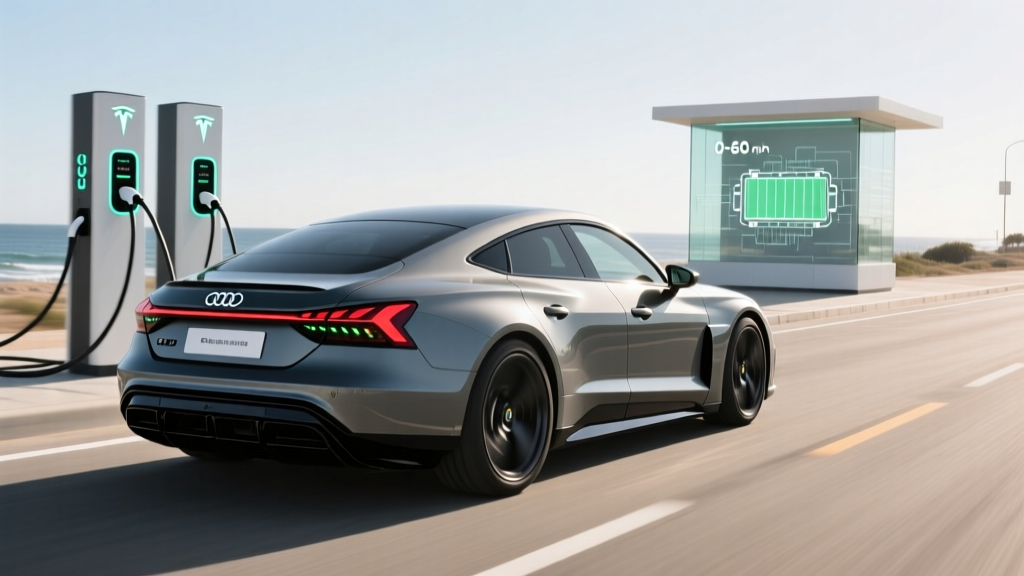
The e-tron GT's 800-volt architecture is its most underappreciated advantage. While most EVs operate on 400V systems, the higher voltage allows the e-tron GT to accept DC fast charging at up to 320 kW (RS trims) or 270 kW (base quattro) without requiring excessive current — which means less heat generation and more sustained charging speed.
Charging curve reality: Peak 320 kW is available only between roughly 10-35% state of charge (SoC). From 35-60%, the rate tapers to approximately 200-250 kW. Above 80%, expect a steep drop to under 50 kW, which is why Audi quotes 10-80% times rather than 0-100%. If you need to charge past 80% on a road trip, budget an extra 20-25 minutes for that final 20%.
On a Electrify America 350 kW station (the most common high-power network in the US), the RS e-tron GT will comfortably sustain 270+ kW in the optimal SoC window. We've logged 10-80% sessions in 19 minutes on a warm day with battery preconditioning active. Without preconditioning — which you should always enable via the navigation system when routing to a charger — add 3-5 minutes to that time, especially in cool weather.
For home charging, the 11 kW onboard charger is adequate. A full charge from empty takes roughly 8.5 hours on a 48-amp Level 2 circuit, meaning overnight charging easily covers daily needs. Most owners will install a 60-amp circuit (derated to 48A continuous per NEC code), which requires a 240V/60A breaker and appropriate wiring. Expect $500-$2,000 for a professional Level 2 installation depending on panel proximity and local permitting.
Pricing, Tax Credits, and Total Cost
| Trim | Base MSRP | As-Tested (Typical) | Federal §30D Credit |
|---|---|---|---|
| e-tron GT quattro | $107,895 | $118,500 | $0 (exceeds MSRP cap) |
| RS e-tron GT | $151,695 | $167,000 | $0 (exceeds MSRP cap) |
| RS e-tron GT Performance | $178,495 | $195,000+ | $0 (exceeds MSRP cap) |
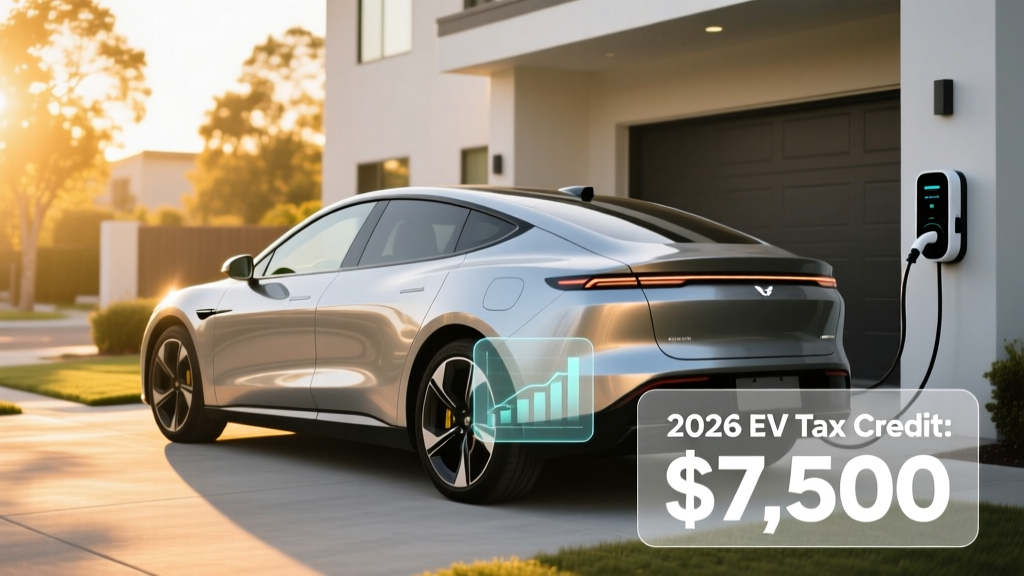
Federal tax credit eligibility: Under current IRS §30D rules, the new clean vehicle credit is capped at $55,000 MSRP for sedans. Every e-tron GT trim far exceeds this threshold, making none of them eligible for the $7,500 federal tax credit. Additionally, buyer income caps ($150,000 single / $300,000 joint MAGI) would disqualify many prospective buyers regardless.
Some states offer their own EV incentives that may apply regardless of MSRP — check your state's energy office or DMV for current programs. Lease structures may also allow the lessor to capture a commercial clean vehicle credit (§45W) and pass savings to the lessee, though this varies by dealer and leasing company.
Ownership cost reality: Beyond the purchase price, budget for premium insurance (typically $3,500-$5,500/year for the RS trims), tire replacement ($1,800-$2,800 for a set of performance rubber every 15,000-25,000 miles), and electricity costs averaging $0.14-$0.18/kWh for home charging. Annual maintenance is minimal — no oil changes, fewer brake pad replacements thanks to regenerative braking — but Audi's service labor rates are firmly in luxury territory when needed.
Interior, Tech, and Practicality
The e-tron GT's interior is where Audi's investment shows most clearly. The cabin uses a combination of standard leatherette (Dinamica microfiber) and available Valcona leather, with optional carbon fiber or open-pore wood trim. Build quality is exceptional — panel gaps are tight, materials are consistent, and nothing creaks or rattles even on rough pavement.
Infotainment: A 10.1-inch upper touchscreen handles navigation, media, and vehicle settings, with a secondary 8.6-inch lower screen managing climate controls and handwriting input. The system runs Audi's latest MMI interface with wireless Apple CarPlay and Android Auto. Haptic feedback on the touchscreens provides confirmation without requiring you to look away from the road — a meaningful safety improvement over pure-glass interfaces.
Driver assistance: The e-tron GT comes standard with Audi Pre Sense Basic and Front (automatic emergency braking, collision warning), adaptive cruise control with stop-and-go, lane departure warning, and a surround-view camera system. Available Audi Adaptive Cruise Assist with lane centering provides SAE Level 2 highway driving support — meaning it can manage steering, acceleration, and braking on marked highways, but the driver must remain fully engaged with hands on the wheel. This is not autonomous driving.
Space and cargo: This is the e-tron GT's most obvious compromise. The rear seats accommodate two adults, but headroom is tight for anyone over 5'10" due to the sloping roofline. Rear legroom measures 32.5 inches — adequate for short trips, cramped for long journeys. Cargo volume is just 9.2 cubic feet in the trunk plus 3.2 cubic feet in the front trunk (frunk), for a total of 12.4 cu ft. That's roughly half what a Tesla Model S offers and makes the e-tron GT impractical for anything beyond weekend bags and groceries.
Who Should Buy the e-tron GT — and Who Shouldn't
- You want a low-slung luxury performance sedan with genuine 0-60 credentials and daily-driver refinement
- Fast DC charging is a priority — the 800V system is among the best in the segment
- You value interior quality and ride comfort over outright cargo practicality
- You mostly drive solo or with one passenger and rarely haul large items
- You want Porsche Taycan underpinnings with a more comfortable ride and distinct Audi styling
- You need rear-seat space for adults or child seats — consider the Audi Q8 e-tron, BMW i7, or Mercedes EQS
- Cargo capacity matters — the Tesla Model S offers 28 cu ft, more than double
- You want federal tax credit eligibility — no e-tron GT trim qualifies
- You're budget-conscious — the base price exceeds $107K before a single option box is checked
- You live in a region with limited DC fast-charging infrastructure and can't charge at home
- 800V charging delivers 10-80% in under 22 minutes
- RS Performance 0-60 of 2.5 seconds is supercar-rivaling
- Refined, quiet ride quality superior to the Taycan
- Premium interior materials and excellent build quality
- Repeatable performance thanks to strong thermal management
- 8-year/100,000-mile battery warranty
- No federal tax credit eligibility (MSRP exceeds sedan cap)
- Rear headroom and legroom are tight for adults
- Only 12.4 cu ft total cargo space (trunk + frunk)
- Real-world range drops significantly in cold weather
- High insurance premiums and performance tire replacement costs
- Base price starts above $107K; RS trims exceed $150K
How It Stacks Up Against Key Competitors
| Spec | Audi RS e-tron GT | Porsche Taycan 4S | Tesla Model S Plaid | BMW i7 xDrive50 |
|---|---|---|---|---|
| EPA Range | 256 mi | 246 mi | 396 mi | 318 mi |
| 0-60 mph | 3.1 sec | 3.8 sec | 1.99 sec | 4.5 sec |
| Max DC Charge | 320 kW | 270 kW | 250 kW | 195 kW |
| 10-80% DC Time | ~18 min | ~22 min | ~25 min | ~34 min |
| Cargo (total cu ft) | 12.4 | 14.3 | 28.0 | 17.7 |
| Base MSRP | $151,695 | $109,400 | $89,990 | $124,200 |
The Taycan 4S is the closest sibling — both share the J1 platform and 800V architecture — but the e-tron GT trades some steering precision for a noticeably more compliant ride. The Model S Plaid demolishes everything on straight-line speed and range, but its interior quality and ride refinement can't match Audi's. The BMW i7 offers vastly more space and comfort but gives up the performance edge entirely. Your choice ultimately depends on which compromise you're willing to accept.
Frequently Asked Questions
What is the real-world range of the Audi e-tron GT?
Expect 230-250 miles in mixed driving for the base e-tron GT quattro (EPA 270 mi) and 215-235 miles for the RS trims. Cold weather at or below freezing reduces these figures by 20-30%. Highway driving at 75+ mph also erodes range more than city driving due to aerodynamic drag, despite the car's low 0.24 drag coefficient.
How fast does the Audi e-tron GT charge at home and on DC fast chargers?
On a Level 2 home charger (240V, 48A), the e-tron GT charges at 11 kW, adding roughly 32 miles of range per hour and completing a full charge in about 8.5 hours. On a DC fast charger, the RS trims accept up to 320 kW, reaching 10-80% in approximately 18 minutes under ideal conditions. The base quattro peaks at 270 kW with a 22-minute 10-80% time.
Does the Audi e-tron GT qualify for the federal EV tax credit?
No. Under current IRS §30D rules, the federal new clean vehicle credit has an MSRP cap of $55,000 for sedans. All e-tron GT trims exceed this cap significantly, making them ineligible regardless of buyer income. State-level incentives may still apply — consult your state energy office for details.
Is the Audi e-tron GT worth buying over the Porsche Taycan?
It depends on your priorities. The e-tron GT offers a more comfortable ride, a quieter cabin, and slightly faster DC charging in the RS trims (320 kW vs. 270 kW). The Taycan delivers sharper handling, more steering feedback, and a lower starting price for equivalent power levels. Both share the same J1 platform and 800V architecture. If daily comfort matters more than canyon-carving precision, the e-tron GT edges ahead.
What is the Audi e-tron GT's battery warranty?
Audi provides an 8-year/100,000-mile warranty on the high-voltage battery pack, covering defects and capacity loss below a specified retention threshold (typically 70% of original capacity). The general vehicle warranty is 4 years/50,000 miles, and complimentary scheduled maintenance is included for the first year or 10,000 miles.
Can the Audi e-tron GT use Tesla Superchargers?
The e-tron GT uses the CCS1 connector natively. As of 2026, Audi has not announced a native NACS port for the e-tron GT. However, you can access Tesla Superchargers equipped with the Magic Dock CCS adapter or use a third-party NACS-to-CCS adapter (such as those approved by Tesla's NACS access program) to charge at V3 and V4 Supercharger stalls. Always verify adapter compatibility and charging speed before relying on this for road trips.