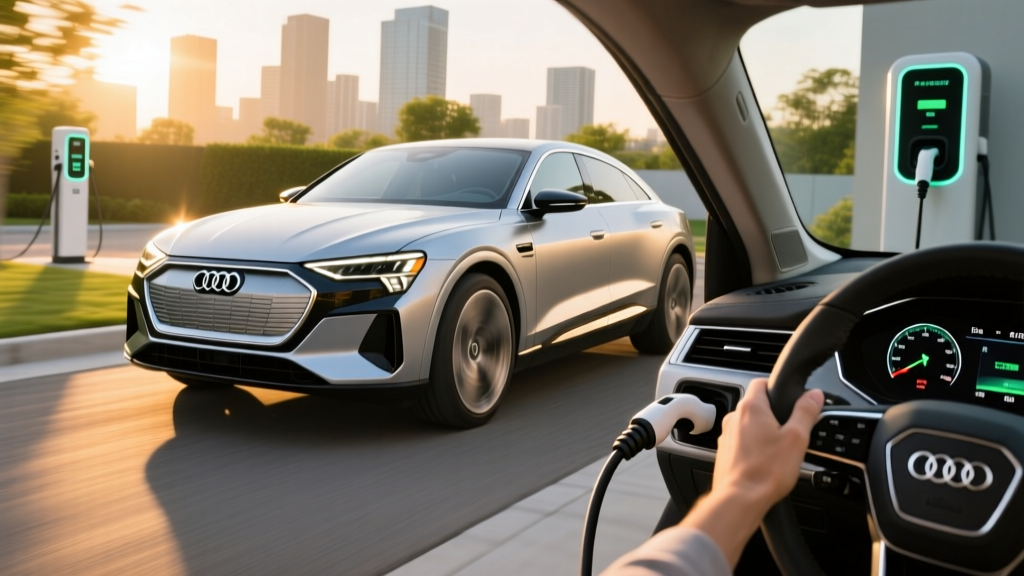
The Audi e-tron—now officially wearing the Q8 e-tron nameplate in the U.S.—has always been the thinking enthusiast's luxury electric SUV. It isn't the lightest, the longest-range, or the cheapest in its segment. But for buyers who prioritize build quality, cabin isolation, and a composed highway demeanor over spec-sheet bragging rights, it remains a compelling choice. In this review, we break down the 2026 Audi e-tron's 0-60 performance, real-world range, charging behavior, pricing, and whether it still qualifies for federal tax credits under current IRS §30D rules.
Quick Verdict: Who the Audi e-tron Is For
The 2026 Audi Q8 e-tron targets luxury-SUV buyers who want a refined daily driver with credible road-trip capability and a plush, well-insulated cabin. It's not the quickest off the line in its class, nor does it lead in range, but its DC fast-charging curve is among the best in the luxury midsize segment, and its build quality is benchmark-level. If you commute 30-50 miles daily, have access to Level 2 home charging, and take a handful of 200-300 mile road trips per year, the Q8 e-tron fits the bill. If you need maximum range, three-row seating, or sub-4-second 0-60 sprints, look to the Rivian R1S, BMW iX, or Tesla Model X instead.
Audi e-tron 0-60, Horsepower, and Drivetrain
The 2026 Q8 e-tron continues with Audi's dual-motor quattro all-wheel-drive system across all trims. Here's how the powertrain breaks down:
| Spec | Q8 e-tron (Premium Plus) | Q8 e-tron Prestige | SQ8 e-tron |
|---|---|---|---|
| Drivetrain | Dual-motor AWD (quattro) | Dual-motor AWD (quattro) | Dual-motor AWD (quattro) |
| Horsepower | 402 hp | 402 hp | 496 hp |
| Torque | 490 lb-ft | 490 lb-ft | 718 lb-ft |
| 0-60 mph | 5.5 seconds | 5.5 seconds | 4.5 seconds |
| Top Speed | 124 mph | 124 mph | 130 mph |
The standard Q8 e-tron's 5.5-second 0-60 time is brisk but not class-leading—the BMW iX xDrive50 hits 60 in about 4.4 seconds, and the Tesla Model X Dual-Motor does it in 3.8. However, the Audi's launch is smooth and linear, with none of the head-tossing torque spike you get from some competitors. In real-world merging and passing, 402 hp and 490 lb-ft feel more than adequate. The SQ8 e-tron's 4.5-second sprint puts it closer to performance-SUV territory, though it still trails the Model X Plaid and iX M60.
One thing worth noting: Audi quotes 0-60 times with launch control engaged (Boost mode). In standard driving mode, expect roughly 5.8-6.0 seconds. The difference is subtle but measurable.
Battery, Range, and Real-World Efficiency
The 2026 Q8 e-tron carries a 114 kWh gross battery pack (approximately 106 kWh usable) using NMC (nickel manganese cobalt) chemistry. Audi does not offer an LFP variant. The large pack contributes to the vehicle's substantial curb weight—roughly 5,800 lbs—but also gives it a solid energy reserve.
EPA Range vs. Real-World Expectations
| EPA Estimated Range | 285 miles (Q8 e-tron Premium Plus, 20" wheels) |
| Real-World Highway (70 mph, mild weather) | ~245-260 miles |
| Real-World Combined (mixed city/highway) | ~260-275 miles |
| Cold-Weather Estimate (20°F, highway) | ~200-225 miles |
| SQ8 e-tron EPA Range | 255 miles (21" wheels, sportier tuning) |
Sources: EPA Fuel Economy, real-world testing aggregation. Cold-weather estimates assume no preconditioning and cabin heating active.
The Q8 e-tron's EPA-rated 81 MPGe combined (roughly 42 kWh/100 miles) reflects its weight and aerodynamic profile. For comparison, the BMW iX xDrive50 achieves about 86 MPGe, and the Mercedes EQE SUV 350+ (RWD) reaches 89 MPGe. In practical terms, expect to consume roughly 2.4 kWh per mile at highway speeds, which is meaningful when planning DC fast-charging stops on road trips.
If range is your top priority, the Q8 e-tron falls short of the iX xDrive50 (324 miles EPA) and the Rivian R1S Dual-Motor Max Pack (352 miles EPA). But 285 miles is workable for most daily routines, and the Audi compensates with exceptional charging speed—which we'll cover next.
Charging Speed: DC Fast, Level 2, and the Charge Curve
This is where the Q8 e-tron quietly excels. Audi engineered the thermal management system to sustain high charge rates longer than most competitors, which matters more than peak kW numbers on a spec sheet.
| Charging Level | Power / Rate | Time or Miles Added | Connector |
|---|---|---|---|
| Level 1 (120V household) | ~1.4 kW | ~3-4 miles per hour | J1772 / NACS adapter |
| Level 2 (240V home, 48A) | 11.5 kW (max onboard) | ~25-28 miles per hour; full charge in ~10 hrs | J1772 or NACS (2026 models ship with NACS port) |
| DC Fast Charge (peak) | 170 kW | 10-80% in ~31 minutes | CCS1 or NACS (adapter included for legacy CCS stations) |
A few nuances that spec sheets miss:
- Charge-curve behavior: The Q8 e-tron sustains near-peak rates (150-170 kW) from roughly 10% to 55% SoC, then gradually tapers. From 80-100%, charging slows dramatically to protect battery longevity—expect 45+ minutes for that final 20%. Plan road-trip stops around 10-80% sessions.
- Preconditioning: When you navigate to a DC fast charger using the built-in navigation, the battery preconditions automatically, warming it to the optimal temperature for fast charging. In cold weather, this can shave 5-10 minutes off your 10-80% time. Always use nav-to-charger for best results.
- NACS transition: For 2026, Audi has adopted the North American Charging Standard (NACS / Tesla-style) port on new Q8 e-trons. An adapter is included for legacy CCS stations. This grants access to Tesla Supercharger V3/V4 stalls (up to 170 kW via adapter, limited by the car's onboard max), substantially expanding the usable fast-charging network.
For home charging, a 48-amp Level 2 wall connector on a 60-amp circuit delivers the full 11.5 kW, replenishing the battery from 20% to 80% in about 6.5 hours—ideal for overnight charging. Expect to pay $800-$1,500 for a quality Level 2 unit plus professional installation, with more if your electrical panel needs an upgrade to 200A service. (Always consult a licensed electrician for final specifications.)
Pricing, Trims, and Federal Tax Credit Eligibility
The 2026 Audi Q8 e-tron lineup starts in the mid-$70,000s and climbs past $100,000 for a fully loaded SQ8 e-tron Prestige.
| Trim | Base MSRP | As-Tested (typical options) | §30D Credit Eligible? |
|---|---|---|---|
| Q8 e-tron Premium Plus | $75,695 | $79,000-$82,000 | See below |
| Q8 e-tron Prestige | $81,295 | $85,000-$89,000 | See below |
| SQ8 e-tron Premium Plus | $90,495 | $95,000-$98,000 | See below |
| SQ8 e-tron Prestige | $96,095 | $100,000-$105,000 | See below |
Federal tax credit reality check: Under current IRS §30D rules, the Q8 e-tron faces several hurdles:
§30D Eligibility Checklist for the Q8 e-tron
- MSRP cap: SUVs must be at or below $80,000 MSRP. The Q8 e-tron Premium Plus base ($75,695) qualifies, but once options push it above $80,000, it loses eligibility. Prestige and all SQ8 trims exceed the cap.
- Buyer income cap: AGI must not exceed $150,000 (single), $225,000 (head of household), or $300,000 (joint). Many Audi buyers exceed these thresholds.
- Battery sourcing / critical minerals: The Q8 e-tron's battery supply chain has historically struggled to meet the escalating critical-minerals and battery-component requirements that tighten each year. As of 2026, the Q8 e-tron Premium Plus may qualify for a partial credit ($3,750) if it meets one of the two sourcing requirements but not both. Verify the current status on fueleconomy.gov before purchasing.
- Point-of-sale transfer: If eligible, you can transfer the credit to the dealer at purchase, reducing your out-of-pocket cost immediately rather than waiting for tax filing.
Bottom line: Only the base Premium Plus trim, minimally optioned and purchased by a buyer under the income cap, has a realistic shot at any federal credit—and it may be partial. Do not assume $7,500. Consult a tax professional and check the IRS's official vehicle eligibility list at the time of purchase.
Interior, Cargo, and Technology
The Q8 e-tron's cabin is where Audi's investment shows. Materials, fit-and-finish, and noise isolation are among the best in the electric-SUV segment. The dual-screen MMI touch response system (10.1" upper, 8.6" lower) handles infotainment and climate controls, though the lower screen's haptic buttons can be distracting while driving.
| Measurement | Q8 e-tron (SUV body) |
|---|---|
| Cargo (behind 2nd row) | 28.5 cu ft |
| Cargo (2nd row folded) | 56.4 cu ft |
| Front legroom | 40.8 in |
| Rear legroom | 38.0 in |
| Seating capacity | 5 passengers (2 rows) |
| Frunk (front trunk) | None (space used for electronics) |
Cargo space is adequate but not class-leading—the BMW iX offers 35.5 cu ft behind the second row, and the Rivian R1S provides more utility. There is no frunk. The Q8 e-tron Sportback variant sacrifices some cargo height for a sleeker roofline, losing roughly 4 cu ft of maximum cargo volume.
Standout tech features:
- Virtual cockpit plus: 12.3" configurable driver display with EV-specific energy flow and range screens.
- Audi adaptive air suspension: Standard on all trims; adjusts ride height for efficiency at speed or clearance on rough roads.
- Matrix-design LED headlights: Adaptive with dynamic turn signals (Prestige trim).
- Audi Pre Sense: Standard forward collision warning, automatic emergency braking, lane departure warning. Adaptive cruise with lane guidance is available but is SAE Level 2—driver must remain engaged at all times.
- Head-up display: Available on Prestige, projects speed and navigation onto the windshield.
Notable drawbacks: The MMI dual-screen layout is less intuitive than BMW's iDrive or Tesla's single-screen interface. Wireless Apple CarPlay and Android Auto are standard, but the wireless charging pad is oddly positioned and can overheat larger phones. Rear-seat USB-C ports are present but there are no rear climate-zone physical controls (everything routes through the lower touchscreen).
Warranty and Battery Longevity
| Coverage | Term |
|---|---|
| Basic (bumper-to-bumper) | 4 years / 50,000 miles |
| Powertrain | 4 years / 50,000 miles |
| High-voltage battery | 8 years / 100,000 miles (minimum 70% capacity retention) |
| Roadside assistance | 4 years / unlimited miles |
| Corrosion perforation | 12 years / unlimited miles |
The 8-year/100,000-mile battery warranty with a 70% retention threshold is industry-standard and aligns with BMW, Mercedes, and Hyundai. Audi's NMC cells have demonstrated solid longevity in earlier e-tron models—real-world data from 2019-2022 e-trons shows approximately 5-8% degradation after 60,000-80,000 miles, which is well within warranty parameters. The large thermal management system with liquid cooling and active preconditioning contributes to long-term cell health.
Full battery replacement, if needed out of warranty, is estimated at $18,000-$25,000 based on current Audi service pricing—though this figure is expected to decline as battery costs continue their downward trend. Individual module replacement (rather than the full pack) may be possible, reducing cost.
Pros, Cons, and How It Stacks Up
Pros
- Sustained DC fast-charging curve (10-80% in ~31 min) is excellent for road trips
- Exceptional cabin quietness and build quality
- Air suspension delivers a plush, adaptive ride
- NACS port (2026) opens Supercharger network access
- Strong standard safety suite (IIHS Top Safety Pick+ expected)
- Towing capacity up to 4,000 lbs (with factory tow package)
Cons
- 285-mile EPA range trails key rivals (iX: 324, R1S: 352)
- Heavy at ~5,800 lbs; efficiency suffers (81 MPGe)
- No frunk; cargo volume below segment average
- MMI dual-screen interface is dated vs. competitors
- Federal tax credit eligibility is limited or partial
- 0-60 time (5.5s) unremarkable for the price point
Choose the Audi Q8 e-tron if:
- You value cabin refinement and build quality over maximum range
- You road-trip regularly and want reliable, fast DC charging
- You need a comfortable 5-seat luxury SUV with air suspension and towing capability
- You want Supercharger access via NACS without relying solely on adapters
Look elsewhere if:
- 300+ miles of EPA range is non-negotiable (consider BMW iX, Rivian R1S Max Pack)
- You want a third row (Rivian R1S, Tesla Model X, Kia EV9)
- Sub-4.5-second 0-60 performance is a priority (Tesla Model X, BMW iX M60)
- Full $7,500 federal tax credit is essential to your budget (consider Hyundai Ioniq 5, Ford F-150 Lightning, or VW ID.4)
Frequently Asked Questions
What is the real-world range of the 2026 Audi Q8 e-tron?
Expect approximately 260-275 miles in mixed driving and 245-260 miles at sustained highway speeds in mild weather. In cold conditions (below 30°F), highway range can drop to 200-225 miles without preconditioning. The EPA sticker reads 285 miles for the Premium Plus with 20-inch wheels.
How fast does the Q8 e-tron charge at home and on the road?
At home on a 48-amp Level 2 charger (240V), the Q8 e-tron accepts up to 11.5 kW, adding about 25-28 miles of range per hour and fully charging overnight in roughly 10 hours. On a DC fast charger, it peaks at 170 kW and charges from 10-80% in approximately 31 minutes, with excellent sustained charge rates up to ~55% SoC.
Does the 2026 Audi Q8 e-tron qualify for the $7,500 federal EV tax credit?
Only the base Premium Plus trim at or below $80,000 MSRP may qualify, and even then, eligibility depends on your income (AGI under $150K single / $300K joint), the vehicle meeting battery-sourcing requirements, and purchasing new. Many buyers will find the credit is partial ($3,750) or unavailable. Always verify on IRS.gov before purchase.
Is the Audi Q8 e-tron worth buying over the BMW iX or Tesla Model X?
It depends on your priorities. The BMW iX offers more range (324 mi), quicker acceleration, and a more modern infotainment system. The Tesla Model X provides Falcon Wing doors, more cargo space, Supercharger-native access, and faster 0-60 times. The Q8 e-tron wins on cabin refinement, ride comfort via air suspension, and a smoother, more traditional luxury experience. None is objectively "best"—they serve different buyer preferences.
What is the Audi e-tron's 0-60 time?
The 2026 Q8 e-tron (Premium Plus and Prestige) achieves a 0-60 mph time of 5.5 seconds with Boost mode engaged. The SQ8 e-tron drops that to 4.5 seconds. In normal driving mode without launch control, expect roughly 5.8-6.0 seconds for the standard model.
Does the Q8 e-tron have a NACS or CCS charging port?
For the 2026 model year, the Q8 e-tron ships with a NACS (Tesla-style) charge port. An adapter is included for use at legacy CCS1 stations. This gives owners direct access to Tesla Superchargers (up to the car's 170 kW max) alongside Electrify America, EVgo, and other networks.
How long will the Q8 e-tron's battery last?
Audi warranties the high-voltage battery for 8 years or 100,000 miles against dropping below 70% capacity. Real-world data from earlier e-tron models suggests 5-8% degradation over 60,000-80,000 miles, indicating the battery should retain well over 90% capacity through the warranty period. With proper care (avoiding frequent 100% charges, using preconditioning), the pack should last the life of the vehicle.