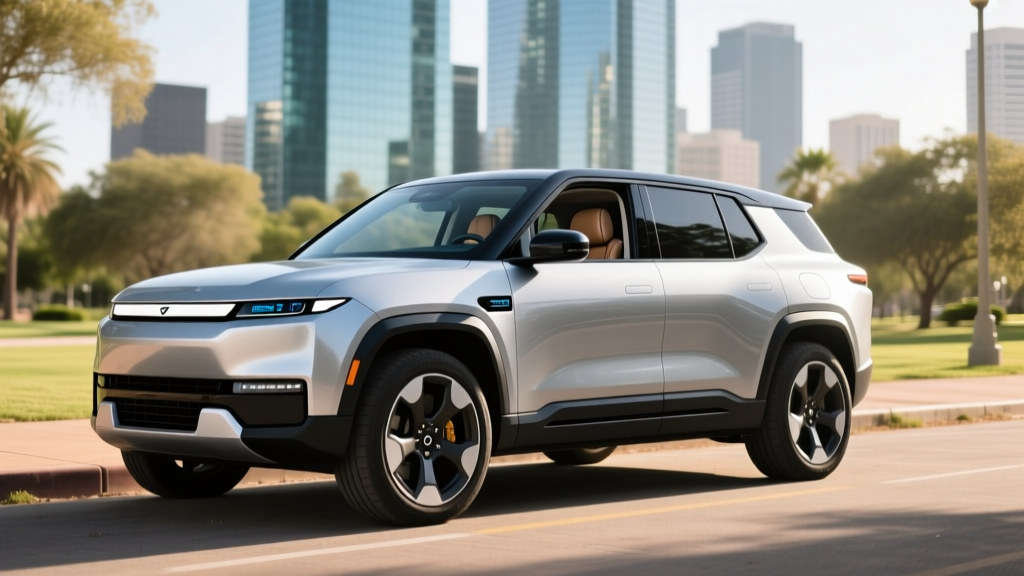
If you have been watching the three-row electric SUV market, the Rivian R1S likely sits near the top of your list. It is one of the few EVs that can genuinely seat seven adults, tow over 7,700 pounds, and still deliver sports-car acceleration. But with base prices pushing into the high $70,000s and top trims cracking $100,000, many buyers are asking a practical question: are Rivian SUV lease deals the smartest way to get into one?
Leasing an R1S in 2026 has distinct advantages — particularly around the federal tax credit, which Rivian can pass through as a lease incentive even when buyers would not qualify under purchase rules. This guide walks through every number you need: EPA range, real-world efficiency, DC fast-charging speeds, battery chemistry, pricing by trim, and what a lease actually costs after incentives.
2026 Rivian R1S at a Glance: Key Specs by Trim
Rivian refreshed the R1S for the 2025 model year with a new electrical architecture, updated battery packs, and a more powerful Dual-Motor and Tri-Motor lineup. Those changes carry into 2026. Here is the spec breakdown across the core configurations:
| Spec | Dual-Motor Standard | Dual-Motor Max | Tri-Motor Max |
|---|---|---|---|
| Battery (usable) | ~92 kWh (LFP) | ~141 kWh (NMC) | ~141 kWh (NMC) |
| EPA Range | 270 mi | 410 mi | 390 mi |
| Horsepower | 533 hp | 533 hp | 850 hp |
| 0–60 mph | 4.5 sec | 4.5 sec | 2.9 sec |
| Drivetrain | AWD (dual-motor) | AWD (dual-motor) | AWD (tri-motor) |
| Max DC Fast Charge | 200 kW | 220 kW | 220 kW |
| 10–80% DC Time | ~30 min | ~41 min | ~41 min |
| Level 2 Home Rate | 11.5 kW (~25 mi/hr) | 11.5 kW (~25 mi/hr) | 11.5 kW (~25 mi/hr) |
| MPGe (combined) | 73 MPGe | 70 MPGe | 65 MPGe |
| Efficiency | 46 kWh/100 mi | 48 kWh/100 mi | 52 kWh/100 mi |
| Towing Capacity | 7,700 lb | 7,700 lb | 7,700 lb |
| Base MSRP | $79,900 | $89,900 | $105,900 |
Source: EPA / fueleconomy.gov and Rivian official specifications.
Real-World Range: What the EPA Number Does Not Tell You
EPA Estimate: 410 miles (Dual-Motor Max Pack)
Real-World Highway (70 mph, mild weather): ~320–350 miles
Real-World Cold Weather (below 30°F, mixed driving): ~250–290 miles
With Towing (5,000 lb trailer): ~160–190 miles
The 410-mile EPA figure on the Max Pack is genuinely impressive for a 5,900-pound SUV. But large, boxy vehicles pay an aerodynamic penalty at highway speeds. In real-world testing, the R1S Max Pack typically delivers 320–350 miles on a flat highway loop at 70 mph in moderate temperatures. That is still excellent — enough to cover most road-trip legs without anxiety.
Cold weather is where the math tightens. Lithium-ion batteries lose efficiency in freezing temperatures, and the R1S's cabin and battery heating demands are substantial. Expect a 25–35% range reduction below 30°F. Rivian includes a heat pump on all 2026 R1S models, which mitigates some of this loss compared to resistive heating, but physics is physics.
If you plan to tow, plan for roughly half the EPA range. A 5,000-pound camper trailer at highway speeds will consume 80–90 kWh/100 mi, cutting effective range to around 160–190 miles on the Max Pack. That is usable for regional trips with planned DC fast-charger stops, but it demands route planning.
Charging Speed: DC Fast and Home Level 2 Breakdown
| Charging Level | Power / Rate | Miles Added per Hour | Notes |
|---|---|---|---|
| Level 1 (120V) | ~1.4 kW | ~3 mi/hr | Emergency/trickle only |
| Level 2 (240V, 48A) | 11.5 kW | ~25 mi/hr | Full overnight charge (~16 hr for Max Pack) |
| DC Fast (peak) | 200–220 kW | ~550 mi/hr (peak) | Sustained rate tapers above 60% SoC |
| Tesla Supercharger (NACS) | Up to 250 kW (V3 stalls) | Varies by stall | Native NACS port on 2025+ R1S |
The 2026 R1S comes with a native NACS charge port, meaning it plugs directly into Tesla Superchargers without an adapter. This is a major practical advantage, as the Supercharger network remains the most reliable DC fast-charging infrastructure in the US. On a V3 Supercharger (250 kW capable), the R1S Max Pack peaks around 220 kW and holds strong through roughly 55–60% state of charge before tapering. A 10–80% session takes approximately 41 minutes on the Max Pack.
The Standard Pack with its LFP battery charges slightly faster in the 10–80% window (~30 minutes) because the pack is smaller, but it also holds less total energy. LFP chemistry tolerates frequent 100% charges better than NMC, so Standard Pack owners can charge to full daily without the degradation concerns that NMC owners manage by staying at 80–90% for routine use.
At home on a Level 2 wall connector (11.5 kW / 48 amps), the Max Pack needs roughly 16 hours from empty to full. Most owners will arrive home at 30–50% SoC and wake up fully charged. A 48-amp hardwired Level 2 charger requires a 60-amp circuit; budget $800–$2,000 for professional installation depending on panel proximity and local permit costs.
Lease Pricing, Tax Credits, and What You Will Actually Pay
This is where Rivian SUV lease deals become interesting — and where the math diverges sharply from buying.
| Detail | Purchase | Lease |
|---|---|---|
| Dual-Motor Standard Base MSRP | $79,900 | $79,900 (capitalized cost) |
| Dual-Motor Max Base MSRP | $89,900 | $89,900 (capitalized cost) |
| Federal §30D Credit (purchase) | Not eligible — MSRP exceeds $80,000 SUV cap on Max; Standard may qualify depending on sourcing | N/A for buyer directly |
| Lease Credit (commercial clean vehicle, §45W) | N/A | Up to $7,500 passed through by lessor |
| Buyer Income Cap (purchase §30D) | $150K single / $300K joint | No income cap on lease credit |
| Estimated Monthly Lease (36 mo, DM Standard) | N/A | ~$899–$1,099/mo depending on money factor, residual, and credit pass-through |
| Estimated Monthly Lease (36 mo, DM Max) | N/A | ~$1,099–$1,349/mo |
Why leasing unlocks the credit: Under current IRS rules, the §30D clean vehicle credit for purchases has an MSRP cap of $80,000 for SUVs, along with buyer income limits and battery critical-mineral sourcing requirements. The R1S Dual-Motor Max at $89,900 exceeds the purchase cap outright. However, when you lease, the vehicle is technically purchased by the leasing company (the lessor), which can claim the commercial clean vehicle credit under §45W. Most lessors pass this $7,500 through as a capitalized-cost reduction, effectively lowering your monthly payment.
This lease loophole has no buyer income cap and no MSRP cap, making it the most accessible path to a federal incentive on a high-end R1S. Rivian Financial Services and third-party lessors like U.S. Bank have historically structured R1S leases this way. Always confirm with the dealer that the $7,500 is applied as a cap-cost reduction before signing.
For the Standard Pack at $79,900, purchase eligibility under §30D depends on the specific battery's critical-mineral and component sourcing for the model year. The LFP cells in the Standard Pack have historically faced sourcing challenges under the strict IRS rules that tightened in 2024–2025. Leasing sidesteps this entirely.
Interior, Cargo, and Tech: What It Is Like to Live With
The R1S is a genuine three-row SUV, not a crossover pretending to be one. Here are the dimensions that matter:
- Cargo behind 3rd row: 10.4 cu ft (tight for a full-size SUV — the battery pack raises the floor)
- Cargo behind 2nd row (3rd row folded): 57.6 cu ft
- Cargo behind 1st row (all rear seats folded): 104.7 cu ft
- Front headroom: 41.2 in
- Second-row legroom: 38.5 in
- Third-row legroom: 30.4 in (usable for children and short-trip adults; tight for 6-footers)
The tech stack is strong. The 15.6-inch center display runs Rivian's in-house software, which has matured considerably through OTA updates. Wireless Apple CarPlay and Android Auto are standard. The 12.3-inch driver display is clear and configurable. The gear tunnel — a pass-through storage compartment between the rear wheels — is a clever feature unique to Rivian's skateboard platform, adding roughly 11 cu ft of lockable, weatherproof storage accessible from either side of the vehicle.
On the driver-assist front, the R1S ships with Rivian's Driver+ system, a Level 2 hands-on-highway assist with adaptive cruise and lane centering. It is competent but not class-leading; it requires hands-on-wheel engagement and does not support hands-free driving on mapped highways the way GM's Super Cruise or Ford's BlueCruise do.
Battery Chemistry, Degradation, and Warranty
Rivian uses two distinct battery chemistries across the R1S lineup, and the choice matters for long-term ownership:
| Factor | Standard Pack (LFP) | Max Pack (NMC) |
|---|---|---|
| Chemistry | Lithium Iron Phosphate | Nickel Manganese Cobalt |
| Energy Density | Lower (heavier per kWh) | Higher (more range in similar volume) |
| Cycle Life | 3,000+ cycles to 80% SoH | 1,500–2,000 cycles to 80% SoH |
| Daily 100% Charging | Recommended — LFP tolerates full SoC well | Not ideal — 80–90% daily, 100% for trips |
| Cold-Weather Performance | Slightly worse in extreme cold | Better low-temp efficiency |
| Estimated Degradation at 150K mi | ~8–12% loss | ~10–15% loss |
The warranty on all 2026 R1S models covers the battery pack and drive units for 8 years or 175,000 miles, whichever comes first. Rivian's battery warranty guarantees at least 70% capacity retention over that period. The bumper-to-bumper limited warranty is 5 years / 60,000 miles.
For lease holders on a typical 36-month / 36,000-mile term, battery degradation is essentially a non-issue. You will return the vehicle long before any meaningful capacity loss appears. This is one of the underrated advantages of leasing an EV — you never face the tail-end degradation risk or out-of-warranty battery replacement costs (estimated at $15,000–$22,000 for the Max Pack if needed post-warranty).
R1S vs. the Competition: How It Stacks Up
| Spec | Rivian R1S (DM Max) | Tesla Model X (Long Range) | Kia EV9 (GT-Line AWD) |
|---|---|---|---|
| EPA Range | 410 mi | 335 mi | 270 mi |
| Base MSRP | $89,900 | $79,990 | $73,900 |
| 0–60 mph | 4.5 sec | 3.8 sec | 5.0 sec |
| Third Row | Standard (7-seat) | Optional (6 or 7-seat) | Standard (6 or 7-seat) |
| Towing | 7,700 lb | 5,000 lb | 5,000 lb |
| NACS Native | Yes | Yes | No (CCS, adapter avail.) |
| Off-Road Capability | Excellent (air suspension, 14.9 in clearance) | Moderate | Moderate |
The R1S wins on range, towing, and off-road capability. The Model X wins on acceleration and Supercharger-native maturity. The EV9 wins on price — it is $16,000 cheaper than the R1S Max and offers strong value, though with notably less range and towing capacity. Your choice depends on whether you need the R1S's specific strengths or can live with a less expensive alternative.
Choose the R1S if: You need 400+ mile range, 7,700-lb towing, genuine off-road capability, and a three-row layout with adult-usable second-row space.
Choose the Model X if: Acceleration and the Supercharger ecosystem are your top priorities, and you do not tow heavy loads.
Choose the EV9 if: Budget is the primary constraint and 270 miles of range covers your daily and regional driving needs.
Pros and Cons of the 2026 Rivian R1S
- 410-mile EPA range (Max Pack) — best in three-row EV class
- 7,700-lb towing with integrated trailer brake controller
- Native NACS — full Supercharger access without adapter
- Genuine off-road capability with air suspension
- LFP Standard Pack option offers excellent cycle life
- OTA updates continue adding features post-purchase
- Lease credit loophole bypasses §30D MSRP and income caps
- Cargo behind 3rd row is only 10.4 cu ft
- Third-row legroom (30.4 in) is tight for adults
- High base price — $79,900 minimum before options
- Driver+ is competent but not hands-free like Super Cruise
- Efficiency drops sharply when towing (~50% range loss)
- Service center network still growing in rural areas
- Insurance premiums run 15–25% higher than comparable ICE SUVs
Who Should Lease the R1S — and Who Should Look Elsewhere?
Best fit: Active families who need three rows for school runs and weekend trips, tow a boat or camper a few times a year, and want a single vehicle for daily driving plus adventure travel. The lease structure works especially well for buyers who exceed the §30D income cap or who want to avoid long-term battery depreciation risk.
Think twice if: You rarely use a third row (the two-row R1T or a smaller EV SUV would be more efficient), your daily commute is short and a 270-mile range EV would suffice at lower cost, or you live in an area with limited Rivian service infrastructure. Also consider that lease mileage limits typically cap at 10,000–15,000 miles per year — if you drive more, excess mileage penalties ($0.20–$0.30/mile) can erase the credit benefit.
Frequently Asked Questions
Does the 2026 Rivian R1S qualify for the federal EV tax credit?
For outright purchase, eligibility is complicated. The §30D credit has an $80,000 MSRP cap for SUVs, which eliminates the Max Pack trims. The Standard Pack at $79,900 technically clears the cap, but eligibility also depends on battery critical-mineral sourcing and buyer income limits ($150K single / $300K joint). For leases, the lessor can claim the commercial clean vehicle credit (§45W) of up to $7,500 with no MSRP cap and no buyer income cap, and most pass this through as a cap-cost reduction. Always confirm with your leasing dealer that the credit is applied. See IRS clean vehicle credit guidelines for current rules.
What is the real-world range of the R1S on a road trip?
On a 70-mph highway drive in 60–75°F weather, the Max Pack delivers roughly 320–350 miles. In winter conditions below 30°F, expect 250–290 miles. Plan charging stops at 250-mile intervals for comfort and to stay in the faster portion of the charge curve.
How fast does the R1S charge on a road trip?
On a 250 kW-capable DC fast charger (such as a Tesla V3 Supercharger), the R1S Max Pack peaks at approximately 220 kW and charges from 10–80% in about 41 minutes. The Standard Pack completes 10–80% in roughly 30 minutes due to its smaller battery. Charging speed tapers significantly above 80% SoC, so it is rarely worth waiting past 85–90% on a road trip.
Is it better to buy or lease the Rivian R1S in 2026?
Leasing is the stronger financial play for most buyers right now. You sidestep the §30D MSRP and income caps, avoid long-term battery degradation risk, and can step into the next-generation platform in three years. Buying makes sense only if you drive very high annual miles (exceeding lease limits), want to keep the vehicle 7+ years, or qualify for the purchase credit on the Standard Pack and prefer to own outright.
What are the biggest drawbacks of the R1S?
Limited cargo space behind the third row (10.4 cu ft), tight third-row legroom for adults, high starting price, and a driver-assist system that is not hands-free. Rivian's service network is also still expanding, which can mean longer wait times for body or warranty work in some regions.
Can the R1S tow a travel trailer?
Yes — the R1S is rated for 7,700 pounds with the available tow package. However, expect range to drop to roughly 160–190 miles on the Max Pack when towing a 5,000-pound trailer at highway speeds. Plan routes around DC fast chargers and allow extra travel time.