The Short Answer: Which Audi Electric Sedan Fits You?
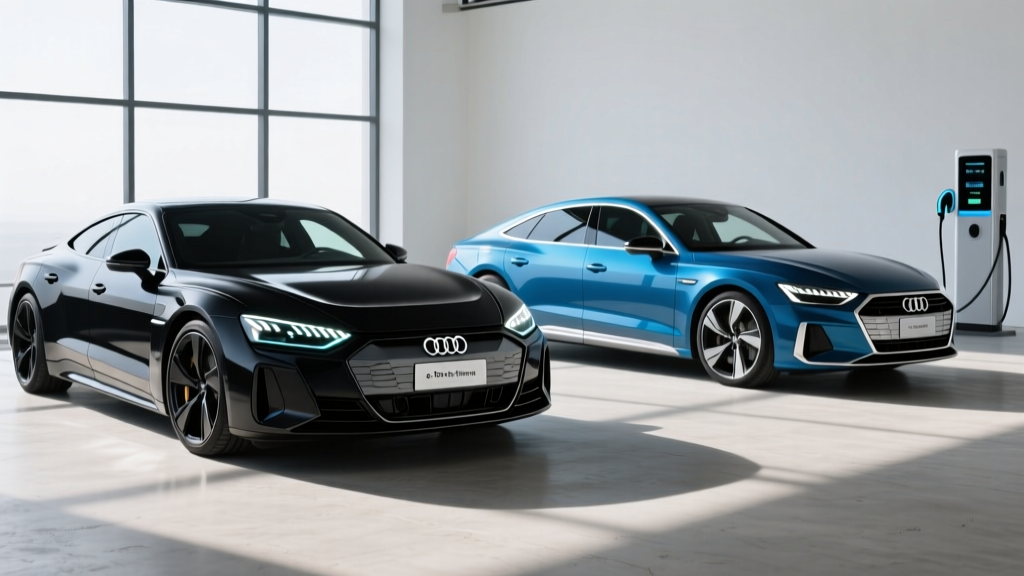
If you're researching an Audi electric sedan in 2026, Audi currently offers two distinct battery-electric sedan platforms in the U.S. market: the Audi e-tron GT / RS e-tron GT (a performance grand tourer on the J1 platform, starting at ~$107,900) and the all-new Audi A6 e-tron (a luxury midsize sedan on the PPE platform, starting at ~$68,000). The e-tron GT delivers up to an EPA-estimated 276 miles of range with 270 kW peak DC fast charging, while the A6 e-tron targets up to an EPA-estimated 321 miles with a more practical price of entry. Your choice depends on whether you prioritize track-capable performance or daily-driver efficiency and value.
2026 Audi Electric Sedan Lineup at a Glance
Audi's electric sedan strategy in 2026 splits into two distinct product lines, each built on a different Volkswagen Group architecture. Understanding the platform difference matters: it dictates battery size, charging speed, interior packaging, and ultimately price.
| Spec | 2026 Audi e-tron GT quattro | 2026 Audi RS e-tron GT | 2026 Audi A6 e-tron (RWD) |
|---|---|---|---|
| Platform | J1 (800V) | J1 (800V) | PPE (800V) |
| Battery (usable/total) | 83.7 kWh / 93.4 kWh (NMC) | 83.7 kWh / 93.4 kWh (NMC) | 94.5 kWh / 100 kWh (NMC) |
| EPA Range | 276 mi | 272 mi | ~321 mi (est.) |
| Horsepower | 522 hp (boost) | 637 hp (boost) | 362 hp |
| 0–60 mph | 3.9 sec | 3.1 sec | 5.2 sec |
| Peak DC Charge Rate | 270 kW | 270 kW | 270 kW |
| 10–80% DC Fast Charge | ~22 min | ~22 min | ~21 min |
| Level 2 (AC) Rate | 11 kW (9.6 kW standard) | 11 kW | 11 kW |
| MPGe (combined) | 85 MPGe | 81 MPGe | ~100 MPGe (est.) |
| Base MSRP | $107,900 | $150,900 | ~$68,000 |
| Drivetrain | AWD (dual motor) | AWD (dual motor) | RWD (single motor) |
Sources: fueleconomy.gov, Audi USA. A6 e-tron figures reflect announced/estimated specs for the U.S. market; final EPA certification may vary.
Real-World Range: What the EPA Sticker Doesn't Tell You
EPA range estimates are tested under controlled conditions that rarely mirror your actual commute. Here's what to expect in practice from each Audi electric sedan:
e-tron GT / RS e-tron GT — EPA 276 / 272 miles
Real-world expectation: 220–250 miles on highway road trips (70–80 mph sustained). In freezing temperatures (below 32°F), expect 180–210 miles. The J1 platform's 800V architecture and standard heat pump help mitigate cold-weather losses, but the GT's low-slung, performance-oriented aero creates more drag at speed than a conventional sedan.
A6 e-tron — EPA ~321 miles (estimated)
Real-world expectation: 270–295 miles highway, 290–310 miles mixed suburban. The PPE platform's larger 100 kWh battery pack and more upright sedan profile yield better highway efficiency. Cold-weather range: 230–260 miles. This is the Audi electric sedan for drivers who prioritize range over 0–60 times.
Charging-curve reality check: All three models peak at 270 kW, but that rate holds only between roughly 10–35% state of charge. From 35–80%, the curve tapers progressively — expect an average sustained rate of ~150–170 kW across the full 10–80% session. This is why the quoted 10–80% time is ~22 minutes rather than the ~11 minutes peak rate alone would suggest. Always precondition the battery via the MMI navigation system before arriving at a DC fast charger; skipping preconditioning can add 5–8 minutes to your session in cool weather.
Audi Electric Sedan vs. Gas Equivalent: The Cost Math
Let's compare the A6 e-tron against its closest internal-combustion sibling, the 2026 Audi A6 45 TFSI (2.0L turbo, 261 hp, starting ~$58,000). The EV carries a higher sticker price, but the total cost of ownership tells a more nuanced story over five years.
| Cost Factor (5 Years / 75,000 mi) | Audi A6 e-tron (EV) | Audi A6 45 TFSI (Gas) |
|---|---|---|
| Purchase Price (MSRP) | $68,000 | $58,000 |
| Federal Tax Credit (§30D) | Up to $7,500 (see eligibility below) | $0 |
| Effective Purchase Price | ~$60,500 | $58,000 |
| Fuel/Energy Cost | ~$3,750 (home charging at $0.14/kWh avg) | ~$10,125 ($3.60/gal, 28 MPG combined) |
| Maintenance | ~$1,800 (cabin air, wipers, brake fluid, tires) | ~$4,200 (oil, filters, brakes, spark plugs) |
| Insurance (avg) | ~$12,500 | ~$10,000 |
| Estimated Depreciation | ~$28,000 | ~$24,000 |
| Total 5-Year Cost | ~$106,550 | ~$106,325 |
Assumptions: 15,000 mi/yr, national avg electricity $0.14/kWh (EIA), gas $3.60/gal. Insurance premiums for EVs run 15–25% higher on average due to repair-cost data. Depreciation estimates based on early PPE-platform retention trends. Actual costs vary by state, driving habits, and utility rates.
The five-year totals are nearly identical — but the EV front-loads cost in the purchase price while the gas car bleeds money at the pump and service bay. If you can charge at home on a Level 2 circuit, your per-mile energy cost drops to roughly $0.05/mile versus $0.135/mile for gas. That gap widens dramatically if your utility offers off-peak EV rates ($0.08–0.10/kWh), which could save an additional $1,000–$1,500 over five years.
Charging at Home and on the Road: What You Need to Know
Owning any Audi electric sedan means solving the home-charging equation first. Public DC fast charging at $0.35–$0.50/kWh erases most of the EV cost advantage — home charging is where the economics work.
| Charging Level | Power (kW) | Miles of Range per Hour | Where You'll Use It |
|---|---|---|---|
| Level 1 (120V outlet) | ~1.4 kW | ~4–5 mi/hr | Emergency/trickle only |
| Level 2 (240V, 48A) | 11.5 kW | ~33–38 mi/hr | Home daily charging |
| DC Fast Charge | Up to 270 kW | ~600+ mi/hr (peak) | Road trips, public stations |
Home Level 2 installation cost breakdown:
| Item | Typical Cost Range |
|---|---|
| Level 2 charger hardware (e.g., ChargePoint Home Flex, Wallbox Pulsar Plus) | $500–$700 |
| Electrician labor (240V/60A circuit, ~40 ft run) | $800–$2,500 |
| Permit & inspection | $100–$300 |
| Electrical panel upgrade (if needed, 200A service) | $1,500–$4,000 |
| Total (no panel upgrade) | $1,400–$3,500 |
| Total (with panel upgrade) | $2,900–$7,500 |
Both the e-tron GT and A6 e-tron accept up to 11 kW on Level 2 AC, meaning a full overnight charge (10–100%) takes roughly 9–10 hours. For most owners, plugging in at home each evening and waking to a full battery eliminates range anxiety for daily driving entirely.
Connector note: For 2026, Audi models sold in the U.S. ship with a NACS (North American Charging Standard) port, granting native access to Tesla Supercharger V3/V4 stalls (250–350 kW) without an adapter. This is a significant practical advantage over older CCS1-equipped Audis, as the Supercharger network remains the most reliable public DC fast-charging network by uptime metrics. Always confirm connector type at time of purchase, as transition-year inventory may include CCS-equipped vehicles with a NACS adapter included.
Federal Tax Credit Eligibility: §30D Rules for 2026
The IRS §30D Clean Vehicle Credit can reduce your effective purchase price by up to $7,500 — but eligibility is far from guaranteed. Here's the checklist for 2026:
- MSRP cap: Sedans must have an MSRP at or below $55,000. This immediately disqualifies both the e-tron GT ($107,900+) and most A6 e-tron trims from the new-vehicle credit. However, point-of-sale dealer transfer of the credit is available if the vehicle qualifies.
- Buyer income limits: AGI must not exceed $150,000 (single), $225,000 (head of household), or $300,000 (joint filers).
- Battery sourcing: A percentage of critical minerals and battery components must be sourced from the U.S. or FTA-partner nations. These thresholds tighten annually; verify current-year compliance on the fueleconomy.gov tax credit lookup.
- Final assembly: Vehicle must undergo final assembly in North America.
- Point-of-sale transfer: Buyers can transfer the credit to the dealer at purchase, reducing the sale price directly — even if tax liability is lower than the credit amount.
Reality check: The A6 e-tron's ~$68,000 starting MSRP exceeds the $55,000 sedan cap, meaning it likely does not qualify for the new-vehicle §30D credit in most trims. The e-tron GT is well above the cap. Consult a tax professional and check the IRS's official eligible-vehicle list before counting on this credit in your budget. Some buyers may benefit from state-level incentives (often $1,000–$5,000 depending on jurisdiction) or utility company rebates for home charger installation — check your state's energy office and local utility.
Audi Electric Sedan vs. Gas and Hybrid: Who Wins Where?
| Category | Audi A6 e-tron (BEV) | Audi A6 45 TFSI (Gas) | Audi A6 55 TFSI e (PHEV) |
|---|---|---|---|
| Starting MSRP | ~$68,000 | ~$58,000 | ~$71,000 |
| EPA Range / MPG | ~321 mi / ~100 MPGe | ~420 mi / 28 MPG | ~25 mi electric + 350 mi gas |
| Per-Mile Fuel Cost | ~$0.05 (home) | ~$0.135 | ~$0.10 (blended) |
| 5-Year Maintenance | ~$1,800 | ~$4,200 | ~$3,500 |
| Home Charging Needed? | Yes (essential) | No | Recommended |
| Road-Trip Convenience | Good (270 kW DC) | Best (3-min gas stop) | Good (gas backup) |
| Cold-Weather Penalty | 15–25% range loss | Minimal | Minimal (gas engine heat) |
The PHEV middle ground: If you can't install a Level 2 charger at home, or you frequently drive routes with sparse DC fast-charging infrastructure, the A6 55 TFSI e plug-in hybrid offers ~25 miles of electric-only commuting with a gas engine for longer trips. You'll still save on short commutes, but you'll pay more upfront and carry the maintenance burden of both a combustion engine and an electric drivetrain.
Common Misconceptions About Audi Electric Sedans
| Myth | Fact |
|---|---|
| "The battery will need replacing in 5 years." | Audi warranties the high-voltage battery for 8 years / 100,000 miles against degradation below 70% of original capacity. Industry data from J1-platform vehicles (Porsche Taycan, e-tron GT) shows ~5–8% degradation after 100,000 miles with normal use. A full battery replacement (out of warranty) costs $20,000–$30,000, but is rarely needed within the vehicle's typical ownership lifecycle. |
| "I can't road-trip in an Audi EV." | With 270 kW peak DC charging and NACS access to Tesla Superchargers, you can add ~150 miles of range in a 10-minute stop. On a 600-mile trip, expect two 20-minute charging breaks — adding roughly 40 minutes total versus a gas car. |
| "EVs are worse in winter." | Range drops 15–25% in freezing temperatures due to battery chemistry and cabin heating demands. However, preconditioning while plugged in, using seat/steering-wheel heaters instead of cabin air, and the standard heat pump on PPE-platform vehicles significantly reduce the penalty. Traction and AWD performance (e-tron GT) are excellent in snow. |
| "Electric Audis are basically Teslas with a different badge." | Audi's J1 and PPE platforms are co-developed within the VW Group (shared with Porsche Taycan and upcoming PPE models). Build quality, NVH isolation, suspension tuning, and interior materials are distinctly Audi — and in most reviews, a clear step above Tesla Model S in fit and finish. The software and ADAS approach is more conservative, which some buyers prefer. |
| "I don't need home charging — public chargers are everywhere." | Public DC fast charging costs 2.5–4× more per kWh than home charging. Relying exclusively on public chargers eliminates the primary EV cost advantage and subjects you to station downtime. Home Level 2 charging is effectively a requirement for economical EV ownership. |
Decision Framework: Which Audi Electric Sedan Should You Buy?
Choose the Audi A6 e-tron if:
- You want a daily-driver luxury sedan with 300+ miles of real-world range
- Your budget is $65,000–$80,000 (before incentives)
- You prioritize efficiency (~100 MPGe) over acceleration
- You need rear-seat space and a practical trunk for family use
- You commute 40–80 miles daily and can charge at home
Choose the Audi e-tron GT if:
- You want Porsche Taycan-rivaling performance (3.9s 0–60) with Audi styling
- Your budget is $105,000–$135,000+ and range is secondary to driving dynamics
- You value 800V architecture for rapid DC charging on road trips
- You rarely carry rear-seat passengers (the GT's roofline compromises rear headroom)
Choose the Audi RS e-tron GT if:
- You want supercar-level acceleration (3.1s 0–60, 637 hp) in a four-door package
- Budget is $150,000+ and this is a second/third vehicle
- Track capability and launch performance are priorities
Skip the EV and consider a PHEV (A6 55 TFSI e) if:
- You cannot install a Level 2 charger at home (apartment, street parking, older electrical panel)
- You regularly drive 400+ miles in rural areas with limited charging infrastructure
- You live in an extreme cold-weather climate and need maximum winter range certainty
Frequently Asked Questions
What is the real-world range of the Audi e-tron GT on a road trip?
On a 70 mph highway drive in moderate temperatures (60–80°F), expect approximately 220–250 miles before needing to charge. In cold weather (below 32°F), plan for 180–210 miles. Always buffer 30–40 miles below your projected range for safety.
How long does it take to charge an Audi electric sedan at home?
On a Level 2 (240V) home charger at 11 kW, a full charge from 10% to 100% takes approximately 9–10 hours for the e-tron GT (93.4 kWh pack) and 10–11 hours for the A6 e-tron (100 kWh pack). Most owners charge from 20–80% overnight, which takes roughly 5–6 hours — more than sufficient for daily use.
Do Audi electric sedans qualify for the $7,500 federal tax credit?
As of 2026, the new-vehicle §30D credit has a $55,000 MSRP cap for sedans. Both the e-tron GT ($107,900+) and most A6 e-tron trims (~$68,000+) exceed this limit and likely do not qualify. Always verify on fueleconomy.gov and consult a tax professional, as rules and eligible-vehicle lists update periodically.
What's the battery warranty on an Audi electric sedan?
Audi covers the high-voltage battery for 8 years or 100,000 miles, whichever comes first, against capacity loss below 70% of original. This is standard across the luxury EV segment and consistent with BMW, Mercedes, and Porsche coverage terms.
Is the Audi e-tron GT the same as the Porsche Taycan?
They share the J1 800V platform and similar battery hardware, but differ in tuning, interior design, software, and styling. The e-tron GT prioritizes grand-touring comfort with slightly softer suspension tuning, while the Taycan leans toward sports-car dynamics. Pricing, equipment levels, and brand experience are the primary differentiators.
Can I use Tesla Superchargers with a 2026 Audi electric sedan?
Yes. 2026 Audi EVs sold in the U.S. are equipped with NACS charge ports, granting native access to the Tesla Supercharger network (V3 at 250 kW, V4 at up to 350 kW) without an adapter. This significantly expands your road-trip charging options, particularly in rural corridors where Superchargers often outnumber Electrify America or EVgo stations.
How much does insurance cost for an Audi electric sedan?
Expect premiums 15–25% higher than a comparable gas Audi, driven by higher repair costs (specialized body-shop requirements, battery-protection protocols) and higher vehicle MSRP. For the A6 e-tron, national average premiums range from $2,200–$2,800/year depending on your state, driving record, and coverage level. Shop quotes from EV-friendly insurers before purchasing.