Quick Answer: Which Audi Electric Model Is Right for You?
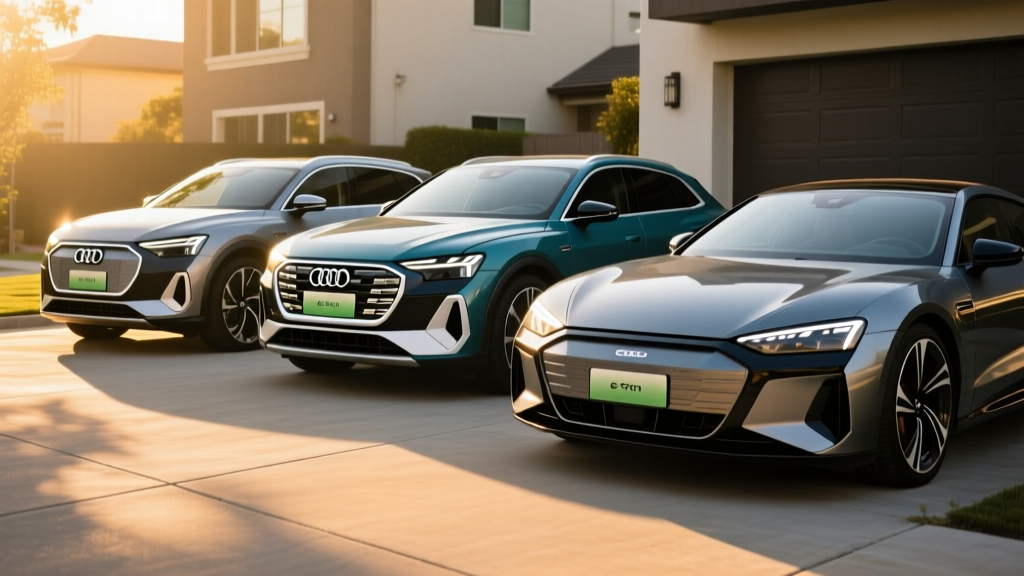
Audi's 2026 electric lineup spans three distinct vehicles targeting different buyers. The Q4 e-tron (starting ~$51,300) is the entry point with up to 265 miles of EPA range and the best chance at federal tax credits. The Q6 e-tron (~$65,095) offers the newest PPE platform, 310+ miles of range, and 270 kW DC fast charging. The e-tron GT (~$107,900) is the performance flagship with 238–270 miles of range and 0–60 mph in as little as 3.1 seconds. Your choice hinges on budget, charging access, and whether you prioritize luxury utility or driving dynamics.
The 2026 Audi Electric Lineup at a Glance
Audi has steadily expanded its battery-electric portfolio, moving from the original e-tron SUV (now discontinued) to a broader range built on dedicated EV platforms. For 2026, three core models define Audi's electric strategy in the U.S. market. Each sits on different underpinnings and serves a distinct purpose.
| Spec | Q4 e-tron | Q6 e-tron | e-tron GT |
|---|---|---|---|
| Platform | VW MEB | Porsche/Audi PPE | Porsche J1 |
| Body Style | Compact SUV | Midsize SUV | 4-door gran turismo |
| Battery (usable) | 77 kWh (NMC) | 94.9 kWh (NMC) | 83.7 kWh (NMC) |
| EPA Range | Up to 265 mi | Up to 310 mi | 238–270 mi |
| Max DC Charge Rate | 175 kW | 270 kW | 270 kW (800V) |
| 10–80% DC Charge | ~28 min | ~21 min | ~22 min |
| Level 2 Rate | 11 kW | 11 kW | 9.6 kW |
| Horsepower | 282–340 hp | 383–509 hp | 469–646 hp |
| 0–60 mph | 5.8–7.6 sec | 4.9–5.8 sec | 3.1–3.9 sec |
| Base MSRP | $51,300 | $65,095 | $107,900 |
| Battery Warranty | 8 yr / 100,000 mi | 8 yr / 100,000 mi | 8 yr / 100,000 mi |
Sources: fueleconomy.gov, Audi USA official specs. Range figures represent the highest-EPA-rated trim per model. Real-world highway and cold-weather range will be lower — see ownership section below.
Real-World Range vs. EPA Stickers
EPA range estimates provide a standardized baseline, but real-world results depend on speed, terrain, temperature, and climate control usage. Here's what to expect when you leave the dealership:
Range Reality Check
| Model | EPA Sticker | Highway (70 mph, 72°F) | Cold Weather (30°F, mixed) |
|---|---|---|---|
| Q4 e-tron (quattro) | 242 mi | ~210–225 mi | ~175–195 mi |
| Q6 e-tron (quattro) | 310 mi | ~270–290 mi | ~225–250 mi |
| e-tron GT (quattro) | 270 mi | ~235–255 mi | ~190–215 mi |
Lithium-ion batteries lose efficiency in cold temperatures due to increased internal resistance. Audi's liquid thermal management system and available heat pump (standard on Q6 e-tron, optional on Q4 e-tron) mitigate this, but physics still wins. Expect 20–30% range reduction in sustained sub-freezing conditions.
The Q6 e-tron benefits from the 800-volt PPE architecture, which not only enables faster charging but also improves powertrain efficiency under load. In mixed driving, the Q6 e-tron consistently delivers closer to its EPA figure than the MEB-based Q4 e-tron, which shows greater variance at highway speeds.
Charging Speeds and Infrastructure
Charging capability separates a pleasant EV experience from a frustrating one. Audi's three electric models differ significantly in how quickly they replenish.
| Charging Level | Q4 e-tron | Q6 e-tron | e-tron GT |
|---|---|---|---|
| Level 1 (120V, 1.4 kW) | ~4 mi/hr | ~5 mi/hr | ~4 mi/hr |
| Level 2 (240V, 11 kW) | ~30 mi/hr | ~35 mi/hr | ~28 mi/hr |
| DC Fast (peak kW) | 175 kW | 270 kW | 270 kW |
| DC Fast 10–80% | ~28 min | ~21 min | ~22 min |
| Connector | CCS1 (NACS adapter avail.) | CCS1 (NACS adapter avail.) | CCS1 (NACS adapter avail.) |
The Q6 e-tron and e-tron GT use 800-volt architectures, enabling sustained high charge rates. However, peak kW is not sustained kW. A 270 kW peak typically holds from roughly 10–40% State of Charge (SoC), then tapers progressively. The 10–80% time reflects this curve — you'll see the most rapid gains in the first 15 minutes, with the final 20% taking considerably longer.
For 2026, Audi provides a NACS adapter for Tesla Supercharger access on all models, expanding the public fast-charging network significantly. Electrify America remains the primary CCS partner, included with complimentary charging credits on new purchases.
Home Charging Setup
Most Audi electric owners will charge primarily at home. A Level 2 home charger (240V, 48-amp circuit) adds 28–35 miles of range per hour — enough to fully replenish any model overnight. Installation costs vary widely:
| Item | Typical Cost Range |
|---|---|
| Level 2 EVSE hardware (e.g., ChargePoint Home Flex, Audi-branded) | $500–$800 |
| Electrician labor (50-amp circuit, 240V outlet or hardwire) | $800–$2,500 |
| Electrical panel upgrade (if needed, 100A → 200A) | $1,500–$4,000 |
| Permit and inspection | $100–$400 |
| Total (no panel upgrade) | $1,400–$3,700 |
| Total (with panel upgrade) | $2,900–$7,700 |
Always hire a licensed electrician and pull permits. Your home's existing electrical panel capacity determines whether an upgrade is necessary — a 200-amp panel is typically sufficient for a 48-amp EV circuit alongside normal household loads.
EV vs. Gas: Cost of Ownership Compared
The upfront price of an Audi electric vehicle is higher than a comparable gas-powered Audi, but operating costs tilt the long-term equation. Here's a five-year comparison using the Q4 e-tron versus the gas-powered Audi Q5 (a common cross-shop):
| Cost Factor (5 years / 75,000 mi) | Q4 e-tron (EV) | Q5 45 TFSI (Gas) |
|---|---|---|
| Purchase price (base MSRP) | $51,300 | $46,600 |
| Federal tax credit (§30D, if eligible) | –$3,750 to $7,500* | $0 |
| Fuel/Energy cost | $3,200–$5,400** | $8,800–$10,500*** |
| Maintenance (scheduled) | $800–$1,200 | $2,800–$3,500 |
| Insurance (avg.) | $9,500–$12,000 | $7,500–$9,500 |
| Estimated 5-year total | $61,050–$73,400 | $65,700–$70,100 |
*Tax credit eligibility depends on MSRP caps, buyer income limits, battery sourcing requirements, and point-of-sale transfer rules under IRS §30D. The Q4 e-tron may qualify for partial or full credit; the Q6 e-tron and e-tron GT exceed the $80,000 SUV MSRP cap. Consult a tax professional.
**Based on $0.13–$0.22/kWh home charging and occasional DC fast charging at $0.35–$0.48/kWh.
***Based on 24 MPG combined and $3.40–$4.20/gallon.
The EV's higher insurance premiums (typically 15–25% above gas equivalents due to repair costs and battery replacement risk) partially offset fuel savings. However, the near-elimination of scheduled maintenance — no oil changes, fewer brake replacements due to regenerative braking, no transmission fluid — provides meaningful savings over time.
Federal Tax Credits and Incentives
The federal EV tax credit under IRS §30D remains complex and model-dependent for 2026. Here's the eligibility checklist:
- MSRP Cap: SUVs (Q4 e-tron, Q6 e-tron) must be under $80,000; sedans (e-tron GT) under $55,000. The e-tron GT exceeds this cap.
- Buyer Income Limits: Modified AGI must not exceed $150,000 (single), $225,000 (head of household), or $300,000 (joint).
- Battery Sourcing: Critical minerals and battery components must meet escalating domestic/free-trade-partner thresholds. Credit splits into two halves ($3,750 each) based on mineral and component sourcing compliance.
- Point-of-Sale Transfer: Eligible buyers can transfer the credit to the dealer at purchase, reducing the out-of-pocket price immediately rather than waiting for a tax refund.
- Final Assembly: Vehicle must undergo final assembly in North America. The Q4 e-tron (built in Chattanooga, TN) qualifies; the Q6 e-tron and e-tron GT (built in Europe) do not qualify for the new-vehicle credit.
Common Misconceptions
| Myth | Fact |
|---|---|
| "All Audi EVs get the full $7,500 credit." | Only the Q4 e-tron (U.S.-built) is eligible. The Q6 e-tron and e-tron GT are assembled in Europe and don't qualify for the new-vehicle §30D credit. Check the DOE qualifying list. |
| "EV batteries need replacing every 5 years." | Audi warranties its batteries for 8 years/100,000 miles with a 70% capacity retention threshold. Industry data shows NMC batteries typically retain 85–90% capacity at 100,000 miles under normal use. |
| "You can't road-trip an Audi EV." | With 270 kW charging and NACS Supercharger adapter access, a Q6 e-tron can add ~180 miles in 15 minutes. Route planning is required, but major corridors are well-served. |
| "EVs cost more to insure, always." | Premiums are generally 15–25% higher, but vary by state, driver profile, and insurer. Some carriers now offer EV-specific discounts. |
| "Level 1 charging is useless." | Level 1 (120V) adds 4–5 miles per hour. For drivers covering under 40 miles daily with overnight parking, it can be sufficient — no installation needed. |
Decision Framework: Which Audi Electric Model Fits?
Choose Based on Your Situation
Choose the Q4 e-tron if:
- Your budget is $50,000–$60,000
- You want the best shot at the federal tax credit
- Daily driving is under 80 miles round-trip
- You prefer a compact SUV form factor
- You have home Level 2 charging access
Choose the Q6 e-tron if:
- Your budget is $65,000–$80,000
- You need 300+ miles of range for road trips
- You want the latest PPE platform with 270 kW charging
- You value rear-seat space and cargo room over the Q4
- Federal tax credit ineligibility doesn't deter you
Choose the e-tron GT if:
- Performance is the priority (0–60 in 3.1 seconds, RS variant)
- Budget exceeds $100,000
- You prefer a low-slung grand touring silhouette over an SUV
- You accept lower practicality (tight rear seats, smaller trunk)
- You want 800V charging in a Porsche-derived package
Consider a plug-in hybrid alternative if:
- You lack reliable home charging access
- You frequently drive in regions with sparse DC fast-charging infrastructure
- Your budget favors the Audi Q5 PHEV (~$55,000, ~23 miles electric-only range)
First-Time EV Buyer Essentials
If this is your first electric vehicle, these ownership realities matter more than spec sheets:
Charging access is everything. Before purchasing, confirm your home electrical panel can support a 240V/48-amp circuit. If you live in an apartment or lack a garage, research public Level 2 options near your home or workplace. Relying solely on DC fast charging accelerates battery wear and costs 2–3× more per mile than home charging.
Preconditioning matters for fast charging. Audi's navigation system will precondition the battery (warm it to optimal temperature) when you route to a DC fast charger. This can cut 10–80% charge times by several minutes, especially in cold weather. Always use the built-in navigation for charging stops.
The charge curve is real. Don't plan road trips around peak kW numbers. Charging from 10–80% takes 21–28 minutes depending on the model, but 80–100% can take nearly as long due to tapering. Plan to charge to 80% and drive on — it's faster overall.
Regenerative braking changes your driving. Audi EVs offer adjustable regen levels. The Q6 e-tron's one-pedal driving mode (max regen) recovers energy in stop-and-go traffic and reduces brake pad wear. Expect brake pads to last 100,000+ miles under normal use.
Software updates are ongoing. Audi delivers over-the-air (OTA) updates that can improve range estimation, charging curves, and infotainment features. Ensure your vehicle is connected to Wi-Fi periodically for updates to download.
Frequently Asked Questions
Does the Audi Q6 e-tron qualify for the $7,500 federal tax credit?
No. The Q6 e-tron is assembled in Ingolstadt, Germany, and fails the North American final assembly requirement under IRS §30D. The Q4 e-tron, built in Chattanooga, Tennessee, is the only Audi EV currently eligible — though the exact credit amount ($3,750 or $7,500) depends on battery mineral and component sourcing compliance. Always verify on fueleconomy.gov before purchasing.
How long does it take to charge an Audi electric vehicle at home?
On a Level 2 home charger (240V, 11 kW), the Q4 e-tron charges from 0–100% in approximately 7.5 hours, the Q6 e-tron in about 9 hours, and the e-tron GT in roughly 8.5 hours. Most owners charge overnight and never start from 0% — a 20–80% top-up takes 4–6 hours depending on the model.
What happens if the battery degrades significantly?
Audi's high-voltage battery warranty covers 8 years or 100,000 miles, guaranteeing at least 70% of original capacity. If capacity drops below this threshold, Audi will repair or replace the battery at no cost. Independent data from similar NMC packs suggests typical degradation of 10–15% over 100,000 miles — well within the warranty floor.
Can I tow with an Audi electric SUV?
The Q4 e-tron is rated for up to 2,650 lbs of towing capacity; the Q6 e-tron for up to 4,400 lbs. However, towing significantly reduces range — expect a 30–50% reduction depending on trailer weight and aerodynamics. The e-tron GT is not rated for towing.
Is the Audi e-tron GT the same as the Porsche Taycan?
They share the J1 800-volt platform, battery architecture, and many powertrain components. The e-tron GT differentiates with Audi-specific styling, interior design, suspension tuning, and software. The RS e-tron GT produces 646 hp compared to the Taycan Turbo's similar output, but driving character and cabin ambiance are distinctly Audi.
Do Audi EVs require less maintenance than gas Audis?
Yes. Without an internal combustion engine, there are no oil changes, spark plugs, timing belts, or exhaust system repairs. Brake pads last far longer due to regenerative braking. Scheduled maintenance typically involves cabin air filter replacement, brake fluid checks, and tire rotation — totaling roughly $200–$300 per year versus $500–$800 for a gas equivalent.
Specifications reflect 2026 model-year data available at time of publication. Tax credit rules, pricing, and availability are subject to change. Always confirm current figures with your local Audi dealer and consult irs.gov for the latest §30D guidance. Safety ratings available at iihs.org and nhtsa.gov.