Quick Verdict: A Luxury EV Built for Comfort, Not Range Records
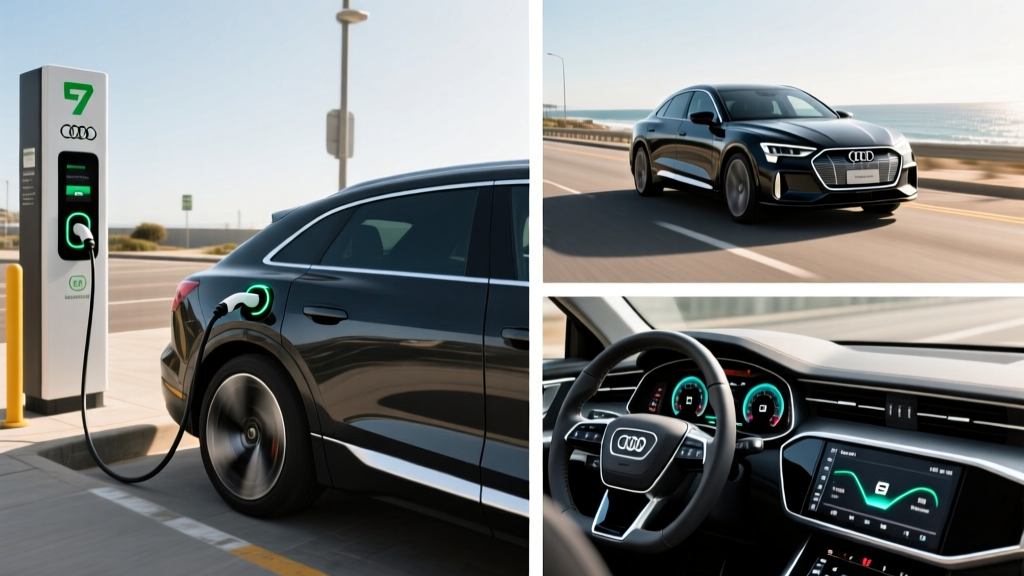
The Audi e-tron Quattro occupies a specific niche in the electric luxury SUV segment: it prioritizes cabin refinement, ride quality, and build precision over chasing maximum EPA range. With 218 miles of EPA-estimated range (Premium Plus trim) and a 150 kW DC fast-charging peak, the e-tron Quattro is best understood as a premium daily driver and highway cruiser — not a cross-country endurance machine. If your typical week involves a 40-mile commute, occasional 150-mile road trips, and reliable home charging, the e-tron Quattro delivers one of the most polished driving experiences in its class. If you regularly push 300+ miles between charges, competitors like the BMW iX xDrive50 or Tesla Model X Long Range serve that use case better.
This review covers the current-generation Audi e-tron Quattro (the original e-tron platform, sold alongside the newer Q8 e-tron lineup) with the latest model-year specifications, pricing, and federal tax credit rules under IRS §30D.
Range, Battery, and Efficiency: The Numbers That Matter
| Specification | Value |
|---|---|
| EPA Range (Premium Plus, 20" wheels) | 218 miles |
| EPA Range (Prestige, 21" wheels) | 204 miles |
| Battery Gross / Usable Capacity | 95 kWh / 83.5 kWh |
| Battery Chemistry | NMC (Nickel Manganese Cobalt) |
| EPA Efficiency (Combined) | 78 MPGe (2.31 kWh/mi) |
| Drivetrain | Dual-motor AWD (Quattro) |
| Total System Output | 402 hp (Boost mode) |
| 0–60 mph | 5.5 seconds |
| Top Speed | 124 mph (electronically limited) |
| Curb Weight | ~5,765 lbs |
| Towing Capacity | 4,000 lbs (with factory hitch) |
Real-World Range: What to Actually Expect
EPA Sticker: 218 miles (Premium Plus trim with 20" wheels)
Real-World Highway (70 mph, 72°F, moderate terrain): Expect approximately 190–205 miles. The e-tron Quattro's heavy curb weight and aerodynamic profile reduce highway efficiency more than city driving, where regenerative braking recovers energy.
Real-World City / Suburban: Closer to the EPA estimate — 210–220 miles — thanks to regen and lower average speeds.
Cold Weather (below 32°F, heater on): Plan for 155–175 miles. NMC batteries lose efficiency in freezing temperatures, and cabin heating draws significant energy. Using the e-tron's standard heat pump and preconditioning while plugged in mitigates some of this loss.
Practical Trip Planning Rule: Budget 170–180 miles between DC fast-charger stops on road trips to keep State of Charge above 15% and avoid the steep charging-curve taper above 80%.
The 83.5 kWh usable battery capacity (from a 95 kWh gross pack) uses NMC (nickel manganese cobalt) chemistry, which offers higher energy density than LFP but requires more careful thermal management and benefits from keeping State of Charge between 20–80% for long-term health. Audi's battery management system reserves roughly 11.5 kWh as a buffer to protect against deep discharge and overcharge degradation.
Efficiency at 78 MPGe combined (approximately 43 kWh/100 miles) places the e-tron Quattro behind lighter competitors. For reference, the BMW iX xDrive50 achieves 86 MPGe combined, and the Tesla Model X Long Range reaches 102 MPGe. The gap is primarily a weight story — at 5,765 lbs, the e-tron Quattro carries several hundred pounds more than its rivals.
Charging Speed: DC Fast Charging and Home Level 2
| Charging Level | Power / Rate | Time / Range Added |
|---|---|---|
| DC Fast Charge (Peak) | 150 kW (CCS connector) | 10–80% in ~30 minutes |
| DC Fast Charge (Sustained 10–80%) | Avg ~110–120 kW | ~140 miles added in 30 min |
| Level 2 Home (240V, 40A) | 9.6 kW | ~23 miles per hour of charging |
| Level 2 Home (240V, 48A) | 11.5 kW | ~28 miles per hour of charging |
| Level 1 (120V, 12A) | 1.4 kW | ~3–4 miles per hour of charging |
The e-tron Quattro's 150 kW peak DC fast-charging rate was competitive at launch but now trails newer platforms. The Hyundai Ioniq 5 peaks at 240 kW, and the Lucid Air at 300 kW. However, peak kW is not sustained kW — what matters is the charging curve.
The e-tron's charging curve is one of its genuine strengths. Audi's thermal management system holds the battery at an optimal temperature window, allowing the e-tron to sustain close to peak power for a longer portion of the charge session. In real-world testing at Electrify America and other 150+ kW stations, the e-tron Quattro typically holds 120–140 kW from roughly 10–60% SoC, then tapers to ~80 kW by 70%, and drops sharply above 80%. The 10–80% charge takes approximately 30 minutes under ideal conditions (preconditioned battery, warm ambient temperature, uncongested charger).
Preconditioning matters. If you navigate to a DC fast charger using the e-tron's built-in navigation, the vehicle will automatically begin warming or cooling the battery to prepare for optimal charge acceptance. Arriving at a charger without preconditioning — especially in cold weather — can add 10–15 minutes to your session as the battery management system brings the pack to temperature before ramping up power.
For home Level 2 charging, the e-tron Quattro accepts up to 11.5 kW (48 amps) on a 240V/60A circuit. This adds roughly 28 miles of range per hour, meaning a full overnight charge (10 hours) easily replenishes the entire battery. Most owners install a 40A or 48A Level 2 wallbox (such as a ChargePoint Home Flex or Tesla Wall Connector with J1772 adapter) on a 50A or 60A dedicated circuit. Expect home Level 2 installation costs to range from $500–$2,500 depending on panel proximity and local permitting.
Performance and Driving Dynamics
The e-tron Quattro's dual-motor all-wheel-drive system produces 355 hp in standard mode and 402 hp in Boost mode (activated by fully depressing the accelerator or via a dedicated switch). The 0–60 mph sprint takes 5.5 seconds — quick for a 5,765-lb SUV, but not in the same league as the Tesla Model X Plaid (2.5 seconds) or even the BMW iX M60 (3.6 seconds).
Where the e-tron Quattro excels is in the quality of its acceleration and ride. The torque delivery is linear and progressive rather than the neck-snapping surge some EVs produce. The standard adaptive air suspension smooths over broken pavement with a composure that few competitors match, and the cabin isolation from wind, road, and motor noise is genuinely outstanding. This is a luxury vehicle first and an EV second — and that's precisely what its target buyer wants.
The Quattro AWD system uses an asynchronous front motor and a synchronous rear motor. Under light-load cruising, the front motor decouples to reduce drag and improve efficiency, engaging instantly when traction demands it. Regenerative braking offers three levels (selectable via steering-wheel paddles) plus an automatic mode that uses radar and navigation data to modulate regen based on traffic and terrain. The e-tron does not offer true one-pedal driving to a full stop — it will creep at very low speeds, requiring the brake pedal for complete stops.
Interior, Cargo, and Technology
The e-tron Quattro's interior reflects Audi's current design language: clean horizontal lines, high-quality materials (standard leather, available Valcona or extended leather), and a dual-touchscreen MMI setup (10.1" upper display for navigation/media, 8.6" lower display for climate and vehicle functions). The Audi Virtual Cockpit Plus (12.3" digital instrument cluster) is standard and provides configurable range, navigation, and media readouts.
Cargo volume:
- Behind second row: 28.5 cubic feet
- Second row folded: 57.0 cubic feet
- Front trunk (frunk): Not available — the space is occupied by power electronics and the HVAC system
Passenger space:
- Front legroom: 41.6 inches
- Rear legroom: 39.1 inches
- Seating: 5 passengers (no third-row option)
The lack of a frunk is a notable omission in a segment where the Tesla Model X offers 6.0 cu ft up front and the Rivian R1S provides 11.0 cu ft. The 28.5 cu ft behind the second row is adequate for weekly groceries and two large suitcases but trails the BMW iX (35.5 cu ft) and the Tesla Model X (41.1 cu ft behind the second row with five seats).
Driver assistance: The e-tron Quattro comes with Audi's Adaptive Cruise Assist (a Level 2 SAE system combining adaptive cruise control and lane centering), along with Audi Side Assist (blind-spot monitoring), Rear Cross-Traffic Assist, and Traffic Sign Recognition. This is not a hands-free system — the driver must maintain steering-wheel contact and remain fully engaged at all times. There is no Level 3 or Level 4 autonomous capability on this vehicle.
Infotainment: Wireless Apple CarPlay and Android Auto are standard, along with built-in navigation with real-time traffic and EV-specific route planning (integrating charger locations and battery preconditioning). The MMI system is responsive but relies heavily on touch input — there are fewer physical buttons than in previous Audi generations, which some owners find frustrating for climate adjustments while driving.
Pricing, Trims, and Federal Tax Credit Eligibility
| Trim | Base MSRP | Est. As-Tested | §30D Federal Credit Eligibility |
|---|---|---|---|
| Premium Plus | $70,800 | $73,000–$76,000 | See eligibility notes below |
| Prestige | $78,400 | $82,000–$86,000 | See eligibility notes below |
The Audi e-tron Quattro starts at $70,800 MSRP for the Premium Plus trim (including destination charge), with the Prestige trim at $78,400. Common options — such as the Towing Package ($650), Bang & Olufsen 3D sound ($1,800), and 21" wheel packages ($1,500) — push typical as-tested prices into the $75,000–$86,000 range.
Federal §30D EV Tax Credit — Eligibility Requirements
The IRS §30D New Clean Vehicle Credit offers up to $7,500, but eligibility depends on multiple factors that change annually. As of current rules:
- MSRP Cap: SUVs must have an MSRP at or below $80,000. The Premium Plus trim qualifies; the Prestige trim may exceed the cap depending on options.
- Buyer Income Cap: Modified adjusted gross income must not exceed $150,000 (single), $225,000 (head of household), or $300,000 (joint filing).
- Battery Sourcing: A percentage of critical minerals and battery components must be sourced from the U.S. or free-trade-agreement countries. These thresholds increase annually and may affect eligibility for vehicles with non-compliant supply chains.
- Point-of-Sale Transfer: Eligible buyers can transfer the credit to the dealer at purchase, reducing the purchase price directly rather than waiting for a tax refund.
- Final Assembly: Vehicle must undergo final assembly in North America. Verify the specific VIN on the DOE's eligible vehicle list.
Important: Battery sourcing and critical-mineral requirements have tightened significantly. Confirm the exact credit amount with your Audi dealer and a tax professional before relying on a $7,500 reduction. The credit may be $3,750 (partial) or $0 depending on the model year's supply-chain compliance.
Warranty and Long-Term Ownership
Audi provides the following warranty coverage for the e-tron Quattro:
- Limited Vehicle Warranty: 4 years / 50,000 miles
- High-Voltage Battery Warranty: 8 years / 100,000 miles (covers capacity loss below 70% of original)
- Powertrain / Electric Drive Components: 8 years / 100,000 miles
- Corrosion Perforation: 12 years, unlimited miles
- Roadside Assistance: 4 years / unlimited miles
The 70% capacity retention threshold at 8 years/100,000 miles is standard for the industry (matching BMW, Mercedes, and Tesla). Based on owner-reported data from fueleconomy.gov and EV owner communities, the e-tron's NMC battery with its large buffer and active thermal management shows approximately 5–8% degradation over the first 50,000 miles, which is within normal expectations. Long-term projections suggest 85–90% State of Health at 100,000 miles for owners who avoid frequent DC fast charging above 90% SoC and who precondition regularly.
Audi also includes 2 years of complimentary DC fast charging at Electrify America stations (with a 250 kWh or session-time cap depending on the program year), which meaningfully reduces road-trip costs in the early ownership period.
Competitive Comparison: e-tron Quattro vs. Key Rivals
| Spec | Audi e-tron Quattro (Premium Plus) | BMW iX xDrive50 | Tesla Model X LR |
|---|---|---|---|
| EPA Range | 218 mi | 324 mi | 335 mi |
| Battery (Usable) | 83.5 kWh (NMC) | 105.2 kWh (NMC) | ~100 kWh (NMC) |
| Peak DC Charge | 150 kW | 195 kW | 250 kW |
| 10–80% Time | ~30 min | ~35 min | ~30 min |
| 0–60 mph | 5.5 sec | 4.4 sec | 3.8 sec |
| Horsepower | 402 hp (Boost) | 516 hp | 670 hp |
| Cargo (behind 2nd row) | 28.5 cu ft | 35.5 cu ft | 41.1 cu ft |
| Base MSRP | $70,800 | $87,250 | $79,990 |
| MPGe (Combined) | 78 MPGe | 86 MPGe | 102 MPGe |
The e-tron Quattro's advantage is price and luxury execution — it undercuts the BMW iX by over $16,000 and the Model X by ~$9,000 at base, while offering arguably the best cabin materials and ride comfort in the group. The trade-off is range (100+ miles less than both competitors) and charging speed. If range is your top priority, the iX or Model X wins decisively. If build quality, quietness, and daily-drive refinement matter most — and your driving pattern stays within ~180 real-world miles — the e-tron Quattro makes a strong value case in the luxury EV SUV segment.
Pros
- Exceptional ride quality with standard adaptive air suspension
- Outstanding cabin quietness and material quality
- Flat, sustained DC fast-charging curve (150 kW peak held well)
- 4,000-lb towing capacity (best in class for a luxury EV SUV)
- Competitive base price vs. BMW iX and Tesla Model X
- Strong standard safety tech and IIHS Top Safety Pick+ history
Cons
- 218-mile EPA range trails competitors by 100+ miles
- No frunk — front space used by electronics
- 150 kW peak charge rate is below newer 800V platforms
- Heavy curb weight (5,765 lbs) hurts efficiency
- Touchscreen-heavy MMI can be distracting while driving
- Prestige trim may exceed $80,000 MSRP cap for §30D credit
Who Should Buy the Audi e-tron Quattro?
Choose the Audi e-tron Quattro if:
- Your daily driving is under 100 miles round-trip and you charge at home overnight
- You prioritize ride comfort, cabin quietness, and build quality over maximum range
- You need AWD capability for snow/rain and value the Quattro system's reputation
- You tow a small trailer or boat (4,000-lb capacity is class-leading here)
- You prefer a traditional luxury-brand dealership experience with established service infrastructure
Look elsewhere if:
- You regularly drive 250+ miles between charging stops on road trips
- Maximum cargo volume or a third row is essential (consider the Tesla Model X or Rivian R1S)
- You want the fastest possible DC charging (800V platforms like the Ioniq 5 or Kia EV6 charge in ~18 min)
- Performance acceleration is a priority (the BMW iX or Tesla Model X deliver significantly quicker 0–60 times)
Frequently Asked Questions
What is the real-world range of the Audi e-tron Quattro?
The EPA rates the Premium Plus trim at 218 miles. In real-world highway driving at 70 mph in moderate temperatures, expect approximately 190–205 miles. In cold weather (below freezing with cabin heat), plan for 155–175 miles. City driving with regenerative braking can approach or slightly exceed the EPA figure.
How fast does the Audi e-tron Quattro charge?
On a DC fast charger, the e-tron Quattro peaks at 150 kW and charges from 10–80% in approximately 30 minutes under ideal conditions. Its charging curve is notably flat, sustaining 120–140 kW for a significant portion of the session. At home on a Level 2 charger (240V, 48A), it charges at 11.5 kW, adding roughly 28 miles of range per hour — a full overnight charge easily tops up the battery.
How much does the Audi e-tron Quattro cost after tax credits?
The Premium Plus trim starts at $70,800 MSRP. If you qualify for the full $7,500 federal §30D credit (meeting income caps, MSRP caps, and battery-sourcing requirements), the effective price drops to approximately $63,300. However, battery-sourcing rules have tightened — the actual credit may be $3,750 or $0 depending on the specific model year's supply chain. Confirm with your dealer and a tax professional before purchase. State and utility incentives may stack on top.
Does the Audi e-tron Quattro qualify for the federal EV tax credit?
It may, partially or fully. The Premium Plus trim's $70,800 MSRP is under the $80,000 SUV cap. The Prestige trim may exceed the cap once options are added. Buyer income limits ($150K single / $300K joint), battery critical-mineral sourcing thresholds, and North American final-assembly requirements all apply. Check the VIN on fueleconomy.gov and consult IRS §30D guidance for the most current eligibility information.
Is the Audi e-tron Quattro worth buying vs. competitors?
If you value luxury execution, ride comfort, and a lower entry price over maximum range, the e-tron Quattro is a strong choice — it delivers a more refined daily-driving experience than most competitors at a lower base MSRP. However, if range and charging speed are top priorities, the BMW iX xDrive50 (324 mi EPA, 195 kW charging) or Tesla Model X Long Range (335 mi EPA, 250 kW charging) are objectively better road-trip vehicles. The e-tron Quattro is a luxury commuter that happens to be electric; its rivals are electric vehicles that happen to be luxurious.
What is the battery warranty on the Audi e-tron Quattro?
Audi covers the high-voltage battery for 8 years or 100,000 miles, whichever comes first. The warranty guarantees the battery will retain at least 70% of its original capacity during that period. If capacity drops below 70%, Audi will repair or replace the battery to bring it above the threshold. This is consistent with industry standards from BMW, Mercedes-Benz, and Tesla.
Can the Audi e-tron Quattro use Tesla Superchargers?
The e-tron Quattro uses a CCS1 connector natively. Tesla's NACS connector is not directly compatible. However, Tesla has begun opening select Supercharger stations to non-Tesla EVs via the Magic Dock adapter (built into some Supercharger stalls) or through a Tesla-purchased CCS adapter. Availability varies by station — check the Tesla app or PlugShare for CCS-compatible Supercharger locations. The broader Electrify America and EVgo networks remain the e-tron's primary DC fast-charging ecosystem.