Quick Verdict: The Audi e-tron's Mileage Story in 2026
If you're researching Audi e-tron mileage, you've likely noticed a gap between the EPA sticker and what forums report. The 2026 Audi e-tron (the nameplate Audi uses for its core electric SUV, sold alongside the Q8 e-tron variant) delivers an EPA-estimated 285 miles of range on a full charge. That's the headline number. The reality — as with every EV — depends heavily on how, where, and when you drive.
This review unpacks every mileage-relevant spec: battery capacity and chemistry, real-world range under highway and cold-weather conditions, DC fast-charge speeds and taper behavior, home charging rates, efficiency in MPGe and kWh/100mi, and what you'll actually pay after federal tax credits. We'll also compare it against the BMW iX, Mercedes EQE SUV, and Genesis Electrified GV70 so you can decide if the e-tron's mileage profile fits your driving life.
Range & Efficiency: EPA Numbers vs. the Real World
Real-World Expectation: 245–265 miles highway (70–75 mph); 210–230 miles in sub-30°F winter conditions
City/Mixed Driving: 270–285 miles (regen braking recovers more energy in stop-and-go)
The 2026 Audi e-tron carries a 114 kWh gross battery pack (approximately 106 kWh usable) using NMC (nickel-manganese-cobalt) chemistry. NMC offers higher energy density than LFP, which is why Audi can package this much capacity into a midsize luxury SUV without excessive weight penalty — though at roughly 5,800 lbs, the e-tron is hardly light.
The EPA rates the e-tron at 79 MPGe combined (76 city / 82 highway), which translates to roughly 42 kWh per 100 miles. That efficiency figure is the e-tron's weak point relative to competitors. For context, the BMW iX xDrive50 achieves 86 MPGe combined, and the Tesla Model X manages 102 MPGe. The e-tron's heavier curb weight and less aggressive aero tuning explain the gap.
| Metric | Value |
|---|---|
| EPA Range (20" wheels) | 285 miles |
| EPA Range (21" wheels) | 272 miles |
| Battery (gross / usable) | 114 kWh / ~106 kWh |
| Chemistry | NMC (Nickel-Manganese-Cobalt) |
| MPGe (combined) | 79 MPGe |
| Efficiency | 42 kWh/100mi |
| Heat Pump | Standard |
Cold-weather impact: The standard heat pump helps, but NMC batteries lose 15–25% range in sustained sub-freezing temperatures. On a January highway drive at 70 mph in 20°F weather, plan for roughly 210–230 miles before you need to plug in. Preconditioning the battery while plugged in (via the myAudi app) mitigates some of this loss and is critical for maximizing DC charge speed in cold weather.
Highway reality: At sustained 75–80 mph in moderate temperatures (60–75°F), expect 245–265 miles. The e-tron's boxier SUV profile and weight work against it at speed. If your commute is mostly highway, budget your charging stops accordingly.
Charging Speed: DC Fast Charge & Home Level 2
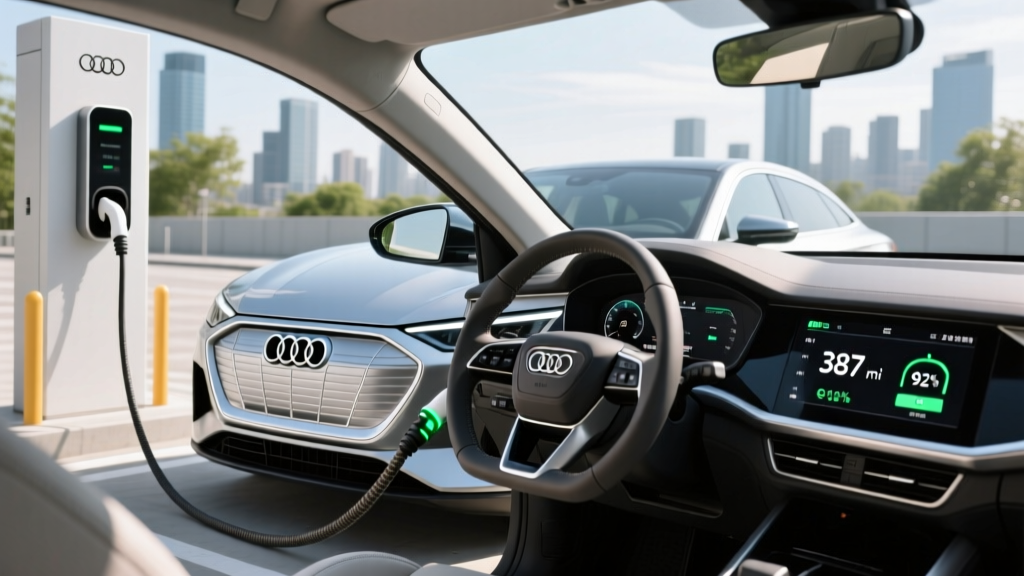
Charging speed is where Audi e-tron mileage anxiety either gets resolved or gets worse. The 2026 e-tron supports a peak DC fast-charge rate of 170 kW on a CCS1 connector. That's competitive but not class-leading — the Hyundai Ioniq 5 peaks at 240 kW, and the Porsche Macan Electric hits 270 kW on 800V architecture.
Here's what the charge curve actually looks like in practice:
| Charging Level | Power (kW) | Speed / Time |
|---|---|---|
| Level 1 (120V household) | 1.4 kW | ~3 miles per hour |
| Level 2 (240V, 40A circuit) | 9.6 kW | ~22 miles per hour; full charge in ~11 hours |
| Level 2 (240V, 48A circuit) | 11.5 kW | ~26 miles per hour; full charge in ~9.5 hours |
| DC Fast Charge (CCS1) | 170 kW peak | 10–80% in ~28 minutes |
| DC Fast Charge (sustained avg) | ~120 kW avg (10-80%) | ~200 miles added in 28 min |
The charge-curve reality: The e-tron hits 170 kW only briefly between roughly 10–30% state of charge. By 50% SoC, it tapers to around 120 kW, and above 80% it drops sharply to under 50 kW. This taper behavior is normal for NMC packs managed conservatively (Audi prioritizes battery longevity over peak speed), but it means your 10–80% session averages closer to 120 kW than the 170 kW headline.
Home charging setup: The e-tron's onboard charger accepts up to 11.5 kW on Level 2. A 48-amp hardwired wallbox (requiring a 60-amp circuit) delivers a full overnight charge in about 9.5 hours. Most owners install a 40-amp unit (9.6 kW) on a 50-amp breaker, which adds roughly 22 miles per hour of charging — plenty for daily use if you plug in each night. Expect $800–$1,500 for a quality Level 2 charger and professional installation, potentially more if your panel needs an upgrade to 200A service.
On the road, the CCS1 connector gives you access to Electrify America, EVgo, ChargePoint, and most non-Tesla networks. Audi includes a complimentary charging credit (typically 250 kWh at Electrify America) with new purchases, though terms vary by model year.
Performance & Drivetrain
The 2026 e-tron uses a dual-motor all-wheel-drive (quattro) setup producing 402 horsepower and 490 lb-ft of torque in Boost mode. The 0–60 mph time is 5.5 seconds. That's brisk for a 5,800-lb SUV, though it won't embarrass a Model X Plaid or even an iX M60.
What matters more for daily driving is the e-tron's refinement. Audi tunes the regen braking to feel progressive rather than aggressive, and the one-pedal driving mode is available but not as forceful as a Nissan LEAF or Chevrolet Bolt. The air suspension (standard on Prestige, optional on Premium Plus) smooths out road imperfections and adjusts ride height for efficiency at highway speed.
| Metric | Value |
|---|---|
| Drivetrain | Dual-motor AWD (quattro) |
| Horsepower (Boost) | 402 hp |
| Torque | 490 lb-ft |
| 0–60 mph | 5.5 seconds |
| Top Speed | 124 mph (electronically limited) |
| Towing Capacity | 4,000 lbs (with factory tow package) |
| Suspension | Adaptive air suspension (std/optional by trim) |
Pricing, Trims & Federal Tax Credit Eligibility
The 2026 Audi e-tron starts at $71,995 MSRP (Premium trim, including destination). Here's the trim breakdown:
| Trim | Base MSRP | As-Tested (typical options) | §30D Credit Eligibility |
|---|---|---|---|
| Premium | $71,995 | $73,500 | Eligible — up to $7,500 (income/sourcing rules apply) |
| Premium Plus | $77,495 | $82,000 | Eligible — up to $7,500 |
| Prestige | $83,995 | $89,000 | Eligible — up to $7,500 |
Federal tax credit (IRS §30D) details: The e-tron qualifies for up to $7,500 under current rules, but eligibility is not automatic. Per IRS guidelines, you must meet all of the following:
- Income cap: Modified AGI ≤ $150,000 (single), $225,000 (head of household), $300,000 (married filing jointly)
- MSRP cap: SUVs/vans/pickups must have MSRP ≤ $80,000. The Premium and Premium Plus trims qualify; a heavily optioned Prestige may exceed the cap — verify your build's MSRP before purchase.
- Battery sourcing: The $7,500 credit splits into two halves ($3,750 each): one for critical-mineral sourcing and one for battery-component manufacturing. Audi's supply chain has shifted significantly since 2023, but final assembly and battery-component origin determine your actual credit. Confirm with your dealer at point of sale.
- Point-of-sale transfer: You can transfer the credit to the dealer at purchase for an immediate price reduction, or claim it on your tax return (Form 8936).
Bottom line: A Premium-trim e-tron at ~$72K, with the full $7,500 credit applied at point of sale, lands around $64,500 before state incentives, taxes, or registration. That's competitive with a similarly equipped BMW iX but pricier than a Model X.
Interior, Cargo & Technology
The e-tron seats five with generous dimensions. Front legroom is 41.3 inches; rear legroom is 39.1 inches — both class-competitive. Cargo space behind the second row is 28.5 cubic feet, expanding to 57.0 cubic feet with the rear seats folded. There is no frunk (front trunk), which is a notable omission versus the Tesla Model X (which offers a small frunk) and the Rivian R1S.
Infotainment: The dual-screen MMI touch response system (10.1" upper, 8.6" lower) runs Audi's latest MIB4 software. Wireless Apple CarPlay and Android Auto are standard. The system is responsive but requires more menu-diving for climate controls than physical buttons would.
Driver assistance: Audi's Adaptive Cruise Assist with lane-centering is a Level 2 SAE system — it handles steering, acceleration, and braking on highways but requires your hands on the wheel and full attention. It is not self-driving. The available Park Assist Plus handles parallel and perpendicular parking autonomously. The e-tron earns IIHS Top Safety Pick+ when equipped with specific headlights.
Notable drawbacks: No frunk. The MMI dual-screen layout is less intuitive than BMW's iDrive or Tesla's single-screen approach. Rear visibility is compromised by thick C-pillars — the 360° camera system (standard on Premium Plus and above) is nearly mandatory for parking confidence.
Battery Warranty & Long-Term Ownership
Audi covers the e-tron's high-voltage battery with an 8-year / 100,000-mile warranty, guaranteeing a minimum of 70% capacity retention. The powertrain (motors, power electronics) carries the same 8/100k coverage. The basic vehicle warranty is 4 years / 50,000 miles.
NMC chemistry typically degrades 10–15% over the first 100,000 miles under normal use. Audi's conservative thermal management (liquid cooling with active preconditioning) is designed to keep degradation on the lower end of that range. If you plan to keep the e-tron beyond 150,000 miles, budget for potential battery module replacement — though full-pack replacements for the e-tron have run $15,000–$22,000 out of warranty, individual module service is less costly.
Ownership cost context: Electricity for the e-tron averages $0.13–$0.16/kWh on home Level 2 (national average), translating to roughly $5.50–$6.75 per 100 miles. Compare that to a gas SUV getting 22 MPG at $3.50/gallon ($15.90 per 100 miles), and the per-mile savings are substantial — approximately $9–$10 per 100 miles. Over 15,000 annual miles, that's $1,350–$1,500 in annual fuel savings.
Audi e-tron vs. Key Competitors: Mileage Comparison
| Metric | Audi e-tron | BMW iX xDrive50 | Mercedes EQE 350+ SUV | Genesis Electrified GV70 |
|---|---|---|---|---|
| EPA Range | 285 mi | 324 mi | 305 mi | 236 mi |
| Battery (usable) | ~106 kWh | ~105 kWh | ~90 kWh | ~74 kWh |
| MPGe (combined) | 79 | 86 | 85 | 83 |
| DC Fast Charge (peak) | 170 kW | 200 kW | 170 kW | 240 kW |
| 10–80% DC time | ~28 min | ~31 min | ~32 min | ~18 min |
| 0–60 mph | 5.5 sec | 4.4 sec | 6.4 sec | 4.5 sec |
| Base MSRP | $71,995 | $75,900 | $78,050 | $67,350 |
| §30D Credit | Up to $7,500 | Up to $7,500 | Up to $7,500 | Up to $7,500 |
Choose the BMW iX if: Maximum range (324 mi EPA) and efficiency (86 MPGe) are your top priorities, and you don't mind BMW's polarizing design language.
Choose the Genesis Electrified GV70 if: You want the lowest entry price ($67K), fastest DC charging (240 kW, 18-min 10–80%), and can accept the shorter 236-mile range as a trade-off.
Choose the Mercedes EQE SUV if: You want a balance of range (305 mi) and brand prestige, and you're willing to pay a premium for it.
Pros & Cons
Pros
- Quiet, refined cabin with excellent build quality
- Standard quattro AWD with 4,000-lb towing
- Adaptive air suspension (available) for superb ride comfort
- Conservative battery management promotes long-term health
- Competitive pricing within German luxury EVs
- Standard heat pump for cold-weather efficiency
Cons
- 79 MPGe is below class average (iX: 86, Model X: 102)
- No frunk — missed cargo opportunity
- 170 kW peak DC charge is outpaced by 800V competitors
- 285-mile EPA range trails iX (324) and EQE SUV (305)
- MMI dual-screen interface requires learning curve
- Heavy at 5,800 lbs impacts efficiency and tire wear
Who the Audi e-tron Suits Best
Daily commuters (30–80 miles round-trip): Ideal. Plug in nightly at home, wake up to a full charge, and never think about range. The e-tron's comfort and quiet make traffic bearable.
Families: Strong fit. Five seats, 28.5 cu ft cargo (strollers, groceries, sports gear), standard AWD for all-weather confidence, and IIHS Top Safety Pick+ rating. The lack of a frunk means you'll use the cargo area for everything.
Road-trippers: Workable with planning. A 500-mile trip requires one 25–30 minute DC fast-charge stop (at an Electrify America or EVgo 150+ kW station). The CCS1 network is robust on interstates but sparser in rural corridors. If you regularly drive 400+ miles in remote areas, the iX's 324-mile range provides more buffer.
Towing: The 4,000-lb capacity handles a small boat trailer or light camper. Expect range to drop 30–40% when towing at highway speeds — plan for 170–200 miles of range under load.
Frequently Asked Questions
What is the real-world range of the 2026 Audi e-tron?
In mixed driving at moderate temperatures, expect 255–275 miles. Sustained highway driving at 75 mph drops that to 245–265 miles. In sub-30°F winter conditions, plan for 210–230 miles. The EPA's 285-mile estimate is achievable in city-heavy driving with regen braking recovery.
How fast does the Audi e-tron charge at home and on the road?
On a 48-amp Level 2 home charger (11.5 kW), a full charge takes about 9.5 hours, adding ~26 miles per hour. On a DC fast charger, it peaks at 170 kW and charges from 10–80% in approximately 28 minutes, adding roughly 200 miles of range.
How much does the 2026 Audi e-tron cost after the federal tax credit?
The Premium trim starts at $71,995. With the full $7,500 §30D credit applied at point of sale (assuming you meet income, MSRP, and battery-sourcing requirements), the effective price drops to approximately $64,495 before state incentives, taxes, and registration.
Does the Audi e-tron qualify for the $7,500 federal EV tax credit?
Yes, the e-tron is on the IRS qualifying vehicle list. However, your personal eligibility depends on your modified adjusted gross income (≤$300K joint, ≤$150K single), the specific trim's MSRP (must be ≤$80K for SUVs), and the battery's critical-mineral and component sourcing at time of manufacture. Verify with your dealer and a tax professional.
Is the Audi e-tron worth buying vs. the BMW iX or Tesla Model X?
The e-tron wins on cabin quietness, ride comfort, and traditional luxury build quality. The BMW iX wins on range (324 mi), efficiency (86 MPGe), and performance (4.4 sec 0–60). The Tesla Model X wins on efficiency (102 MPGe), Supercharger network access, and cargo versatility (frunk + falcon-wing doors). If comfort and Audi's dealer/service network matter most, the e-tron is the right call.
What are the biggest drawbacks of the Audi e-tron?
The main compromises are efficiency (79 MPGe is below rivals), no front trunk, 170 kW peak charging that trails 800V competitors, and a curb weight of 5,800 lbs that accelerates tire wear. The MMI infotainment also has a steeper learning curve than BMW iDrive or Tesla's interface.