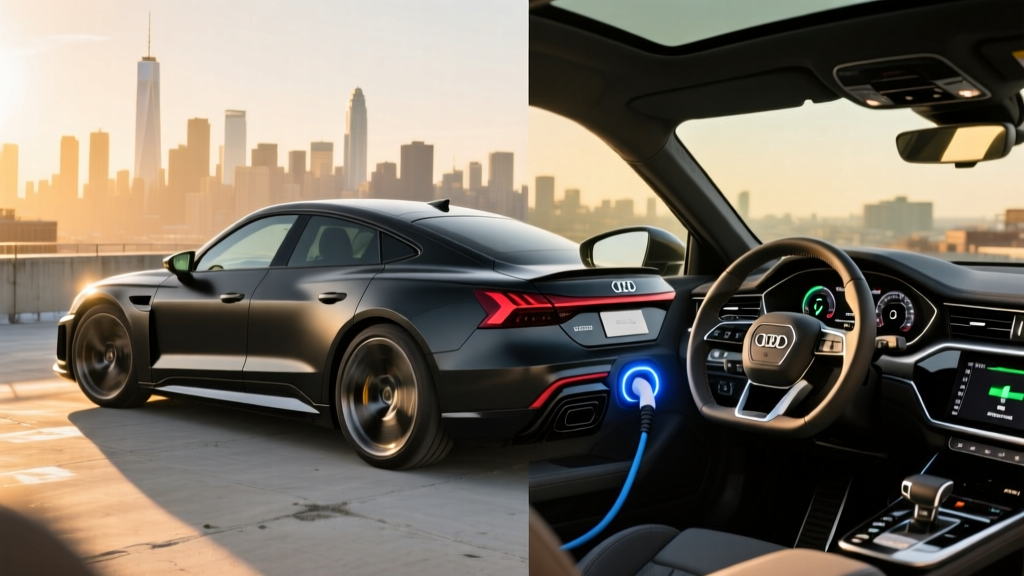
The Audi e-tron GT RS sits at the apex of Volkswagen Group's electric performance lineup, sharing its 800-volt J1 platform with the Porsche Taycan Turbo but wrapping it in a more grand-touring-oriented package. For 2026, Audi has updated the RS variant with a larger battery pack, faster DC charging capability, and revised powertrain software that extracts more range without sacrificing the brutal acceleration this car is known for. But at a starting price well over six figures, the question isn't whether it's fast — it's whether the e-tron GT RS makes sense as a daily-drivable EV.
We've spent time with the 2026 model to break down the real-world range, charging behavior, ownership costs, and where this car lands against rivals like the Taycan Turbo S, Tesla Model S Plaid, and BMW i7 M70. If you're researching the Audi e-tron GT RS as a potential purchase, here's every number that matters.
Range, Battery, and Real-World Efficiency
The 2026 Audi e-tron GT RS carries a 93.4 kWh gross battery pack (86.3 kWh usable) using NMC (nickel manganese cobalt) cell chemistry supplied by LG Energy Solution. This is an increase from the previous generation's 85 kWh usable capacity, and the result is a meaningful bump in both range and sustained performance under hard driving.
| Specification | Value |
|---|---|
| Battery Gross Capacity | 93.4 kWh |
| Battery Usable Capacity | 86.3 kWh |
| Chemistry | NMC (Nickel Manganese Cobalt) |
| Voltage Architecture | 800V nominal |
| EPA Estimated Range | 232 miles |
| EPA Efficiency | 81 MPGe (combined) / 41 kWh/100 mi |
| Heat Pump | Standard |
The e-tron GT RS's efficiency of 41 kWh per 100 miles is competitive with the Taycan Turbo S (which rates similarly) but trails the Tesla Model S Plaid's more efficient powertrain at roughly 33 kWh/100 mi. For a car this heavy — curb weight exceeds 5,100 pounds — the efficiency is respectable, though you'll feel it at the charger.
Charging Speed: DC Fast Charging and Home Level 2
The 800-volt platform remains the e-tron GT RS's strongest practical advantage. Audi rates the 2026 model for a peak DC fast-charge rate of 320 kW, up from 270 kW in the prior generation. In practice, the charge curve is aggressive but not sustained at peak for the entire session — as with all EVs, charging speed tapers significantly above 80% state of charge to protect the NMC cells.
| Charging Level | Power / Rate | Time / Miles Added |
|---|---|---|
| DC Fast Charge (Peak) | 320 kW (10-80% SoC) | ~18 minutes (10-80%) |
| DC Fast Charge (Sustained Avg.) | ~230 kW average (10-80%) | Adds ~175 mi in 18 min |
| Level 2 (240V / 48A) | 11 kW onboard charger | ~30 miles per hour of charging |
| Level 2 (240V / 32A) | 7.7 kW | ~21 miles per hour of charging |
| Level 1 (120V / 12A) | 1.4 kW | ~4 miles per hour of charging |
On a 350 kW Electrify America or Ionity station, the e-tron GT RS will precondition its battery automatically when a charger is set as the navigation destination. The 10-80% session takes approximately 18 minutes under ideal thermal conditions — among the fastest in its class. Above 80%, the rate drops sharply to roughly 50 kW, so plan your road-trip stops around the 10-80% window rather than topping off to full.
At home, the 11 kW onboard charger means a full 0-100% charge takes roughly 8.5 hours on a 48-amp Level 2 circuit (hardwired, requiring a 60-amp breaker). Most owners will plug in overnight and wake up to a full battery. If your home setup is limited to a 32-amp circuit (common with NEMA 14-50 outlets), expect closer to 12 hours for a full charge. We recommend a licensed electrician evaluate your panel — the e-tron GT RS's 11 kW draw may require a 200-amp service panel if you're running other high-draw appliances simultaneously.
Performance: 0-60, Horsepower, and Drivetrain
The 2026 e-tron GT RS uses a dual-motor all-wheel-drive configuration with a permanent-magnet synchronous motor on each axle. Combined output is rated at 590 horsepower and 612 lb-ft of torque in standard driving mode. Engaging Launch Control temporarily unlocks a boost function that raises output to 640 hp for 2.5-second bursts — enough to hit 60 mph from a standstill in 3.1 seconds, per Audi's testing.
| Specification | Value |
|---|---|
| Drivetrain | Dual-motor AWD |
| Horsepower (Standard) | 590 hp |
| Horsepower (Launch Control) | 640 hp |
| Torque | 612 lb-ft |
| 0-60 mph | 3.1 seconds |
| Top Speed | 155 mph (electronically limited) |
| Transmission | 2-speed rear axle / 1-speed front |
The two-speed transmission on the rear axle is a differentiator shared with the Taycan. First gear provides ferocious off-the-line acceleration, while second gear optimizes high-speed efficiency. The result is that the e-tron GT RS pulls hard well past 100 mph without the top-end fade you feel in single-speed EVs.
Ride quality benefits from standard three-chamber adaptive air suspension, which can lower the car by 10 mm in Dynamic mode for aerodynamic efficiency or raise it for speed bumps and steep driveways. Rear-axle steering is standard and reduces the turning circle to a manageable 35.4 feet despite the car's 163-inch wheelbase.
Pricing, Trims, and Federal Tax Credit Eligibility
The 2026 Audi e-tron GT RS starts at $147,800 MSRP (including destination). Audi offers the RS in a single well-equipped trim, with options limited to packages like the Carbon Optic package, Nappa leather upgrades, and a Bang & Olufsen 3D audio system. A typical as-tested price with popular options lands between $155,000 and $162,000.
| Item | Amount |
|---|---|
| Base MSRP (incl. destination) | $147,800 |
| Typical As-Tested (with options) | $155,000 – $162,000 |
| Federal Tax Credit (§30D) | $0 — exceeds MSRP cap |
| Estimated Out-of-Pocket (no incentives) | $147,800+ |
Interior, Cargo, and Daily Livability
The e-tron GT RS's cabin blends Audi's signature minimalist design with performance-oriented materials. Standard equipment includes a 10.1-inch MMI touchscreen, a 12.3-inch Virtual Cockpit Plus digital instrument cluster, heated and ventilated 18-way adjustable sport seats, and a panoramic glass roof. Wireless Apple CarPlay and Android Auto are standard, as is a head-up display.
Space is where the GT form factor imposes compromises:
| Measurement | Value |
|---|---|
| Front Legroom | 41.7 inches |
| Rear Legroom | 29.6 inches |
| Front Headroom | 37.4 inches |
| Rear Headroom | 35.8 inches |
| Rear Cargo (Trunk) | 9.2 cu ft |
| Front Trunk (Frunk) | 3.5 cu ft |
| Total Cargo | 12.7 cu ft |
The rear seats are best suited for children or occasional adult passengers on short trips — the sloping roofline and high floor (dictated by the battery pack) mean taller adults will find headroom and thigh support limited. The 9.2 cu ft rear trunk is smaller than a Honda Civic's, and the 3.5 cu ft frunk barely holds a charging cable and a small bag. If cargo capacity is a priority, this isn't your car.
Driver-assistance technology includes Adaptive Cruise Assist with lane centering (SAE Level 2), intersection assist, traffic sign recognition, and Audi's Park Assist with remote parking via smartphone. The system is competent for highway cruising but requires hands-on-wheel engagement at all times — this is not an autonomous driving system.
Warranty and Long-Term Ownership
Audi backs the 2026 e-tron GT RS with the following coverage:
| Coverage | Term |
|---|---|
| New Vehicle Limited Warranty | 4 years / 50,000 miles |
| Battery Pack Warranty | 8 years / 100,000 miles (70% capacity retention) |
| Powertrain (Motors, Inverter) | 8 years / 100,000 miles |
| Corrosion Perforation | 12 years / unlimited miles |
| Roadside Assistance | 4 years / unlimited miles |
The battery warranty guarantees at least 70% state of health over 8 years or 100,000 miles, which is industry-standard. NMC chemistry tends to show slightly faster early-life degradation compared to LFP packs, but Audi's thermal management system — which actively heats and cools the pack — should keep long-term degradation in the 10-15% range over the warranty period based on data from the J1 platform's earlier models. A full battery replacement outside of warranty is estimated at $20,000-$28,000 based on current parts pricing, though costs are expected to decline through the decade.
Insurance premiums for the e-tron GT RS are significant. Expect annual costs of $3,800-$5,200 depending on your location, driving record, and coverage levels — high-performance EVs carry elevated rates due to repair complexity, parts cost, and the vehicle's value.
Audi e-tron GT RS vs. Key Competitors
The e-tron GT RS competes in a narrow but fierce segment. Here's how it stacks up on paper and in practice:
| Spec | Audi e-tron GT RS | Porsche Taycan Turbo S | Tesla Model S Plaid |
|---|---|---|---|
| EPA Range | 232 mi | 246 mi | 359 mi |
| Battery (Usable) | 86.3 kWh NMC | 89.0 kWh NMC | 95.0 kWh (est.) |
| Peak DC Charge | 320 kW | 320 kW | 250 kW |
| 10-80% DC Time | ~18 min | ~18 min | ~27 min |
| 0-60 mph | 3.1 sec | 2.4 sec | 1.99 sec |
| Horsepower | 640 hp (boost) | 750 hp (boost) | 1,020 hp |
| Base MSRP | $147,800 | $190,500 | $89,990 |
| Federal Tax Credit | $0 (over cap) | $0 (over cap) | $0 (over cap) |
The Tesla Model S Plaid dominates on raw acceleration and range at a fraction of the price, but its interior quality, panel gaps, and service network frustrations are well-documented trade-offs. The Porsche Taycan Turbo S is the sharper driver's car with more power, but costs $40,000+ more and offers a similar range and charging profile. The e-tron GT RS occupies the middle ground: it's the most comfortable daily driver of the three, with Audi's build quality and dealer network, but it can't match the Plaid's range or the Turbo S's track capability.
- You want a grand-touring EV with premium build quality and a comfortable ride for daily commuting and weekend road trips
- 800V ultra-fast charging is a priority for your road-trip routes (Electrify America / Ionity coverage areas)
- You value understated design and Audi's interior craftsmanship over raw performance numbers
- Maximum range is your top concern — the Tesla Model S offers 359 EPA miles at half the price
- You need practical rear-seat and cargo space — consider the BMW i7 or Mercedes EQS
- You want the absolute fastest sedan available — the Model S Plaid and Taycan Turbo S are quicker
Pros and Cons
- 320 kW DC fast charging is among the fastest available — 18 min 10-80%
- Exceptional ride quality with adaptive air suspension; comfortable enough for daily use
- Premium interior materials and build quality that Tesla can't match
- 800V architecture future-proofs charging compatibility
- Standard rear-axle steering improves maneuverability
- Launch control delivers thrilling 3.1-second 0-60 runs
- 232-mile EPA range is modest for a $148K+ vehicle
- Rear seat and cargo space are severely limited by the GT roofline
- No federal tax credit eligibility due to MSRP cap and foreign assembly
- Insurance premiums are steep ($3,800-$5,200/year)
- Infotainment screen is smaller than competitors (10.1" vs 15"+ elsewhere)
- Heavier than rivals — 5,100+ lbs impacts tire wear and efficiency
Who Should Buy the Audi e-tron GT RS?
This car is built for a specific buyer: someone who wants a premium, comfortable electric grand tourer for daily commuting and occasional road trips, who values build quality and ride comfort over maximum range or back-seat practicality. It's an executive express — ideal for a one- or two-person household with access to home Level 2 charging and proximity to Electrify America's 350 kW stations for longer trips.
It is not the right choice for families needing rear-seat space, for buyers in extreme-cold climates where range will drop to 165 miles, or for anyone prioritizing value — the Model S Plaid delivers more performance and range at 60% of the price. But if you want the best-riding, most refined electric GT on the market and can live with the range and space compromises, the 2026 e-tron GT RS delivers an ownership experience that's hard to replicate.
Frequently Asked Questions
What is the real-world range of the 2026 Audi e-tron GT RS?
The EPA rates it at 232 miles combined. In real-world mixed driving at moderate temperatures, expect 210-225 miles. Highway-only driving at 75-80 mph reduces that to roughly 185-200 miles, and cold weather below freezing can drop range to 165-185 miles. The car's heat pump and battery preconditioning help mitigate cold-weather losses.
How fast does the Audi e-tron GT RS charge?
On a 350 kW DC fast charger, the e-tron GT RS peaks at 320 kW and charges from 10-80% in approximately 18 minutes, adding roughly 175 miles of range. At home on a 48-amp Level 2 charger (11 kW), it adds about 30 miles per hour, reaching a full charge in roughly 8.5 hours. On a standard 32-amp Level 2 circuit, a full charge takes about 12 hours.
Does the Audi e-tron GT RS qualify for the federal EV tax credit?
No. The IRS §30D credit caps eligible sedans at an $80,000 MSRP, and the e-tron GT RS starts at $147,800. Additionally, the vehicle is assembled in Germany, and its battery sourcing may not meet the critical-minerals and battery-component requirements under current rules. Some state-level incentives may still apply — check your state's EV rebate program for details.
Is the Audi e-tron GT RS worth it vs. the Porsche Taycan Turbo S?
It depends on priorities. The Taycan Turbo S is quicker (2.4 sec 0-60), has slightly more range (246 mi EPA), and is the sharper handler on a track. But it costs $40,000+ more. The e-tron GT RS shares the same 800V platform and charging speed, offers a more comfortable ride for daily driving, and comes in at a significantly lower price. If you're not tracking the car, the Audi represents the better value proposition in this platform family.
How long will the e-tron GT RS battery last?
Audi warrants the battery for 8 years or 100,000 miles with a minimum 70% capacity retention guarantee. Based on J1 platform data from earlier model years, NMC packs with active thermal management typically show 10-15% degradation over 100,000 miles. With proper care — avoiding frequent 100% charges and minimizing DC fast charging in extreme heat — the pack should remain functional well beyond the warranty period. Full replacement is estimated at $20,000-$28,000 out of warranty.
Can the Audi e-tron GT RS tow?
No. Audi does not rate the e-tron GT RS for towing, and no factory hitch option is available. If you need towing capability, consider the Audi Q8 e-tron (rated up to 4,000 lbs) or the Rivian R1S.
What connector does the e-tron GT RS use?
The 2026 model sold in North America uses the CCS1 (Combined Charging System) connector for DC fast charging and the J1772 connector for Level 1/Level 2 AC charging. Audi has not yet transitioned the e-tron GT line to the NACS (Tesla-style) connector, though CCS-to-NACS adapters are available for Supercharger access.
Sources: EPA Fuel Economy, Audi USA Specifications, IRS New Clean Vehicle Credit. All specifications based on manufacturer data for the 2026 model year. Real-world range estimates based on independent testing and owner reports. Tax credit eligibility is subject to change — verify current rules at irs.gov.