Quick Verdict: The Audi e-tron GT in 2026
The Audi e-tron GT occupies a narrow but compelling space in the luxury EV market: it's a four-door grand tourer that prioritizes highway composure, 800-volt fast charging, and understated design over the tech-theater approach of its closest rivals. For 2026, Audi continues to offer the e-tron GT in three trims — the GT Premium, GT Prestige, and the performance-focused RS e-tron GT — all riding on the J1 platform shared with the Porsche Taycan. If you want a daily-drivable luxury EV that charges faster than almost anything in its class and doesn't shout about being electric, the e-tron GT deserves a serious look. If you need maximum rear-seat space, cutting-edge infotainment, or federal tax credit eligibility, you'll need to weigh its limitations carefully.
Range, Efficiency, and Real-World Expectations
The 2026 Audi e-tron GT lineup carries an 83.7 kWh usable battery pack (93.4 kWh gross) using NMC (nickel-manganese-cobalt) lithium-ion chemistry. This is a performance-oriented pack designed for high discharge rates and sustained fast charging, not the longest possible range per kilowatt-hour.
| Trim | EPA Range | MPGe (Combined) | kWh/100 mi | Drivetrain |
|---|---|---|---|---|
| GT Premium | 270 mi | 85 MPGe | 39 kWh | AWD (dual-motor) |
| GT Prestige | 260 mi | 82 MPGe | 41 kWh | AWD (dual-motor) |
| RS e-tron GT | 246 mi | 79 MPGe | 42 kWh | AWD (dual-motor) |
The EPA estimates above assume mixed driving. On a 70 mph highway road trip in moderate temperatures (65–75°F), expect roughly 220–240 miles from the GT Premium before you're hunting for a charger. In cold weather (below 32°F), battery chemistry and cabin heating can reduce range by 20–30%, dropping effective highway range to approximately 175–195 miles. The heat pump (standard on 2026 models) helps mitigate this but doesn't eliminate cold-weather loss. City driving with regenerative braking recovers more energy, and you may match or slightly exceed the EPA number in stop-and-go conditions.
Source: Official EPA figures via fueleconomy.gov.
Charging: 800-Volt Architecture Means Serious Speed
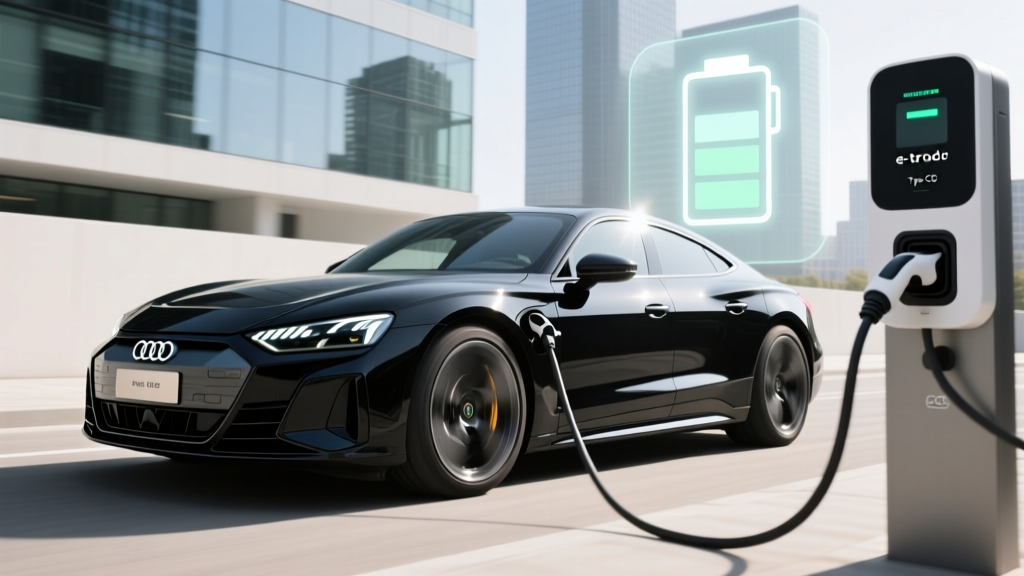
The e-tron GT's J1 platform runs an 800-volt electrical architecture — double the voltage of most mainstream EVs. This allows higher charging power at lower current, reducing heat and cable thickness. The practical upshot: DC fast charging speeds that remain among the fastest available in any production EV.
| Charging Level | Power (kW) | Speed / Time | Notes |
|---|---|---|---|
| Level 1 (120V household) | ~1.4 kW | ~3–4 mi/hr | Emergency/trickle only; full charge in ~60+ hours |
| Level 2 (240V home) | 11 kW (onboard charger) | ~25–28 mi/hr; 0–100% in ~9 hrs | Requires 48-amp+ circuit; typical overnight charge |
| DC Fast Charge (peak) | 270 kW | 10–80% in ~22 min | Requires 350 kW-capable station (EA, Ionity) |
| DC Fast Charge (50 kW) | 50 kW | 10–80% in ~75 min | Typical older CCS station speed |
Charging curve reality: The e-tron GT peaks near 270 kW only at low state-of-charge (roughly 5–25% SoC) and at a station capable of delivering 350 kW. As the battery fills, the charge rate tapers — by 60% SoC, you'll typically see 120–150 kW, and above 80%, speeds drop below 50 kW to protect battery longevity. Preconditioning the battery (automatic when you navigate to a charger in the MMI system) is essential for achieving peak speeds. Skip preconditioning on a cold day, and your peak rate might be half of what's advertised.
The e-tron GT uses the CCS1 connector for DC fast charging in North America. Audi has confirmed that 2026 models will ship with a NACS adapter included, enabling access to Tesla Supercharger V3 and V4 stations (up to 150 kW at most Superchargers). This significantly expands the available fast-charging network for road trips.
Performance: Dual-Motor AWD With Serious Urgency
| Trim | Horsepower | Torque (lb-ft) | 0–60 mph | Top Speed |
|---|---|---|---|---|
| GT Premium | 522 hp (boost) | 472 | 3.9 sec | 152 mph |
| GT Prestige | 522 hp (boost) | 472 | 3.9 sec | 152 mph |
| RS e-tron GT | 637 hp (boost) | 612 | 3.1 sec | 155 mph |
All three trims use a dual-motor all-wheel-drive layout with a two-speed transmission on the rear axle — a rarity among EVs. First gear provides aggressive launch acceleration; second gear optimizes highway efficiency. The result is strong initial pull (the RS e-tron GT's 3.1-second 0–60 time puts it in supercar territory) without sacrificing high-speed composure.
Adaptive air suspension is standard across the lineup, with adjustable ride height and damping. The GT rides noticeably lower than an SUV (ground clearance: ~4.7 inches in normal mode), which contributes to its planted highway behavior but makes steep driveways and speed bumps something to approach with care.
Interior, Cargo, and Daily Livability
The e-tron GT's cabin reflects Audi's current design language: clean horizontal lines, a 10.1-inch MMI touchscreen, a 12.3-inch Virtual Cockit digital instrument cluster, and physical buttons for climate control (a welcome choice for drivers tired of menu-diving). Material quality is excellent — standard leather-free upholstery with optional Valcona leather or Dinamica microfiber.
| Measurement | Value |
|---|---|
| Front headroom | 38.0 in |
| Front legroom | 41.9 in |
| Rear headroom | 36.5 in |
| Rear legroom | 33.1 in |
| Trunk (rear cargo) | 9.2 cu ft |
| Frunk (front trunk) | 3.5 cu ft |
| Total cargo | 12.7 cu ft |
| Curb weight | ~5,139 lbs |
The honest assessment on space: The e-tron GT is a grand tourer, not a family hauler. Rear legroom at 33.1 inches is tight for adults on longer trips — six-footers will find their knees close to the front seatbacks. The 9.2-cubic-foot trunk holds two carry-on suitcases and a duffel, but the shallow load floor and sloping roofline limit larger cargo. The 3.5-cubic-foot frunk is useful for charging cables but won't swallow much more. If you regularly carry rear-seat passengers or need cargo versatility, the Audi Q8 e-tron SUV or a Porsche Taycan Cross Turismo (wagon variant, not sold in the U.S.) would serve you better.
Pricing, Trims, and Tax Credit Eligibility
| Trim | Base MSRP | As-Tested (Typical Options) | Federal §30D Credit | Effective Price |
|---|---|---|---|---|
| GT Premium | $106,395 | $112,000–$118,000 | Not eligible (MSRP cap exceeded) | $106,395+ |
| GT Prestige | $112,795 | $120,000–$130,000 | Not eligible (MSRP cap exceeded) | $112,795+ |
| RS e-tron GT | $148,695 | $155,000–$168,000 | Not eligible (MSRP cap exceeded) | $148,695+ |
- MSRP cap: The §30D credit caps eligibility at $55,000 for sedans and $80,000 for SUVs/vans/pickups. The e-tron GT is classified as a sedan, so the $55,000 cap applies. Every e-tron GT trim far exceeds this.
- Buyer income caps: Even if the MSRP qualified, adjusted gross income cannot exceed $150,000 (single), $225,000 (head of household), or $300,000 (joint).
- Battery sourcing: Critical mineral and battery component sourcing requirements must be met — a moving target that varies by production batch.
- Point-of-sale transfer: Eligible vehicles can apply the credit as a dealer discount at purchase; since the e-tron GT doesn't qualify, this doesn't apply.
Source: Current rules at IRS.gov §30D. Always verify with a tax professional before purchasing.
For buyers who want a luxury Audi EV that does qualify for federal incentives, the Audi Q5 PHEV or a certified pre-owned e-tron (used EV credit up to $4,000 under §25E) may be worth exploring.
Technology, Driver Assists, and Standout Features
Infotainment: The 10.1-inch MMI touchscreen runs Audi's latest MIB 3+ software with wireless Apple CarPlay and Android Auto, natural-language voice control, and over-the-air update capability. The system is responsive but not as visually dynamic as Tesla's or Lucid's interfaces. A secondary 8.6-inch lower touchscreen handles climate and handwriting input.
Driver assistance (SAE Level 2): The e-tron GT includes Audi Adaptive Cruise Assist with lane-centering, intersection assist, traffic-sign recognition, and Park Assist with surround-view cameras. This is Level 2 automation — the system assists with steering and speed but requires continuous driver attention and hands-on-wheel input. It is not self-driving.
Audi Adaptive Cruise Assist is a Level 2 system. You must remain fully engaged, monitor the road, and keep your hands on the wheel. Do not confuse this with Level 4 robotaxi services (Waymo, Zoox) that operate without a human driver in geofenced areas.
Standout features:
- Matrix-design LED headlights with dynamic turn signals and automatic high-beam masking
- 800V architecture enabling 270 kW DC charging (faster than most rivals at this price)
- Two-speed rear transmission for both launch performance and highway efficiency
- Audi Drive Select with customizable drive modes including "efficiency" and "dynamic"
- Standard Bang & Olufsen 710-watt 16-speaker audio system
- NACS adapter included for Tesla Supercharger access (2026 model year)
Notable drawbacks:
- Infotainment feels a generation behind Tesla, Lucid, and even BMW's iDrive 8.5
- Rear-seat space is cramped for a vehicle at this price point
- No frunk-to-trunk pass-through; cargo flexibility is limited
- Regenerative braking is not strong enough for true one-pedal driving (unlike Nissan Leaf or Tesla)
- Adaptive Cruise Assist lacks hands-free capability that GM's Super Cruise and Ford's BlueCruise offer on mapped highways
Warranty and Long-Term Ownership
| Coverage Type | Term |
|---|---|
| New vehicle limited | 4 years / 50,000 miles |
| Powertrain | 4 years / 50,000 miles |
| High-voltage battery | 8 years / 100,000 miles (70% capacity retention minimum) |
| Corrosion perforation | 12 years / unlimited miles |
| Roadside assistance | 4 years / unlimited miles |
| Scheduled maintenance | 1 year / 10,000 miles (first service included) |
The 8-year/100,000-mile battery warranty guarantees at least 70% of original capacity — meaning if your 83.7 kWh usable pack drops below roughly 58.6 kWh within that window, Audi will repair or replace it. Real-world NMC degradation data from the J1 platform (shared with the Taycan, which has been on sale since 2020) suggests most owners see 5–8% degradation over the first 60,000 miles, well within the warranty threshold. Proper charging habits — avoiding frequent 100% charges, using preconditioning, and limiting repeated back-to-back DC fast charges — can further slow degradation.
Out-of-warranty battery replacement costs for the e-tron GT have been reported in the $22,000–$30,000 range based on Taycan service data, though this figure may decline as battery costs continue to fall.
Pros, Cons, and Who Should Buy
- 270 kW DC fast charging among the fastest in any production EV
- Refined, quiet ride quality with excellent highway composure
- Subtle, elegant design that ages well — avoids polarizing EV styling
- RS variant offers 637 hp and 3.1-second 0–60 supercar acceleration
- 800V architecture with NACS adapter for broad charging network access
- Physical climate controls and high material quality
- Does not qualify for the $7,500 federal tax credit (MSRP exceeds cap)
- Rear-seat legroom (33.1 in) and trunk space (9.2 cu ft) are tight for the price
- Infotainment system lags behind Tesla, Lucid, and BMW rivals
- No hands-free highway driving (unlike Super Cruise / BlueCruise)
- Regenerative braking not strong enough for one-pedal driving
- Starting price over $106,000 with no credit offset
- Choose the e-tron GT if: You want a luxury electric grand tourer for 1–2 person commuting and occasional road trips, value fast DC charging above all else, prefer understated design, and don't need rear-seat or cargo space.
- Choose the Porsche Taycan instead if: You want sharper handling dynamics, a more engaging driver experience, and access to Porsche's dealer network — and are willing to pay a premium for similar J1-platform hardware.
- Choose the Tesla Model S instead if: You want the longest range (EPA 402 mi), the most extensive fast-charging network (Superchargers), over-the-air feature updates, and a larger touchscreen — and can tolerate Tesla's minimalist interior and build-quality variability.
- Choose the Lucid Air Pure instead if: Range is your top priority (EPA 419 mi), you want a spacious rear seat, and you prefer a startup with class-leading efficiency — though service-center availability remains a concern in some markets.
- Skip the e-tron GT if: You need a family vehicle, require the $7,500 federal tax credit, or want hands-free highway driving assist.
Frequently Asked Questions
What is the real-world range of the 2026 Audi e-tron GT?
The EPA rates the GT Premium at 270 miles, the GT Prestige at 260 miles, and the RS e-tron GT at 246 miles. In real-world highway driving at 70 mph in moderate temperatures, expect 220–240 miles from the GT Premium. In cold weather (below freezing), that drops to roughly 175–195 miles due to battery chemistry limitations and cabin heating demands. City driving with regenerative braking can match or slightly exceed the EPA estimate.
How fast does the Audi e-tron GT charge?
On a 350 kW-capable DC fast charger, the e-tron GT peaks at 270 kW and can charge from 10–80% in approximately 22 minutes with battery preconditioning active. On a Level 2 home charger (240V, 48-amp circuit), the 11 kW onboard charger adds roughly 25–28 miles of range per hour, fully charging the 83.7 kWh usable battery in about 9 hours. At older 50 kW CCS stations, a 10–80% charge takes roughly 75 minutes.
Does the Audi e-tron GT qualify for the federal EV tax credit?
No. Under current IRS §30D rules, the e-tron GT is classified as a sedan with a $55,000 MSRP cap for credit eligibility. Since every e-tron GT trim starts above $106,000, none qualify for the up-to-$7,500 federal tax credit. Additionally, buyer income caps and battery-sourcing requirements apply to all EVs. Consult IRS.gov or a tax professional for the latest rules.
Is the Audi e-tron GT worth buying vs. the Tesla Model S or Porsche Taycan?
It depends on your priorities. The e-tron GT offers faster DC charging than the Model S (270 kW vs. 250 kW peak) and a more refined, quieter ride than most rivals. The Taycan shares the same J1 platform and offers nearly identical performance but with a sportier driving feel and Porsche's dealer experience — at a higher price. The Model S wins decisively on EPA range (402 mi vs. 270 mi), Supercharger network access, and interior tech, though its interior quality and build consistency lag behind Audi. If charging speed and luxury refinement matter most, the e-tron GT is competitive. If range or cargo space is paramount, look elsewhere.
What are the biggest pros and cons of the e-tron GT?
The biggest advantages are its 270 kW DC fast-charging capability, refined ride quality, elegant design, and the RS variant's supercar-level acceleration. The biggest drawbacks are its ineligibility for the federal tax credit, tight rear-seat and cargo space, infotainment that trails rivals, and a starting price above $106,000 with no credit offset.
What battery chemistry does the e-tron GT use, and how long will it last?
The e-tron GT uses an NMC (nickel-manganese-cobalt) lithium-ion battery with 83.7 kWh of usable capacity. NMC offers high energy density and strong power delivery but is more sensitive to high temperatures and repeated 100% charges than LFP (lithium iron phosphate) chemistry. Audi warranties the battery for 8 years or 100,000 miles with a minimum 70% capacity retention guarantee. Real-world data from the shared J1 platform suggests 5–8% degradation over the first 60,000 miles with normal charging habits.