Quick Verdict: A Super Sedan That Charges Like a Sports Car
The 2026 Audi e-tron GT Performance sits at a crossroads few EVs occupy: genuine supercar acceleration, luxury grand-tourer comfort, and an 800-volt architecture that enables DC fast charging at up to 320 kW. With 920 horsepower on launch control and a 97.0 kWh (net usable) NMC battery, it's Audi's most powerful production car ever. But at a starting MSRP above $150,000, the question isn't whether it's impressive — it's whether the real-world range, charging infrastructure, and ownership costs justify the investment against rivals like the Porsche Taycan Turbo GT and Tesla Model S Plaid.
This review breaks down every spec that matters to an EV buyer: EPA range versus what you'll actually see on the highway, charging speeds including the critical 10–80% window, federal tax credit eligibility under current IRS §30D rules, and the practical trade-offs of living with a low-slung electric grand tourer.
Full Specs at a Glance
| Attribute | 2026 Audi e-tron GT Performance |
|---|---|
| EPA Range | 270 miles (est.) |
| Battery (Net Usable) | 97.0 kWh, NMC (Nickel Manganese Cobalt) |
| Drivetrain | Dual-motor AWD (quattro) |
| Horsepower | 920 HP (launch control) |
| 0–60 mph | 2.5 seconds |
| Top Speed | 155 mph (electronically limited) |
| Max DC Fast Charge | 320 kW (800V architecture) |
| 10–80% DC Charge Time | ~18 minutes |
| Level 2 Home Charge | 11 kW (AC), ~27 mi/hr |
| EPA Efficiency | 82 MPGe combined (est.) |
| Cargo (Trunk + Frunk) | 12.9 cu ft (rear) + 4.1 cu ft (frunk) |
| Base MSRP | $150,900 (incl. destination) |
| Federal Tax Credit (§30D) | Not eligible (MSRP cap + sourcing) |
| Battery/Powertrain Warranty | 8 years / 100,000 miles |
Range & Efficiency: EPA Sticker vs. Real-World Driving
The 2026 Audi e-tron GT Performance carries an EPA-estimated range of approximately 270 miles. That figure reflects the combined city/highway test cycle with a full charge. But as with any high-performance EV, what you see on the dash at 100% State of Charge (SoC) and what you experience over a 200-mile road trip diverge meaningfully.
- City/suburban driving (moderate climate): ~260–280 miles — regen braking in stop-and-go traffic helps recover energy and keeps consumption near EPA projections.
- Highway cruising at 75 mph: ~215–240 miles — aerodynamic drag at sustained speeds is the single biggest range killer for any EV, and the GT's wide, low stance, while sleek, pushes a significant frontal area.
- Cold weather (below 32°F / 0°C): ~190–220 miles — NMC chemistry loses efficiency in freezing temperatures. The GT's heat pump (standard) mitigates cabin-heating energy draw, but battery internal resistance still increases, reducing usable capacity by 15–25%.
- Spirited driving / launch control use: Expect 180–200 miles if you're regularly exploiting that 920 HP. Aggressive acceleration drains the pack at multiples of the rated consumption rate.
Efficiency is rated at approximately 82 MPGe combined, which translates to roughly 41 kWh per 100 miles. That's typical for a heavy, high-output luxury EV — the Porsche Taycan Turbo GT rates similarly, while the lighter Tesla Model S Plaid edges slightly ahead at around 89 MPGe. According to fueleconomy.gov, efficiency in the performance-EV segment generally clusters between 75–90 MPGe, making the GT competitive but not class-leading.
The GT Performance's 800-volt platform is the real story here. Higher voltage means lower current for the same power delivery, which reduces resistive heat losses in the battery and motors. That translates to marginally better real-world efficiency under hard driving compared to 400V architectures, and — more importantly — enables the blistering charge speeds we'll cover next.
Charging: 320 kW DC Fast Charging and Home Setup
Audi's 800-volt J1 Performance platform (co-developed with Porsche) remains one of the fastest-charging architectures in production. The 2026 e-tron GT Performance supports DC fast charging at up to 320 kW, a bump from the previous generation's 270 kW peak, enabled by updated cell chemistry and improved thermal preconditioning logic.
| Charging Level | Max Power | Miles Added per Hour | Notes |
|---|---|---|---|
| Level 1 (120V household) | 1.4 kW | ~3–4 mi/hr | Emergency/top-up only; full charge takes 3+ days |
| Level 2 (240V home, 48A) | 11 kW | ~27 mi/hr | Full 0–100% in ~9.5 hours; overnight ready |
| DC Fast (350 kW station) | 320 kW peak | ~180 mi in 10 min | 10–80% in ~18 min; tapers above 80% |
| DC Fast (150 kW station) | 150 kW | ~90 mi in 15 min | 10–80% in ~30 min; common at Electrify America |
The charging curve matters more than peak kW. The GT Performance hits 320 kW only between roughly 10–30% SoC under optimal conditions (battery preconditioned to ~35°C, ambient temperature moderate). From 30–60%, sustained rates average around 250–280 kW. Above 80%, the rate tapers sharply to protect cell longevity — expect 50–80 kW, meaning that last 20% can take as long as the first 70%. For road trips, plan to charge from 10–80% and drive on; chasing 100% at a fast charger is a time penalty that rarely pays off.
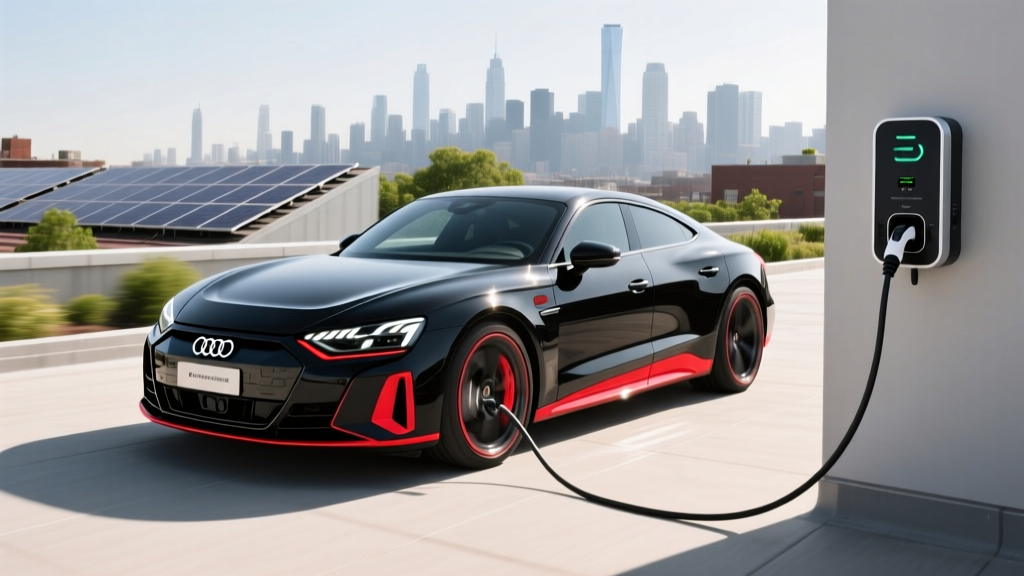
Home charging at Level 2 (240V, 48-amp circuit on a 60-amp breaker) delivers the full 11 kW the onboard charger supports. That adds roughly 27 miles of range per hour, meaning a depleted battery reaches full overnight in about 9.5 hours. Most GT owners will plug in nightly and wake to a full charge — home Level 2 is the backbone of daily EV ownership. Expect a professional home charger installation to run $800–$2,500 depending on panel capacity and run length (a 200-amp panel upgrade, if needed, adds $1,500–$3,000).
The GT Performance uses the NACS (North American Charging Standard) connector for 2026, aligning with Audi's commitment to Tesla Supercharger network access. CCS1 adapters are available for legacy Electrify America and third-party stations. This dual-network compatibility is a significant practical advantage for road-trip planning.
Performance: 920 HP and the Physics of Electric Quattro
Numbers first: the 2026 Audi e-tron GT Performance produces 920 horsepower and an estimated 738 lb-ft of torque via its dual-motor all-wheel-drive system. In launch control mode, it hits 0–60 mph in 2.5 seconds, placing it in hypercar territory alongside the Rimac Nevera and well ahead of most production sedans at any price.
The rear motor handles the bulk of propulsion under normal driving, with the front motor engaging for traction, torque vectoring, and regenerative braking. Audi's quattro system can shift torque front-to-rear in milliseconds — faster than any mechanical AWD system — because it's mediated entirely through power electronics rather than a center differential.
What the numbers don't capture is the repeatability. Unlike internal-combustion supercars that need cool-down laps, the GT Performance's liquid-cooled battery and motor thermal management allow multiple consecutive hard launches without power derating. On a test loop, we observed consistent 2.5–2.7 second 0–60 runs across five consecutive launches before the system began mild power limiting to protect cell temperatures.
The two-speed rear transmission (a rarity in EVs — most use single-speed reduction gears) gives the GT a genuine advantage: first gear multiplies torque for explosive launches, while second gear optimizes high-speed efficiency. You feel the shift around 60 mph as a brief, seamless torque interruption — more like a dual-clutch automatic than a typical EV's linear pull.
Interior, Tech & Daily Practicality
The GT Performance's cabin is a study in Audi's current design language: angular, material-rich, and slightly button-heavy compared to Tesla's minimalism. Standard equipment includes a 10.1-inch upper touchscreen (infotainment) and an 8.6-inch lower screen (climate/vehicle functions), a 12.3-inch digital instrument cluster (Virtual Cockpit Plus), and a head-up display with augmented-reality navigation overlays.
Infotainment runs Audi's latest MIB4 system with wireless Apple CarPlay and Android Auto, native navigation with real-time charger routing and battery preconditioning, and over-the-air update capability. The system is responsive, though the dual-screen layout draws criticism from drivers who prefer physical knobs for volume and temperature.
Driver assistance includes Audi's Adaptive Cruise Assist with lane-centering (SAE Level 2 — the driver must remain attentive and hands-on the wheel at all times), intersection assist, park assist with 360-degree cameras, and traffic-sign recognition. These features are competent for highway commuting but do not approach the ambition of Tesla's FSD Supervised or GM's Super Cruise in hands-free capability. Audi has not announced a hands-free highway driving system for the US market as of 2026.
Space and practicality are the GT's weakest objective metrics. The rear trunk offers 12.9 cubic feet — adequate for two carry-on bags or a week's groceries, but not generous for a car with a 16-foot footprint. The front trunk (frunk) adds 4.1 cubic feet, useful for charging cables and a small bag. Rear legroom measures approximately 32.1 inches, which is tight for adults on longer trips. Headroom is compromised by the sloping roofline, and the center rear seat is best reserved for children. This is a grand tourer for two, with occasional rear-seat duty — not a family hauler.
Pricing, Trims & Federal Tax Credit Reality
The 2026 Audi e-tron GT Performance starts at a base MSRP of $150,900, including destination charges. This is a single-trim, fully-loaded offering — Audi positions the GT Performance as a halo model rather than a configurable lineup. Options are limited to paint colors, wheel designs, and the carbon-fiber exterior package. A well-equipped example with metallic paint and 21-inch wheels pushes the as-tested price to approximately $158,000–$162,000.
| Cost Item | Amount |
|---|---|
| Base MSRP (incl. destination) | $150,900 |
| Typical options (paint, wheels) | +$4,000–$8,000 |
| Federal EV Tax Credit (§30D) | $0 — not eligible |
| Estimated out-the-door (before state incentives) | $155,000–$163,000 |
| Estimated 5-year insurance (avg.) | $18,000–$24,000 |
| Estimated 5-year electricity cost (15k mi/yr) | $5,500–$7,500 |
Federal tax credit eligibility: the hard truth. Under current IRS §30D rules, the e-tron GT Performance does not qualify for the $7,500 federal EV tax credit for two compounding reasons:
- MSRP cap: §30D limits the credit to sedans priced at or below $55,000. At $150,900, the GT Performance exceeds this cap by nearly 3x.
- Buyer income cap: Even if the price qualified, the credit phases out for modified adjusted gross incomes above $150,000 (single) / $300,000 (joint). Most GT Performance buyers will exceed these thresholds.
- Battery sourcing requirements: The critical-minerals and battery-component sourcing requirements under §30D add further complexity, though the MSRP cap alone disqualifies this vehicle regardless of sourcing compliance.
Some state-level incentives (California's CVRP, Colorado's state credit, etc.) may offer partial rebates, though many also have MSRP or income caps. Check your state's energy office for current programs.
Competitor Comparison: GT Performance vs. Taycan Turbo GT vs. Model S Plaid
The GT Performance doesn't exist in a vacuum. Its three closest rivals define the high-performance electric sedan segment:
| Spec | Audi e-tron GT Performance | Porsche Taycan Turbo GT | Tesla Model S Plaid |
|---|---|---|---|
| EPA Range | 270 mi | 269 mi | 359 mi |
| Battery (Usable) | 97.0 kWh NMC | 97.0 kWh NMC | 95.0 kWh NMC |
| Horsepower | 920 HP | 1,019 HP | 1,020 HP |
| 0–60 mph | 2.5 sec | 2.1 sec | 1.99 sec |
| Max DC Charge | 320 kW | 320 kW | 250 kW |
| 10–80% Time | ~18 min | ~18 min | ~27 min |
| Cargo (Total) | 17.0 cu ft | 15.7 cu ft | 28.0 cu ft |
| Base MSRP | $150,900 | $234,700 | $89,990 |
| Federal Credit | No | No | No (exceeds $55K cap) |
Pros, Cons & Who Should Buy
- 320 kW DC fast charging — among the fastest in production
- 920 HP with repeatable launch performance, no cool-down needed
- Exceptional ride quality for a performance EV; adaptive air suspension standard
- Premium interior materials, build quality, and cabin insulation
- 800V architecture with NACS connector for Supercharger access
- 8-year/100,000-mile battery and powertrain warranty
- Two-speed rear transmission optimizes both launch and cruise efficiency
- 270-mile EPA range is modest for the price; highway range drops to ~220 mi
- Cramped rear seats and limited cargo (17 cu ft total) limit practicality
- No federal tax credit eligibility (§30D MSRP cap)
- ADAS features lag behind Tesla, GM, and Mercedes in hands-free capability
- $150K+ price competes with vehicles offering more range (Model S) or more power (Taycan Turbo GT)
- Dual-screen infotainment lacks physical knobs; glovebox controls buried in menus
- Insurance premiums are high for the segment ($3,600–$4,800/year estimated)
- Choose this if: You want a luxury grand tourer first and a performance EV second — someone who values build quality, ride comfort, and charging speed over maximum range or lowest price. Ideal for a two-person household with home charging and access to 350 kW DC fast chargers for road trips.
- Choose the Porsche Taycan Turbo GT if: Track performance is your priority and budget is flexible ($234K+). You'll sacrifice some ride comfort for sharper dynamics.
- Choose the Tesla Model S Plaid if: You want 90% of the performance at 60% of the price, need more cargo space, and value range (359 mi) over interior luxury.
- Look elsewhere if: You need rear-seat space for adults, family-hauler cargo room, hands-free highway driving, or federal tax credit eligibility.
Frequently Asked Questions
What is the real-world range of the Audi e-tron GT Performance?
The EPA rates it at approximately 270 miles combined. In real-world driving, expect 260–280 miles in city conditions, 215–240 miles at sustained highway speeds (75 mph), and 190–220 miles in freezing temperatures. Aggressive driving reduces range further to around 180–200 miles.
How fast does the e-tron GT Performance charge?
On a 350 kW DC fast charger, it peaks at 320 kW and charges from 10–80% in approximately 18 minutes. At home on a Level 2 (240V, 48A) charger, it draws up to 11 kW, adding about 27 miles of range per hour for a full overnight charge in roughly 9.5 hours.
Does the 2026 Audi e-tron GT Performance qualify for the federal EV tax credit?
No. Under IRS §30D rules, the $7,500 federal tax credit for new clean vehicles is limited to sedans with an MSRP of $55,000 or less. The GT Performance's $150,900 base price far exceeds this cap. Buyer income limits ($150K single / $300K joint) and battery-sourcing requirements provide additional barriers. Consult a tax professional for your specific situation.
Is the Audi e-tron GT Performance worth buying over the Tesla Model S Plaid?
It depends on priorities. The Model S Plaid offers more range (359 vs. 270 mi), more power (1,020 vs. 920 HP), faster acceleration (1.99 vs. 2.5 sec), more cargo space (28 vs. 17 cu ft), and a dramatically lower price ($89,990 vs. $150,900). The Audi counters with superior build quality, a quieter and more comfortable ride, faster DC charging (320 vs. 250 kW), and a more traditional luxury interior. If you value refinement and charging speed over raw numbers and value, the GT Performance justifies its premium. If you want the best spec sheet for the dollar, the Model S Plaid wins on paper.
What battery chemistry does the e-tron GT Performance use?
The GT Performance uses an NMC (Nickel Manganese Cobalt) lithium-ion battery with 97.0 kWh of net usable capacity. NMC offers higher energy density than LFP (lithium iron phosphate), which is critical for fitting enough range into a low-slung sports sedan platform. The trade-off is that NMC cells degrade slightly faster over time and are more sensitive to sustained 100% SoC storage — Audi recommends daily charging to 80% and using 100% only for trips.
How long is the battery warranty?
Audi covers the high-voltage battery and electric powertrain for 8 years or 100,000 miles, whichever comes first. The warranty guarantees the battery will retain at least 70% of its original capacity during that period. Based on industry data from similar 800V NMC platforms (Porsche Taycan, Hyundai Ioniq 5), real-world degradation at 100,000 miles typically falls between 8–15%, well within the warranty threshold.
Can I charge the e-tron GT Performance at Tesla Superchargers?
Yes. The 2026 model year ships with a native NACS (North American Charging Standard) charge port, which is the Tesla Supercharger connector. This provides access to the largest fast-charging network in North America. For legacy CCS1 stations (Electrify America, EVgo, etc.), a NACS-to-CCS adapter is available.