The Audi e-tron GT has always been a paradox: a four-door grand tourer that shares its J1 platform with the Porsche Taycan yet wraps it in a cabin that prioritizes serenity over sportiness. For 2026, Audi refreshes the GT with a larger 105 kWh (93.4 kWh usable) NMC lithium-ion pack, faster DC charging, and a subtly reworked interior that addresses the biggest complaints from early adopters — namely, touch-sensitive controls and cramped rear headroom. This review focuses on the 2026 Audi e-tron GT interior experience, real-world range, and the ownership math that matters before you sign.
Quick Verdict: Who the e-tron GT Is For
If you want a luxury EV that whispers rather than shouts — one that can cover 250 real-world highway miles in comfort, charge from 10–80% in roughly 20 minutes on a 350 kW station, and still turn heads at the valet — the e-tron GT remains a top pick. It's not the most spacious sedan in its class, and the starting price is steep, but the cabin execution and ride refinement are difficult to match. Choose this if you value interior craftsmanship and effortless cruising over outright track performance or maximum cargo space.
2026 Audi e-tron GT Interior: Materials, Layout & Comfort
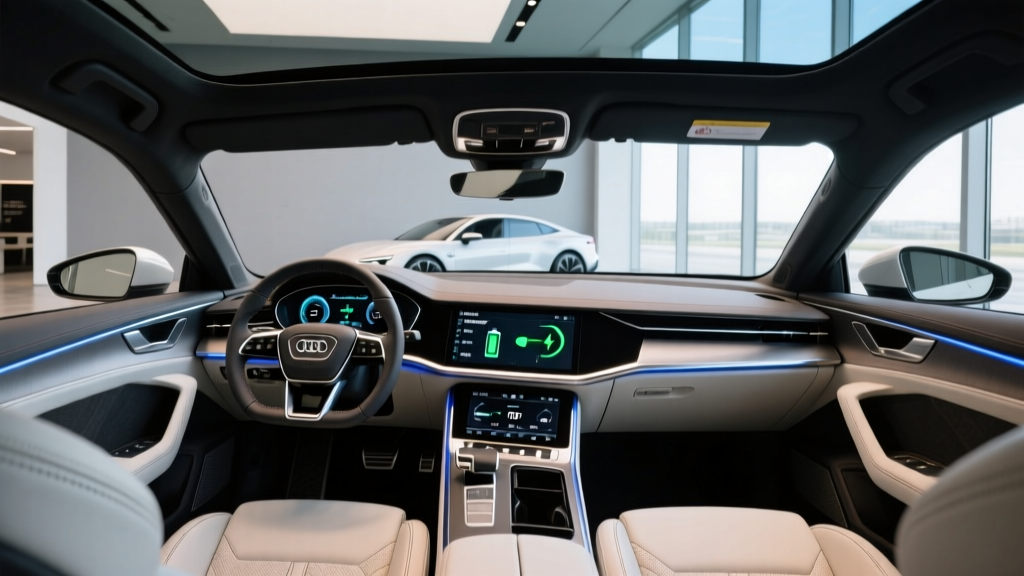
Step inside and the e-tron GT's cabin immediately distinguishes itself from the more minimalist Tesla Model S or the tech-forward Mercedes EQS. Audi leans on traditional luxury: open-pore wood, available Dinamica microfiber, and Nappa leather with diamond stitching on Prestige trims. The 12.3-inch Virtual Cockit Plus driver display and 10.1-inch MMI touchscreen are carried over, but for 2026 Audi has reintroduced physical toggle switches for climate control — a direct response to owner feedback.
Front seats are heated and ventilated across all trims, with 18-way power adjustment and massage on Prestige. Rear seat legroom measures 32.1 inches — adequate for adults on shorter trips but tight for anyone over six feet on long hauls. Headroom in back is 36.5 inches, improved slightly over the pre-2025 model thanks to a reshaped roofliner, though the sloping roofline still limits true limousine comfort.
Cargo space remains a weak point: 9.2 cubic feet in the rear trunk and a modest 3.5-cubic-foot frunk. That's enough for two carry-ons and a laptop bag up front — useful, but far less than a Model S or even the Taycan Cross Turismo.
| Dimension | Measurement |
|---|---|
| Front Headroom | 38.4 in |
| Front Legroom | 41.3 in |
| Rear Headroom | 36.5 in |
| Rear Legroom | 32.1 in |
| Trunk (rear) | 9.2 cu ft |
| Frunk | 3.5 cu ft |
| Seating Capacity | 4 passengers (2+2 layout) |
Range, Efficiency & Real-World Expectations
The 2026 e-tron GT Premium Plus and Prestige trims carry a 105 kWh gross / 93.4 kWh usable NMC battery pack. The EPA rates the standard GT at 270 miles combined. The performance-oriented RS e-tron GT, with its 646 hp dual-motor setup, drops to an EPA-estimated 257 miles.
Efficiency lands at 85 MPGe combined (34 kWh/100 mi) per EPA data. That's respectable for a 5,100-pound luxury sedan, though the Lucid Air Grand Touring achieves over 130 MPGe with a more efficient powertrain.
| Spec | e-tron GT Premium Plus | RS e-tron GT |
|---|---|---|
| Battery (usable) | 93.4 kWh NMC | 93.4 kWh NMC |
| EPA Range | 270 mi | 257 mi |
| MPGe (combined) | 85 MPGe | 81 MPGe |
| Horsepower | 522 hp (boost) | 646 hp (boost) |
| 0–60 mph | 3.9 sec | 3.1 sec |
| Drivetrain | Dual-motor AWD | Dual-motor AWD |
| Top Speed | 152 mph | 155 mph |
Charging Speed: DC Fast, Level 2 & Home Setup
The 2026 e-tron GT uses an 800-volt architecture, enabling peak DC fast-charging rates of 270 kW on compatible stations (Electrify America 350 kW stalls, Tesla Superchargers with NACS adapter). Audi claims a 10–80% charge in approximately 20 minutes under ideal thermal conditions.
Here's what the charge curve actually looks like in practice: the GT sustains above 200 kW from roughly 10% to 45% SoC, then tapers to 150 kW through 65%, and drops sharply above 80%. If you're road-tripping, plan your stops around 10–70% for the fastest turnaround — pushing to 90% adds 12–15 minutes for only ~40 extra miles.
For home charging, the onboard AC charger accepts up to 11 kW (48 amps) on a Level 2 wallbox. That translates to roughly 28–30 miles of range per hour of charging, or a full 0–100% fill in about 9.5 hours — easily achievable overnight.
| Level | Power | Speed | Time / Notes |
|---|---|---|---|
| Level 1 (120V) | 1.4 kW | ~4 mi/hr | Emergency only; ~65 hr for full charge |
| Level 2 (240V) | 11 kW | ~29 mi/hr | ~9.5 hr 0–100%; overnight-ready |
| DC Fast (peak) | 270 kW | ~180 mi in 10 min | 10–80% in ~20 min (ideal conditions) |
| DC Fast (50 kW) | 50 kW | ~14 mi/hr | 10–80% in ~1.5 hr |
The e-tron GT ships with a CCS1 port. Audi now includes a NACS adapter for access to Tesla Supercharger V3/V4 stalls, expanding the usable fast-charging network considerably for 2026.
Pricing, Trims & Federal Tax Credit Eligibility
The 2026 e-tron GT starts at $107,995 (Premium Plus, including $1,195 destination). The Prestige trim adds roughly $7,000 for upgraded leather, the Bang & Olufsen 710-watt audio system, and matrix LED headlights. The RS e-tron GT starts at $149,995.
As-tested, a loaded Prestige with the Year One package (black optics, 21-inch wheels, carbon-fiber mirror caps) can reach $120,000+ before incentives.
| Trim | Base MSRP | Federal §30D Credit | Effective Price |
|---|---|---|---|
| Premium Plus | $107,995 | $0 (over MSRP cap) | $107,995 |
| Prestige | $114,995 | $0 (over MSRP cap) | $114,995 |
| RS e-tron GT | $149,995 | $0 (over MSRP cap) | $149,995 |
Critical tax credit note: The e-tron GT does not qualify for the $7,500 federal EV tax credit under IRS §30D rules. Sedans must have an MSRP at or below $55,000 to be eligible, and the e-tron GT starts nearly double that threshold. Additionally, buyer income caps ($150,000 single / $300,000 joint) and battery critical-mineral sourcing requirements further restrict eligibility for vehicles in this price class. No state rebates are included here as they vary by jurisdiction — check your local DMV or energy office.
Performance, Ride Quality & Daily Driving
The standard e-tron GT produces 469 hp continuously and 522 hp in launch-control boost mode, delivering a 3.9-second 0–60 mph time. The RS variant hits 646 hp and 3.1 seconds — supercar territory, though the 5,139-pound curb weight is always felt during direction changes.
Where the GT truly excels is ride quality. The standard three-chamber air suspension soaks up highway expansion joints with composure that makes the Taycan Turbo feel firm by comparison. Steering is precise if light, and the brake-by-wire regen system blends seamlessly with the friction brakes — no grabby transitions at stoplights.
Driver assistance includes Audi's Adaptive Cruise Assist with lane centering, which operates at SAE Level 2 — meaning you must keep hands on the wheel and eyes on the road at all times. It is not a self-driving system. The 2026 model adds an improved parking assistant with remote maneuvering via the myAudi app.
Warranty & Long-Term Ownership
Audi covers the e-tron GT with a 4-year/50,000-mile limited warranty and an 8-year/100,000-mile battery warranty that guarantees at least 70% capacity retention. Scheduled maintenance is minimal — cabin air filter and brake fluid at two-year intervals — and Audi includes two years of complimentary Electrify America DC charging (up to 800 kWh).
Insurance premiums run 15–25% higher than a comparable A6 sedan, reflecting the battery replacement cost (estimated $22,000–$28,000 out of warranty). Depreciation is steeper than the Taycan's, with industry data showing 45–50% value retention at 36 months.
- Exceptional cabin materials and quietness
- 270 kW DC fast charging on 800V architecture
- Air suspension delivers class-leading ride comfort
- 270-mile EPA range is adequate for most road trips
- NACS adapter included for Supercharger access
- Does not qualify for $7,500 federal tax credit (MSRP cap)
- Rear seat and cargo space trail competitors
- Insurance and depreciation costs are above average
- Infotainment screen is smaller than rivals (10.1 in)
- Real-world cold-weather range drops to ~200 mi
How It Compares: e-tron GT vs. Key Rivals
The Porsche Taycan 4S shares the J1 platform and offers sharper handling but a firmer ride and a less intuitive infotainment system. The Tesla Model S Plaid demolishes the GT in performance (1,020 hp, 1.99-sec 0–60) and range (402 mi EPA) but can't match interior fit-and-finish. The Lucid Air Pure starts lower at $69,900, offers 419 miles of EPA range, and qualifies for the tax credit — making it the value pick if luxury badges are secondary.
For buyers cross-shopping the Taycan and e-tron GT: the Audi wins on cabin serenity, ride comfort, and value (roughly $10,000 less at comparable trims). The Porsche wins on driving engagement and brand cachet among enthusiasts.
Frequently Asked Questions
What is the real-world range of the 2026 Audi e-tron GT?
Expect 235–250 miles in highway driving at 70 mph in moderate temperatures. In cold weather below freezing, plan for 195–215 miles. City driving with regeneration can exceed 280 miles.
How fast does the e-tron GT charge at home and on the road?
At home on a Level 2 wallbox (11 kW), you'll gain about 29 miles per hour, filling the battery overnight in roughly 9.5 hours. On a 350 kW DC fast charger, 10–80% takes approximately 20 minutes.
Does the 2026 Audi e-tron GT qualify for the federal EV tax credit?
No. Under current IRS §30D rules, sedans must have an MSRP of $55,000 or less. The e-tron GT starts at $107,995, making it ineligible regardless of buyer income or battery sourcing.
Is the Audi e-tron GT worth buying over the Porsche Taycan?
If ride comfort, cabin quietness, and a lower entry price matter most, the e-tron GT is the better choice. If you prioritize driving dynamics and brand prestige, the Taycan edges ahead. Both share the same 800V platform and charging performance.
What battery chemistry does the e-tron GT use?
The 2026 e-tron GT uses an NMC (nickel manganese cobalt) lithium-ion pack with 93.4 kWh of usable capacity. NMC offers higher energy density than LFP, which keeps the pack size manageable for the GT's low-slung design, though LFP typically offers longer cycle life.
How much cargo space does the e-tron GT have?
The rear trunk offers 9.2 cubic feet, and the front trunk (frunk) provides 3.5 cubic feet. Total cargo volume is limited compared to the Tesla Model S (28 cu ft rear hatch) or the Taycan Cross Turismo.